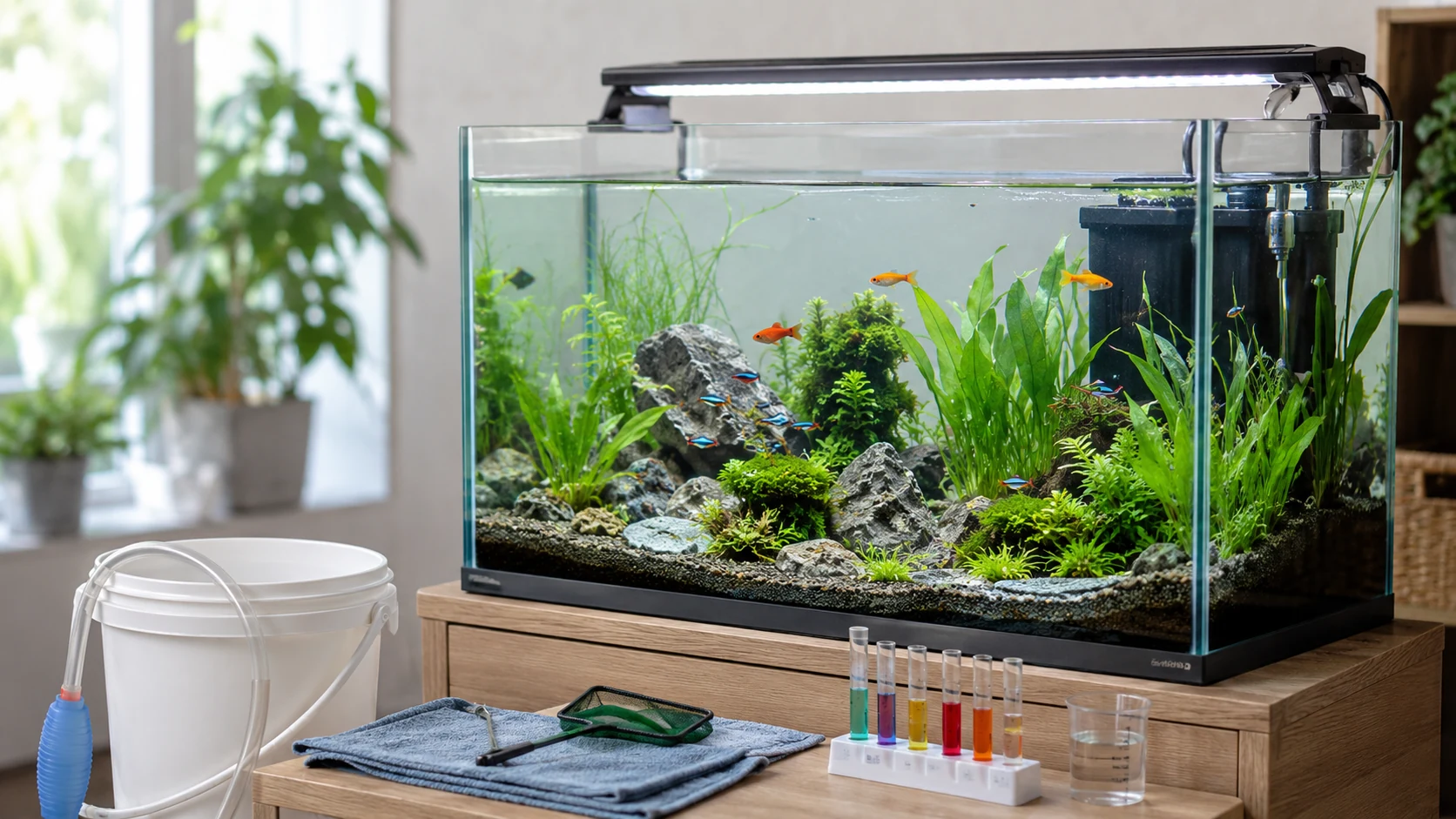
Aquarium water can look clear while being chemically unsafe.
That is the beginner trap. Clear water does not prove ammonia is zero. It does not prove nitrite is safe. It does not prove pH, KH, or temperature are stable. Fish live inside water the way we live inside air. If the water chemistry shifts suddenly, the fish cannot step away from it.
Good water care is not about making the tank look clean for you. It is about keeping the closed aquatic system stable for the fish.
Water care at a glance
| Task | Practical beginner rule |
|---|---|
| Test ammonia/nitrite | Always in new tanks, after problems, or after fish deaths |
| Test nitrate | Track buildup and water-change need |
| Use conditioner | Every time untreated tap water enters the tank |
| Match temperature | Keep new water within about ±1°C / ±2°F when possible |
| Change water | Small steady changes beat rare dramatic corrections |
| Protect biofilter | Do not replace or rinse all media under tap water |
| Watch behavior | Gasping, flashing, hiding, clamped fins, jumping, and lethargy mean test water first |
The closed-system mindset
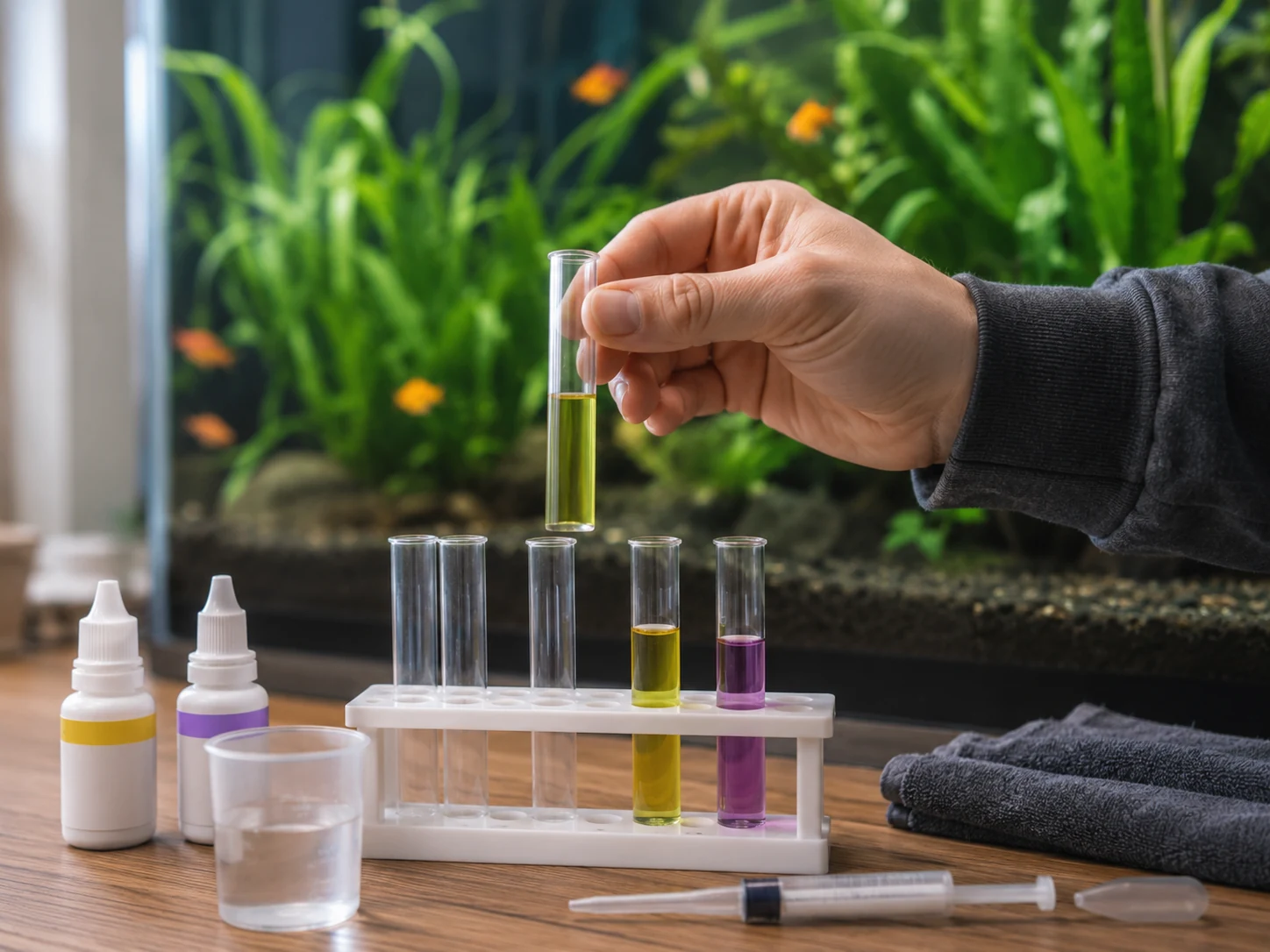
A pond has rain, soil, plants, microbial zones, and dilution. A glass aquarium has limited water and whatever you add to it.
Food becomes waste. Fish release ammonia. Dead leaves decay. Filters trap debris. Minerals accumulate or decline. Tap water chemistry varies. Every action changes the system.
Technical action: treat every water-care step as a chemistry change.
Danger/trap: “cleaning” too hard can shock fish, damage the biofilter, and release hidden waste.
Safe process: test first, change gradually, protect filter bacteria, and correct the cause instead of only the symptom.
The pure-water paradox: why RO water must be remineralized
Many beginners move to reverse osmosis (RO), distilled, or bottled purified water after worrying about tap water. The water looks clean, so it feels safer.
Pure water is not automatically safe aquarium water.
RO and distilled water can have almost no general hardness (GH) and almost no carbonate hardness (KH). KH is the buffer that helps resist sudden pH movement as acids are produced by fish waste, biological filtration, plant respiration, and dissolved carbon dioxide. Without enough KH, pH can become unstable. In a stocked aquarium, that instability can stress fish, irritate gills and skin, and weaken or disrupt the biofilter.
Technical action: treat RO water as a blank base, not finished aquarium water.
Danger/trap: using pure RO water for routine water changes without remineralizing can strip away the mineral structure fish, shrimp, plants, and nitrifying bacteria depend on.
Safe process: remineralize RO or distilled water before it enters the aquarium. For many general community tanks, a practical starting target is roughly 4–8 dGH and 2–4 dKH, then adjust for the actual livestock. Shrimp, livebearers, soft-water fish, and planted tanks may need different targets. Mix and test the replacement water first, then add it slowly.
The big four tests: ammonia, nitrite, nitrate, pH
Ammonia and nitrite are emergency numbers. In a safe cycled tank, both should be 0 ppm.
Nitrate is the longer-term buildup number. It rises as the biofilter processes waste. Water changes, plant growth, and controlled feeding keep it from climbing indefinitely.
pH tells you acidity/alkalinity, but stability matters more than chasing a perfect number. A fish adjusted to stable pH often handles that better than repeated chemical swings.
| Parameter | What it tells you | Beginner response |
|---|---|---|
| Ammonia | Waste toxicity / biofilter failure | Water change, conditioner that detoxifies ammonia if needed, reduce feeding, protect filter |
| Nitrite | Cycling instability / oxygen transport risk | Water change, reduce feeding, test daily, protect biofilter |
| Nitrate | Waste accumulation trend | Regular water changes, feeding control, plant/debris management |
| pH | Stability and buffering clue | Avoid chasing; check KH if pH drifts |
Chlorine vs chloramine
Tap water must be treated before it goes into the aquarium.
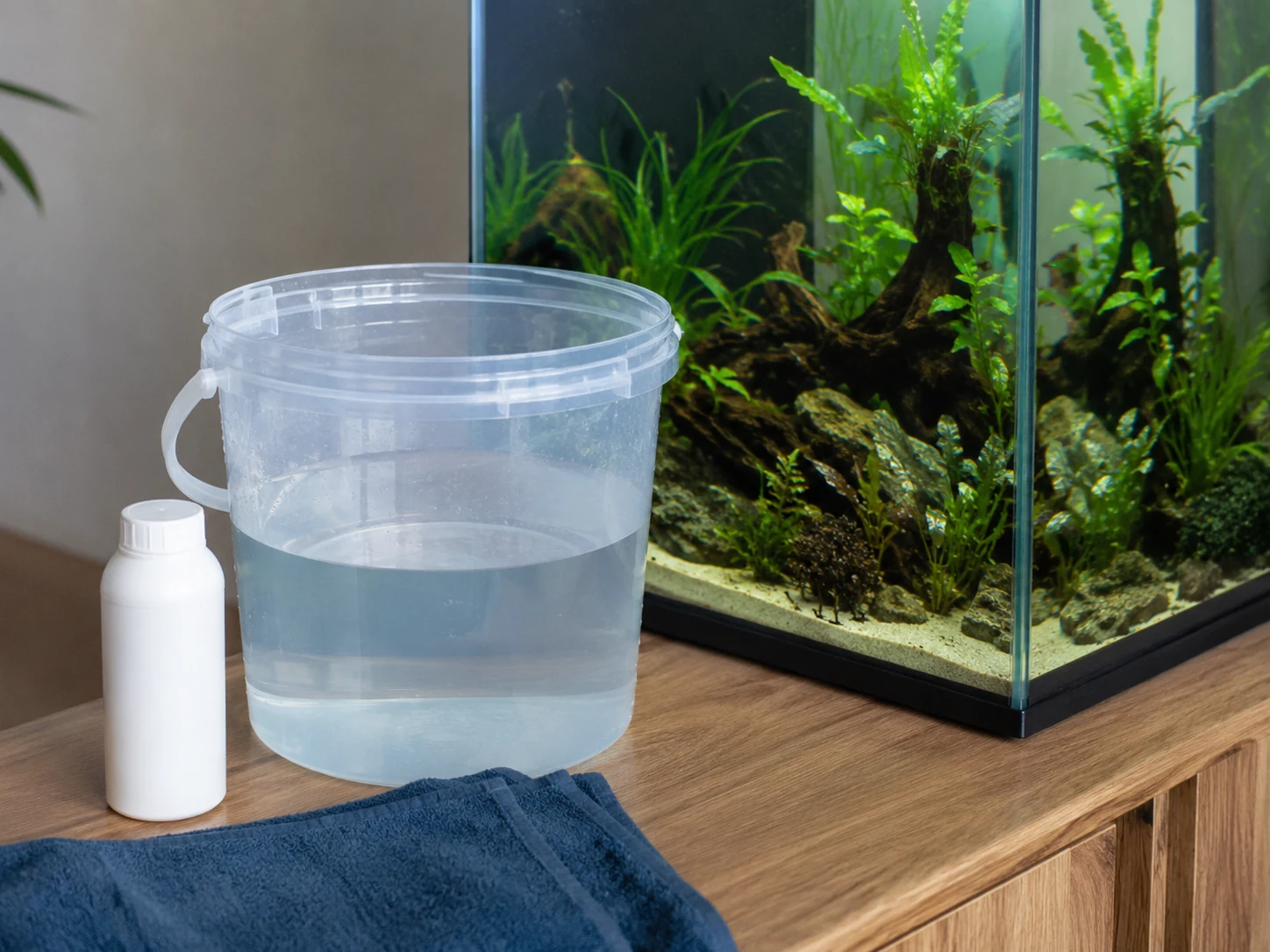
Chlorine can dissipate with time and aeration, but beginners should still use conditioner because waiting is inconsistent. Chloramine is more persistent and does not simply “gas off” the same way. Many municipalities use chloramine because it lasts longer in distribution systems.
Technical action: condition all tap water.
Danger/trap: letting water sit overnight may not make chloramine-safe water.
Safe process: use a water conditioner that treats both chlorine and chloramine, dose according to the label for the full amount of new water, and mix before adding when possible.
Water changes: steady beats dramatic
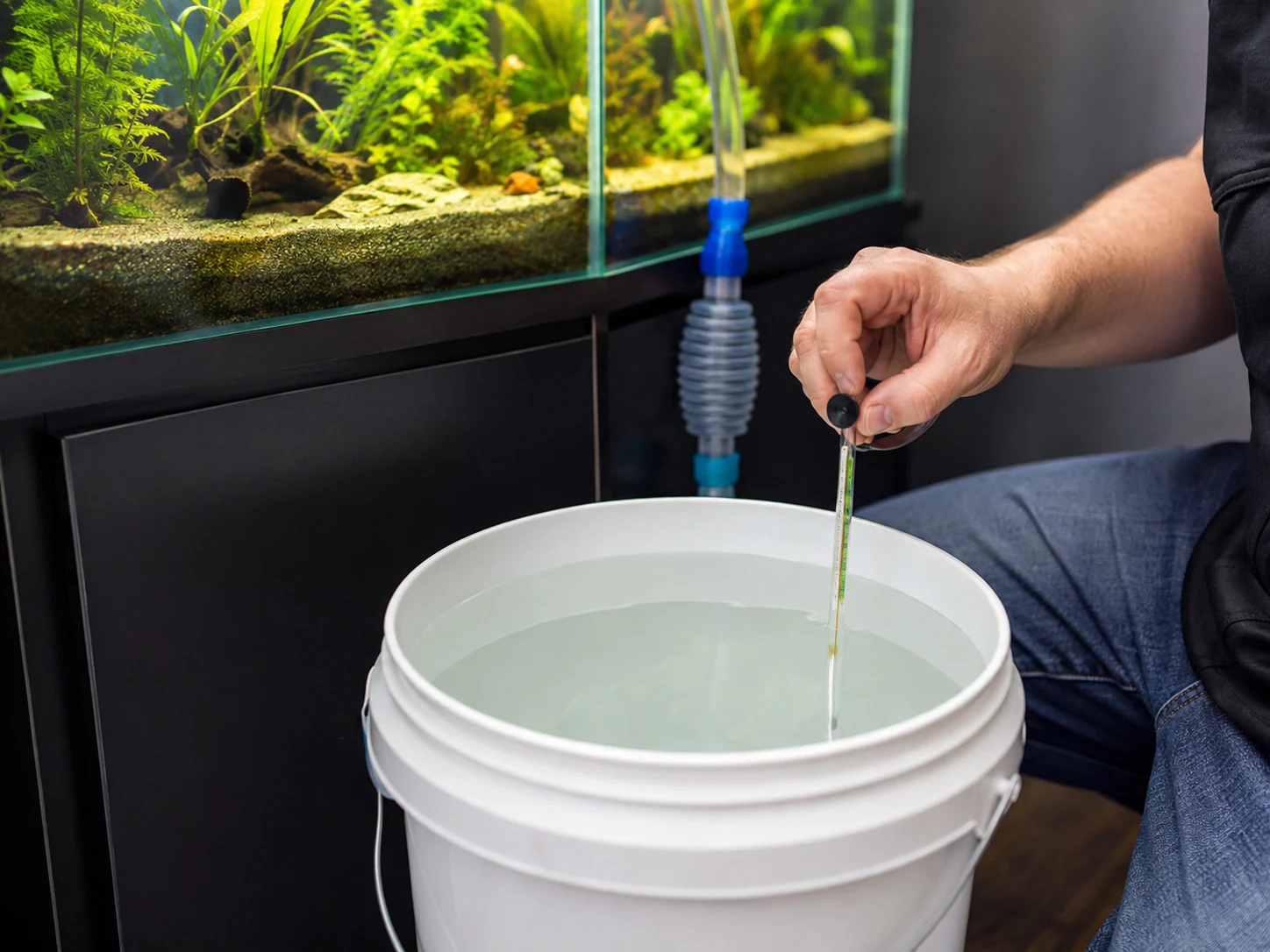
Regular partial water changes remove nitrate, dissolved organics, hormones, and minerals that accumulate over time. They also replenish some minerals depending on source water.
But a water change is still an environmental shift.
Technical action: change water to maintain stability.
Danger/trap: a neglected tank with very high nitrate, depleted KH, and shifted pH can kill fish if you suddenly replace most of the water.
Safe process: for maintained tanks, weekly partial changes are normal. For old neglected tanks, use smaller changes such as 10–15% daily or every other day while testing pH, nitrate, ammonia, and nitrite. Bring the system back gradually.
Old Tank Syndrome
Old Tank Syndrome happens when water quality drifts slowly over time. Fish adapt under stress. New fish die quickly. The keeper blames the store, but the tank chemistry has become very different from healthy source water.
Common signs:
- very high nitrate;
- low or unstable KH;
- pH much lower than tap water;
- dirty substrate and filter;
- fish that seem “fine” until a big cleanup;
- new fish dying soon after introduction.
Do not fix Old Tank Syndrome with one giant reset while fish are inside.
Correct it gradually. Test, perform small water changes, clean filter media in stages, and avoid deep-stirring the entire substrate at once.
Temperature matching and oxygen
New water should be close in temperature to the tank water. A difference of about ±1°C / ±2°F is a useful beginner target when possible.
Temperature is not only comfort. It affects oxygen. Warmer water holds less dissolved oxygen, while fish metabolism increases. If you raise temperature or the room heats up, oxygen demand rises.
Technical action: match temperature and watch aeration.
Danger/trap: adding much warmer water can reduce oxygen availability and stress fish.
Safe process: match temperature, pour slowly, and increase surface movement if the tank is warm, crowded, medicated, or recovering from ammonia/nitrite.
The biofilter is life support
The filter is not just a dirt trap. It houses bacteria that process ammonia and nitrite. The biological media is life support.
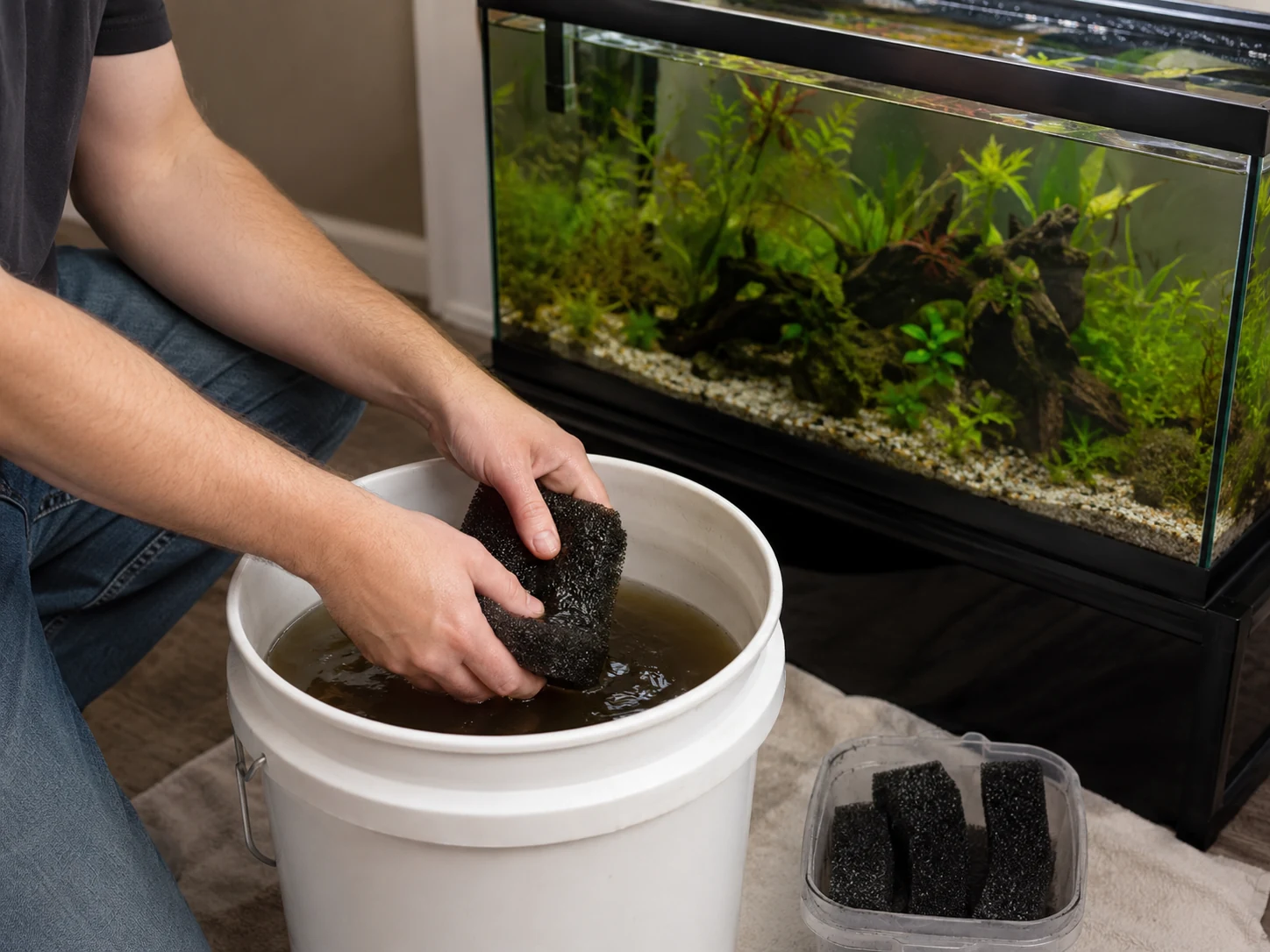
Technical action: clean clogged mechanical media when flow drops.
Danger/trap: replacing all cartridges, rinsing all media under tap water, or cleaning the filter and substrate aggressively on the same day can damage the biofilter.
Safe process: rinse reusable sponges or media gently in old tank water. Replace disposable media only in stages if you must. Never replace all biological media at once.
Substrate cleaning without a double crash
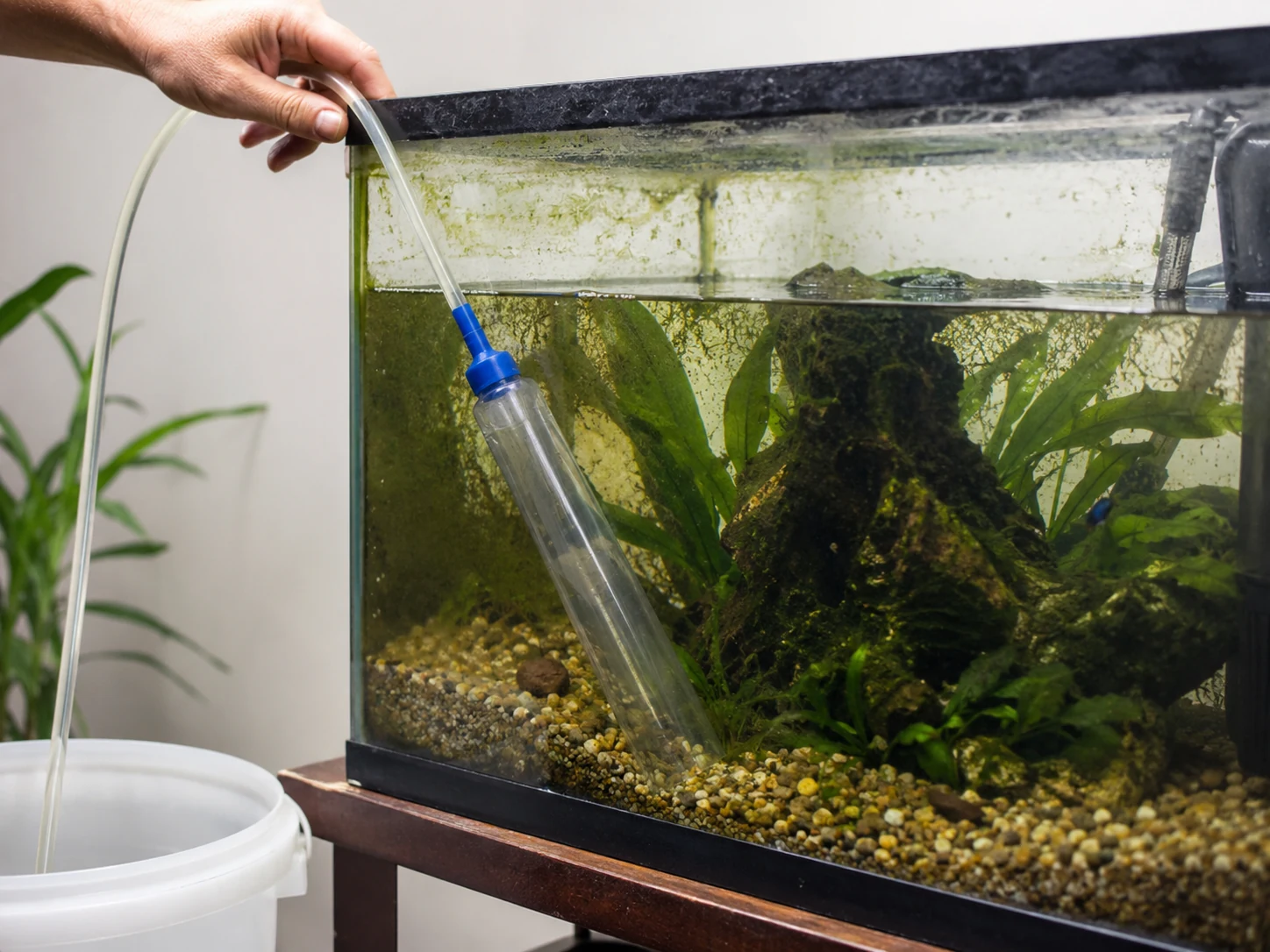
Dirty substrate can release ammonia-producing waste. But aggressive cleaning can also disturb too much at once.
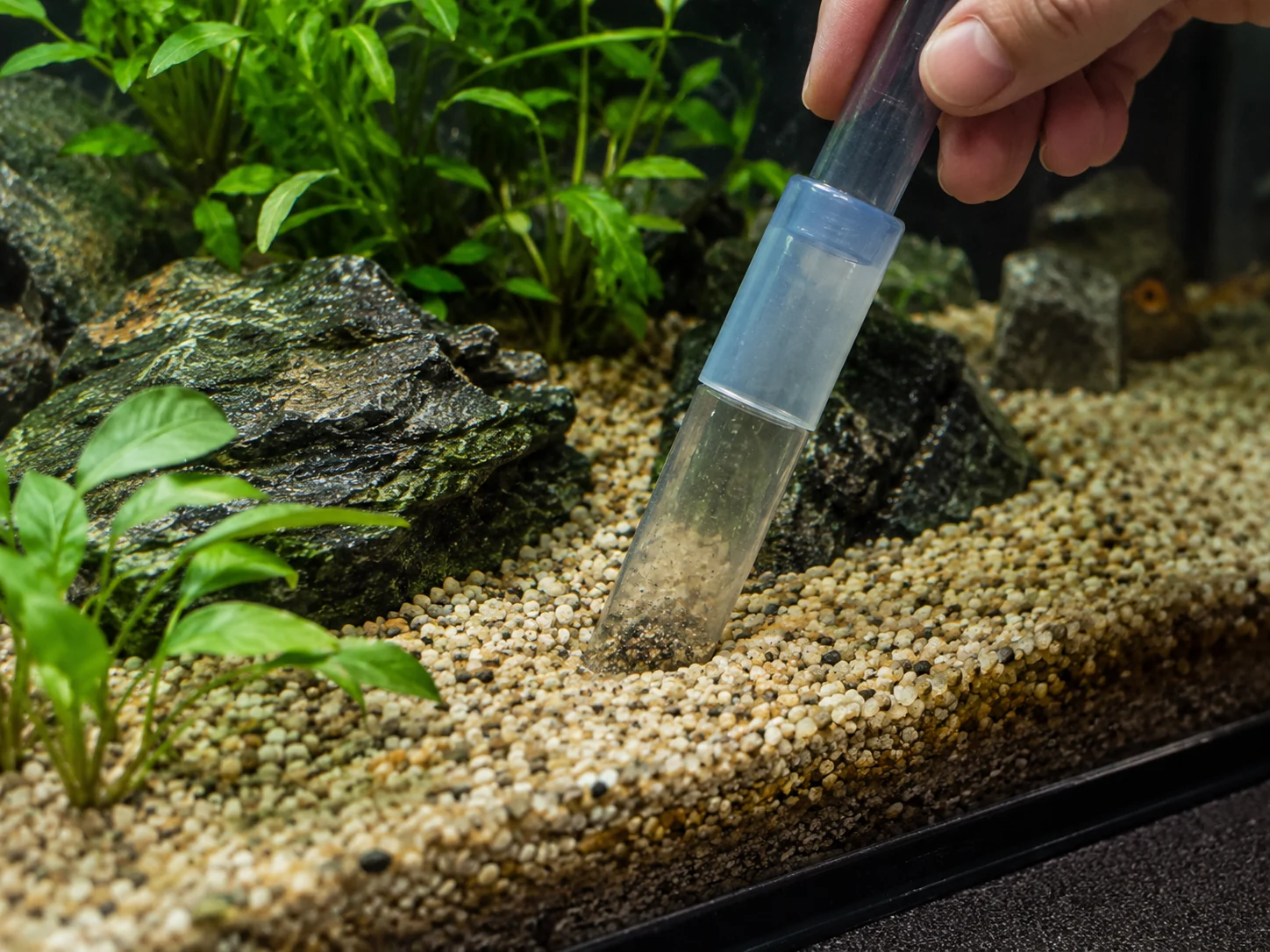
Technical action: siphon visible debris.
Danger/trap: deep-stirring an old dirty substrate while also doing a huge water change and cleaning the filter can create a double crash: water chemistry shock plus biofilter disruption.
Safe process: clean in sections. If there is a rotten smell or suspected hydrogen sulfide pocket, disturb only a small localized area while siphoning directly at that point so foul water leaves the tank. Add aeration and avoid feeding heavily afterward.
Emergency water change logic
Sometimes a larger water change is necessary: ammonia spike, nitrite spike, contamination, overdose, dead fish, or obvious poisoning.
But even emergency changes need logic.
- Test if you can.
- Dose conditioner for chlorine/chloramine.
- Match temperature.
- Increase aeration.
- Remove the cause if visible.
- Change water in controlled steps.
- Retest.
If ammonia is present and pH is high, ammonia is more dangerous. In that situation, an ammonia-detoxifying conditioner used according to the label can buy time while you perform controlled water changes and protect the biofilter.
Behavior that means test water first
Do not explain abnormal behavior as personality before testing.
Test water first when fish show:
- gasping at surface;
- flashing or rubbing;
- clamped fins;
- sudden hiding;
- lethargy;
- jumping;
- loss of appetite;
- spitting food;
- red gills;
- repeated deaths;
- sitting on the bottom.
The fish is not being dramatic. It is responding to the water it has to breathe.
Water Care Toolkit
Useful items:
- liquid ammonia/nitrite/nitrate test kit;
- pH and KH test kit;
- thermometer;
- water conditioner for chlorine and chloramine;
- ammonia-detoxifying conditioner for emergencies;
- gravel siphon;
- dedicated aquarium bucket;
- turkey baster for tight debris;
- air stone or backup air pump;
- reusable filter sponge/floss.
FAQ
How often should I change aquarium water?
Many maintained beginner tanks do well with weekly partial water changes. The exact amount depends on stocking, feeding, nitrate, and tank stability.
Is clear aquarium water safe?
Not always. Ammonia, nitrite, pH swings, and chloramine are invisible. Test the water.
Do I need conditioner every water change?
Yes, if untreated tap water enters the aquarium. Use conditioner that treats chlorine and chloramine.
Can I let tap water sit overnight instead of conditioner?
Not reliably. Chloramine can persist, so conditioner is the safer beginner method.
How much water should I change in an emergency?
It depends on the problem. For ammonia or nitrite, controlled partial changes plus conditioner and aeration are safer than panic cleaning everything at once.
Why did my fish die after a big water change?
Possible causes include temperature shock, pH/osmotic shock, chlorine/chloramine, stirring old waste, or damaging the biofilter.
Should I clean my filter during every water change?
Only clean it when flow drops or debris is clogging it. Rinse gently in old tank water and protect biological media.
What is Old Tank Syndrome?
It is gradual water-quality decline in an under-maintained tank, often with high nitrate and shifted pH/KH. Fish adapt under stress, then sudden changes or new fish fail.
Should I deep clean my whole tank?
Usually no. Clean in sections. Avoid cleaning substrate, filter, and decor aggressively on the same day unless you are doing a controlled teardown.
What should I do if fish are gasping?
Increase aeration immediately, test ammonia and nitrite, check temperature, and perform a conditioned water change if toxins are present.
Can I use pure RO water in my aquarium?
Not by itself for routine use. RO water should normally be remineralized before it enters a stocked aquarium, because pure RO water has little to no GH/KH buffering and can make pH and mineral levels unstable.
What GH and KH should remineralized RO water have?
For a general community aquarium, roughly 4–8 dGH and 2–4 dKH is a practical starting point. The correct target depends on your fish, shrimp, plants, and source-water strategy.
Related Guides
- How to Cycle a Fish Tank
- How Often Should You Change Aquarium Water?
- Ammonia, Nitrite, and Nitrate
- Aquarium Maintenance Schedule
- Aquarium Substrate and Decor Guide
- Fish Gasping at the Surface
Author Box
Written by the Healthy Aquariums editorial team. We focus on practical fishkeeping decisions that protect fish health, water stability, and the biological filter.
Editorial Note
This guide prioritizes stability over dramatic “cleaning.” In aquariums, a sudden improvement from the human perspective can still be a shock event for fish.
References
- Aqueon. The Nitrogen Cycle. https://www.aqueon.com/articles/the-nitrogen-cycle
- Aqueon. Freshwater Aquarium Water Quality. https://www.aqueon.com/articles/freshwater-aquarium-water-quality
- PetMD. New Tank Syndrome in Fish. https://www.petmd.com/fish/conditions/systemic/new-tank-syndrome-fish
- The Spruce Pets. What Is Old Tank Syndrome? https://www.thesprucepets.com/old-tank-syndrome-1381225
- API Fishcare. The Nitrogen Cycle. https://www.apifishcare.com/blog/the-nitrogen-cycle-keeping-your-aquarium-healthy
- Merck Veterinary Manual. Environmental Diseases of Aquatic Animals in Aquatic Systems. https://www.merckvetmanual.com/exotic-and-laboratory-animals/aquatic-systems/environmental-diseases-of-aquatic-animals-in-aquatic-systems