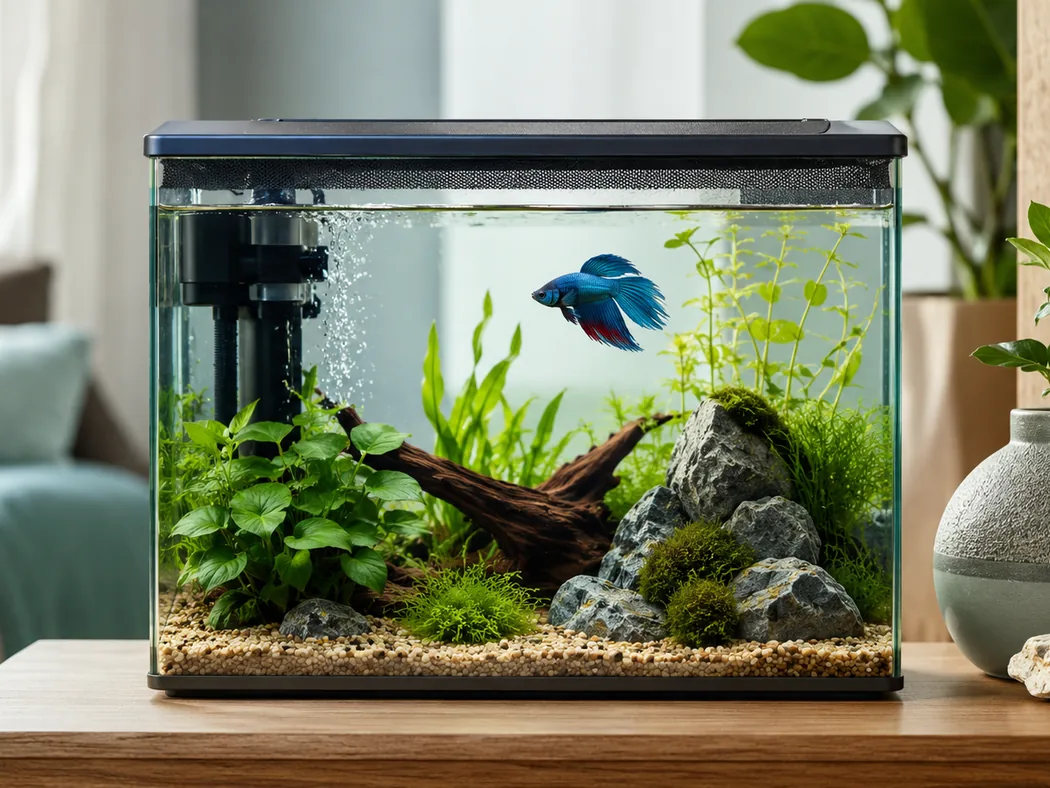
A betta can survive bad conditions for a while. That does not make those conditions good.
If you are setting up a betta tank for the first time, the goal is not to build the fanciest nano aquarium on the shelf. The goal is to create water that stays stable, a current the fish can handle, and a layout that lets the betta explore, rest, and breathe at the surface without stress.
Have you ever wondered why some bettas seem fine for a few days, then suddenly clamp their fins, hide, or stop eating? Most of the time, the problem started long before the fish acted sick. It usually started with a tank that looked finished before it was actually ready.
Surviving is not the same as living well. A calmer, warmer, more stable tank usually beats a smaller, prettier, more fragile one.
Betta Tank Essentials at a Glance
Before you worry about aquascaping, focus on the equipment and conditions that keep the fish stable. This is the foundation.
| Essential | Good beginner choice | Why it matters |
|---|---|---|
| Tank | 5 gallons / ~19 L minimum, 10 gallons / ~38 L better | More water volume means better temperature and water-quality stability. |
| Lid or mesh cover | Fitted lid with ventilation or mesh top | Bettas jump. They also breathe atmospheric air, so the cover should not be airtight. |
| Heater | Adjustable heater sized for the tank | Keeps tropical water stable instead of swinging with room temperature. |
| Thermometer | Separate glass or digital thermometer | Confirms the real water temperature instead of trusting the heater dial. |
| Filter | Sponge filter or gentle low-flow filter | Supports beneficial bacteria without blasting the fish around. |
| Water conditioner | Dechlorinator for tap water | Protects fish and bacteria from chlorine or chloramine. |
| Liquid test kit | Ammonia, nitrite, nitrate, and pH testing | Lets you see water problems before the fish pays the price. |
| Décor and plants | Fin-safe caves, broad-leaf plants, floating plants | Creates hiding places and resting spots near the surface. |
| Maintenance tools | Siphon, aquarium-only bucket, algae pad | Makes routine cleaning easier and less stressful. |
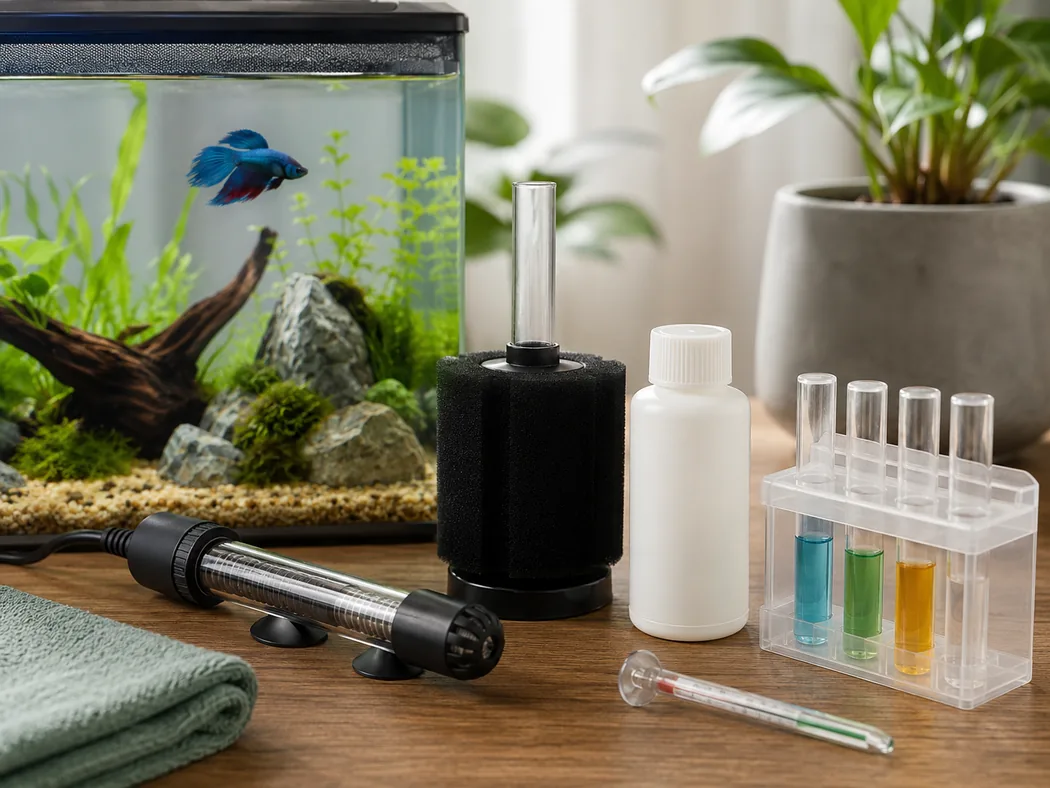
Do Bettas Need a Heater?
In most homes, yes.
Bettas are tropical fish. They do best in warm, stable water. A practical beginner temperature range is around 76–80°F or 24–27°C.
The exact number matters less than stability. A betta kept at 78°F steadily is usually better off than one swinging between warm afternoons and cold nights. Temperature swings can stress fish, slow digestion, and weaken immune response over time.
Room temperature is often not enough, especially in air-conditioned homes, cold seasons, or rooms where temperature drops overnight.
Use an adjustable aquarium heater and a separate thermometer. Do not trust the heater dial alone. The dial is a setting. The thermometer tells you what the water actually is.
| Tank size | Common heater starting point | Notes |
|---|---|---|
| 5 gallons / ~19 L | 25W adjustable heater | Use slim design; check for hot spots; monitor daily at first. |
| 10 gallons / ~38 L | 50W adjustable heater | Easiest beginner size to regulate. |
| 20 gallons / ~76 L | 100W, or two 50W heaters | Two heaters improve heat distribution and backup safety. |
These wattages are practical starting points. Room temperature, tank shape, lid coverage, and heater quality all affect stability. The thermometer is the only reliable check.
Never run a heater out of water. Unplug it before water changes, wait a few minutes before removing it, and do not touch a hot heater with wet hands. When you use a lid, leave ventilation and roughly 2–3 cm of air space above the water so the betta can breathe warm air at the surface.
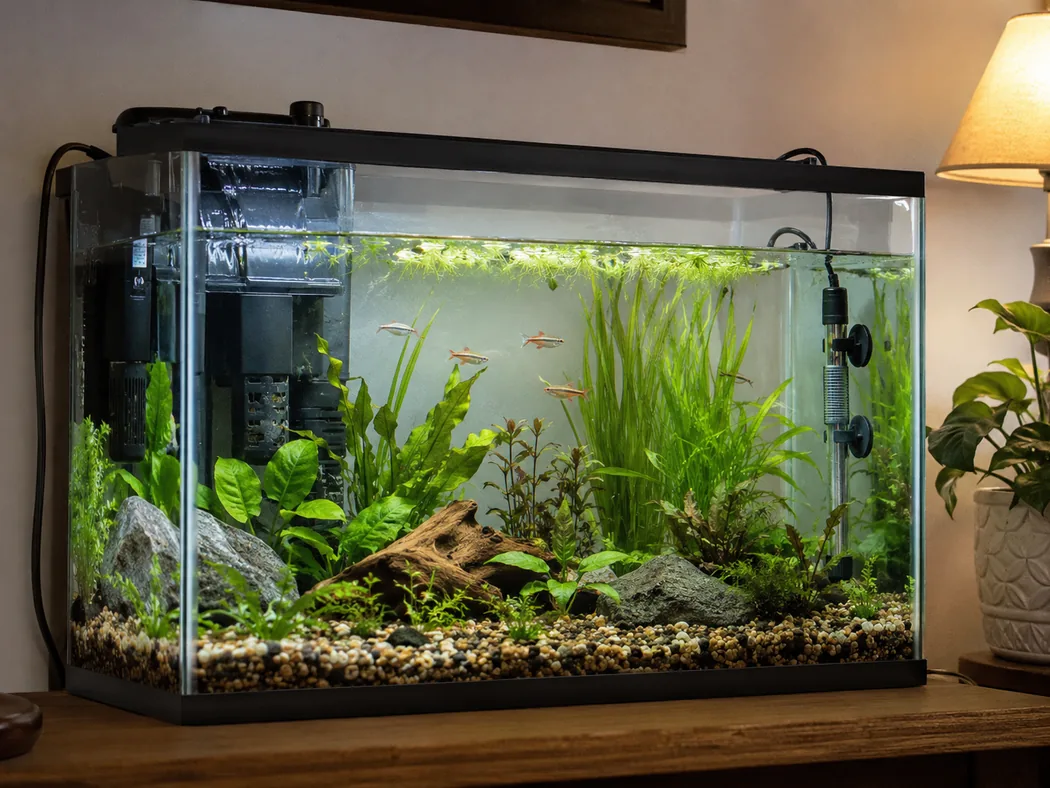
Do Bettas Need a Filter?
Yes.
The old argument is that bettas can breathe air, so they do not need a filter. That misunderstands what a filter actually does.
A filter is not only about oxygen. It supports beneficial bacteria that convert fish waste into less harmful compounds. Without biological filtration, ammonia/ammonium (NH3/NH4+) builds up quickly, especially in small tanks.
The challenge is that bettas do not like strong current. Long-finned bettas especially can get exhausted fighting flow all day.
Good betta filtration is gentle but biologically active.
| Filter type | Good for bettas? | Notes |
|---|---|---|
| Sponge filter | Yes | Gentle flow, excellent biological media, needs air pump. |
| Low-flow internal filter | Yes, if gentle | Watch current strength; adjust or baffle if needed. |
| Adjustable HOB filter | Yes, if baffled | Add sponge pre-filter on intake; reduce or baffle the output. |
| Strong HOB or canister | Usually not ideal | May stress long-finned bettas in small tanks. |
| No filter | Not recommended | Requires very frequent water changes and is less stable. |
A sponge filter is one of the safest beginner choices for bettas. It creates gentle flow, gives beneficial bacteria a place to grow, and is hard to mess up.
The test is simple: your betta should be able to swim calmly, rest near the surface, and reach the top without fighting the current.
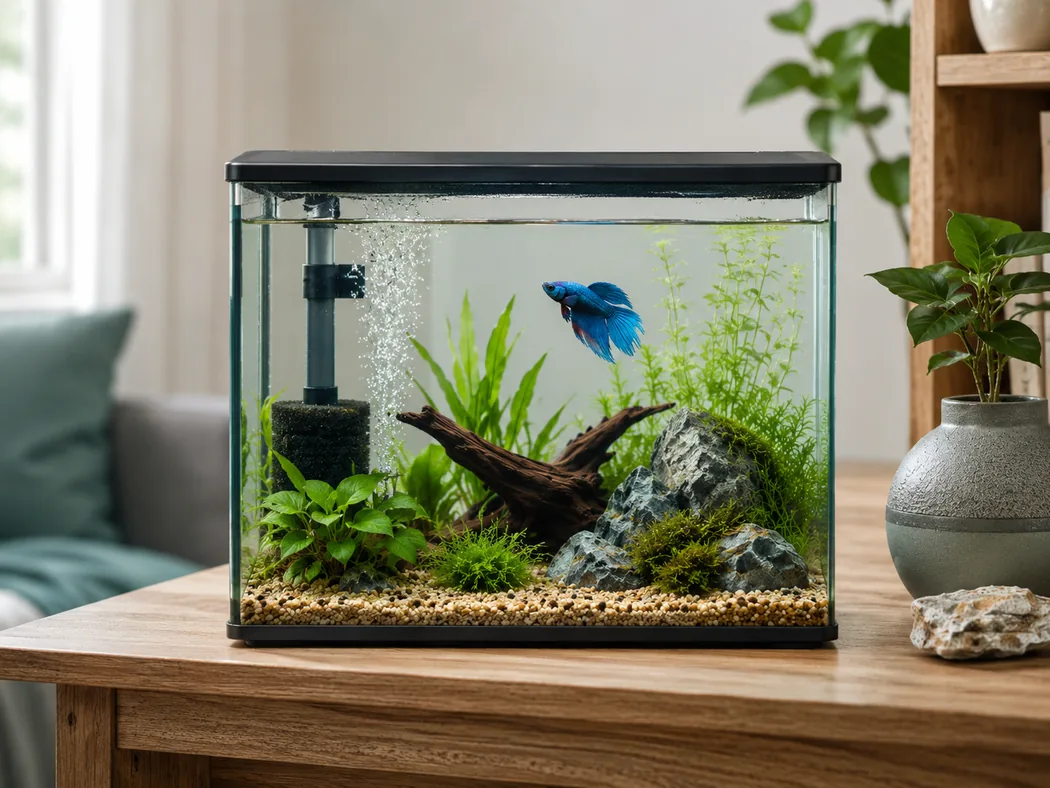
Gentle Betta Filtration That Won't Blast Your Fish Around
If you are shopping after reading this section, start with categories that solve the real problem: calm biological filtration.
- Sponge filter for nano or betta tanks
- Small air pump and check valve
- Airline tubing and bleed valve if needed
- Pre-filter sponge for adjustable HOB filters
How to Set Up a Betta Tank Step by Step
Step 1: Choose and Place the Tank
Choose a 5-gallon / ~19 L tank at minimum, 10 gallons / ~38 L if you can.
Place it on a level, stable surface that can hold the full weight of water, substrate, and equipment. A filled 10-gallon tank can weigh over 50 kg / 110 lb. Do not trust a wobbling shelf.
Keep it away from direct sunlight, cold drafts, and air conditioning vents. Use a lid or mesh cover with ventilation rather than an airtight cover. Bettas breathe atmospheric air, and they need warm, accessible air at the surface.
Step 2: Add Substrate
For most first betta tanks, small smooth gravel or a shallow layer of sand works well.
| Substrate choice | Beginner verdict | Notes |
|---|---|---|
| Small smooth gravel | Best simple choice | Easy to vacuum and does not compact. |
| Shallow coarse sand | Possible | Keep it shallow and siphon gently above the surface. |
| Deep fine sand | Not ideal first choice | Can compact and trap debris if neglected. |
| Planted aquasoil | Useful for planted setups | Adds nutrients but also adds complexity. |
| Sharp gravel | Avoid | Can trap waste and may be rough near the glass. |
Rinse substrate before adding it. A betta tank does not need a deep substrate bed. About 2–3 cm is enough for most beginner setups.
Step 3: Add Hardscape and Hiding Places
Use smooth rocks, betta-safe caves, silk or live plants, and soft hides. Avoid sharp plastic decorations, rough resin ornaments, and tiny holes the fish could get stuck in.
Fin-safe test: if the decoration would snag delicate fabric, it may tear a betta's fins.
If you want to use driftwood, use a small pre-soaked piece. In a 5-gallon / ~19 L tank, unprepared driftwood can release a large tannin load relative to the water volume, turning the water tea-colored. Tannins are not automatically dangerous, but sudden color changes often panic beginners into excessive water changes that destabilize the cycle.
Soak or boil driftwood first. Change the soaking water until it lightens before adding the wood to the tank.
Step 4: Install Filter and Heater
Install the filter and heater before filling the tank completely. It is much easier to adjust equipment placement in an empty or half-filled tank.
Place the heater where water movement circulates warmth around it. Do not bury it in substrate. Place the thermometer on the opposite side of the tank to confirm even temperature distribution.
Step 5: Fill With Conditioned Water
Treat tap water with a water conditioner before adding it to the tank. Chlorine and chloramine can harm fish and beneficial bacteria.
Pour slowly to avoid disturbing the substrate. A plate or plastic bag placed over the substrate softens the flow.
Step 6: Start the Filter and Heater
Turn on the filter and heater. Check for leaks, unusual noise, and flow strength.
Before starting the heater, make sure it is fully submerged. Never run a heater out of water. Unplug it before water changes.
Let the tank stabilize. The water may look ready.
It is not ready yet.
Step 7: Cycle the Tank Before Adding the Betta
This is the step most beginners skip.
Even a hardy betta is vulnerable to ammonia and nitrite in an uncycled tank. Before adding your fish, the tank needs an established biological filter.
Related guide: How to Cycle a Fish Tank
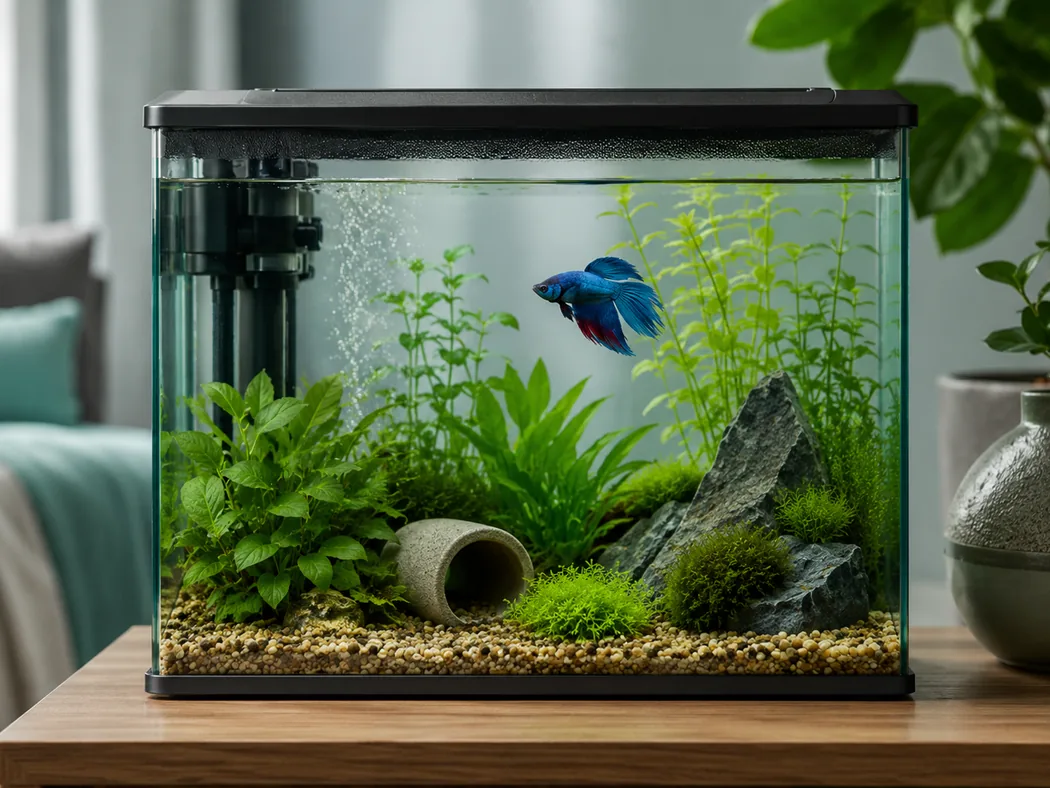
Cycling a Betta Tank Before Adding Your Fish
A betta tank cycles the same way as any freshwater aquarium.
Fish waste and decaying food create ammonia/ammonium (NH3/NH4+). Beneficial bacteria convert that into nitrite (NO2-), then nitrate (NO3-).
Fish waste → NH3/NH4+ → NO2- → NO3-
In a fishless cycle, you build the bacteria colony before the betta goes in. That is the kinder, safer method.
Before adding the betta, check these parameters:
| Parameter | Target before adding betta |
|---|---|
| Ammonia/Ammonium (NH3/NH4+) | 0 ppm |
| Nitrite (NO2-) | 0 ppm |
| Nitrate (NO3-) | Present but controlled with water changes |
| Temperature | Stable 76–80°F or 24–27°C |
| pH | Around 6.5–7.5, stable |
A stable pH matters more than chasing a perfect number. Betta splendens can tolerate a wider range, but sudden swings are more stressful than a slightly imperfect number.
If Your Betta Is Already in an Uncycled Tank
This happens all the time. Someone buys the betta first, then learns about cycling later. If that is you, do not panic, but do not pretend the tank is safe because the water looks clear.
You are now doing a fish-in cycle. The goal is not to fix it overnight. The goal is to protect the fish while the biological filter catches up.
| Action | Why it matters |
|---|---|
| Test ammonia/ammonium (NH3/NH4+) and nitrite (NO2-) daily | These are the urgent danger signals. |
| Feed very lightly | Less food means less waste. |
| Keep the filter running 24/7 | Beneficial bacteria need oxygen and constant flow. |
| Do small conditioned water changes when ammonia or nitrite appears | Dilution is the most reliable emergency tool. |
| Do not replace filter media | You need the bacteria colony to grow. |
| Do not add tank mates | The tank is already biologically stressed. |
A detoxifying conditioner can help in an emergency. Products such as Seachem Prime can temporarily bind ammonia and nitrite, reducing immediate stress, but think in short 24–48 hour windows, not miracles. Your test kit may still show total ammonia because many kits read both NH3 and NH4+ together, even after detoxification.
The emergency mindset is simple: test, detox if needed, dilute with conditioned water, feed lightly, keep the filter alive, and repeat until the tank is stable.
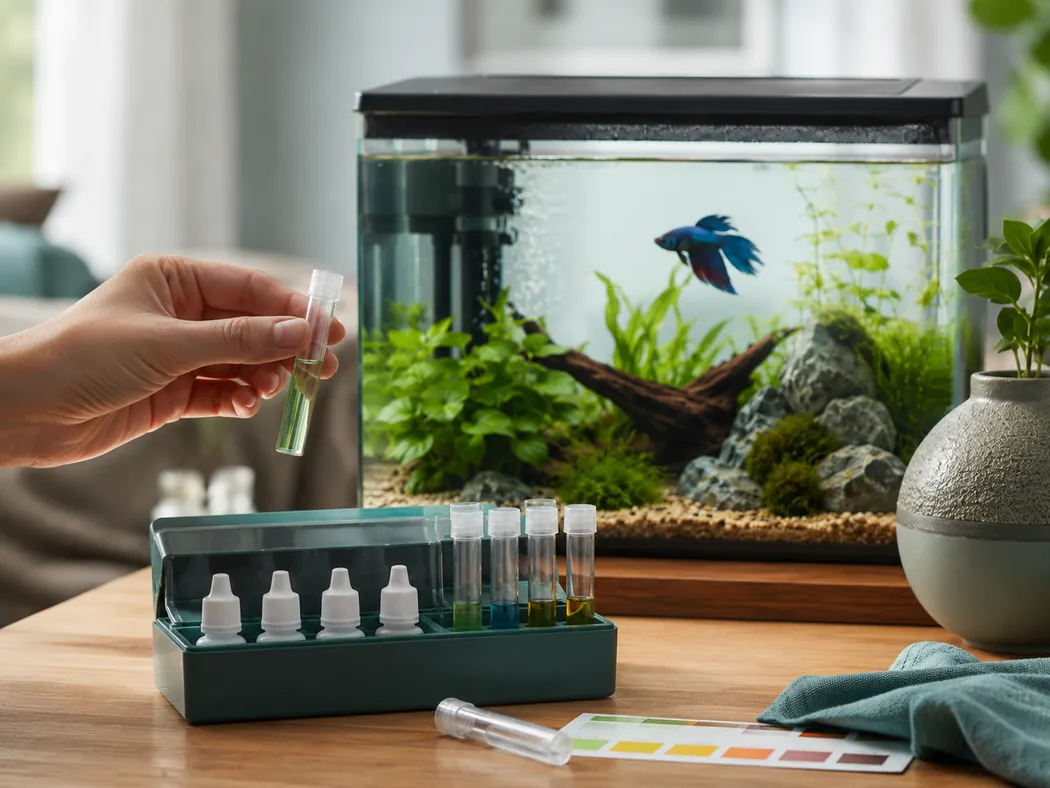
Best Decorations and Plants for Bettas
A good betta tank gives the fish places to explore, rest near the surface, and feel secure.
A bare tank may be easy to clean, but it often gives the fish nothing to do and nowhere to feel safe.
Good additions include smooth caves, silk or live plants, floating plants, betta logs or hammock leaves, and driftwood with smooth edges.
Avoid sharp plastic plants, rough resin ornaments, tiny holes the fish can get stuck in, mirrors left in the tank permanently, and decorations with flaking paint.
Fin-safe test reminder: if the decoration would snag delicate fabric, it may damage betta fins.
| Plant | Why it works for bettas |
|---|---|
| Anubias | Hardy, broad leaves for resting; attach to rock or wood. |
| Java fern | Hardy, low-tech; attach to wood or rock. |
| Java moss | Soft cover and texture. |
| Hornwort | Fast-growing, useful for surface cover. |
| Floating plants | Shade, surface comfort, natural feel. |
| Cryptocoryne | Good rooted plant once settled. |
Do not bury Anubias or Java fern rhizomes. If the rhizome is buried, the plant rots. Attach them to rock or driftwood instead.
Live plants are excellent but not required. You do not need a high-tech planted setup to give a betta a better home.
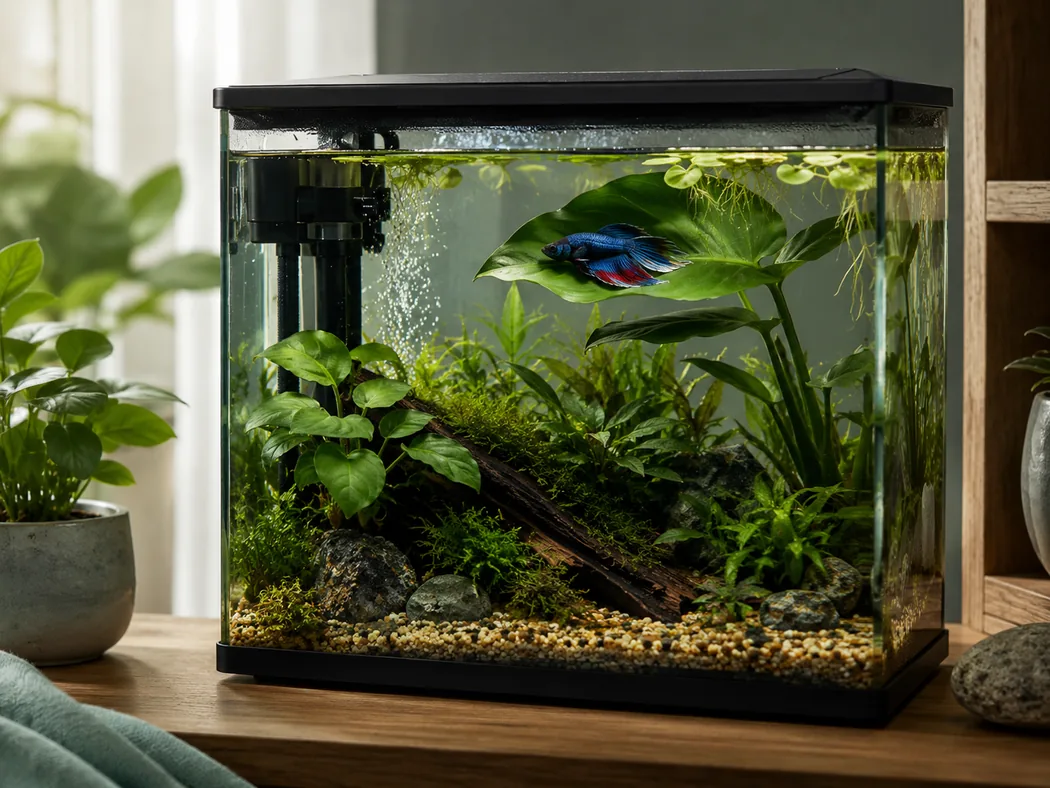
Betta-Safe Plant and Decor Kit
If you want to make the tank feel calmer and more natural, start with simple décor that solves betta-specific needs rather than random ornaments.
- Anubias or Java fern attached to rock or wood
- Floating plants for soft shade
- Betta leaf hammock or floating betta log
- Smooth cave hide or soft silk plant
Why You Should Avoid Tank Mates in a 5-Gallon Setup
A 5-gallon / ~19 L tank is a single-betta setup.
It is not a community tank.
That does not mean bettas can never have tank mates, but it does mean that in a 5-gallon tank, the math almost never works in the other animal's favor.
| Reason | What it means in practice |
|---|---|
| Limited water volume | More animals means faster ammonia buildup. |
| Territorial behavior | Male bettas claim space, and other fish have nowhere to retreat. |
| Filter load | A 5-gallon filter is usually sized for one small fish, not a community. |
| Stress on both animals | Constant proximity can stress the betta and the tank mate. |
| Feeding competition | Bettas are slow, deliberate eaters. Faster tank mates often steal food. |
In a 10-gallon / ~38 L tank, carefully chosen companions become more realistic, but they still require research.
| Possible companion | Notes |
|---|---|
| Nerite or mystery snails | Peaceful, useful algae cleaners, and they do not compete for open swimming space. |
| Amano or ghost shrimp | Can work in larger tanks, but some bettas will hunt smaller shrimp. |
| Corydoras (10+ gallons) | Need groups and smooth substrate. Not a 5-gallon option. |
| Kuhli loaches | Peaceful, group fish that need hiding places and a larger mature tank. |
What to avoid regardless of tank size: another male betta, female bettas in random small setups, fin-nippers such as tiger barbs, fast aggressive feeders, and neon tetras in a small or newly cycled tank.
The safest beginner answer is still the simplest one: start with one betta in a 5–10 gallon tank. Add complexity after you understand how the tank behaves.
Common Betta Tank Setup Mistakes
Mistake 1: The bowl
A bowl without a heater, filter, or lid is not a betta home. It is a slow emergency. The water goes bad faster, the temperature drops overnight, and the fish has no filtration support.
Mistake 2: Strong filter current
Bettas are not stream fish. If your betta spends all day hiding behind décor to avoid the current, that is the message.
Mistake 3: Skipping the cycle
Clear water is not cycled water. A new tank can look beautiful and still have rising ammonia that will stress or kill a betta within days.
Mistake 4: Sharp or rough decorations
Long-finned bettas tear fins on sharp plastic plants, jagged resin ornaments, and rough edges. If it would snag delicate fabric, it can snag fins.
Mistake 5: Leaving a mirror in the tank
Short flaring sessions are fine. Constant exposure to a mirror or reflective surface is chronic stress, not enrichment.
Mistake 6: Assuming a bare tank is automatically easier
A tank with nothing to explore, rest on, or hide near is not simpler for the fish. It is just emptier.
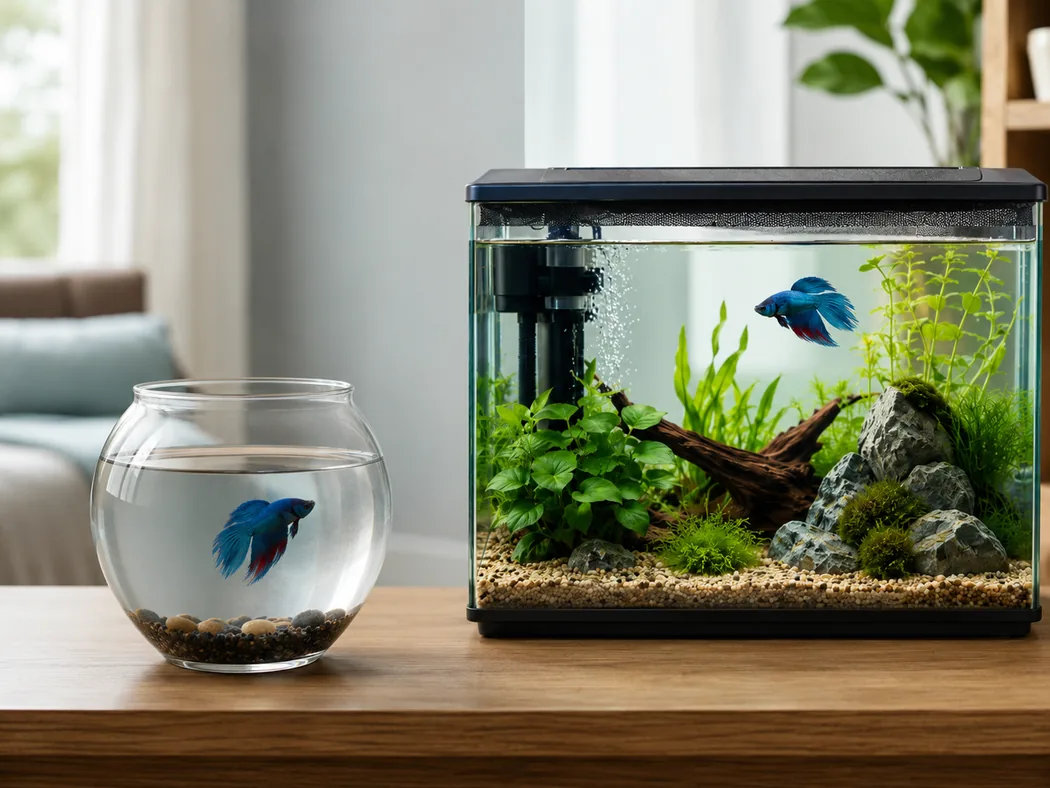
Betta Setup Checklist
Before adding your betta, check these.
| Question | Ready |
|---|---|
| Is the tank at least 5 gallons / ~19 L? | Yes |
| Is the tank on a stable, level surface? | Yes |
| Is a lid or mesh cover in place? | Yes |
| Is the heater running and temperature stable at 76–80°F / 24–27°C? | Yes |
| Is the thermometer showing stable temperature? | Yes |
| Is the filter running with gentle flow? | Yes |
| Has tap water been treated with conditioner? | Yes |
| Has the tank been cycled? | Yes |
| Are ammonia/ammonium (NH3/NH4+) and nitrite (NO2-) at 0 ppm? | Yes |
| Is nitrate (NO3-) controlled? | Yes |
| Are decorations and plants fin-safe? | Yes |
| Is there at least one resting place near the surface? | Yes |
| Do you have a test kit, siphon, conditioner, and bucket ready? | Yes |
If you cannot answer yes to these, wait. Waiting is part of responsible fishkeeping.
Related Guides
How to Set Up a Fish Tank
Start with the full beginner path from empty tank to safer first fish.
Water SafetyHow to Cycle a Fish Tank
Learn what ammonia, nitrite, and nitrate actually mean in a new aquarium.
Tank SizeFish Tank Size Guide
Understand why more water volume usually makes beginner fishkeeping easier.
ChecklistFreshwater Aquarium Checklist
See what matters before you buy fish or extra décor.
Buying GuideBest Filter for a 10-Gallon Tank
Helpful if you want gentler filtration choices for smaller freshwater setups.
Test KitsBest Aquarium Test Kits
Compare testing options if you are ready to buy your own kit.
ProblemWhy Is My Fish Tank Cloudy?
Useful if your new setup looks hazy and you are not sure what to do next.
Fish CareGuppy Care Guide
A good next read if you plan to compare beginner species before stocking other tanks.
Final Advice
A betta tank is ready when the water is stable, not when the glass looks pretty.
A 5-gallon tank with a lid, a gentle filter, a reliable heater, treated and cycled water, and a few safe resting places is a better home than the most beautiful bowl on any shelf.
It does not need to be complicated. It just needs to be right.
FAQ
What size tank does a betta need?
A 5-gallon / ~19 L tank is the practical beginner minimum for one betta. A 10-gallon / ~38 L tank is better if you have the space and budget.
Do bettas need a heater?
Yes, in most homes. Bettas are tropical fish and do best in stable water around 76–80°F or 24–27°C. Room temperature is often too cold or too variable without a heater.
Do bettas need a filter?
Yes. A filter supports beneficial bacteria that process fish waste. A gentle sponge filter or low-flow filter is ideal for bettas because it provides biological filtration without strong current.
Do bettas need a lid?
Yes. Bettas can jump, and a lid helps prevent escape. The lid should not be airtight. Use ventilation or a mesh top so the fish can still access warm atmospheric air at the surface.
What plants are safe for bettas?
Anubias, Java fern, Java moss, hornwort, floating plants, and Cryptocoryne are beginner-friendly options. Avoid sharp plastic plants that can snag fins.
Can bettas live with other fish?
In a 5-gallon tank, usually not. In a larger well-planted setup, some tank mates such as nerite snails, ghost shrimp, or corydoras may work, but research carefully. Never keep two male bettas together.
How do I know when my betta tank is cycled?
Use a water test kit. Ammonia/ammonium (NH3/NH4+) and nitrite (NO2-) should both read 0 ppm before the betta goes in.
How often should I change water in a betta tank?
This depends on tank size, stocking, and filter capacity. Many 5-gallon betta tanks benefit from a 25–30% water change once or twice per week. Test the water to guide the schedule rather than following a fixed routine blindly.
What temperature should a betta tank be?
Around 76–80°F or 24–27°C. Stability matters as much as the exact number. Avoid tanks that swing significantly between warm days and cold nights.
Why is my betta hiding near the bottom?
This can signal stress, illness, water-quality problems, or temperature issues. Test ammonia/ammonium (NH3/NH4+), nitrite (NO2-), and temperature first.
This article is written for beginner freshwater betta setups. Betta needs vary with individual fish, local water chemistry, room temperature, tank size, filtration, and maintenance routine. Always research your exact setup and test the water before making stocking decisions.
References
- RSPCA — Fish environment and aquarium welfare guidance
- RSPCA Knowledgebase — Aquarium water quality and biological filtration basics
- FishBase — Betta splendens species data
- Always check the manufacturer instructions for heaters, filters, conditioners, and test kits before use.