Most beginner aquarium problems do not start because people are careless. They start because the tank looks finished before it is actually ready.
You can buy a glass tank, add gravel, install a filter, fill it with water, turn on the light, and make the aquarium look beautiful in one afternoon. But the part that keeps fish alive is mostly invisible. It is the bacteria growing inside the filter. It is the way ammonia/ammonium (NH3/NH4+), nitrite (NO2-), and nitrate (NO3-) move through the tank. It is whether the water is stable enough for a living animal, not just clear enough for your eyes.
That is the mistake many new fishkeepers make: they confuse “clear water” with “safe water.”
Have you ever wondered why some fish die in water that looks perfectly clear? It usually comes down to the invisible side of fishkeeping: ammonia/ammonium (NH3/NH4+), nitrite (NO2-), oxygen, temperature stability, and the bacteria colony inside the filter.
Set up the tank for water stability first. Make it beautiful second.
The Real Goal of Setting Up a Fish Tank
A fish tank is not just a container. It is a small biological system.
Fish produce waste. Uneaten food breaks down. Plant leaves melt. Bacteria grow. Oxygen moves through the water. The filter becomes more than a machine; it becomes a living surface where beneficial bacteria do a huge part of the work.
When the tank is new, that system is not mature yet.
This is why I do not like telling beginners, “Just set up the tank and wait a few days.” A few days of running water does not automatically mean the aquarium is ready. What matters is whether the tank can process waste without ammonia/ammonium (NH3/NH4+) or nitrite (NO2-) building up.
In plain English: your goal is not just to have water in a glass box. Your goal is to build a tank that can handle fish waste.
That is the difference between a tank that looks ready and a tank that is ready.
Choose a Tank Size That Gives You Room for Mistakes
Small tanks look easier because they are cheaper, lighter, and less intimidating. In practice, very small tanks can be less forgiving.
A little extra food in a tiny tank can affect the water quickly. A small temperature swing can matter more. A filter mistake can show up faster. Beginners often buy tiny tanks because they look simple, then spend the next month fighting unstable water.
If you have the space, a 10-gallon tank, about 38 liters, is a much better starting point than most desktop tanks. A 20-gallon tank, about 76 liters, is even more forgiving.
| Tank size | Best beginner use | What to watch out for |
|---|---|---|
| 5 gallons / ~19 L | One betta, shrimp, very light stocking | Less room for mistakes; flow and temperature need attention |
| 10 gallons / ~38 L | A good beginner size for one betta, guppies, shrimp, or a low-stock planted tank | Easy to overstock |
| 20 gallons / ~76 L | Beginner community tanks and small schooling fish | Costs more, but is usually easier long term |
| 40 gallons+ / ~151 L+ | Larger community options and better stability | More water-change planning |
Goldfish deserve a special warning. They are often sold like beginner fish, but they are messy, active, and need more space and filtration than many people expect. A goldfish bowl is not a beginner setup. It is a problem waiting to happen.
If you are not sure what fish you want yet, start with the largest practical tank you can maintain. You are not just buying water volume. You are buying stability.
Related guide: Fish Tank Size Guide
The Equipment Worth Spending Money On First
Beginner aquarium shopping can get confusing because every product looks “essential.” Most of it is not essential on day one.
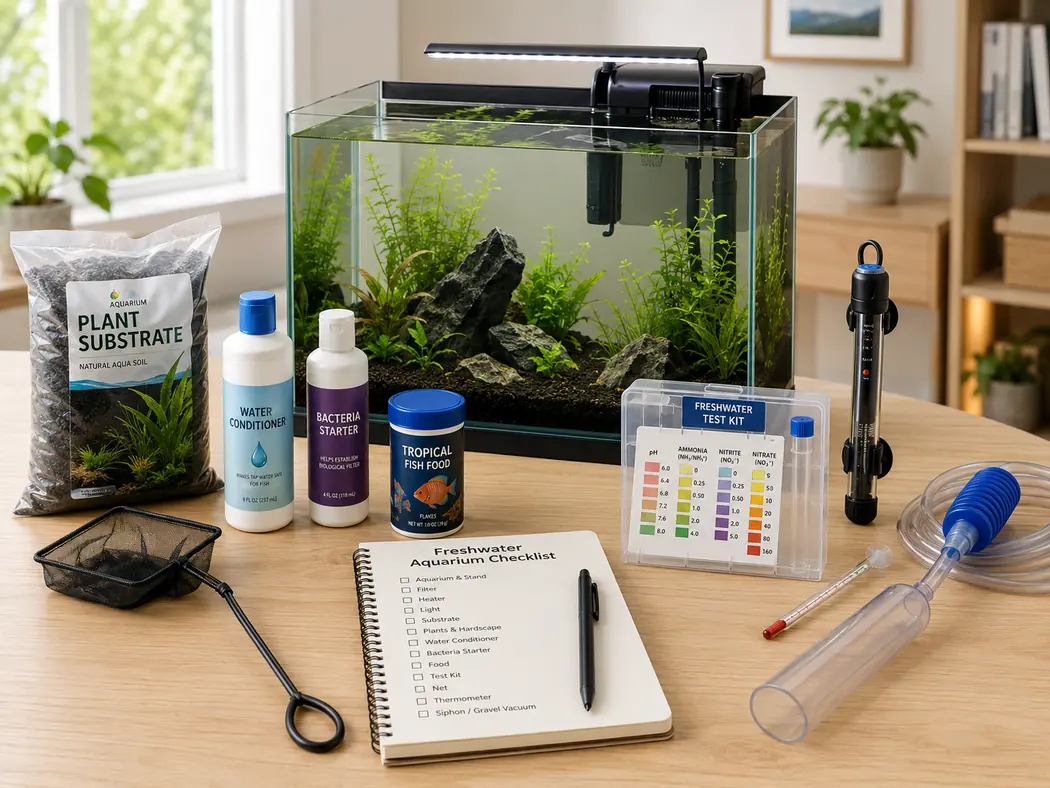
If I were helping someone set up their first freshwater tank on a realistic budget, I would prioritize these first:
| Equipment | Why it matters | Beginner note |
|---|---|---|
| Filter | Holds beneficial bacteria and moves water | Do not judge it only by water clarity |
| Water conditioner | Makes tap water safer by treating chlorine/chloramine | Use it every time you add tap water |
| Test kit | Shows ammonia/ammonium (NH3/NH4+), nitrite (NO2-), nitrate (NO3-), and pH | Your eyes cannot see toxic ammonia |
| Heater | Keeps tropical fish at a stable temperature | Needed for bettas, guppies, and many community fish |
| Thermometer | Verifies actual water temperature | Do not trust the heater dial blindly |
| Siphon/gravel vacuum | Makes water changes easier | One of the most useful maintenance tools |
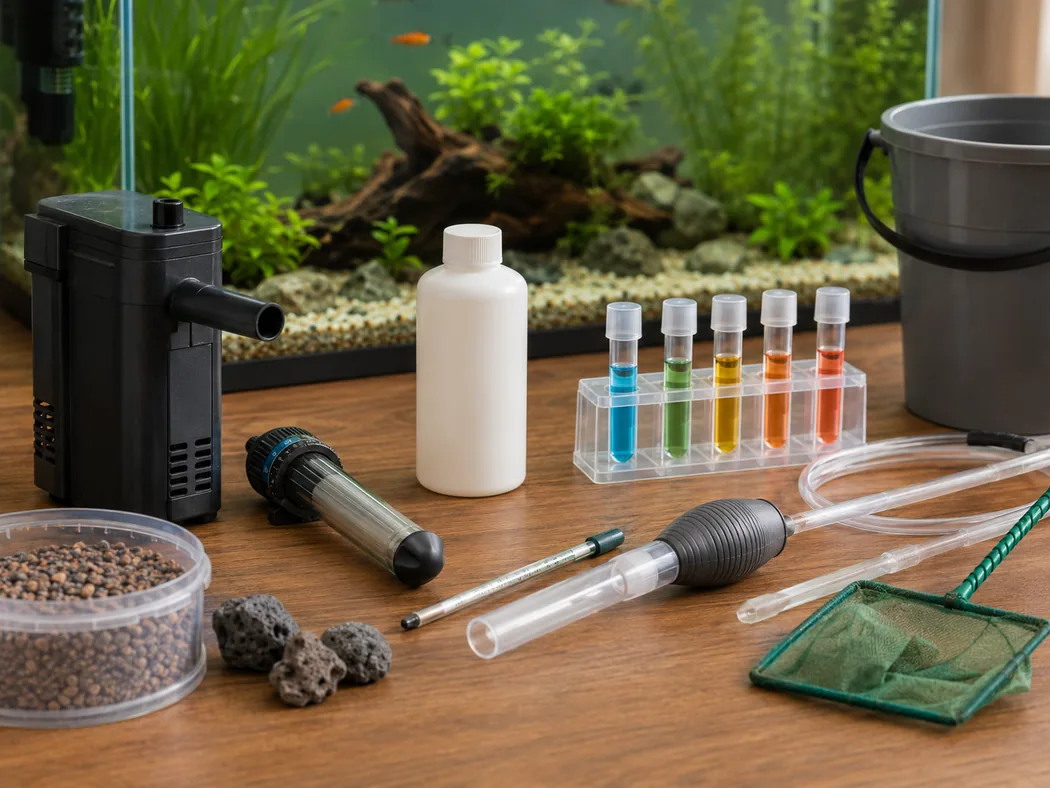
The filter deserves extra attention. Many beginners think the filter is mainly there to remove visible dirt. That is only part of the story.
The more important role is biological filtration. Sponge, ceramic media, and other porous filter media give beneficial bacteria a place to live. Those bacteria help convert toxic waste into less dangerous forms.
So no, I would not spend most of the beginner budget on decorations. I would rather see a simple tank with a good filter and test kit than a beautiful tank with unstable water.
Set Up the Tank Physically
Rinse the empty aquarium with clean water only. Do not use soap, detergent, glass cleaner, or household chemicals inside the aquarium.
Rinse the substrate before adding it. Sand and gravel often carry dust, and that dust can make the water cloudy. You do not need the rinse water to be perfect, but get the worst of the dust out.
Add the substrate, then place rocks, driftwood, and decorations. Keep the layout simple. Leave swimming space. Give fish places to hide. Avoid sharp plastic decorations, especially if you plan to keep bettas or long-finned fish.
Then install the filter and heater before filling the tank completely. It is much easier to adjust equipment before the aquarium is full.
When you fill the tank, treat tap water with conditioner. Pour slowly so you do not blast the substrate everywhere. A plate, bowl, or plastic bag placed over the substrate can soften the flow.
Turn on the filter. Check the heater. Make sure water is moving. Watch the surface. A little surface movement is good because gas exchange matters.
At this point, the aquarium may look ready.
It is not ready yet.
Cycling Is the Part Beginners Want to Skip
This is the part that decides whether your first fish thrive or suffer.
Cycling a tank means growing enough beneficial bacteria to process fish waste. In simple terms, fish waste and decaying food create ammonia/ammonium (NH3/NH4+). Beneficial bacteria convert ammonia/ammonium (NH3/NH4+) into nitrite (NO2-), and another group converts nitrite (NO2-) into nitrate (NO3-).
In a new tank, those bacteria are not established yet.
That is why putting fish into a brand-new tank can be risky even if the water is crystal clear. The tank has not learned how to handle waste.
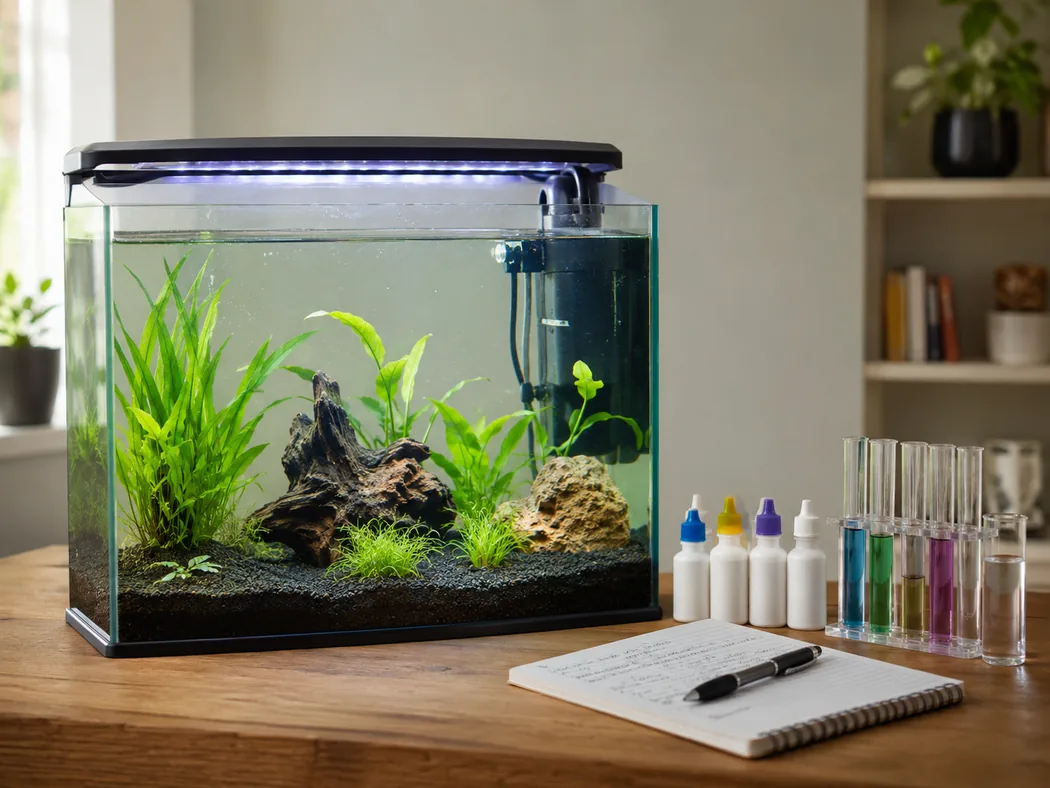
Before fish go in, ammonia/ammonium (NH3/NH4+) and nitrite (NO2-) should read 0 ppm on your test kit. Nitrate (NO3-) may be present and can be reduced with water changes and plants.
A fishless cycle is the safer method because it builds the biological filter before fish are exposed to unstable water.
Related guide: How to Cycle a Fish Tank
What We’d Check First Before Adding Fish
Before adding your first fish, check these basics:
| Question | Ready answer |
|---|---|
| Is the filter running properly? | Yes |
| Has the tank been cycled? | Yes |
| Are ammonia/ammonium (NH3/NH4+) and nitrite (NO2-) at 0 ppm? | Yes |
| Is the water temperature stable for the fish you plan to keep? | Yes |
| Has tap water been treated with conditioner? | Yes |
| Is the tank size suitable for the adult fish? | Yes |
| Are the fish compatible with each other? | Yes |
| Is the current too strong or too weak? | Checked |
| Are there enough hiding places? | Yes |
| Do you have a plan for water changes? | Yes |
If any of these are uncertain, wait. Waiting a few more days is better than adding fish to an unstable tank.
Choose Your First Fish Carefully
A lot of beginner fish lists on the internet are too casual. They recommend fish that are popular, colorful, or easy to buy — not always fish that are forgiving in a new aquarium.
Neon tetras are the perfect example.
They are beautiful. They are peaceful. They look amazing in a planted tank. But I would not choose neon tetras as the first fish for a newly cycled beginner aquarium.
They tend to do better in stable, mature tanks. A brand-new setup can still be going through small swings in water quality, temperature, pH stability, and bacterial balance. Neon tetras can be less forgiving than their “beginner fish” reputation suggests.
Can beginners keep neon tetras successfully? Yes.
Would I make them the first fish in a fresh tank? No.
That difference matters.
Better first-fish options for many beginners can include guppies, platies, zebra danios, or white cloud mountain minnows, depending on tank size, temperature, and local water. No fish is indestructible, but these often give beginners more room to learn.
| Fish | Better tank size | Temperature range | Why it can work | Watch out for |
|---|---|---|---|---|
| Guppies | 10+ gallons / ~38+ L | 72–80°F or 22–27°C | Hardy, active, colorful | Breed quickly; often prefer harder water |
| Platies | 10–20+ gallons / ~38–76+ L | 70–78°F or 21–26°C | Forgiving livebearers | Need space and filtration |
| Zebra danios | 20 gallons / ~76 L preferred | 70–78°F or 21–26°C | Active and hardy | Too active for tiny tanks |
| White cloud mountain minnows | 10–20+ gallons / ~38–76+ L | 65–77°F or 18–25°C | Good for cooler tanks | Not ideal for warm tropical tanks long-term |
| Single betta | 5+ gallons / ~19+ L | 76–80°F or 24–27°C | Great centerpiece fish | Needs gentle flow |
Good fishkeeping is not about copying a list. It is about matching the fish to the tank.
Related guides: Betta Fish Care Guide, Guppy Care Guide, Fish Tank Size Guide
Add Fish Slowly, Not All at Once
Even after cycling, do not fully stock the tank in one day.
Your bacteria colony can handle a certain amount of waste. If you suddenly add too many fish, the waste load can jump faster than the bacteria can adjust. That can lead to ammonia/ammonium (NH3/NH4+) or nitrite (NO2-) showing up again.
Start with a small number of fish. Feed lightly. Test the water. Watch behavior.
If the fish are active, eating, breathing normally, and ammonia/ammonium (NH3/NH4+) and nitrite (NO2-) stay at 0 ppm, you can gradually add more later if the tank size allows it.
The First Week After Adding Fish
The first week tells you a lot.
Do not judge only by how clear the water looks. Watch the fish.
Healthy new fish should gradually become more active, explore the tank, and eat normally. Stressed fish may clamp fins, hide constantly, gasp near the surface, breathe rapidly, or sit near the bottom.
Test ammonia/ammonium (NH3/NH4+) and nitrite (NO2-) during the first week, especially if this is your first aquarium. If either appears, reduce feeding, check the filter, and do a partial water change with conditioned water. Do not add more fish.
Feed less than you think. Overfeeding is one of the easiest ways to ruin a new tank. A tiny amount once a day is often enough at first, depending on the fish.
Keep the light schedule modest, often around 6–8 hours per day for many beginner tanks. Leaving the light on all day invites algae.
Do not deep-clean the filter when the tank is young. If the flow slows down, gently rinse sponge or media in old tank water during a water change. Do not wash it under untreated tap water and do not replace everything at once.
Common Beginner Mistakes
Adding fish because the water looks clear
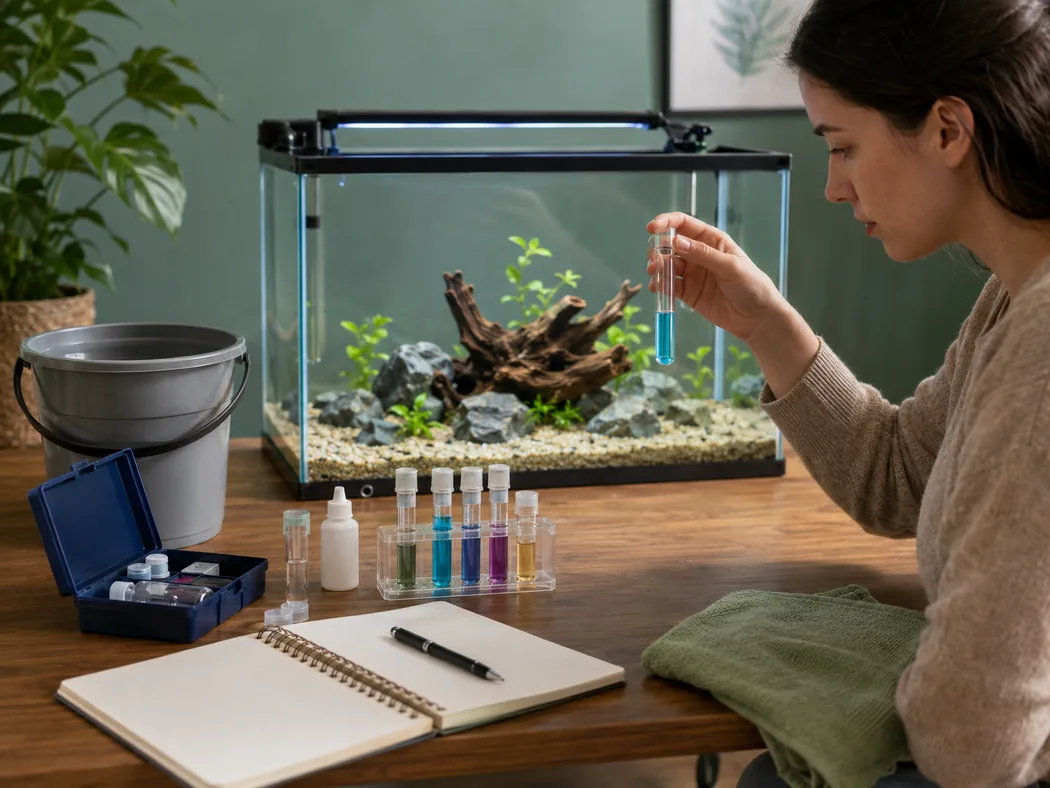
Clear water is not proof that ammonia/ammonium (NH3/NH4+) and nitrite (NO2-) are safe. Test first.
Buying a tank that is too small
Tiny tanks are less stable and can become stressful quickly. Choose a tank size that fits the fish, not just the furniture.
Overstocking
Too many fish create too much waste. Overstocking can lead to ammonia spikes, oxygen problems, aggression, and stress.
Overfeeding
More food does not mean healthier fish. Uneaten food breaks down and harms water quality.
Cleaning the filter too aggressively
Your filter media holds beneficial bacteria. Rinse it gently in old tank water when needed. Do not replace all of it at once unless there is a specific reason.
Choosing fish before researching them
Some fish grow larger than expected. Some need groups. Some are aggressive. Some need specific temperatures or water conditions. Research first.
Trusting clear water too much
Clear water can still be unsafe. Test the water.
A Simple Beginner Setup That Actually Makes Sense
If I had to recommend a practical first setup for most beginners, it would look like this:
| Setup choice | Practical recommendation |
|---|---|
| Tank | 10 or 20 gallons if space allows |
| Filter | Sponge filter or hang-on-back filter with biological media |
| Heater | Needed for tropical fish; choose based on tank size and room temperature |
| Water treatment | Conditioner for every tap-water addition |
| Testing | Ammonia/ammonium (NH3/NH4+), nitrite (NO2-), nitrate (NO3-), pH; GH/KH if your water is unusual or fish are sensitive |
| First stocking | Light stocking, hardy fish, no impulse community |
| Maintenance | Small consistent water changes, light feeding, do not over-clean filter media |
A quick note on GH and KH: beginners do not need to obsess over these on day one, but the terms are worth knowing. GH is general hardness, mostly related to minerals like calcium and magnesium. KH is carbonate hardness, which helps buffer pH and keep it from swinging too easily. If your fish are hardy and your local water is stable, start with ammonia/ammonium (NH3/NH4+), nitrite (NO2-), nitrate (NO3-), pH, and temperature first. Learn GH/KH when you move into shrimp, very soft-water fish, or planted tanks.
This kind of setup may not look dramatic on social media, but it gives you a much better chance of success.
Once you understand how the tank behaves, you can make it more beautiful. Add plants. Improve the layout. Upgrade the light. Try different fish. But do not build the tank around decoration before you understand the water.
FAQ
How long should a new fish tank run before adding fish?
A new tank should not be judged by the number of days it has been running. It should be judged by water tests. The safer target is 0 ppm ammonia, 0 ppm nitrite, and a stable nitrate reading that shows the biological filter is working.
Can I set up a fish tank and add fish the same day?
It is possible only with careful fish-in cycling, but it is not the beginner-friendly route. Most new keepers are safer cycling the tank first, testing the water, and adding fish slowly once the filter can process waste.
What kills most beginner fish in new tanks?
The most common cause is not bad luck. It is usually unstable water, especially ammonia or nitrite in an uncycled tank. Overfeeding, overstocking, and replacing filter media too early make the problem worse.
Do I need live plants for a beginner aquarium?
No, but live plants can help stabilize the tank and give fish cover. Hardy plants such as Java fern, Anubias, and floating plants are often easier than delicate aquascaping plants.
Should I clean everything before adding fish?
Rinse dust from the tank, substrate, and decor, but do not use soap or household cleaners. Once the tank is cycled, do not scrub everything sterile because the beneficial bacteria are part of the system.
What should I buy first for a new fish tank?
Start with the tank, filter, heater if needed, water conditioner, liquid test kit, substrate, safe decor, and a plan for cycling. Fish should come after the system is ready, not before.
How many fish can I add at once?
Add fish slowly. Even a cycled filter needs time to adjust to more waste. For beginners, adding a small group or one centerpiece fish at a time is safer than fully stocking the tank in one day.
Do I need a water test kit?
Yes. A liquid test kit is one of the most useful beginner tools because clear water can still contain ammonia or nitrite. Testing removes guessing from fishkeeping.
Related Guides
Continue with these guides:
- How to Cycle a Fish Tank
- Freshwater Aquarium Checklist
- Fish Tank Size Guide
- Best Filter for a 10-Gallon Tank
- Best Aquarium Test Kits
- Betta Fish Care Guide
- Why Is My Fish Tank Cloudy?
- Low-Tech Planted Tank Setup
- Cloudy Fish Tank Water
- Noisy Aquarium Filter
- Smelly Fish Tank
Final Advice
A fish tank is ready when the water is stable, not when the glass looks pretty.
Take your time. Cycle the tank. Test the water. Choose fish that match your tank and your experience level. Add them slowly. Feed lightly. Keep the filter alive.
That is not the fastest way to set up an aquarium, but it is the way that prevents the most heartbreak.
The goal is not a perfect tank.
The goal is a healthy tank you can understand, maintain, and improve over time.
FAQ
Can I set up a fish tank and add fish the same day?
For most beginners, no. A new tank usually does not have enough beneficial bacteria to process fish waste safely. Cycling first is much safer.
How do I know when my tank is cycled?
Use a water test kit. A cycled tank should be able to process ammonia/ammonium (NH3/NH4+) and nitrite (NO2-) so both read 0 ppm before fish are added. Nitrate (NO3-) may be present and should be managed with water changes and plants.
Why is my new tank cloudy?
New tanks can turn cloudy from substrate dust, bacterial blooms, overfeeding, or weak filtration. Cloudy water is common, but you should still test ammonia/ammonium (NH3/NH4+) and nitrite (NO2-).
What tank size is best for beginners?
A 10-gallon tank, about 38 liters, is a better starting point than most tiny tanks. A 20-gallon tank, about 76 liters, is even more forgiving if you have the space and budget.
Are neon tetras good first fish?
They are popular, but I would not make them the first fish in a brand-new beginner tank. Neon tetras usually do better in stable, mature aquariums. Guppies, platies, zebra danios, or white cloud mountain minnows may be more forgiving depending on your tank and water.
Do I need live plants?
No, but live plants can help make the tank feel more natural and may support water quality. Easy plants like Anubias, Java fern, Java moss, hornwort, and floating plants are good beginner options.
How much should I feed new fish?
Feed lightly. In a new tank, small amounts are safer than heavy feeding. Uneaten food quickly becomes a water quality problem.
Should I replace filter media every month?
Usually, no. Filter media holds beneficial bacteria. Rinse it gently in old tank water when needed, but avoid replacing all of it at once unless there is a specific reason.
Author Box
Healthy Aquariums Team
Healthy Aquariums publishes practical freshwater aquarium guides focused on clearer water, healthier fish, and easier-to-maintain tanks. Our setup and troubleshooting articles are written for everyday fishkeepers who want calm, honest advice before buying more gear or adding more fish.
Editorial Note
This article is intended for beginner freshwater aquariums. Fish needs vary by species, source, local water, and tank conditions. Always research the specific fish you plan to keep and test your own aquarium water before making stocking decisions.
References
This guide was written for beginner freshwater aquariums and cross-checked against animal welfare and fish species references, including RSPCA guidance on aquarium water quality, fishless cycling, and filter media care, plus FishBase species data for fish examples discussed in the article.