Most beginner aquarium shopping goes wrong in a very predictable way.
People buy the things that make the tank look finished before they buy the things that make the tank safe.
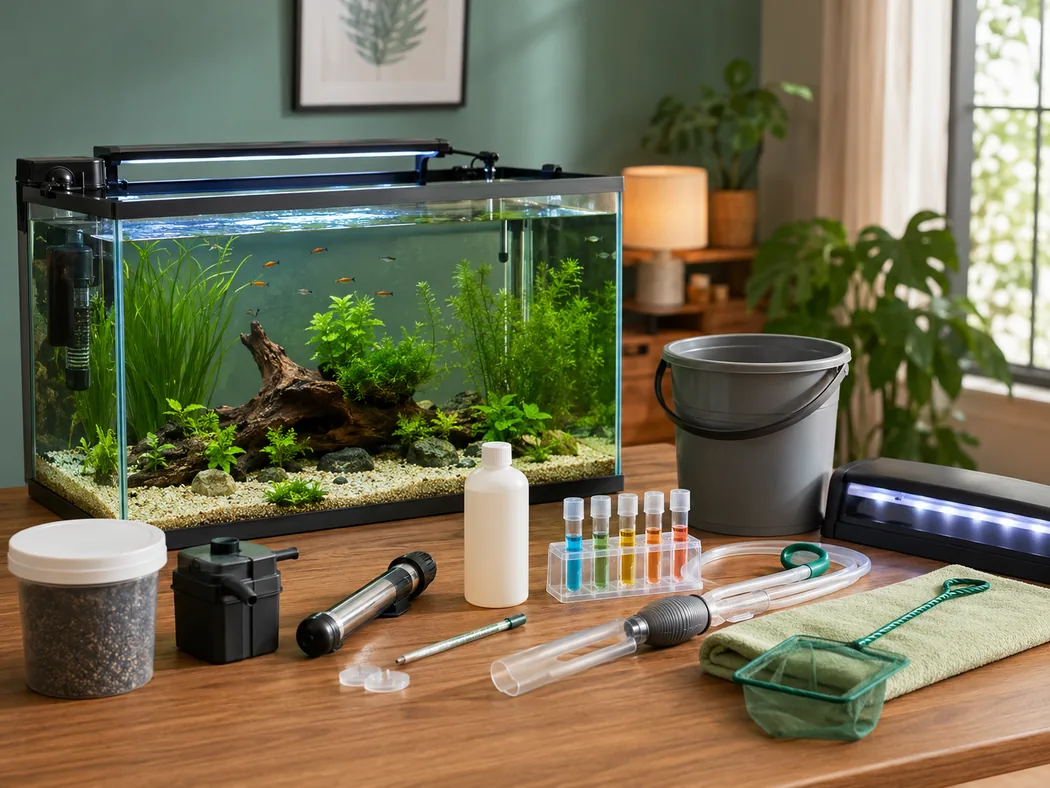
They buy colorful gravel, plastic decorations, a tiny starter tank, a bottle that promises clearer water, and maybe a fish on the same trip. Then they get home and realize they do not have a test kit. Or a proper filter. Or a heater. Or a siphon. Or even a clear plan for cycling the tank before fish go in.
A good aquarium checklist should not help you buy more stuff.
It should help you avoid buying the wrong stuff.
That is the goal of this guide. Not to make you fill a shopping cart. Not to make the tank look expensive. Just to help you set up a freshwater aquarium with the equipment that actually supports healthy fish and stable water.
Buy for water quality first. Decorate after the tank can support fish.
The Real Purpose of an Aquarium Checklist
A checklist is useful only if it separates “needed now” from “nice later.”
Many aquarium products are not bad. They are just not first-day priorities.
Aquascaping tools can be useful later. A fancy light can matter for demanding plants. Extra filter media can be smart. A background can make the tank look cleaner. But none of those matter as much as a safe tank size, working filtration, treated tap water, stable temperature, water testing, and a plan for cycling.
The beginner question should not be:
“What can I buy for my aquarium?”
It should be:
“What does this tank need before a fish has to live in it?”
That one question changes the whole shopping list.
Before You Buy Anything, Choose the Fish First
This is where many checklists fail.
They start with equipment, but the fish should come first.
A betta tank checklist is not the same as a goldfish checklist. A shrimp tank checklist is not the same as a guppy community tank checklist. A 5-gallon tank, about 19 liters, needs a different plan from a 20-gallon tank, about 76 liters.
Before you buy equipment, decide what kind of aquarium you are building.
Not every detail has to be final. But you should know the general direction.
Do you want one betta?
A small guppy tank?
A peaceful beginner community?
Shrimp?
Goldfish?
A planted tank?
Once you know that, the checklist becomes much more useful. You can choose the right tank size, filter flow, heater, substrate, and maintenance tools for the fish instead of forcing fish into whatever equipment you already bought.
Internal link suggestions: Fish Tank Size Guide, How to Set Up a Fish Tank
Essential Freshwater Aquarium Checklist
This is the core list for most beginner freshwater aquariums.
Not every setup needs the exact same version of each item, but most healthy beginner tanks need some form of these essentials.
| Item | Need now? | Why it matters | Beginner note |
|---|---|---|---|
| Aquarium tank | Yes | Determines water volume, fish options, and stability | 10 gallons / ~38 L is better than most tiny tanks; 20 gallons / ~76 L is more forgiving |
| Strong, level stand | Yes | Prevents stress on glass and supports full tank weight | Water is heavy; do not trust weak furniture |
| Filter | Yes | Supports mechanical and biological filtration | Biological media matters more than cartridge marketing |
| Water conditioner | Yes | Treats chlorine/chloramine in tap water | Use every time you add tap water |
| Test kit | Yes | Shows ammonia/ammonium (NH3/NH4+), nitrite (NO2-), nitrate (NO3-), and pH | Your eyes cannot see toxic water |
| Heater | Usually, for tropical fish | Keeps temperature stable | Bettas, guppies, and many community fish need warmth |
| Thermometer | Yes | Confirms actual water temperature | Do not trust the heater dial alone |
| Substrate | Usually | Supports layout, plants, and natural behavior | Sand, gravel, or planted substrate depending on fish/plants |
| Siphon / gravel vacuum | Yes | Makes water changes and debris removal easier | One of the most useful tools you can buy |
| Bucket for aquarium use only | Yes | Prevents chemical contamination | Never use a cleaning-chemical bucket |
| Fish net | Yes | Helps move fish when needed | Choose a soft, appropriate size |
| Lid or cover | Often | Prevents jumping and reduces evaporation | Especially useful for bettas and active fish |
| Light | Usually | Helps viewing and plant growth | Do not over-light a new tank |
| Food | Before fish | Must match species and mouth size | Buy after choosing fish, not before |
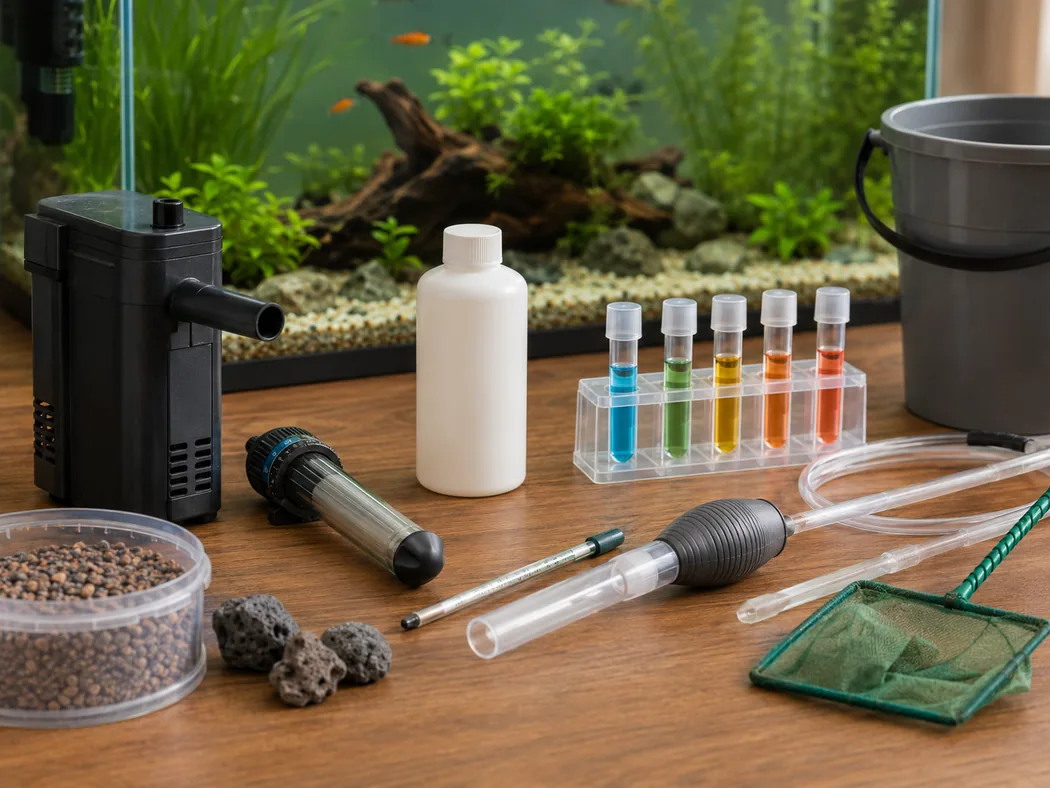
If you are trying to keep the setup simple, focus on this core group first: tank, stand, filter, conditioner, test kit, heater if needed, thermometer, siphon, and bucket.
Decorations are not more important than water safety.
The Three Items I Would Not Skip
If a beginner asked me what they absolutely should not skip, I would name these three:
A real filter.
A water conditioner.
A test kit.
The filter is where much of the useful bacteria colony will live. The conditioner makes tap water safer. The test kit tells you what the water is doing before fish show stress.
You can start with simple decorations.
You can start with easy plants.
You can upgrade the light later.
But if you skip filtration, water treatment, and testing, you are guessing with a living animal.
What Kind of Filter Should a Beginner Buy?
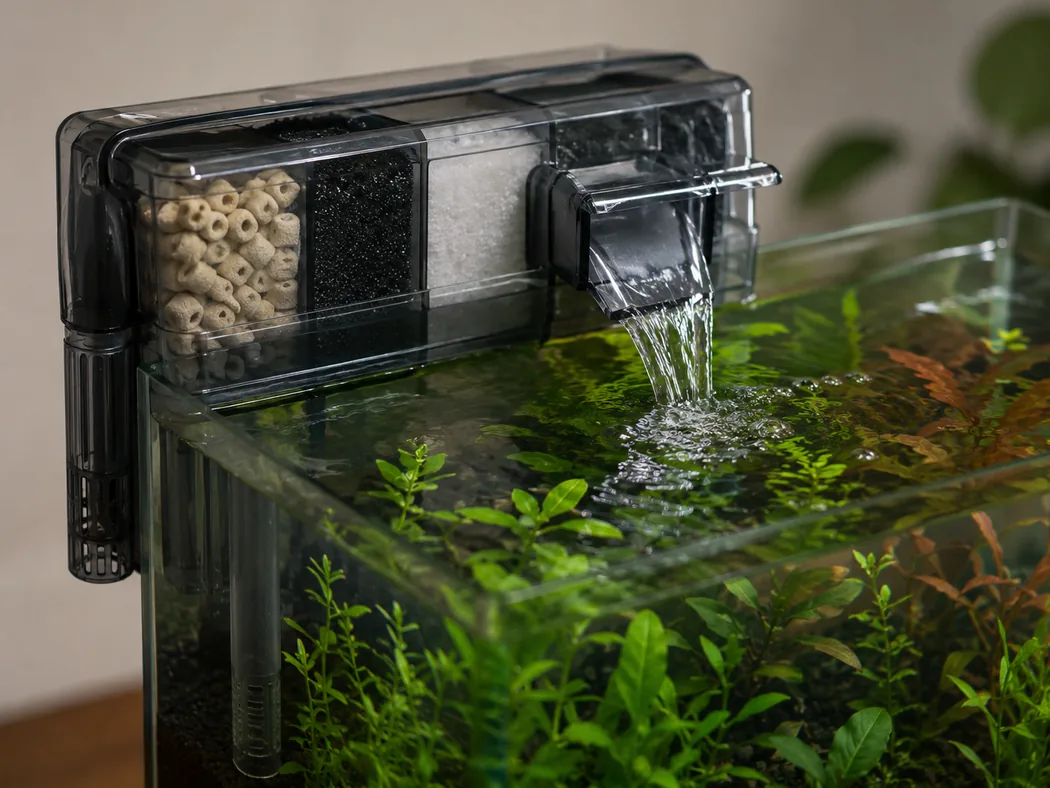
The filter is not just there to make the water look clear.
It also gives beneficial bacteria a place to live. Those bacteria help convert fish waste into less harmful compounds during and after cycling.
For most beginner tanks, these are practical starting points:
| Tank size | Filter direction | Practical note |
|---|---|---|
| 5 gallons / ~19 L | Gentle sponge filter or low-flow internal filter | Good for bettas or shrimp; avoid strong current |
| 10 gallons / ~38 L | Sponge filter or HOB filter | Around 80–120 GPH / 300–450 LPH can work for many setups, but reduce flow for bettas |
| 20 gallons / ~76 L | Larger HOB, sponge pair, or small canister | Around 150–200 GPH / 570–760 LPH is a common range for many community tanks |
| Goldfish setup | Oversized biological filtration | Goldfish produce heavy waste; do not choose the smallest filter possible |
Flow rate is not the whole story. A filter with more usable sponge or biological media is often better than a filter that simply moves water fast.
For bettas and shrimp, gentle flow matters. For active community fish, more water movement may be useful. For goldfish, waste handling matters a lot.
The point of these numbers is not to turn aquarium setup into math homework. They are guardrails. A quiet betta tank, a guppy tank, and a goldfish tank may all be “freshwater aquariums,” but they do not place the same demand on flow, heat, or biological media.
Internal link suggestions: Best Filter for a 10-Gallon Tank, What Size Filter Do You Need?
Heater and Temperature Checklist
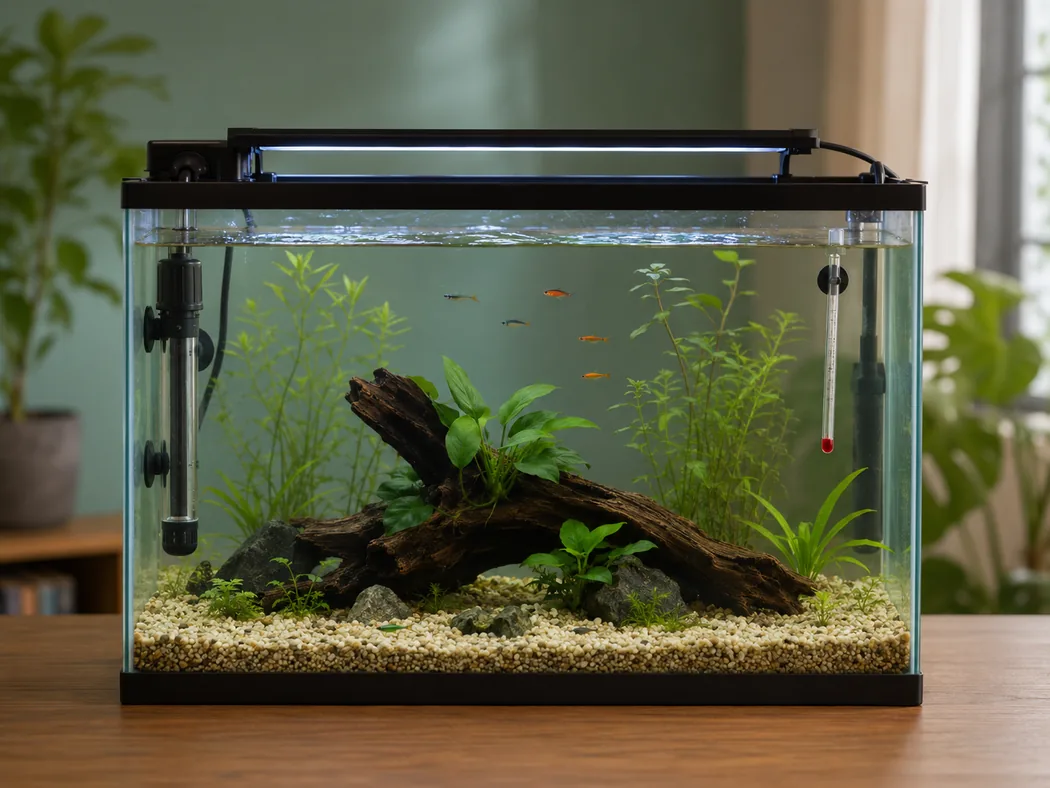
You need a heater if you keep tropical fish and your room temperature is not already stable in the right range.
Many beginner tropical fish do best with warm, steady water. Bettas are commonly kept around 76–80°F or 24–27°C. Many guppies and beginner community fish are commonly kept around 72–80°F or 22–27°C, depending on species, strain, and local conditions. Goldfish are different and usually do not need tropical temperatures.
The exact number matters less than stability. A tank that swings from warm in the afternoon to cold overnight is harder on fish than a tank that stays steady.
A thermometer is what keeps you honest.
| Tank size | Common heater size | Notes |
|---|---|---|
| 5 gallons / ~19 L | 25W | Use adjustable heater; check for hot spots |
| 10 gallons / ~38 L | 50W | Common for stable indoor rooms |
| 20 gallons / ~76 L | 100W or two 50W heaters | Two smaller heaters can improve heat distribution |
| 40 gallons+ / ~151 L+ | Larger heater or two heaters | Place apart for even temperature |
Once the tank can hold a stable temperature, the next question is whether the water is actually safe. That is where conditioner and testing come in. These products are not exciting, but they prevent a lot of the “my fish looked fine yesterday” stories.
Water Conditioner and Test Kit: Boring but Important
Water conditioner is one of the least exciting products in the hobby.
It is also one of the most important.
Tap water may contain chlorine or chloramine, which can harm fish and beneficial bacteria. Use conditioner whenever you add tap water to the aquarium, including during water changes.
A test kit is equally important. Beginners often wait until fish look sick before testing. That is too late.
At minimum, a beginner should be able to test:
| Parameter | Why it matters |
|---|---|
| Ammonia/Ammonium (NH3/NH4+) | Toxic waste compound, especially dangerous in new tanks |
| Nitrite (NO2-) | Also toxic and common during cycling |
| Nitrate (NO3-) | Less immediately toxic, but should be controlled with water changes |
| pH | Helps you understand water stability |
| Temperature | Affects fish stress, metabolism, and cycling behavior |
This is the part of the checklist that feels boring until something goes wrong.
If fish are gasping, hiding, clamping fins, or dying in water that “looks clean,” ammonia/ammonium (NH3/NH4+) and nitrite (NO2-) are two of the first things you want to rule out.
GH and KH can be useful later, especially for shrimp, very soft water, very hard water, or sensitive fish. GH means general hardness, mostly minerals like calcium and magnesium. KH means carbonate hardness, which helps buffer pH and keep it from swinging too easily.
For most first tanks, start with ammonia/ammonium (NH3/NH4+), nitrite (NO2-), nitrate (NO3-), pH, and temperature.
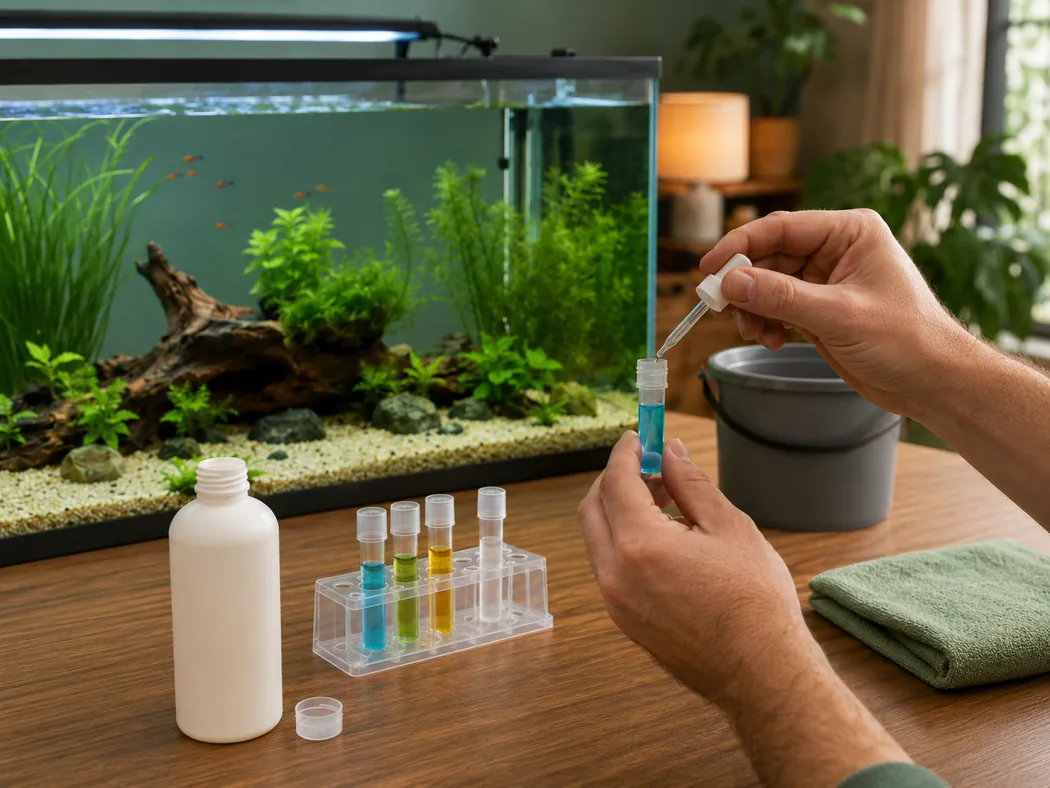
Keep a liquid ammonia/nitrite/nitrate test kit, a water conditioner that handles chlorine and chloramine, and a separate thermometer ready before fish arrive. These tools help you confirm water safety instead of guessing when fish show stress.
Substrate, Plants, and Decorations
Substrate is not just decoration.
It affects cleaning, plant choice, bottom-dwelling fish, and the overall feel of the tank.
Gravel is easy for many beginners. Sand can be better for bottom-dwelling fish like corydoras because it is smoother. Planted substrates can help plants, but they may add complexity and nutrients that beginners need to understand.
Decorations should be fish-safe. Avoid sharp plastic plants or rough ornaments, especially for bettas and long-finned fish. If a decoration can snag pantyhose, it may damage delicate fins.
Live plants are helpful, but you do not need a high-tech planted tank on day one. Easy plants such as Anubias, Java fern, Java moss, hornwort, floating plants, and some Cryptocoryne species are more beginner-friendly than delicate carpeting plants.
Do not bury the rhizome of Anubias or Java fern. Attach them to rock or wood instead.
Useful Later, but Not Urgent
Some aquarium items are useful, but they do not need to be first-day purchases.
| Item | Useful for | Buy now or later? |
|---|---|---|
| Light timer | Stable light schedule, algae control | Very useful early |
| Extra biological media | Improving filter capacity | Useful if your filter has room |
| Aquarium background | Cleaner visual look | Later |
| Aquascaping tools | Planting and trimming | Later unless heavily planted |
| Algae scraper | Cleaning glass | Useful early |
| Plant fertilizer | Planted tanks | Later, depending on plant choice |
| Root tabs | Root-feeding plants | Later if using Amazon swords, crypts, etc. |
| Air pump / air stone | Extra oxygen and surface movement | Useful in some setups |
| Quarantine tank | New fish and illness control | Excellent long term, not always day one |
A light timer is one of the few “not essential but very useful” items I would recommend early. Many beginners leave the aquarium light on too long, then wonder why algae appears.
Six to eight hours of light per day is a reasonable starting point for many beginner tanks.
Things Beginners Often Buy Too Early
This is where a checklist can save money.
Random Water Clarifiers
Cloudy water is often a symptom, not the real problem. In a new tank, it may come from substrate dust, bacterial bloom, overfeeding, or cycling instability. A clarifier might make water look better temporarily, but it does not replace testing and fixing the cause.
Replacement Filter Cartridges
Many filters are sold with disposable cartridges. Be careful. Throwing away all filter media can remove beneficial bacteria. In many tanks, reusable sponge or biological media is more useful long term.
Too Many Chemicals
Do not buy a shelf full of pH adjusters, algae killers, ammonia removers, and mystery additives before you understand your water. Beginners often create bigger swings by trying to “fix” numbers too aggressively.
Tiny Decorative Tanks
Small tanks look cute, but they are often harder to keep stable. If the tank is too small for the fish you want, no accessory will make it a good choice.
Fish Before Cycling
This is the most expensive mistake emotionally.
Buy the tank and equipment first. Cycle the aquarium. Test the water. Then buy fish.
Internal link suggestion: How to Cycle a Fish Tank
Checklist by Tank Type
A freshwater aquarium checklist should change based on the type of tank.
Betta Tank Checklist
A betta tank should not be a tiny bowl.
| Item | Recommendation |
|---|---|
| Tank | 5+ gallons / ~19+ L |
| Filter | Gentle sponge or low-flow filter |
| Heater | Usually needed; stable warm water |
| Lid | Strongly recommended because bettas can jump |
| Decor | Smooth hides, live or silk plants |
| Flow | Gentle enough that the betta is not pushed around |
| Avoid | Sharp plastic plants, strong current, tiny bowls |
For a betta setup, prioritize gentle filtration, a stable adjustable heater, a separate thermometer, soft cover, a lid, water conditioner, and a liquid test kit. The goal is warm, stable, low-current water rather than a crowded tank full of accessories.
Guppy or Small Community Tank Checklist
Guppies and small community fish need more planning than many beginners expect.
| Item | Recommendation |
|---|---|
| Tank | 10+ gallons / ~38+ L, 20 gallons / ~76 L better |
| Filter | Sponge or HOB with biological media |
| Heater | Usually needed |
| Plants/hides | Helpful for stress reduction and fry survival |
| Test kit | Important because livebearers can increase stocking quickly |
| Avoid | Overcrowding, mixed random fish, ignoring breeding |
Guppies breed quickly. If you start with males and females, you are not just buying fish. You are buying future fish.
Shrimp Tank Checklist
Shrimp are small, but they are not “zero-maintenance.”
| Item | Recommendation |
|---|---|
| Tank | 5–10+ gallons / ~19–38+ L |
| Filter | Sponge filter or shrimp-safe intake |
| Heater | Depends on room and shrimp species |
| Water testing | GH/KH becomes more important |
| Plants/moss | Very useful |
| Avoid | Copper-containing products, unstable new tanks |
Cherry shrimp often do well in moderately mineralized water. As a practical beginner target, many keepers aim around GH 6–8 and KH 2–4, while still checking the needs of their specific shrimp line and local water.
Do not chase numbers aggressively on day one. For shrimp, stability is just as important as the target range.
Shrimp often do better in mature, stable aquariums. Do not assume tiny animals need no preparation.
Goldfish Tank Checklist
Goldfish are where many beginner checklists fail.
A goldfish setup needs more space and filtration than most people expect.
| Item | Recommendation |
|---|---|
| Tank | Much larger than a bowl; 20–30+ gallons / ~76–114+ L for fancy goldfish is a more realistic starting point |
| Filter | Oversized biological filtration |
| Heater | Usually not needed for typical indoor fancy goldfish temperatures |
| Test kit | Very important because goldfish produce heavy waste |
| Siphon | Essential for waste removal |
| Avoid | Bowls, tiny tanks, weak filters, overfeeding |
If you already bought a goldfish and a tiny bowl, do not beat yourself up. It is a common mistake because goldfish are marketed badly. But do correct the setup.
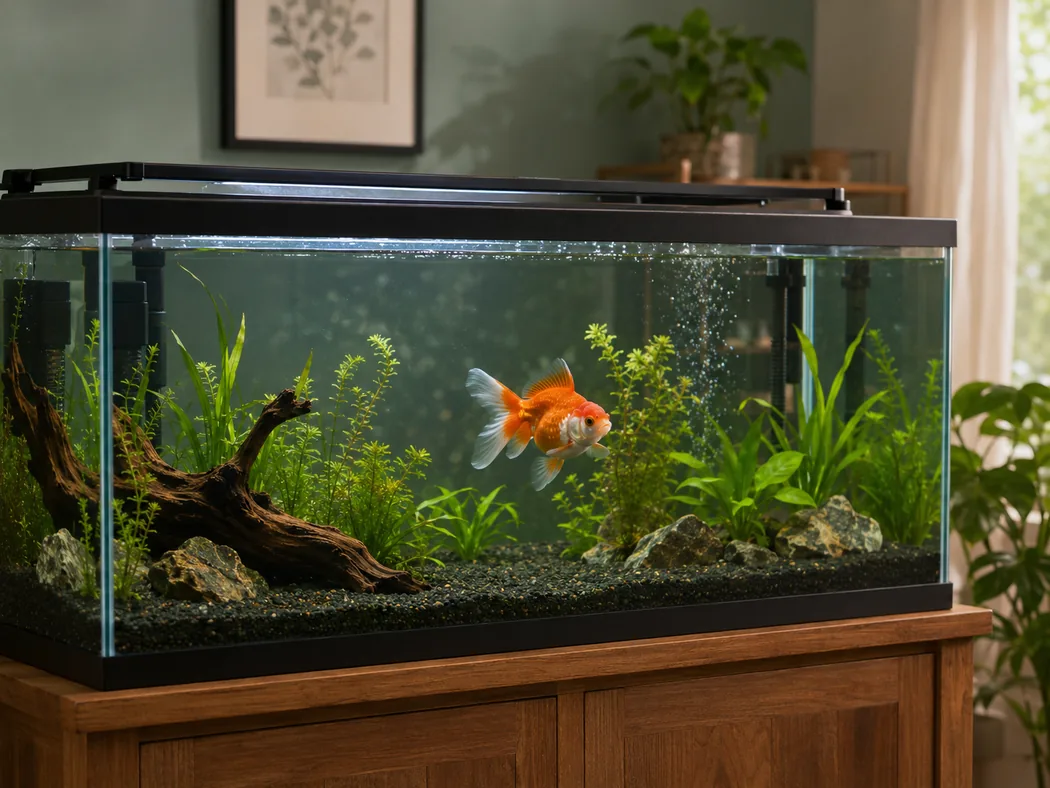
If you already have a goldfish in a tiny bowl or small starter tank, the fix is not a miracle bottle. The real upgrade is more water volume, stronger biological filtration, and a maintenance routine that can keep up with heavy waste.
What to Buy First if Your Budget Is Limited
If your budget is tight, buy fewer decorative items and protect the water first.
Here is how I would prioritize:
| Priority | Buy first | Why |
|---|---|---|
| 1 | Proper tank size and stand | Everything depends on safe volume and support |
| 2 | Filter with biological media | Supports the bacteria colony |
| 3 | Water conditioner | Makes tap water safer |
| 4 | Test kit | Prevents guessing |
| 5 | Heater and thermometer if tropical | Keeps temperature stable |
| 6 | Siphon and aquarium-only bucket | Makes maintenance realistic |
| 7 | Substrate and safe hiding places | Supports fish comfort and layout |
| 8 | Light and timer | Useful, especially for plants and algae control |
| 9 | Plants and aquascaping extras | Great, but not more important than water quality |
If you cannot afford a test kit yet, you probably should not buy fish yet.
That may sound strict, but it is kinder than guessing while fish are already in the tank.
Pre-Fish Checklist
Before adding fish, check this.
| Question | Ready answer |
|---|---|
| Is the tank size suitable for the adult fish? | Yes |
| Is the filter running properly? | Yes |
| Has tap water been treated with conditioner? | Yes |
| Is the heater stable if tropical fish are planned? | Yes |
| Do you have a thermometer? | Yes |
| Has the tank been cycled? | Yes |
| Are ammonia/ammonium (NH3/NH4+) and nitrite (NO2-) reading 0 ppm? | Yes |
| Is nitrate (NO3-) controlled? | Yes |
| Do you have a water-change bucket and siphon? | Yes |
| Are decorations fish-safe? | Yes |
| Have you researched the exact fish? | Yes |
| Are you adding fish slowly? | Yes |
If you cannot answer “yes” to these, wait.
Waiting is part of good fishkeeping.
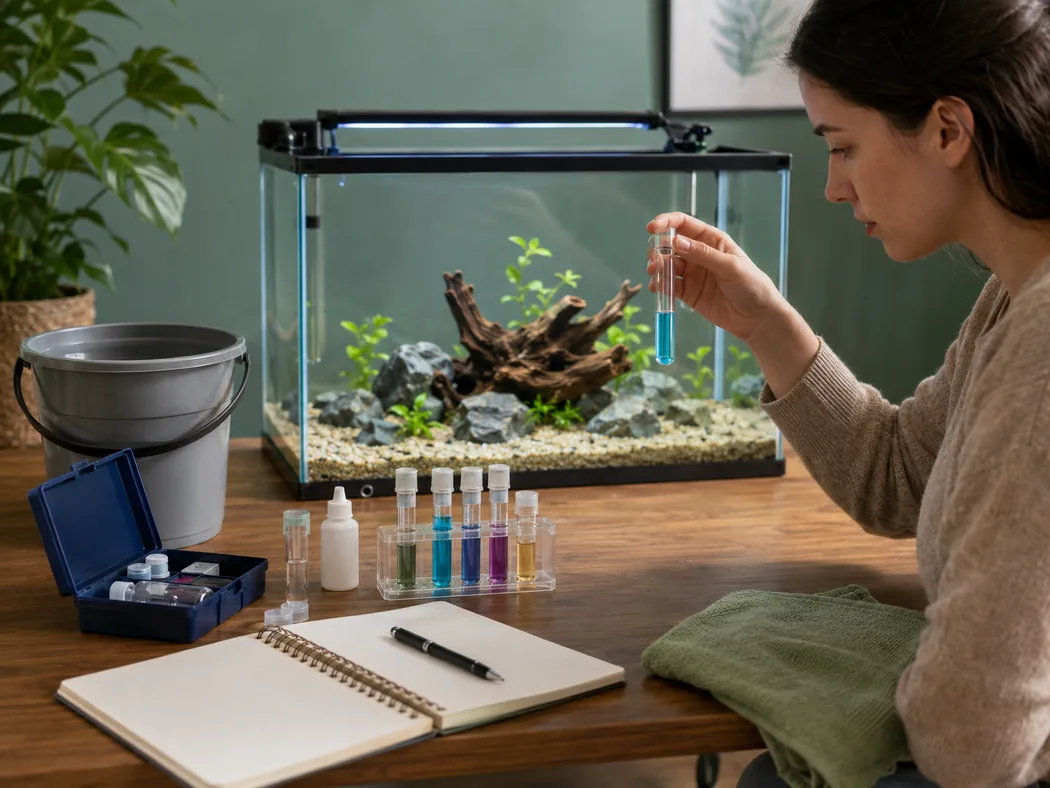
A Simple Beginner Shopping List
If you want the clean version, here it is.
For many beginner freshwater tanks, buy:
- 10-gallon / ~38 L or 20-gallon / ~76 L aquarium
- Strong stand
- Filter with biological media
- Water conditioner
- Liquid test kit or reliable test strips
- Heater if keeping tropical fish
- Thermometer
- Substrate
- Siphon / gravel vacuum
- Aquarium-only bucket
- Fish net
- Lid
- Light
- Safe hiding places or beginner plants
- Appropriate fish food after choosing fish
Do not buy fish on the same trip unless the tank is already cycled and ready.
FAQ
What do I actually need for a freshwater aquarium?
At minimum, you need an appropriately sized tank, filter, heater if the species needs warm water, water conditioner, a test kit, substrate or bare-bottom plan, safe decor, and food suited to the fish.
What should I not buy on day one?
Avoid buying too many fish, random chemical fixes, tiny bowls, sharp decor, and replacement filter cartridges you plan to throw away often. Stability matters more than accessories.
Is a bigger tank easier for beginners?
Usually, yes. More water gives more stability and more time to catch mistakes. A 10–20 gallon tank is often easier to manage than a very small desktop tank.
Do I need an air pump?
Not always. If the filter creates enough surface movement, oxygen may be fine. An air pump can still be useful for sponge filters, hospital tanks, or tanks that need extra surface agitation.
Do I need a heater for every freshwater tank?
No. It depends on the fish. Tropical species usually need stable warm water, while some temperate species do not. Choose the heater based on the fish, not the shelf label.
What is the most important beginner item?
A reliable test kit is one of the most important. It tells you whether the tank is safe instead of relying on water clarity or guesswork.
Should I use bottled bacteria?
Bottled bacteria can help, but it does not replace testing. Treat it as support, not proof that the tank is instantly safe.
How do I know my checklist is complete?
Your checklist is complete when the equipment supports the fish’s temperature, filtration, oxygen, hiding space, diet, and water testing needs. A beautiful setup that cannot keep ammonia at 0 ppm is not ready.
Related Guides
Continue with these guides:
- How to Set Up a Fish Tank
- How to Cycle a Fish Tank
- Fish Tank Size Guide
- Best Filter for a 10-Gallon Tank
- What Size Filter Do You Need?
- Best Aquarium Test Kits
- Betta Tank Setup
- Goldfish Care Guide
- Low-Tech Planted Tank Setup
- How Often Should You Change Aquarium Water?
Final Advice
A freshwater aquarium checklist should not make you buy everything.
It should help you buy the right things in the right order.
Start with the fish you want to keep. Choose enough tank size. Buy a real filter. Treat tap water. Test the water. Cycle the tank. Add fish slowly.
A beautiful tank is nice.
A stable tank is better.
And the best beginner setup is not the one with the most products. It is the one where the fish can stay healthy because the basics were handled before they went in.
FAQ
What do I need for a freshwater aquarium?
Most beginner freshwater tanks need a suitable aquarium, stand, filter, water conditioner, test kit, heater if keeping tropical fish, thermometer, substrate, siphon, aquarium-only bucket, net, lid, light, and appropriate food.
Do I need a filter for a freshwater aquarium?
Yes. A filter is essential for most aquariums because it helps remove debris and supports beneficial bacteria that process fish waste.
Do I need a heater?
You need a heater if you keep tropical fish and your room temperature is not consistently warm enough. Bettas, guppies, and many community fish usually need stable warm water.
Do I need a test kit?
Yes, a test kit is strongly recommended. Clear water can still contain ammonia/ammonium (NH3/NH4+) or nitrite (NO2-). A test kit helps you catch water-quality problems before fish show obvious stress.
Can I set up a tank without live plants?
Yes. Live plants are helpful but not required. If you skip plants, still provide safe hiding places and maintain water quality carefully.
What should I buy first for a fish tank?
Buy the tank, stand, filter, conditioner, test kit, heater if needed, thermometer, siphon, and bucket before buying fish.
What should I avoid buying as a beginner?
Avoid random chemicals, tiny decorative tanks, too many additives, sharp decorations, unnecessary replacement cartridges, and fish before the tank is cycled.
Can I buy fish the same day as the tank?
For most beginners, no. Set up and cycle the tank first. Add fish only after ammonia and nitrite are reading 0 ppm and the tank is stable.
Is a starter aquarium kit enough?
Some starter kits are useful, but many still need upgrades or extra items such as a better heater, test kit, siphon, water conditioner, or improved filter media. Check what is included before assuming it is complete.
What is the most important aquarium item?
The filter, water conditioner, and test kit are the three items I would not skip. Together, they support water quality and reduce guesswork.
Author Box
Healthy Aquariums Team
Healthy Aquariums publishes practical freshwater aquarium guides focused on clearer water, healthier fish, and easier-to-maintain tanks. Our setup and equipment articles are written for everyday fishkeepers who want calm, honest advice before buying more gear or adding more fish.
Editorial Note
This article is written for beginner freshwater aquariums. Equipment needs vary depending on tank size, fish species, room temperature, tap water chemistry, filtration, planting level, and maintenance routine. Always research the specific fish you plan to keep before buying equipment.
References
This guide was written for beginner freshwater aquariums and should be cross-checked against fish welfare, water-quality, and species-reference sources when publishing.