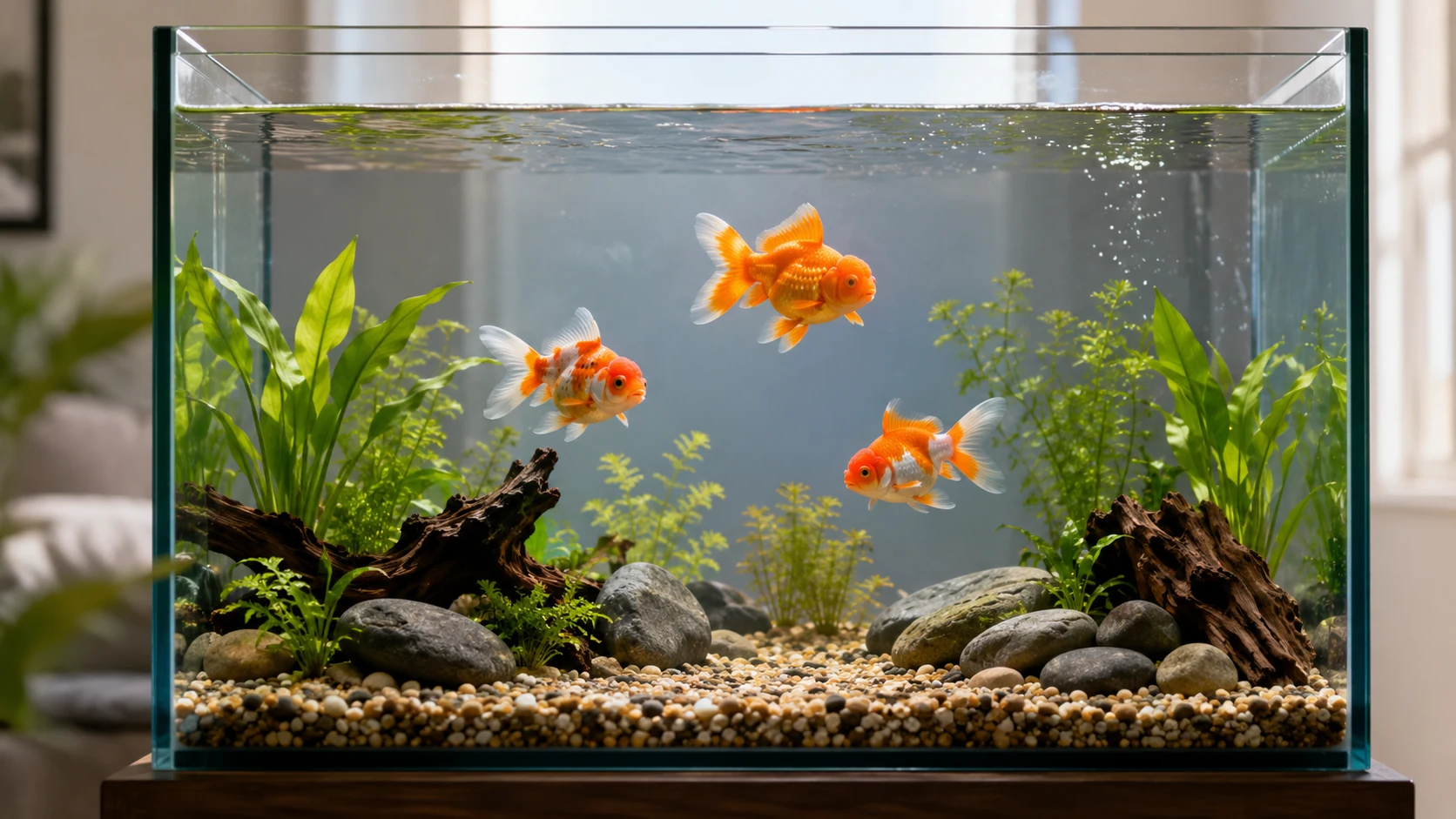
Goldfish are sold like easy fish, but they are not small-system fish.
That is the trap.
A tiny goldfish in a store tank looks harmless. It is cheap, active, and familiar. The beginner buys a bowl, a small starter tank, or a decorative desktop aquarium. For a few days, the fish seems fine. Then the water clouds, the gravel gets dirty, the fish gulps at the surface, and the owner starts adding chemicals instead of fixing the real problem.
The real problem is usually not that goldfish are delicate. It is that they are powerful waste producers placed into systems that are too small to dilute and process their waste.
Good goldfish care is built around four things: space, filtration, oxygen, and controlled feeding.
Big fish. Big waste. Big responsibility.
A goldfish is not a bowl fish.
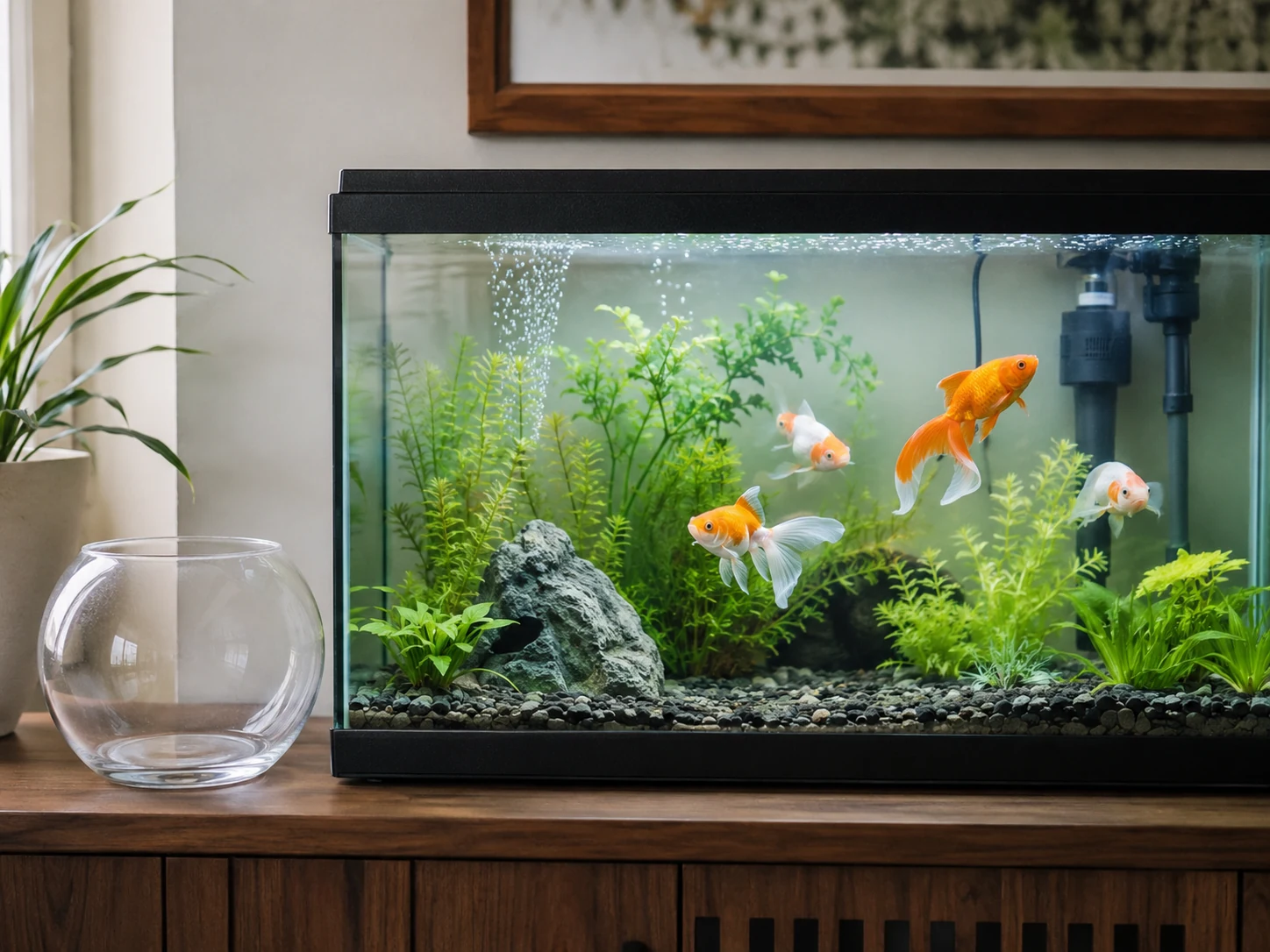
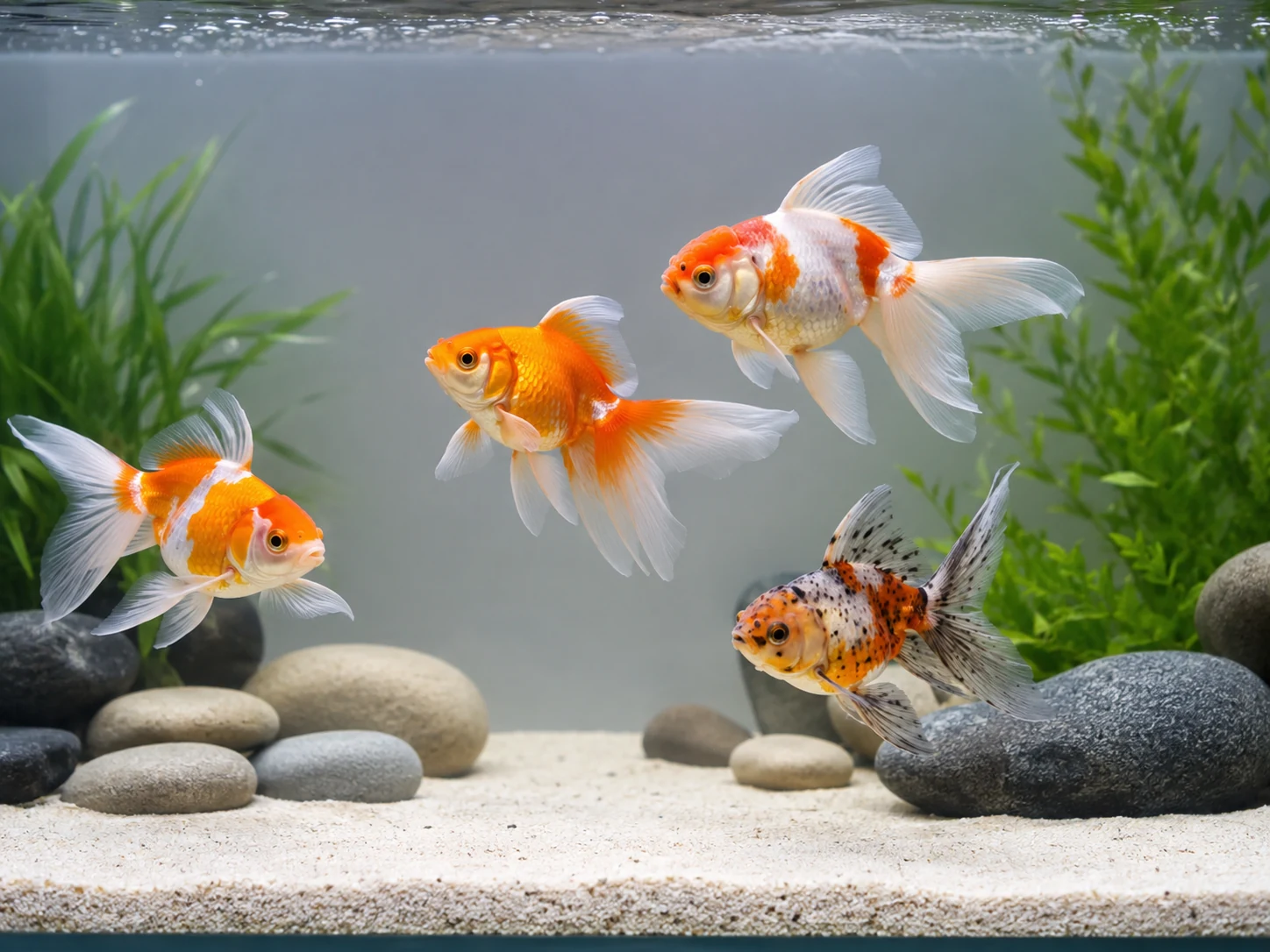
Fancy goldfish are slower, rounder, and usually smaller than common/comet goldfish, but they still need a real aquarium with stable water. Common goldfish, comet goldfish, and shubunkins are more athletic and can grow large enough that many homes cannot keep them well in standard small tanks long-term.
The practical beginner rule:
- Fancy goldfish: start with at least 20 gallons for one, more space strongly preferred, and add space for each additional fish.
- Common/comet/shubunkin goldfish: think pond-sized or very large aquarium long-term, not a small indoor starter tank.
If this sounds bigger than expected, that is the point. Goldfish are easy to buy and hard to house properly.
Goldfish tank size at a glance
| Goldfish type | Beginner minimum thinking | Better long-term direction | Why |
|---|---|---|---|
| One fancy goldfish | 20 gallons minimum | 30–40 gallons if possible | More dilution, easier water quality, room to turn |
| Two fancy goldfish | 30–40 gallons minimum | 40–55+ gallons | Social comfort and waste dilution |
| Common/comet goldfish | Not ideal for small aquariums | Large tank or pond | Fast swimmers, high adult size, heavy waste |
| Bowl or vase | Not suitable | Avoid | Poor oxygen, unstable temperature, ammonia buildup |
This is not about making the tank look impressive. It is about giving the water enough volume that mistakes do not turn toxic overnight.
Why small goldfish tanks fail so fast
Goldfish eat heavily, produce a lot of waste, and constantly disturb the substrate. In a small tank, the waste has nowhere to go except into the water and filter.
The domino chain is simple:
More food and waste → more ammonia production → more work for nitrifying bacteria → higher oxygen demand → faster filter clogging → stressed fish → more disease risk.
A small tank can look clean in the morning and become unsafe by the end of the week. Clear water is not proof of safe water. Goldfish can be sitting in ammonia or nitrite even when the glass looks clean.
Filtration for goldfish
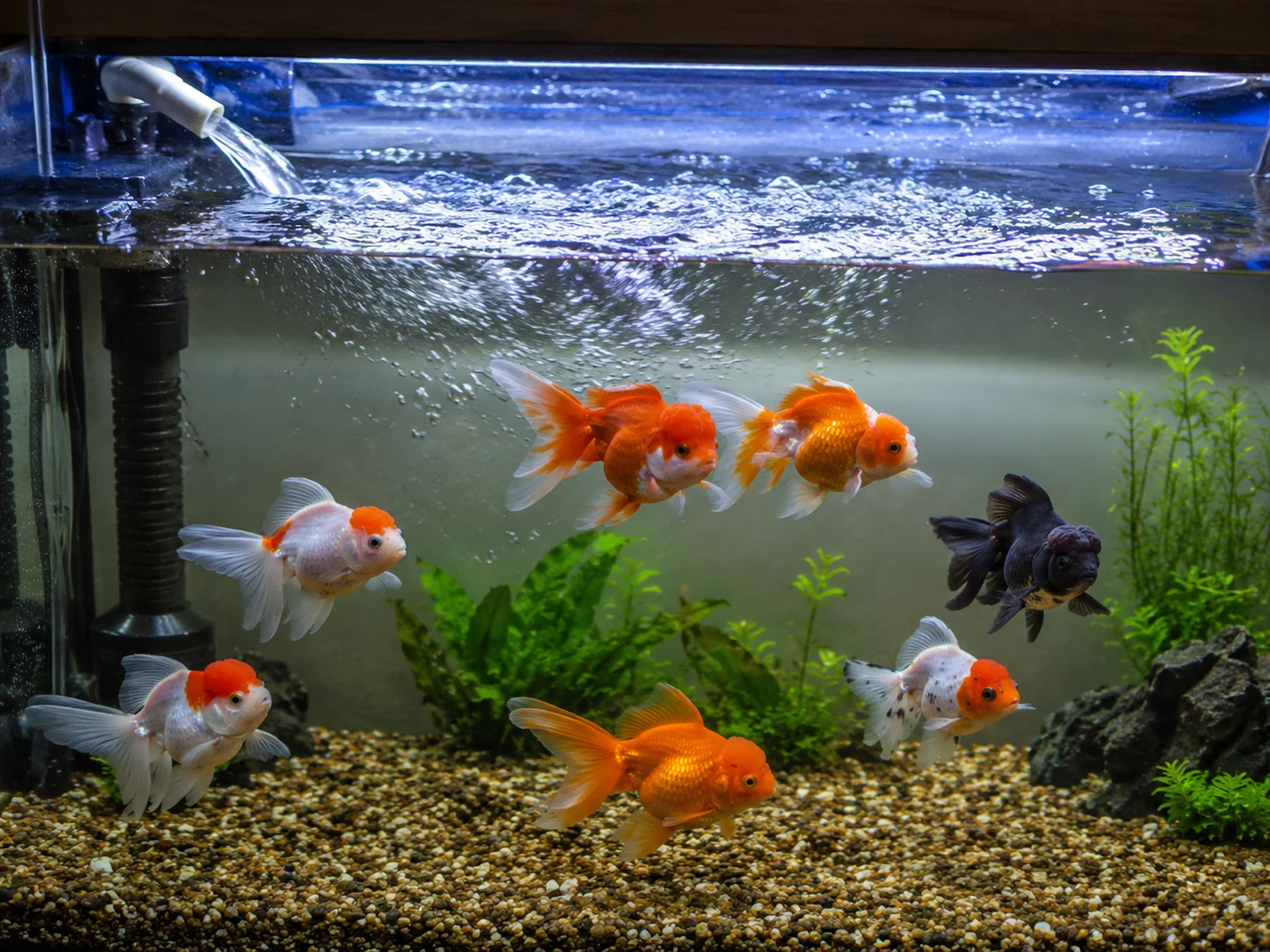
Goldfish need both mechanical and biological filtration.
Mechanical filtration traps particles: poop, plant bits, food dust, and suspended debris. Biological filtration houses nitrifying bacteria that convert ammonia into nitrite and then nitrate. Both matter.
A filter for a goldfish tank should create steady circulation without blasting fancy goldfish around. Fancy goldfish can struggle with strong current because of their body shape and fins. Common goldfish handle current better, but they still need oxygen-rich, stable water rather than chaotic flow.
Technical action: use a filter sized generously for the tank.
Danger/trap: cleaning or replacing all media at once can remove too much biological filtration and trigger ammonia/nitrite spikes.
Safe process: rinse clogged sponges or mechanical pads in old tank water. Preserve established biological media. Replace disposable floss only when needed, and never replace every bacteria-holding surface at the same time.
Substrate hazards: goldfish can choke on the wrong gravel
Goldfish are not delicate hunters. They are constant sifters. They pick up substrate, sort through it, pull off edible biofilm or crumbs, and spit the grains back out. That normal behavior becomes dangerous when the substrate is the wrong size.
Medium gravel is the trap. Pieces around 4–8 mm can be small enough for a growing goldfish to suck into its mouth, but large enough to wedge in the throat or around the pharyngeal teeth. A stuck stone is not a small inconvenience. A choking goldfish may flare its gills, shake its head, stop eating, hang awkwardly, or swim erratically while trying to dislodge it.
Technical action: choose substrate before the fish grows into trouble.
Danger/trap: “aquarium gravel” is not automatically goldfish-safe. A piece that looks too large for a baby fish may become the exact choking size when the fish matures.
Safe process: use either a bare-bottom tank for the easiest waste removal, or ultra-fine aquarium sand under 2 mm so sifted grains can pass safely through the mouth and gills. Avoid sharp gravel, mixed chunky gravel, glass stones, and decorative pebbles that a goldfish can mouth but not reliably spit out.
Oxygen matters more than beginners think
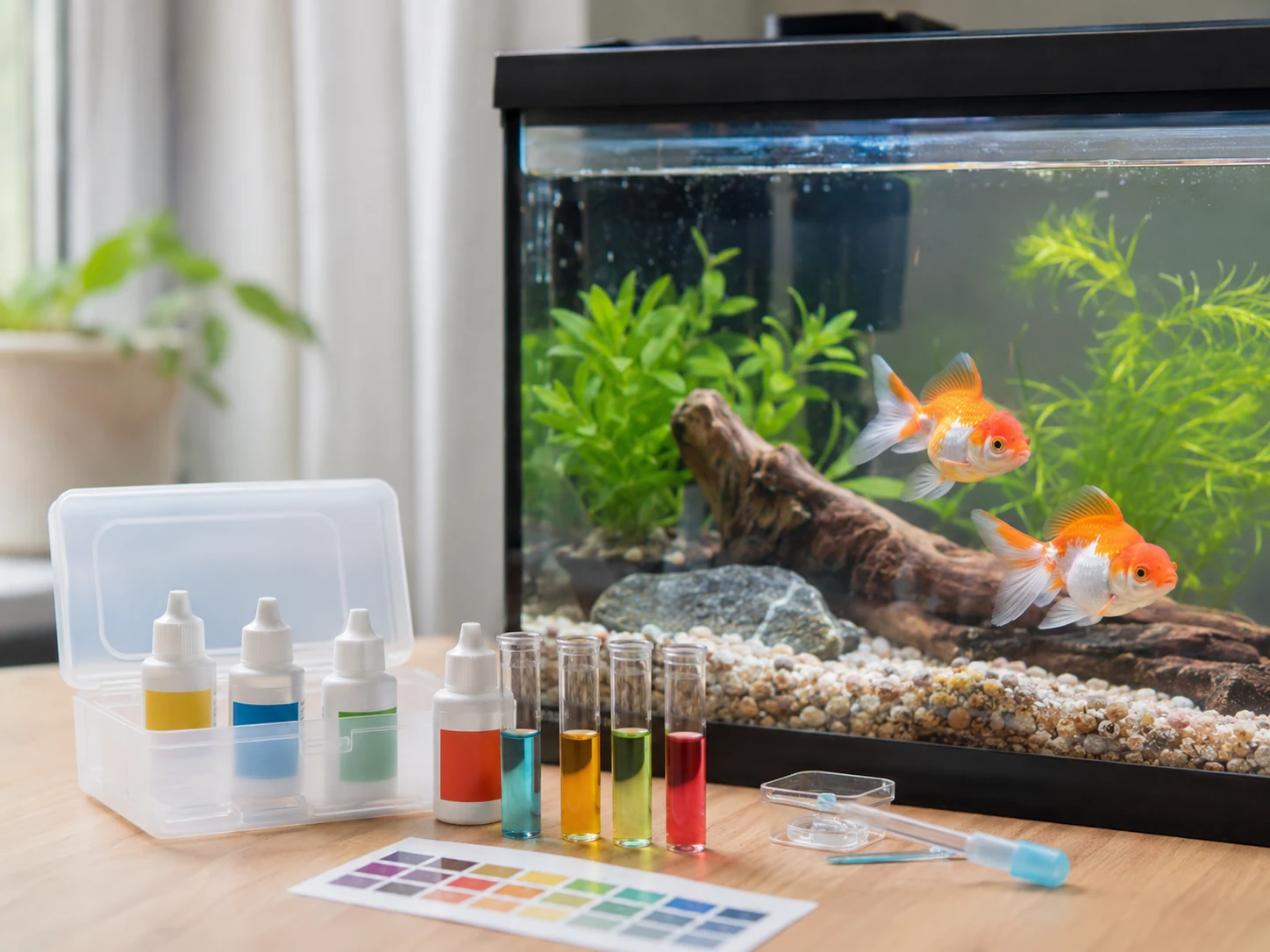
Goldfish are active, messy fish that benefit from good surface movement.
A filter outlet that ripples the surface helps gas exchange. If the tank is warm, crowded, heavily fed, or the filter does not stir the surface, add an air stone or sponge filter for extra aeration.
Temperature, oxygen, and feeding are linked. Warmer water holds less oxygen, while fish metabolism rises. A warm, overfed, low-aeration goldfish tank is a setup for surface gulping and stress.
Do not raise temperature casually to “make the fish more active.” If temperature changes are needed, make them gradually and improve aeration.
The temperature-oxygen trap: summer can turn a goldfish tank dangerous
Goldfish are heavy oxygen users and heavy waste producers. Warm weather makes both problems worse.
As water gets warmer, it physically holds less dissolved oxygen. At the same time, the fish’s metabolism rises, so the fish needs more oxygen and produces more waste. Bacteria breaking down that waste also use oxygen. This is the goldfish “double bind”: less oxygen available, more oxygen demand, and more ammonia pressure at the same time.
Technical action: monitor temperature during seasonal heat.
Danger/trap: a filter that seemed adequate in winter may not provide enough gas exchange during a hot spell, especially in a stocked goldfish tank.
Safe process: if the tank rises above about 75°F / 24°C, increase surface movement and add an independent air stone, sponge filter, or dedicated aeration. Keep the lid area ventilated, avoid overfeeding, and test ammonia and nitrite if fish hang near the surface. Do not rely on filter flow alone if the water surface is mostly still.
Water parameters for goldfish
| Parameter | Practical target |
|---|---|
| Ammonia | 0 ppm |
| Nitrite | 0 ppm |
| Nitrate | Keep low with water changes; avoid chronic high nitrate |
| pH | Stable is more important than chasing a perfect number; many goldfish do well around neutral to moderately alkaline water |
| Temperature | Many fancy goldfish do well in cooler-to-moderate indoor ranges; avoid sudden swings |
| Oxygen | Strong surface movement or added aeration, especially in warm or stocked tanks |
The most important numbers for a beginner are ammonia and nitrite. Both should read zero in a safe, cycled tank.
Water changes: steady beats dramatic
Goldfish tanks need regular water changes, but bigger is not always safer.
If the tank is maintained well, weekly partial water changes are normal. If the tank has been neglected for months and nitrate is very high, a huge sudden water change can shock fish by rapidly changing pH, dissolved solids, and osmotic pressure. This is the Old Tank Syndrome trap.
Technical action: change water to control nitrate and dissolved waste.
Danger/trap: in a very old, dirty tank, replacing 70–90% of the water at once can create a sudden chemistry shift that the fish cannot tolerate.
Safe process: test nitrate and pH first. In neglected tanks, do smaller repeated changes, such as 10–20% daily or every other day, while matching temperature and using conditioner. For normal maintained tanks, weekly partial changes can be larger depending on nitrate trend and fish load.
Temperature matching and conditioner
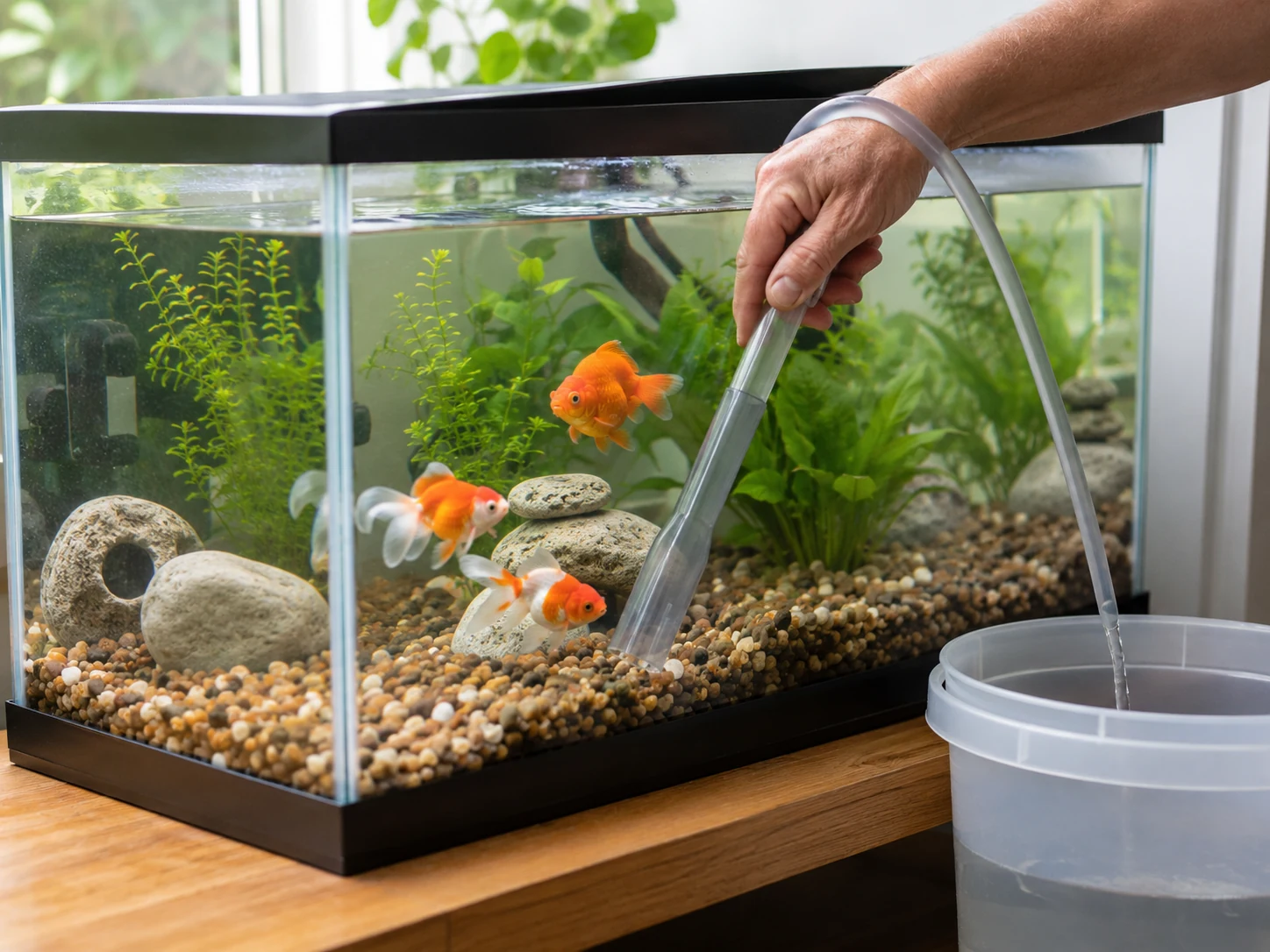
Always condition new water.
Chlorine can dissipate with time and aeration, but chloramine does not reliably gas off in the way beginners assume. Many municipal water supplies use chloramine. Use a water conditioner that treats both chlorine and chloramine.
Match temperature closely. A safe practical target is within about ±1°C / ±2°F of the tank water. Goldfish tolerate cooler water better than many tropical fish, but sudden changes still stress them.
Feeding goldfish without polluting the tank
Goldfish will eat like they are starving.
That does not mean they should be fed heavily. Their appetite is one reason they are overfed so often. Overfeeding goldfish quickly becomes a water quality problem because the fish produce heavy waste and missed food breaks down fast.
Use measured feeding.
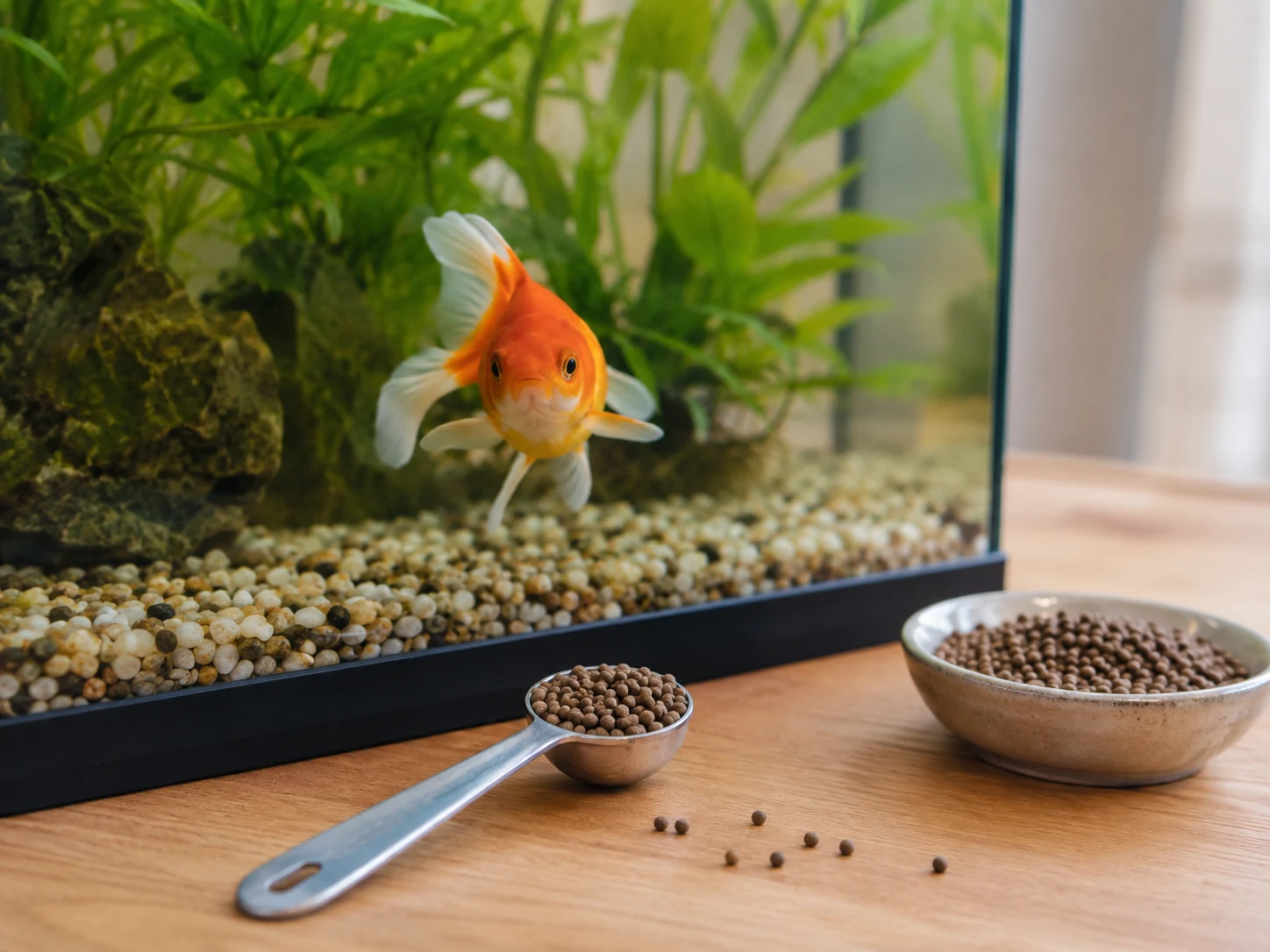
A good beginner approach is one controlled feeding per day, with sinking pellets or gel food that can be portioned. Feed only what they finish quickly. Remove leftovers within 5 minutes. Vegetables can be useful, but they still need a removal rule. Blanched peas, leafy greens, or gel foods left too long become waste.
Avoid floating-only diets for fancy goldfish if they gulp a lot of air. Sinking foods often make feeding more controlled.
Goldfish food mistakes
- Shaking flakes into the tank without measuring.
- Feeding every time the fish begs.
- Leaving vegetables in the tank for hours.
- Using vacation blocks in a small tank.
- Feeding heavily while ammonia or nitrite is present.
- Feeding more because the fish “looks bored.”
If water quality is unstable, feed less until the tank catches up.
Tank mates: be careful
Goldfish are not ideal community fish for most tropical tanks.
They prefer cooler conditions than many tropical species, produce more waste, and may eat very small tank mates. Fancy goldfish can be outcompeted or nipped by faster fish. Common goldfish can be too active for many peaceful aquarium setups.
The simplest beginner setup is a goldfish-only tank with appropriately matched goldfish.
Do not mix fancy goldfish with long-bodied common/comet goldfish in small tanks. The faster fish often outcompete slower fancy varieties at feeding time.
Common goldfish care mistakes
Keeping goldfish in bowls
Bowls usually fail because they are small, unstable, poorly filtered, and low in gas exchange. The fish may survive for a while, but survival is not good care.
Buying the fish before the tank is cycled
Goldfish in an uncycled tank are exposed to ammonia and nitrite during the most dangerous stage of setup. If fish are already in the tank, treat it as a fish-in cycle and test daily.
Replacing filter cartridges every month
This can remove bacteria. If the cartridge is the only filter media, replacing it on schedule can keep the tank biologically immature.
Doing one massive rescue clean
Aggressive gravel cleaning, full filter media replacement, and a huge water change on the same day can cause a double crash: chemistry shock plus biofilter damage.
Assuming stunted goldfish are fine
A goldfish that stays small in a small tank is not proof the tank is adequate. Poor growth, deformity, fin damage, chronic stress, and shortened lifespan are possible outcomes of inadequate space and water quality.
A practical weekly routine
For a healthy goldfish aquarium:
- Test ammonia and nitrite if the tank is new, stocked heavily, or anything seems off.
- Test nitrate weekly until you understand the tank’s pattern.
- Feed measured portions, not freehand dumps.
- Remove visible uneaten food.
- Do a partial water change based on nitrate and waste load.
- Siphon debris from open substrate areas without deep-stirring the entire tank aggressively.
- Rinse mechanical filter media in old tank water if flow is reduced.
- Check surface movement and fish breathing.
Goldfish Emergency Water Quality Toolkit
A goldfish tank should not depend on hope.
Useful items:
- liquid ammonia, nitrite, nitrate, and pH test kit;
- water conditioner that treats chlorine and chloramine;
- gravel siphon sized for the tank;
- extra mechanical filter sponge/floss;
- backup air pump or sponge filter;
- thermometer;
- large clean bucket used only for aquarium water;
- ammonia-detoxifying conditioner for emergencies, used according to the label.
The goal is not to medicate first. The goal is to stabilize water before fish are forced to live in toxic conditions.
Signs your goldfish tank is not working
Watch for:
- surface gulping;
- clamped fins;
- red streaks or irritated fins;
- bottom sitting;
- flashing or rubbing;
- cloudy water that keeps returning;
- ammonia or nitrite above zero;
- nitrate rising rapidly between water changes;
- filter flow slowing every few days;
- fish struggling to turn around comfortably.
These are not personality quirks. They are system feedback.
The honest beginner verdict
Goldfish can be wonderful aquarium fish, but they are not the best choice for small beginner tanks.
If you want a low-maintenance desktop aquarium, choose a different fish. If you want goldfish, plan for real volume, strong filtration, aeration, and regular water testing. A well-kept goldfish tank is beautiful, but it is not effortless.
FAQ
Can goldfish live in a bowl?
A bowl is not a suitable long-term home. It is usually too small, unstable, poorly oxygenated, and difficult to filter properly.
What size tank does a goldfish need?
For one fancy goldfish, start with at least 20 gallons, with 30–40 gallons better if possible. Common and comet goldfish need much larger long-term housing, often a large tank or pond.
Do goldfish need a filter?
Yes. Goldfish are heavy waste producers and need efficient mechanical and biological filtration.
Do goldfish need an air pump?
Not always, if the filter provides strong surface movement. But many goldfish tanks benefit from added aeration, especially when warm, heavily stocked, or heavily fed.
How often should I change goldfish water?
In a maintained tank, weekly partial water changes are common. The exact amount depends on nitrate trend, tank size, stocking, and feeding. In neglected tanks, avoid one huge shock change; use smaller repeated changes.
Can I keep goldfish with tropical fish?
Usually not ideal. Goldfish have different temperature needs, produce heavy waste, and may outcompete or eat smaller fish.
Why is my goldfish gulping at the surface?
Check oxygen, ammonia, nitrite, temperature, and filter flow. Surface gulping is often a water quality or oxygen warning.
How much should I feed goldfish?
Feed measured portions once daily to start. Use sinking pellets or gel food when possible, and remove leftovers within 5 minutes.
Are fancy goldfish easier than common goldfish?
Fancy goldfish are usually more manageable in aquariums than common/comet goldfish, but they are not low-waste fish. They still need space and filtration.
Can I clean the whole goldfish tank at once?
Avoid aggressive full resets unless there is a specific emergency plan. Do not replace all filter media, deep-clean the entire substrate, and do a huge water change all at once.
What substrate is safest for goldfish?
Bare-bottom tanks are the easiest to keep clean, especially for large messy goldfish. If you want substrate, use ultra-fine aquarium sand under 2 mm. Avoid medium gravel because goldfish naturally sift the bottom and can get gravel wedged in the throat as they grow.
Why do goldfish gasp more in summer?
Warm water holds less dissolved oxygen, while goldfish metabolism and waste output rise. That combination can make a tank oxygen-poor even when the water looks clear. Increase surface movement, add aeration, reduce feeding slightly during heat stress, and test ammonia and nitrite.
Related Guides
- Fish Tank Size Guide: How to Choose the Right Aquarium Size Before Buying Fish
- How Often Should You Change Aquarium Water?
- Ammonia, Nitrite, and Nitrate: What They Mean in a Fish Tank
- Aquarium Filters for Beginners
- How Often Should You Feed Aquarium Fish?
- Fish Gasping at the Surface: What to Check First
Author Box
Written by the Healthy Aquariums editorial team. We focus on practical fishkeeping advice that connects fish behavior with water chemistry, filtration, and everyday maintenance.
Editorial Note
Goldfish care advice varies because goldfish types, growth rates, and housing goals vary. This guide takes a conservative beginner-safety approach: more water volume, better filtration, controlled feeding, and testing before guessing.
References
- RSPCA Knowledgebase. How should I care for my goldfish? https://kb.rspca.org.au/categories/companion-animals/fish/how-should-i-care-for-my-goldfish
- PetMD. How To Take Care of Goldfish. https://www.petmd.com/fish/care/how-to-take-care-of-goldfish
- Merck Veterinary Manual. Environmental Diseases of Aquatic Animals in Aquatic Systems. https://www.merckvetmanual.com/exotic-and-laboratory-animals/aquatic-systems/environmental-diseases-of-aquatic-animals-in-aquatic-systems
- MSD Veterinary Manual. Common Environmental Hazards for Fish. https://www.msdvetmanual.com/multimedia/table/common-environmental-hazards-for-fish
- The Spruce Pets. What Size is Best for a Goldfish Tank? https://www.thesprucepets.com/what-size-is-best-for-a-goldfish-tank-5210885
- Practical Fishkeeping. What water temperature do goldfish need? https://www.practicalfishkeeping.co.uk/features/what-water-temperature-do-goldfish-need/
- FAO. Aeration and Oxygenation in Aquaculture. https://www.fao.org/4/x5744e/x5744e0m.htm