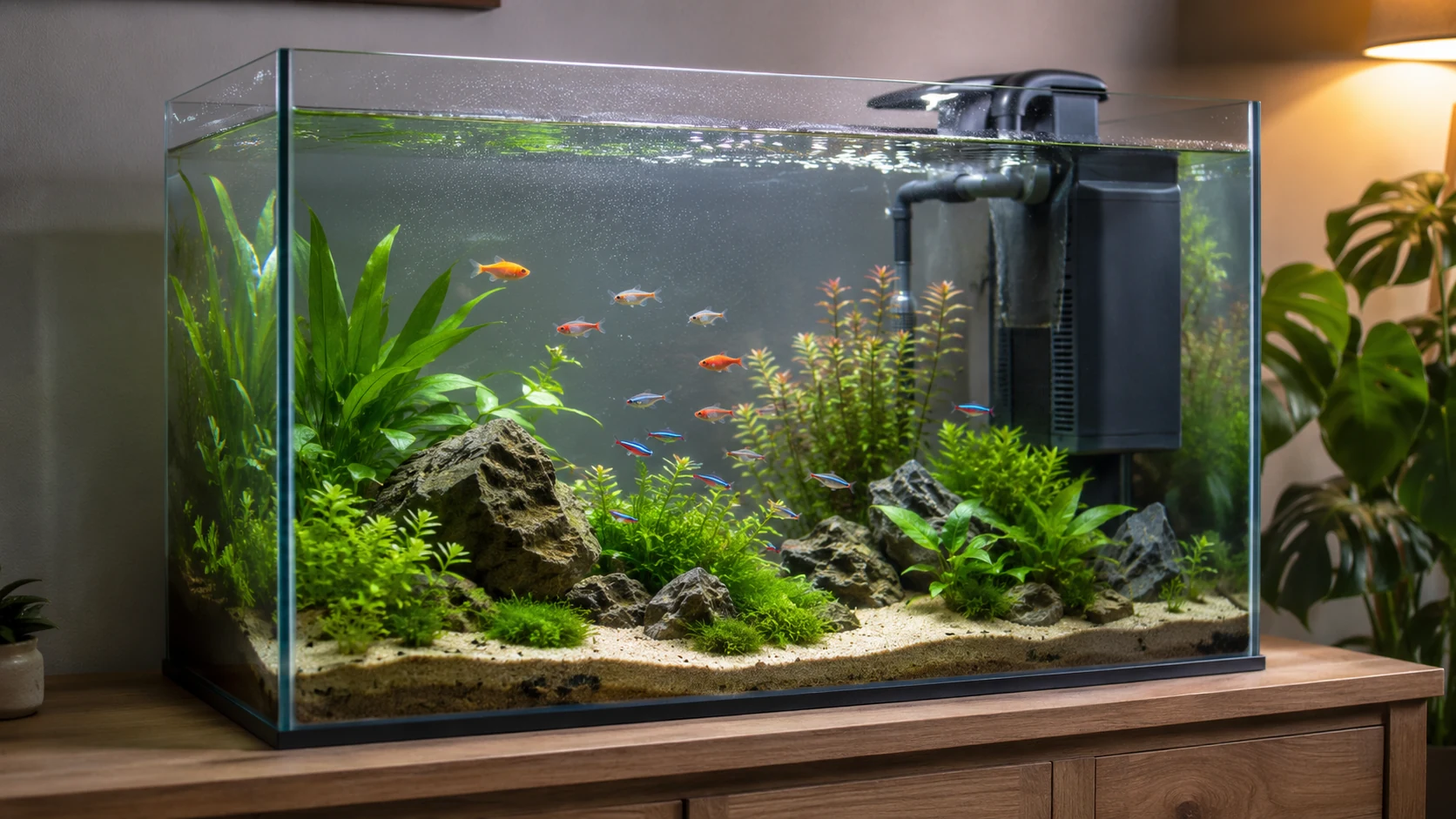
Filter size is not only about gallons. Two tanks with the same volume can need very different filtration if one holds a betta and plants while the other holds messy goldfish.
The right filter has enough biological media, suitable flow, and a maintenance routine you can keep up with. A bigger filter can help, but only if the fish can tolerate the flow and the media can be cleaned without destabilizing the biofilter.
Quick answer
Choose filter size by fish load, feeding, media capacity, flow comfort, and maintenance access. A bigger filter is useful only if the output can be managed and the media can be maintained without disturbing the tank.
For most beginner tanks, do not choose by gallon rating alone. Choose by the real biological load: fish size, adult size, waste production, feeding amount, plant debris, oxygen demand, and how quickly the filter clogs.
Why gallon ratings are imperfect
A filter rated for "up to 20 gallons" may be fine on a lightly stocked 20-gallon planted tank and weak on a 20-gallon goldfish tank. It may also be too strong for a 10-gallon betta tank even if the box says the size is suitable.
| Tank factor | Effect on filtration |
|---|---|
| Messy fish | Need more media and maintenance |
| Heavy feeding | More ammonia production |
| Planted tank | Plants help, but debris still matters |
| Small sensitive fish | Need gentler flow |
| Overcrowding | No filter fully fixes it |
| Poor maintenance | Any filter eventually clogs |
| Warm water | Holds less oxygen, increasing stress risk |
| Fine substrate debris | Can clog mechanical media faster |
The printed rating is a marketing simplification. Your aquarium is a living system.
Flow vs media
Flow moves water. Media gives bacteria surface area. You need both, but more flow alone does not equal better filtration.
A high-flow filter with little media may push water around without giving bacteria enough stable surface. A huge media chamber with almost no circulation may not process waste efficiently.
The useful question is not "How many times per hour does water move?" The better question is: does enough oxygenated water pass through enough stable media without stressing the fish?
Turnover rate: useful but incomplete
Turnover rate means how many times the tank volume theoretically passes through the filter per hour. A common beginner idea is that a tank needs 4x, 6x, or 10x turnover.
This can help as a rough reference, but it is incomplete.
A 10-gallon tank with a filter rated at 100 gallons per hour may appear to have 10x turnover. But media clogging, intake sponge, filter design, and head resistance can reduce actual flow. At the same time, that 100 GPH outlet may be uncomfortable for a betta.
Turnover does not measure media quality, oxygen exchange, fish comfort, or maintenance habits.
Match filter to livestock
Betta tanks
Bettas need gentle flow. For a 5- to 10-gallon betta tank, a sponge filter or adjustable HOB with a baffled return is often safer than a powerful filter. The filter should keep water stable without forcing the fish to fight current all day.
Shrimp tanks
Shrimp need intake safety and stable biology. Sponge filters are excellent. If using a HOB or canister, add a pre-filter sponge over the intake. Raw flow numbers matter less than keeping baby shrimp out of the intake.
Guppy and small community tanks
Guppies, danios, rasboras, and similar active fish can handle more flow than bettas, but food should still remain accessible. A HOB with reusable media or a sponge/HOB combination often works well.
Goldfish tanks
Goldfish produce heavy waste and need strong oxygen support. Filter sizing for goldfish should be much more conservative than the box rating. Large media capacity, strong surface movement, and frequent debris removal are important. A small filter on a goldfish tank becomes overwhelmed quickly.
Corydoras tanks
Corydoras need oxygen-rich water and clean substrate, but they should not live in a tank where flow blasts food away or traps debris behind decor. Filtration should support bottom cleanliness without turning the bottom into a current tunnel.
Practical sizing examples
A lightly stocked 10-gallon betta tank may do well with a gentle sponge filter or adjustable HOB. A 20-gallon community tank with active schooling fish may need more circulation and media. A goldfish tank needs significantly more waste handling and oxygen support than its gallon number suggests. A shrimp tank needs intake safety and stability more than high turnover.
The same gallon rating cannot describe all of these tanks correctly.
Right-Size Filter Upgrade Kit
When upgrading filtration, useful parts include extra biological media, a pre-filter sponge, adjustable flow outlet or spray bar, spare coarse sponge, and an ammonia/nitrite test kit. Run old and new media together whenever possible so the biofilter can transfer safely.
Media volume vs flow comfort
If the filter has enough media but too much current, fish may suffer even while water tests look good. If the current is gentle but the media is tiny, ammonia control may be weak. The best filter size balances both.
This is why adding a pre-filter sponge, spray bar, flow baffle, or extra biological media can sometimes improve a filter more than replacing it.
Filter size must account for oxygen delivery through media
A filter that looks large enough on paper can still underperform if water cannot move oxygen through the media bed. Nitrifying bacteria are oxygen-hungry organisms. They process ammonia and nitrite only while oxygenated water reaches them.
This matters when sizing a filter. If the filter is undersized, mechanical debris clogs the first sponge or pad quickly. If media is packed too tightly, water slows through the bio-media. If a canister tray or HOB chamber is loaded without enough open flow, oxygen transport drops even when the filter still makes noise.
At that point, the aquarium may have plenty of media volume but not enough effective oxygen delivery. The result is a weaker biofilter than the box rating suggests.
Sizing should therefore include three questions:
- Is there enough biological media surface?
- Can water move through that media after debris starts to collect?
- Can mechanical media be cleaned before oxygen flow is throttled?
As a practical rule, if filter output drops by about 15–20% between maintenance sessions, the filter is either clogging too fast, packed too tightly, undersized for the waste load, or being overfed.
When oversizing helps
Oversizing can help when:
- fish are messy;
- the tank is heavily stocked;
- you need more biological media;
- mechanical debris clogs small filters quickly;
- you can reduce or diffuse flow safely;
- you want redundancy.
Oversizing becomes harmful when the current stresses livestock. A strong filter with adjustable output is better than a strong filter that cannot be controlled.
When filter size cannot fix the tank
A filter cannot make an overstocked tank ethical. It cannot make heavy overfeeding safe. It cannot replace water changes forever. It cannot protect fish if the keeper replaces all media at once.
If ammonia or nitrite keeps appearing, do not only buy a larger filter. Check stocking, feeding, cycling, media handling, and maintenance routine.
How to upgrade filtration safely
If you need a larger filter, do not remove the old filter immediately.
Run the new filter alongside the old one for several weeks so bacteria can colonize the new media. If space is limited, move mature media from the old filter into the new filter without letting it dry out.
After the upgrade, test ammonia and nitrite. Feed lightly for a few days. Watch fish behavior around the new flow pattern.
Filter sizing checklist
| Question | Why it matters |
|---|---|
| What fish are in the tank as adults? | Adult size and waste matter |
| How much do they eat? | Food becomes ammonia if wasted |
| Is the flow comfortable? | Fish health depends on behavior, not only water clarity |
| Is the intake safe? | Shrimp, fry, and weak fish can be trapped |
| Is there enough biological media? | Bacteria need stable surfaces |
| Can you clean it easily? | Hard maintenance becomes skipped maintenance |
| Will media be preserved? | Replacing all media can crash the cycle |
FAQ
Can a filter be too big?
Yes. Too much current can stress fish even if water quality is good.
Is turnover rate enough to size a filter?
No. Turnover ignores media volume, fish load, and flow comfort.
What filter for a 10-gallon tank?
A gentle HOB or sponge filter often works, depending on fish. Bettas and shrimp usually need gentler flow and intake protection.
Do goldfish need extra filtration?
Yes. Goldfish produce heavy waste and need strong oxygen support.
Do shrimp need special filter sizing?
They need intake protection and gentle flow more than raw power.
Should I use two filters?
Two filters can add redundancy and media, especially in larger tanks.
What if ammonia still appears?
The tank may be overstocked, overfed, uncycled, or the biofilter may be damaged.
Can plants reduce filter needs?
Plants can help absorb nitrogen, but they do not replace biological filtration and water movement.
Should I upgrade to a canister filter?
Upgrade when you need more media or better circulation and you can maintain hoses, impellers, and media safely.
How do I reduce filter flow?
Use adjustable output, spray bars, baffles, pre-filter sponges, or careful outlet direction. Do not simply force fish to tolerate strong current.
Related Guides
- Aquarium Filter Guide
- How Often Clean Aquarium Filter
- Best Filter for a 10-Gallon Tank
- Canister Filter vs HOB Filter
- Sponge Filter vs HOB Filter
Author Box
Written by the Healthy Aquariums editorial team. We size filters by real aquarium biology: fish load, feeding, oxygen, flow, and bacteria.
Editorial Note
This guide intentionally avoids a single turnover-rate rule because it can mislead beginners with sensitive or messy fish.
References
- Aqueon. The Nitrogen Cycle. https://www.aqueon.com/articles/the-nitrogen-cycle
- API Fishcare. The Nitrogen Cycle. https://www.apifishcare.com/blog/the-nitrogen-cycle-keeping-your-aquarium-healthy
- The Spruce Pets. Aquarium Filtration. https://www.thesprucepets.com/aquarium-filtration-4162079