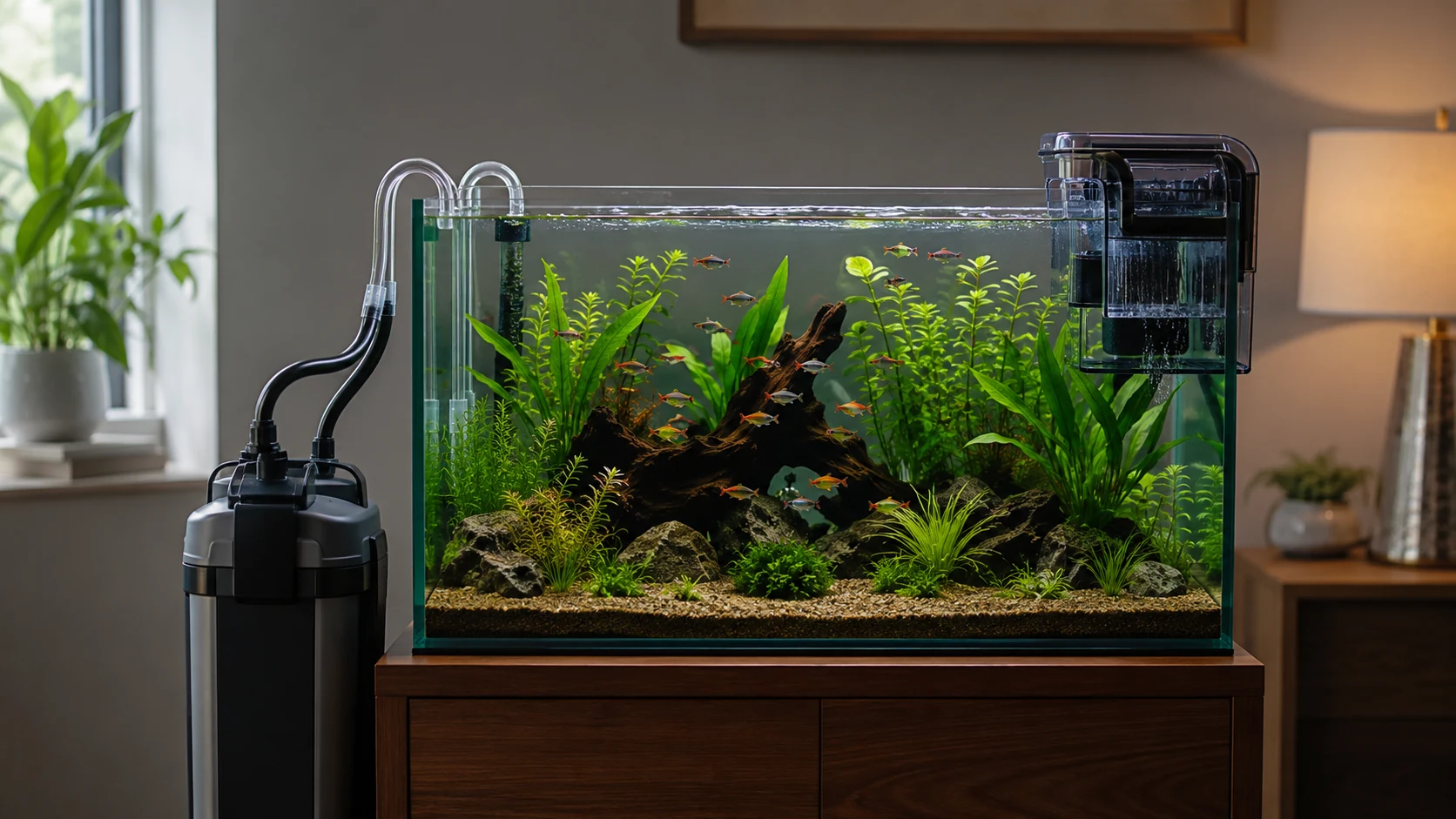
Canister filters and hang-on-back filters can both keep aquariums healthy. The better choice depends less on which one looks more advanced and more on tank size, fish load, flow tolerance, maintenance discipline, and where the aquarium sits.
A canister filter can hold more media and hide equipment better. A hang-on-back filter is easier to access and simpler for beginners. Either one can fail the tank if it is oversized, neglected, cleaned too aggressively, or used with unsafe intake flow.
Quick answer
Choose a HOB filter if you want a simple, accessible filter for a small to medium freshwater aquarium. Choose a canister filter if you need more media capacity, quieter hidden equipment, or stronger filtration for a larger or heavier-load tank — but only if you are willing to clean hoses, impellers, and media correctly.
For most beginners, a good HOB with reusable media is easier. For larger planted tanks, messy fish, or display tanks where appearance matters, a canister can be worth the extra maintenance.
HOB vs canister at a glance
| Feature | HOB filter | Canister filter |
|---|---|---|
| Ease of access | Very easy | More steps |
| Media capacity | Moderate | High |
| Visual appearance | Visible on tank rim | Mostly hidden |
| Flow strength | Moderate to strong | Often stronger |
| Maintenance risk | Cartridge replacement trap | Hose sludge and restart mistakes |
| Best for | Beginner and medium tanks | Larger, messier, or display tanks |
| Cost | Usually lower | Usually higher |
This table is a starting point. A well-set HOB can outperform a neglected canister. A properly maintained canister can outperform a tiny HOB on a heavy-load tank.
Canister vs HOB Starter Pack
Before choosing either filter style, prepare the parts that prevent the common failures: reusable sponge, ceramic biomedia, a pre-filter sponge, a flexible hose brush for canisters, and a flow baffle or spray bar if your fish dislike strong current.
How HOB filters work
A HOB filter pulls water from the aquarium through an intake tube, passes it through media in a chamber, and returns it to the tank as a spillway or waterfall.
The main advantage is access. You can open the lid, remove sponge or media, rinse mechanical debris, and restart quickly. This makes HOB filters beginner-friendly.
The main weakness is that many HOB filters are sold with disposable cartridges. If the cartridge is the only media and you replace it regularly, you may remove the main bacteria colony. A better setup uses reusable sponge, coarse foam, ceramic media, or another stable biological surface that stays in the filter long term.
How canister filters work
A canister filter sits outside the tank, usually below it. Water travels through an intake hose into a sealed canister, passes through media trays, and returns through an outlet, spray bar, lily pipe, or nozzle.
The main advantage is media volume. Canisters can hold layers of sponge, ceramic media, and polishing media. They can support larger tanks or fish with heavier waste output.
The main weakness is hidden maintenance. Hoses can collect bio-sludge. Impellers can become noisy. A dirty canister can trap waste out of sight. If you restart it after long neglect, it may push dirty water into the aquarium. This is not a reason to avoid canisters, but it is a reason to maintain them deliberately.
Biological filtration comparison
Canisters usually win on raw media capacity. More room means more stable biological surface, especially for larger aquariums.
But biological filtration is not just media volume. Beneficial bacteria also need oxygen and water movement. If a canister is packed too tightly or neglected until flow drops, the media advantage is reduced.
HOB filters have less media capacity, but they are easier to inspect. For a lightly stocked tank, a HOB with stable reusable media can be perfectly adequate.
Mechanical filtration comparison
HOB filters are easy to clean because debris is accessible. You can rinse a sponge or replace a small amount of filter floss without opening a sealed unit.
Canisters can hold more mechanical media and polish water well, but they can also become debris storage containers. If you overfeed or keep messy fish, the canister may collect a lot of waste. That waste still affects the system until removed.
The mistake is thinking "out of sight" means "gone." A canister hides debris; it does not delete it.
Flow and fish comfort
Canister filters often produce stronger flow than small HOB filters. That can be good for large tanks, active fish, and planted layouts where circulation matters. It can be bad for bettas, fancy goldfish, shrimp, fry, and long-finned fish if the return is not diffused.
HOB filters can also create too much waterfall current in small tanks. A baffle, pre-filter sponge, or adjustable model helps.
Watch fish behavior after installation. If fish avoid open water, struggle to feed, or gather only in calm corners, the flow pattern needs adjustment.
Maintenance workload
A HOB filter is usually easier to clean more often. A canister usually needs less frequent but more involved maintenance.
HOB routine:
- unplug filter;
- remove sponge or mechanical media;
- rinse in old tank water;
- check impeller if noisy;
- refill and restart.
Canister routine:
- close valves or disconnect hoses safely;
- carry canister carefully;
- open media trays;
- rinse mechanical media in old tank water;
- protect biological media;
- clean impeller and hose buildup when needed;
- prime correctly before restart.
Dry-running a canister or HOB pump can damage the motor. Always prime according to the equipment design.
Noise comparison
A well-running canister can be very quiet because the motor is inside a cabinet. A HOB can create waterfall sound if water level drops.
However, either filter can become noisy. HOB filters rattle when impellers are dirty or water level is low. Canisters make noise when air is trapped, impellers are worn, hoses are clogged, or priming is incomplete.
The quietest filter is not always a type. It is the filter that is clean, properly seated, and matched to the setup.
Fluid dynamics: hydraulic bypassing in HOB and canister filters
Media volume only matters when water is forced through the media. In HOB and canister filters, water follows the path of least hydraulic resistance. If media baskets are packed unevenly, fine floss sags, sponges shrink away from the walls, or tray edges do not seal well, water can bypass the media bed.
This is called hydraulic bypassing. It means water slips around the outside of the sponge, cartridge, or ceramic media instead of passing through the bacterial surfaces. The filter may still sound powerful and return water to the tank, but a portion of that water may have had poor contact with the biofilm.
This is why careful media formatting matters. Do not simply dump loose media into a chamber and assume all water will use it. Use coarse sponge, pads, or media bags positioned so water must move through them. Avoid crushed, sagging, or undersized floss that leaves side gaps. In canisters, seat trays correctly and check seals. In HOB filters, make sure water is not spilling around the media frame.
The installation goal is not maximum stuffing. The goal is full contact: oxygenated aquarium water moving through mechanical and biological media without easy side channels.
Which should you choose?
Choose a HOB filter if:
- the tank is small to medium;
- you want simple maintenance;
- you are a beginner;
- you can modify media to avoid cartridge dependence;
- you need easy access.
Choose a canister filter if:
- the tank is larger;
- fish produce more waste;
- you want equipment hidden;
- you need more media volume;
- you are comfortable with hose and impeller maintenance.
For some tanks, using both can be excellent: a canister for media capacity and a sponge filter for backup oxygen and biological stability.
FAQ
Is a canister filter better than a HOB filter?
Not always. A canister has more media capacity, but a HOB is easier to maintain. The better filter is the one matched to the tank and maintained correctly.
Are canister filters hard to clean?
They are not hard, but they are more involved than HOB filters. You must handle hoses, trays, priming, and impeller cleaning.
Can a HOB filter be enough for a planted tank?
Yes, especially for small to medium low-tech planted tanks. Flow pattern and media stability matter more than filter type alone.
Do canister filters need oxygen?
Beneficial bacteria inside the canister need oxygen-rich water flow. If flow drops badly, the biological performance suffers.
Can canister hoses get dirty?
Yes. Hoses can collect bio-sludge and should be cleaned with flexible brushes when flow drops or restart debris becomes a problem.
Which filter is quieter?
A well-maintained canister is often quieter, but a HOB can be quiet if the water level is high and the impeller is clean.
Which is safer for shrimp?
A sponge filter or HOB with a pre-filter sponge is safer than an exposed canister intake.
Can I use a canister on a small tank?
You can, but the flow must be controllable. A strong canister can overwhelm small fish.
Do HOB cartridges need replacing?
Not if they are your main biofilter. Add reusable media and avoid replacing all bacteria surfaces at once.
What is best for messy fish?
A canister, large HOB, sump, or combined filtration can work, but messy fish also need water changes and careful feeding.
Related Guides
- Aquarium Filter Guide
- What Size Aquarium Filter Do I Need?
- How Often Should You Clean an Aquarium Filter?
- Can You Wash Aquarium Filter Media in Tap Water?
- Best Aquarium Filters
Author Box
Written by the Healthy Aquariums editorial team. We compare aquarium equipment by how it affects fish behavior, water quality, oxygen, and maintenance safety.
Editorial Note
This comparison is not a brand ranking. It is a decision guide for choosing the correct filter style for a real freshwater aquarium.
References
- Aqueon. Aquarium Filtration and Water Quality. https://www.aqueon.com/articles
- API Fishcare. The Nitrogen Cycle. https://www.apifishcare.com/blog/the-nitrogen-cycle-keeping-your-aquarium-healthy
- The Spruce Pets. Aquarium Filter Types. https://www.thesprucepets.com/aquarium-filtration-4162079