Aquarium filters do not need to be spotless. They need to keep water moving and bacteria alive.
A common beginner mistake is cleaning the filter on a strict calendar as if it were a kitchen sponge. Another mistake is ignoring the filter until water barely moves. Both approaches can hurt the aquarium. The right cleaning schedule depends on flow, debris buildup, fish load, feeding, plant debris, and the type of filter.
Quick answer
Clean your aquarium filter when flow noticeably slows, debris buildup is visible, or the filter becomes noisy — not just because a calendar says so.
For many beginner tanks, checking the filter every 2–4 weeks is reasonable. Lightly stocked tanks may go longer. Messy fish or heavy feeding may require more frequent mechanical cleaning. The goal is to restore flow while preserving biological media.
The rule: clean flow blockages, protect bacteria
A filter contains two very different kinds of dirt.
Mechanical debris is trapped fish waste, food particles, plant fragments, and fine particles. This debris can block water flow and should be removed when it accumulates.
Biological media contains beneficial bacteria. This media may look brown or stained, but it is not automatically bad. The bacteria living there help process ammonia and nitrite.
The cleaning mistake is treating both kinds of dirt the same way. If you sterilize the biological media, the tank can lose processing power.
Signs your filter needs cleaning
Clean or inspect the filter if you see:
- weaker water return than usual;
- louder rattling or grinding;
- water bypassing media instead of flowing through it;
- debris collecting near the intake;
- surface film forming;
- fish hanging near high-flow areas for oxygen;
- HOB waterfall becoming uneven;
- sponge filter bubbles slowing;
- canister output dropping;
- dark sludge blasting into the tank after restart.
A dirty filter can reduce oxygen delivery to beneficial bacteria. If flow drops too much, the filter becomes less effective even if it contains plenty of media.
Aquarium-Safe Filter Maintenance Tools
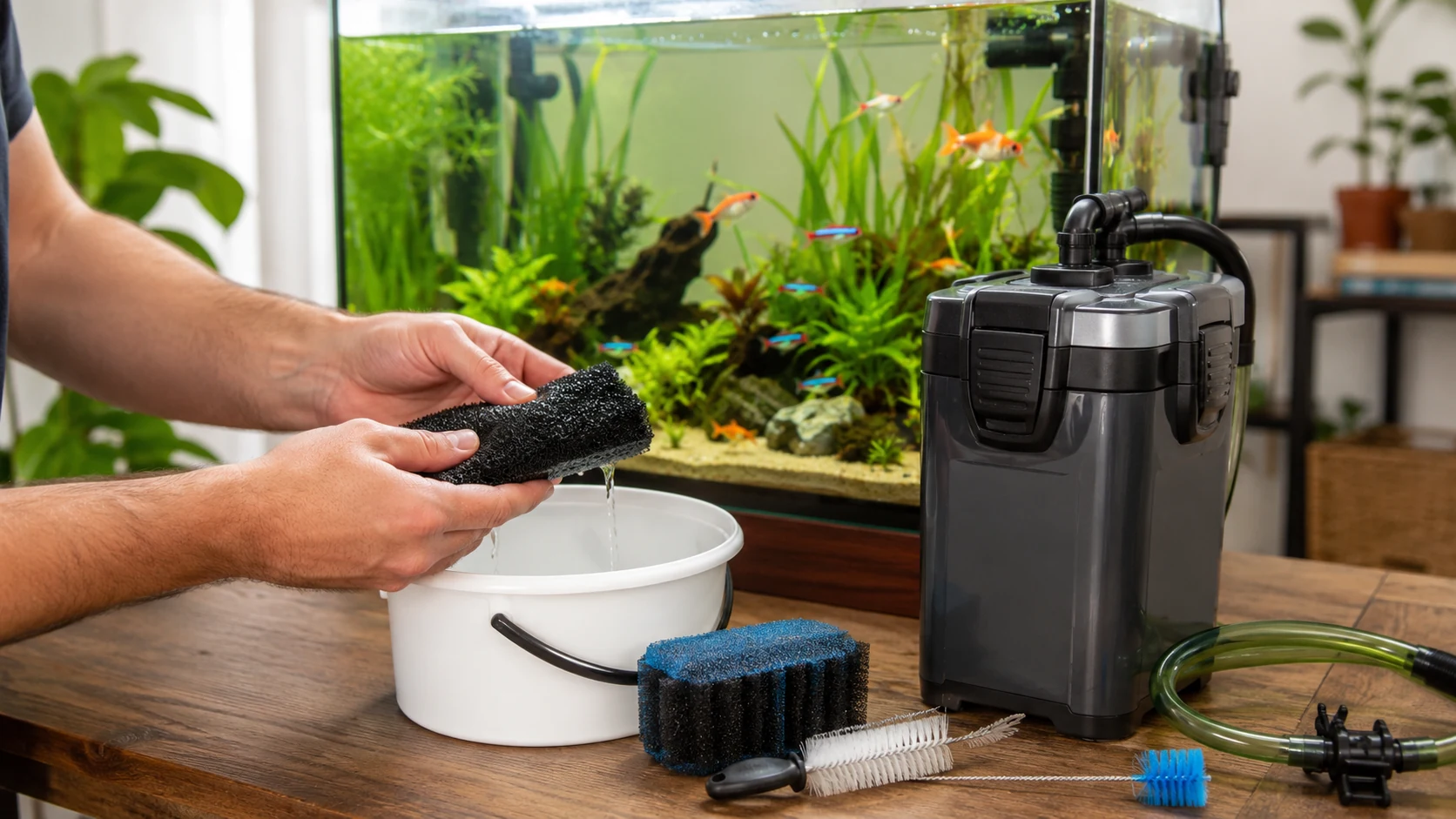
A safe filter-cleaning kit should include an aquarium-only bucket, soft impeller brush, flexible hose brush, spare coarse sponge, filter floss, towel, and water conditioner. Do not use soap, household cleaners, WD-40, or petroleum grease on aquarium filter parts.
Why a fixed schedule can mislead beginners
Two aquariums can need completely different cleaning schedules.
| Tank condition | Filter cleaning frequency |
|---|---|
| Lightly stocked planted tank | Less frequent |
| Messy goldfish tank | More frequent |
| Overfed community tank | More frequent |
| Shrimp tank with sponge filter | Gentle cleaning only when flow drops |
| New tank | Avoid aggressive cleaning |
| Canister filter with long hoses | Inspect flow and hose sludge |
The correct schedule comes from observation. A tank with slow-growing plants and light feeding may not clog quickly. A tank with goldfish, plecos, heavy feeding, or fine debris may clog fast.
Sponge filter cleaning
Sponge filters are simple and forgiving, but they still clog.
To clean one safely:
- Remove a bucket of aquarium water during a water change.
- Turn off the air pump if needed.
- Remove the sponge carefully.
- Squeeze the sponge in old tank water until heavy debris is released.
- Do not make it sterile or bright new.
- Reassemble and restart the air flow.
Do not rinse the sponge under untreated tap water. Do not replace the sponge unless it is physically falling apart. If replacement is needed, run the new sponge alongside the old one first.
HOB filter cleaning
A HOB filter often needs mechanical cleaning when flow drops or water bypasses the media.
Safe process:
- Unplug the filter.
- Remove sponge, floss, or mechanical pad.
- Rinse reusable media in old tank water.
- Replace only fine floss if it is disposable and not the main biofilter.
- Check the impeller well for sludge or grit.
- Refill the filter box before restarting if the model needs priming.
If the filter uses a disposable cartridge, do not throw away the only bacteria surface. Add reusable sponge or biological media so future cartridge changes do not destabilize the tank.
Canister filter cleaning
Canister filters should be cleaned carefully because they can hold a lot of trapped waste.
General process:
- Turn off the filter.
- Close valves or disconnect hoses according to the model.
- Move the canister carefully to avoid spills.
- Open the trays.
- Rinse mechanical sponge in old tank water.
- Leave biological media mostly undisturbed unless flow is blocked.
- Clean impeller and intake areas.
- Inspect hoses for sludge.
- Prime the canister fully before turning power on.
Never dry-run a canister. If the canister is full of air, the impeller can rattle, overheat, or fail to restart properly.
What not to do
Do not clean all filters and media on the same day if the tank depends on them for biological filtration.
Do not replace all media at once.
Do not scrub biological media until it looks new.
Do not use soap.
Do not use hot water.
Do not use WD-40, cooking oil, machine oil, or petroleum grease on aquarium equipment.
Do not clean the substrate aggressively, replace media, and perform a huge water change all at once in a neglected tank. That "deep clean" can create a double crash: disturbed waste plus reduced biofilter capacity plus sudden water chemistry change.
Cleaning during ammonia or nitrite problems
If ammonia or nitrite is present, do not panic-clean the entire filter. The bacteria colony is exactly what the tank needs.
Check whether the filter is running, media is wet, and flow is adequate. Rinse clogged mechanical media gently if flow is blocked. Add aeration. Use conditioner that detoxifies ammonia or nitrite if appropriate according to the label. Perform controlled water changes with temperature-matched, conditioned water.
The goal is to support the biofilter, not reset it.
The oxygen-starvation trap inside clogged media
Delaying filter maintenance because the display water still looks clear can become a biological gamble. Nitrifying bacteria such as Nitrosomonas and Nitrospira are obligate aerobes: they need oxygen-rich water moving across their surfaces to oxidize ammonia and nitrite.
When mechanical waste builds up inside a sponge, cartridge chamber, canister tray, or packed biomedia bed, it forms a dense detritus film. Heterotrophic bacteria quickly colonize that organic sludge because it is rich in carbon. As they break it down, they consume oxygen before the water can penetrate deeper into the media.
The result can be localized anoxia: tiny low-oxygen or oxygen-depleted pockets inside clogged media. From the outside, the filter may still appear to run, but inside the media bed the bacteria doing the most important ammonia and nitrite work may be starved of oxygen.
The fix is not to sterilize the filter. The fix is to restore flow before oxygen transport collapses.
A practical trigger: clean the mechanical stage when you notice roughly a 15–20% visible reduction in output velocity, spillway strength, sponge bubbles, or surface agitation compared with normal operation. This is more reliable than waiting for a monthly date on the calendar.
Filter cleaning checklist
| Check | Safe action |
|---|---|
| Flow weaker | Rinse mechanical sponge in old tank water |
| HOB rattling | Check water level and impeller |
| Canister output weak | Check hoses, impeller, and media compression |
| Sponge bubbles weak | Check air pump, airline, check valve, and sponge clogging |
| Media looks brown | Usually normal; do not sterilize |
| Nitrate high | Water change, feeding control, stocking review |
| Ammonia/nitrite present | Protect biofilter, test daily, increase aeration |
FAQ
How often should I clean my aquarium filter?
Many tanks need inspection every 2–4 weeks, but cleaning should be based on flow and debris, not a fixed calendar.
Should filter media look clean?
No. Biological media often looks brown or stained. That does not mean it is bad.
Can I rinse filter media in tap water?
Avoid untreated tap water because chlorine or chloramine can harm beneficial bacteria. Use old tank water.
Should I replace filter cartridges?
Not if they are the main biofilter. Add reusable media and avoid replacing all bacteria surfaces at once.
Why did my filter get noisy after cleaning?
It may contain trapped air, an impeller may be seated incorrectly, water level may be low, or the filter may not be primed.
Can I clean the filter and change water the same day?
Yes, if cleaning is gentle. Avoid aggressive filter cleaning combined with large sudden water changes in unstable tanks.
How do I clean a canister hose?
Use a flexible pipe brush. Clean hoses when flow drops or sludge buildup is visible.
Should I clean biological media?
Only lightly, and only if flow is blocked. Most of the time it should be left alone or gently swished in old tank water.
Can a dirty filter cause ammonia?
If flow becomes blocked, the filter may process waste poorly. Trapped debris can also decay and add to the waste load.
What if my filter stopped overnight?
Keep media wet, restore flow quickly, add aeration, and test ammonia and nitrite.
Related Guides
- Aquarium Filter Guide
- Can You Wash Aquarium Filter Media in Tap Water?
- What Size Aquarium Filter Do I Need?
- Canister Filter vs HOB Filter
- Aquarium Water Care Guide
Author Box
Written by the Healthy Aquariums editorial team. We focus on maintenance routines that protect the biofilter instead of making the aquarium look temporarily clean at the cost of stability.
Editorial Note
Filter cleaning advice should always be adapted to stocking, feeding, filter type, and water-test results. When in doubt, test ammonia and nitrite before making aggressive changes.
References
- Aqueon. The Nitrogen Cycle. https://www.aqueon.com/articles/the-nitrogen-cycle
- API Fishcare. The Nitrogen Cycle. https://www.apifishcare.com/blog/the-nitrogen-cycle-keeping-your-aquarium-healthy
- Merck Veterinary Manual. Environmental Diseases of Aquatic Animals in Aquatic Systems. https://www.merckvetmanual.com/exotic-and-laboratory-animals/aquatic-systems/environmental-diseases-of-aquatic-animals-in-aquatic-systems