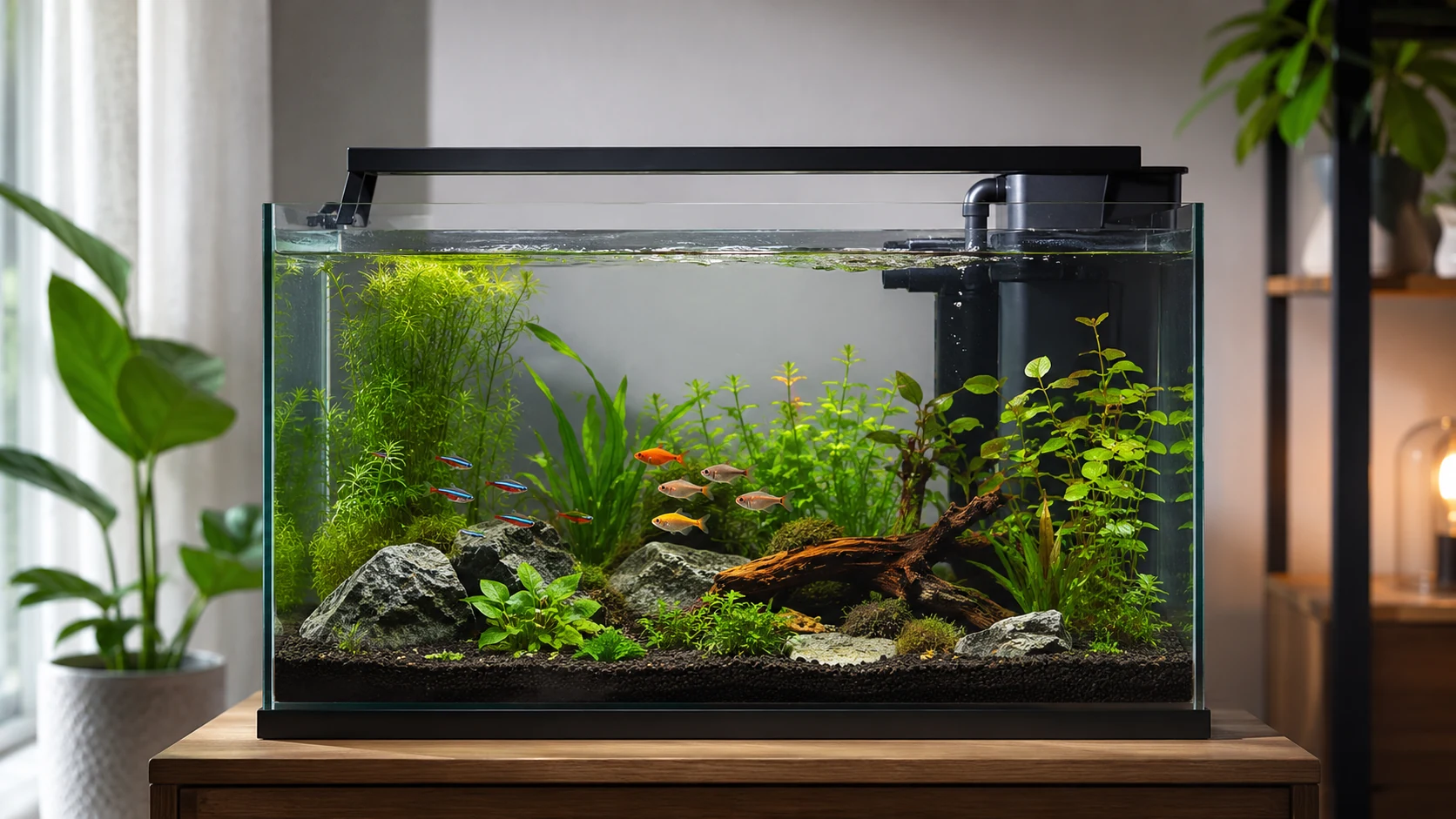
A filter is not just the box that keeps aquarium water looking clear. It is one of the main places where the aquarium's invisible life-support system lives.
That life-support system is the biofilter: the colonies of beneficial bacteria that convert toxic ammonia into nitrite and then nitrate. A beginner can buy a strong filter and still lose fish if they clean it the wrong way, replace all the media, or create flow that the fish cannot handle.
This guide explains aquarium filters from the fish's point of view first, then from the equipment point of view.
Quick answer
Most beginner aquariums need a filter with three things: enough biological media, a flow pattern the fish can live with, and media that can be cleaned without destroying the bacteria colony.
For most small to medium freshwater tanks, a good hang-on-back filter with reusable sponge/media or a sponge filter is safer than a flashy filter that depends on disposable cartridges. Larger or messier tanks may need a canister filter, extra sponge filtration, or a sump-style setup, but bigger is only better when the flow and maintenance routine are controlled.
What an aquarium filter actually does
A filter has three jobs, but beginners often focus on only one.
| Filter job | What it means | Beginner mistake |
|---|---|---|
| Mechanical filtration | Traps visible debris and particles | Cleaning or replacing everything too aggressively |
| Biological filtration | Houses beneficial bacteria that process ammonia | Throwing away the media colony |
| Circulation / oxygen support | Moves oxygen-rich water through the tank and media | Using too much flow for delicate fish |
Mechanical filtration makes the water look better. Biological filtration keeps fish alive. Circulation helps both fish and bacteria receive oxygen.
The problem is that these jobs share the same equipment. If you remove a dirty sponge because it looks ugly, you may also remove the bacteria living in that sponge. If you install a very powerful filter for better circulation, you may stress fish that evolved for calmer water.
The biofilter is the part you must protect
Fish release ammonia through their gills and waste. Rotting food and dead plant matter add more ammonia. In a cycled aquarium, beneficial bacteria convert ammonia into nitrite, and then nitrite into nitrate.
That process does not happen because the filter is expensive. It happens because bacteria have oxygen, water flow, and stable surfaces to live on.
Good biological media can be sponge, ceramic rings, porous biomedia, coarse foam, or other aquarium-safe surfaces. The key is not the marketing name. The key is whether the media stays wet, oxygenated, and undisturbed enough for bacteria to remain stable.
The danger is sudden replacement. If your main bacteria colony lives in one disposable cartridge and you throw it away, the tank can behave like a new aquarium again. Fish may face ammonia or nitrite even though the tank looked mature yesterday.
Main filter types
Sponge filters
Sponge filters are powered by air pumps. Air rises through a tube, pulls water through the sponge, and creates gentle circulation.
They are excellent for shrimp, fry, bettas, hospital tanks, quarantine tanks, and low-flow aquariums. They are cheap, biologically stable, and difficult to clean too aggressively if handled correctly.
Their main weakness is appearance and mechanical polishing. They may not remove fine particles as quickly as some HOB or canister filters. They also require an air pump, airline tubing, and a check valve installed in the correct direction.
Hang-on-back filters
Hang-on-back filters sit on the tank rim and pull water into a chamber before returning it as a waterfall or spillway.
They are popular because they are easy to access, easy to service, and useful for many beginner community tanks. A good HOB filter should have room for reusable sponge and biological media, not only a disposable cartridge.
The main risks are intake safety, excessive flow, waterfall noise, and cartridge replacement habits. Use a pre-filter sponge for shrimp, fry, weak fish, or small fish. If the output is too strong, use a baffle or reduce flow if the filter allows it.
Internal filters
Internal filters sit inside the aquarium. They can be useful in small tanks, quarantine setups, or tanks where external space is limited.
The downside is that they occupy tank space and can create concentrated current. Some models have small media capacity, so do not assume every internal filter has strong biological filtration.
Canister filters
Canister filters sit outside the aquarium and move water through hoses into a sealed media chamber.
They can hold a lot of media and work well for larger tanks, messy fish, and planted aquariums where equipment inside the tank should be minimized. Their weakness is maintenance complexity. Hoses collect bio-sludge, impellers need cleaning, and restarting a neglected canister can send dirty water into the tank.
Canisters are powerful tools, but they reward keepers who maintain them calmly and correctly.
Sumps
Sumps are separate filter reservoirs, usually below the aquarium. They offer huge media capacity and flexibility, but require plumbing design, overflow safety, and more planning. They are common in large or custom systems, not usually the first filter for a beginner.
Biofilter-Safe Filter Media Kit
If you are upgrading a beginner filter, the safest starter kit is simple: coarse reusable sponge, ceramic biomedia, filter floss for temporary polishing, a pre-filter sponge, and a small impeller or pipe brush. Avoid setups where one disposable cartridge is the entire biological filter.
Flow: enough movement, not a washing machine
Filter flow is not only a number on the box. It is what fish experience inside the aquarium.
A betta pushed around by a strong HOB output is not benefiting from "better filtration." A fancy goldfish struggling in a current is using energy it should not have to spend. Shrimp and fry can be trapped by unsafe intakes. Corydoras need oxygen-rich bottom water, but not a jet blasting the substrate all day.
Watch behavior:
- fish constantly hiding from open water;
- long-finned fish pinned in corners;
- food blown away before fish can eat;
- shrimp avoiding the intake area;
- fry disappearing near filter slots;
- surface film forming because flow is too weak;
- debris collecting in dead zones.
The best flow pattern gives oxygen and circulation without forcing fish to fight the equipment.
Filter media order
A simple media order works for most filters:
- Coarse sponge or mechanical media first, to catch large debris.
- Biological media next, where water can flow through steadily.
- Fine polishing floss last, if you use it temporarily.
Do not pack the filter so tightly that flow drops. Bacteria need oxygenated water. A filter stuffed with media but barely moving water can become less effective than a simpler filter with stable flow.
If you add chemical media such as activated carbon, treat it as optional and situational. Carbon can remove some discoloration, odors, or medication residue, but it is not a substitute for water changes, testing, or biological filtration.
How to clean a filter without crashing the tank
The safest filter-cleaning rule is: clean the part that is blocking flow, preserve the part that houses bacteria.
Rinse sponges or reusable mechanical media in old tank water removed during a water change. Squeeze gently until the worst debris comes out. You do not need to make the sponge look new.
Do not rinse all media under untreated tap water. Chlorine and chloramine can harm beneficial bacteria. Do not replace all media at once. If you need to replace damaged media, seed the new media alongside the old media for several weeks when possible.
Clean impellers, intake guards, and hoses when flow drops or noise increases. For canisters and HOB filters, remove sludge from tubes and impeller wells with aquarium-safe brushes. Never use soap, WD-40, machine oil, or petroleum grease. If an O-ring needs lubrication, use only 100% aquarium-safe silicone grease and apply a very thin layer.
Filter problems beginners misdiagnose
Cloudy water is not always a filter problem. It can be bacterial bloom, overfeeding, disturbed substrate, new-tank instability, or dead organic matter.
Bad smell is not solved by replacing all filter media. It often points to trapped waste, low oxygen, dead plant matter, overfeeding, or poor maintenance.
Fish gasping is not fixed by simply adding a bigger filter. Test ammonia and nitrite first, increase aeration, and check temperature. Warm water holds less oxygen, so oxygen stress can appear during heat waves even if the filter is running.
A quiet filter is not always a healthy filter. Flow may be blocked. Media may be clogged. A canister may contain trapped air. Always connect equipment symptoms back to water chemistry and fish behavior.
Filter choice by common aquarium
| Aquarium type | Safer filter choice |
|---|---|
| Betta tank | Sponge filter or adjustable HOB with baffled output |
| Shrimp tank | Sponge filter or protected intake |
| Fry tank | Sponge filter |
| Small community tank | HOB with reusable media or sponge filter |
| Goldfish tank | Large media capacity, strong oxygen, easy debris removal |
| Large planted tank | HOB, canister, or combination depending on layout |
| Quarantine tank | Sponge filter seeded from an established tank |
FAQ
What type of aquarium filter is best for beginners?
A sponge filter or a hang-on-back filter with reusable media is usually best for beginners because it is easy to maintain and biofilter-safe.
Is a bigger filter always better?
No. A bigger filter helps only if the flow is safe for the fish and the media can be maintained properly.
Can I run two filters on one aquarium?
Yes. Two filters can add media capacity and redundancy. This is useful in larger tanks, messy-fish tanks, or tanks where you want backup filtration.
Should I replace filter cartridges every month?
Not if the cartridge is your main biological media. Replacing it can remove beneficial bacteria and trigger ammonia or nitrite problems.
How do I know my filter is cycled?
A cycled filter can process ammonia and nitrite to zero on tests while nitrate gradually appears. Clear water alone does not prove cycling.
Can a sponge filter keep water clear?
It can keep water biologically safe, but it may not polish fine particles as quickly as some HOB or canister filters.
Why is my filter flow getting weak?
Common causes include clogged sponge, dirty impeller, blocked intake, packed media, trapped air, or sludge in hoses.
Is activated carbon necessary?
Usually no. It is useful for specific tasks like removing odors, discoloration, or medication residue, but not required as permanent media.
Can I turn the filter off at night?
No. The filter should run continuously because beneficial bacteria and fish need steady oxygen and water movement.
What should I do if my filter stops working?
Keep the media wet, add backup aeration, test ammonia and nitrite, and restart or replace the filter without letting media dry out.
Related Guides
- Aquarium Filters
- What Size Aquarium Filter Do I Need?
- Sponge Filter vs HOB Filter
- How Often Should You Clean an Aquarium Filter?
- Can You Wash Aquarium Filter Media in Tap Water?
Author Box
Written by the Healthy Aquariums editorial team. We focus on practical aquarium care that protects fish health, biofilter stability, and long-term maintenance routines.
Editorial Note
This guide prioritizes biological filtration and safe maintenance over brand hype. Product recommendations should always be matched to livestock, tank size, feeding load, and flow tolerance.
References
- Aqueon. The Nitrogen Cycle. https://www.aqueon.com/articles/the-nitrogen-cycle
- API Fishcare. The Nitrogen Cycle. https://www.apifishcare.com/blog/the-nitrogen-cycle-keeping-your-aquarium-healthy
- Merck Veterinary Manual. Environmental Diseases of Aquatic Animals in Aquatic Systems. https://www.merckvetmanual.com/exotic-and-laboratory-animals/aquatic-systems/environmental-diseases-of-aquatic-animals-in-aquatic-systems