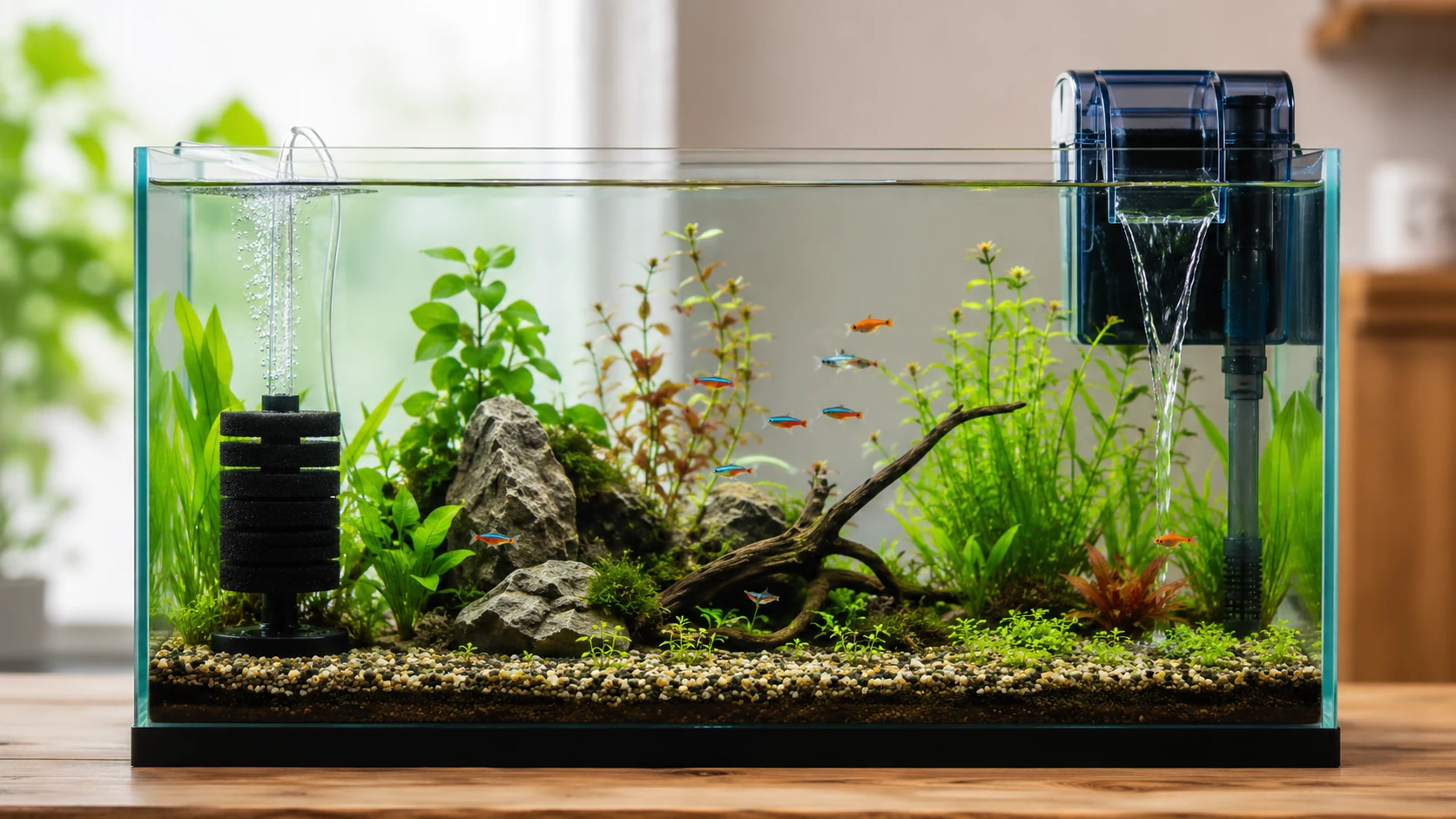
Sponge filters and hang-on-back filters are two of the most beginner-friendly aquarium filters, but they solve different problems.
A sponge filter is gentle, biofilter-safe, and excellent for shrimp, fry, bettas, and hospital tanks. A HOB filter is more compact, often better at mechanical polishing, and convenient for many community aquariums. The right choice depends on livestock, flow needs, maintenance style, and how much visible equipment you can tolerate.
Quick answer
Choose a sponge filter when you need gentle flow, intake safety, and biological stability. Choose a HOB filter when you want a compact filter with easier mechanical debris removal and a cleaner display look.
For many beginner aquariums, either can work. For shrimp and fry, sponge filters are safer. For small community tanks, a HOB with reusable media and a pre-filter sponge can be excellent.
Sponge vs HOB at a glance
| Feature | Sponge filter | HOB filter |
|---|---|---|
| Flow strength | Gentle | Moderate, sometimes strong |
| Intake safety | Very safe | Needs pre-filter sponge for small animals |
| Biological stability | Excellent | Good if media is reusable |
| Mechanical polishing | Moderate | Usually better |
| Noise | Air pump hum and bubbles | Motor hum and waterfall |
| Appearance | Visible inside tank | Hangs on tank rim |
| Maintenance | Squeeze sponge in old tank water | Rinse media, check impeller |
Neither filter is automatically superior. A poorly set HOB can crash a tank if the cartridge is replaced. A neglected sponge filter can clog and reduce flow. Good maintenance matters more than filter ideology.
Why sponge filters are so safe
A sponge filter pulls water through a porous sponge using air lift. Beneficial bacteria colonize the sponge, and the bubbles create gentle oxygenation.
This makes sponge filters ideal for animals that cannot handle strong suction or current:
- shrimp;
- baby fish;
- bettas;
- sick fish;
- quarantine fish;
- small tanks with delicate livestock.
The sponge itself acts as intake protection. Fry and shrimp can graze on the biofilm without being sucked into a motorized intake.
Sponge filter weaknesses
Sponge filters are not perfect.
They sit inside the tank, which some aquarists dislike visually. They may not remove fine floating particles as quickly as a HOB filter with floss. They require an air pump, airline tubing, and a check valve. The air pump can hum if placed on a hard surface.
Also, sponge filters can clog. If bubble flow slows or the sponge looks packed with debris, squeeze it in old tank water. Do not rinse it sterile.
Why HOB filters are convenient
HOB filters are popular because they are accessible. They hang on the tank rim and hold media in a chamber outside the main swimming space.
A good HOB can provide:
- mechanical debris removal;
- space for sponge and biomedia;
- surface movement;
- cleaner tank appearance;
- easy access for maintenance.
For a community tank with small tetras, guppies, rasboras, or similar fish, a HOB can be a strong choice if flow is controlled.
HOB filter weaknesses
The biggest HOB risk is the cartridge trap. Many HOB filters are sold with disposable cartridges that beginners replace too often. If that cartridge is the main bacteria surface, each replacement can weaken the biofilter.
The second risk is intake suction. Shrimp, fry, small fish, and weak fish can be injured or trapped. A pre-filter sponge solves much of this problem.
The third risk is flow. A waterfall return may be too strong for bettas or long-finned fish. Adjustable flow, baffles, or plant placement can help.
Effective surface-to-flow contact: why sponge filters can outperform their size
Sponge filters are often dismissed because they look simple, but their flow path is biologically efficient. In a properly running sponge filter, water must pass through the sponge body before rising through the lift tube. The sponge is both the mechanical screen and the biological surface.
That design reduces one major problem seen in some HOB and canister setups: hydraulic bypassing. In a box filter, water can sometimes move around poorly fitted media. In a sponge filter, the water column is drawn through the porous sponge itself, so the contact between water and bacterial surface is direct.
This does not mean sponge filters are always stronger. They may polish fine particles less effectively, and they may not suit every display tank aesthetically. But for shrimp, fry, bettas, quarantine tanks, and low-flow aquariums, a quality sponge filter can deliver excellent biological contact per unit of flow.
The lesson is practical: judge filters by effective contact, not only by media volume. Five liters of poorly contacted ceramic media can underperform one well-positioned sponge that every drop of water must pass through.
Best choice by livestock
| Livestock / setup | Better starting choice |
|---|---|
| Betta | Sponge filter or baffled HOB |
| Shrimp | Sponge filter |
| Fry / breeding tank | Sponge filter |
| Small community tank | HOB or sponge |
| Bedroom tank | Depends on air pump vs waterfall noise tolerance |
| Planted tank | Either, depending on flow layout |
| Quarantine tank | Sponge filter |
| Display tank | HOB may look cleaner |
Shrimp- and Betta-Safe Filter Setup
For gentle tanks, the highest-value filter accessories are a sponge filter, quiet air pump, airline tubing, correctly oriented check valve, pre-filter sponge for HOB intakes, and a simple flow baffle. These parts protect small fish and shrimp better than raw filter power.
Combining both filters
A sponge filter and HOB filter can work together. The sponge provides stable biological filtration and backup oxygen. The HOB provides mechanical polishing and extra circulation.
This combination is especially useful when cycling new tanks, preparing quarantine media, or keeping backup filtration ready. A mature sponge can be moved to an emergency tank if needed.
Maintenance comparison
Sponge filter maintenance is simple: squeeze the sponge in old tank water when flow slows. Check airline tubing, air stone/lift tube, and check valve direction.
HOB maintenance includes rinsing sponge/media, clearing intake guards, checking the impeller, and keeping the water level high enough to reduce waterfall noise.
For both filters, the principle is the same: remove debris, preserve bacteria.
FAQ
Is a sponge filter better than a HOB filter?
It depends on the tank. Sponge filters are safer for shrimp and fry. HOB filters often polish water better and look cleaner on display tanks.
Can a sponge filter be enough for a community tank?
Yes, if the tank is lightly to moderately stocked and the sponge is sized properly. Some keepers use multiple sponge filters.
Do sponge filters oxygenate the water?
Yes. The rising bubbles help move water and improve gas exchange.
Do HOB filters need a pre-filter sponge?
They should use one for shrimp, fry, small fish, weak fish, or any tank where intake safety matters.
Which filter is quieter?
It depends. Sponge filters depend on air pump noise. HOB filters depend on motor noise and water level.
Can I use both a sponge and HOB filter?
Yes. This can improve redundancy, oxygenation, and media capacity.
Which is better for a betta?
A sponge filter or a very gentle HOB is usually best. Avoid strong current.
Which is better for shrimp?
A sponge filter is usually safest because the intake is protected.
Can a HOB filter crash a tank?
It can if the main cartridge is replaced and no stable biological media remains.
How often should I clean a sponge filter?
Clean it when flow slows or debris buildup is heavy, usually by squeezing it in old tank water.
Related Guides
- Aquarium Filter Guide
- Best Aquarium Filters
- Best Filter for a 10-Gallon Tank
- How Often Should You Clean an Aquarium Filter?
- Freshwater Shrimp Care Guide
Author Box
Written by the Healthy Aquariums editorial team. Our filter comparisons are based on fish safety, biofilter stability, maintenance habits, and real beginner tank behavior.
Editorial Note
This guide focuses on freshwater beginner aquariums. Large predator tanks, high-tech planted systems, and custom sump systems may need different filtration planning.
References
- Aqueon. Aquarium Filtration and Water Quality. https://www.aqueon.com/articles
- API Fishcare. The Nitrogen Cycle. https://www.apifishcare.com/blog/the-nitrogen-cycle-keeping-your-aquarium-healthy
- The Spruce Pets. Sponge Filters for Aquariums. https://www.thesprucepets.com