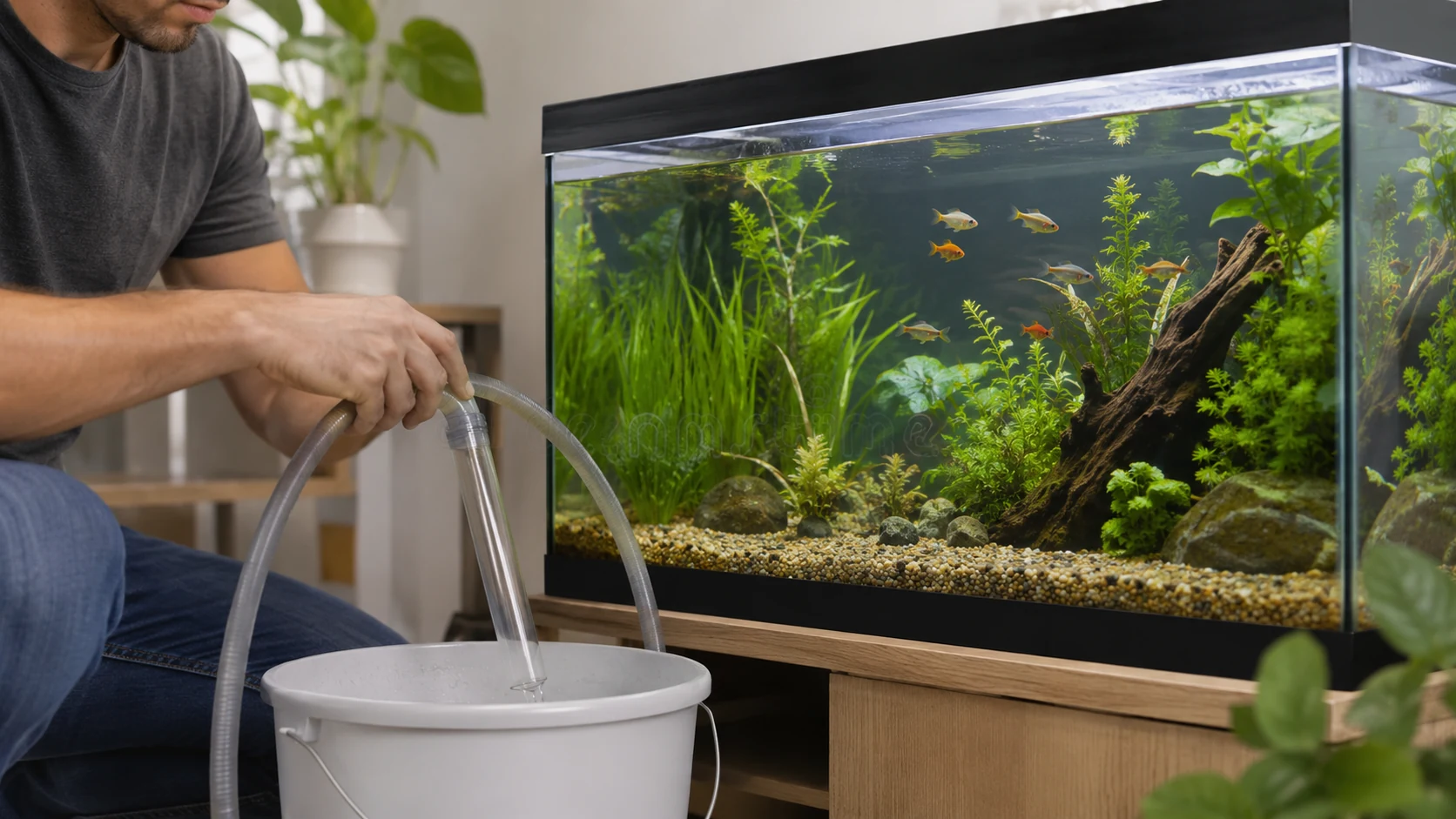
Most aquariums need regular partial water changes.
Not because the water “expires.”
Because fish eat, breathe, poop, and turn food into waste. Filters help. Beneficial bacteria help. Plants help. But none of them make a closed glass box behave like a river.
Water changes remove nitrate, dissolved organics, hormones, fine waste, and things your filter does not magically erase. They also give you a chance to inspect the fish, clean small problem areas, and keep the tank from drifting into trouble.
But more is not always better.
Changing too much water too aggressively can shock fish, swing temperature, shift pH, disturb dirty substrate, or destabilize a stressed tank. Replacing all water every week is not good fishkeeping. It is often panic cleaning.
The better question is not “What is the perfect schedule for every aquarium?”
The better question is:
What does this tank need based on tests, stocking, feeding, filtration, plants, and fish behavior?
For many beginner freshwater tanks, a 20–30% weekly water change is a solid starting point. Then you adjust based on nitrate, ammonia, nitrite, tank size, fish load, and how quickly waste builds up.
Stable beats dramatic.
What Water Changes Actually Do
A water change does not “reset” the aquarium in a healthy way.
It dilutes and removes waste.
| Water changes help remove or reduce | Why it matters |
|---|---|
| Nitrate | Long-term waste buildup |
| Dissolved organics | Smell, algae pressure, water quality |
| Fine debris | Cleaner water and substrate |
| Uneaten food particles | Less decay |
| Fish hormones and metabolites | Better long-term environment |
| Medication residue after treatment | Only when treatment instructions allow |
| Tannins or discoloration | Cosmetic and water clarity |
| Some algae-supporting nutrients | Helps, but does not fix light problems |
Water changes do not replace cycling.
They do not replace filtration.
They do not remove all beneficial bacteria if done correctly, because most nitrifying bacteria live on surfaces like filter media, substrate, glass, plants, and decor, not floating freely in the water column.
That is why partial water changes are usually safe.
The problem is aggressive cleaning of everything at once.
Why You Should Not Change 100% of the Water
A full water change is rarely needed in a normal aquarium.
It can shock fish and destabilize the system.
| Risk of 100% water change | Why it matters |
|---|---|
| Temperature shock | Fish stress, appetite loss, disease vulnerability |
| pH/mineral swing | Osmotic stress |
| Chlorine/chloramine mistake | Gill damage |
| Biofilm disturbance | System instability |
| Substrate disturbance | Waste release |
| Stress from catching fish | Injury and panic |
| Filter/media drying | Biofilter damage |
| Repeated “new tank” instability | Cycle problems |
There are exceptions: contamination, certain emergency cases, or a tank being fully broken down. But those are not routine maintenance.
Routine maintenance should keep the aquarium stable.
Not start it over.
Old Tank Syndrome: When a Big Water Change Can Kill Fish
Old Tank Syndrome happens when an aquarium has been neglected for a long time.
Over months, nitrate can climb extremely high, dissolved organics build up, KH can be depleted, minerals can shift, and pH may crash far below normal source-water pH. The fish may look “used to it,” but that does not mean the water is healthy. It means they have been forced to adapt slowly to bad conditions.
The danger comes when someone suddenly replaces a large amount of that old water with fresh tap water that has a much higher pH, higher KH/GH, different temperature, and different mineral profile.
That sudden change can cause osmotic shock and pH shock.
| Old Tank Syndrome clue | Why it matters |
|---|---|
| Tank has not had water changes for months | Fish may be adapted to old chemistry |
| Very high nitrate | Long-term waste buildup |
| Very low pH | KH may be depleted |
| Fish seem “fine” until a big change | Sudden chemistry shift can shock them |
| Thick mulm, smell, old filter media | System is overloaded |
| Source water pH much higher than tank pH | Large change can be dangerous |
| No recent test history | Unknown risk |
Safer rescue rule:
Do not do a huge water change first.
Start with small changes, often around 10% per day, while testing pH, ammonia, nitrite, nitrate, and temperature. Keep aeration strong. Remove obvious waste slowly. Protect filter media. After a week of gradual correction, reassess the tank and adjust based on test results.
A neglected tank needs rehabilitation.
Not shock therapy.
The Best Starting Schedule for Beginners
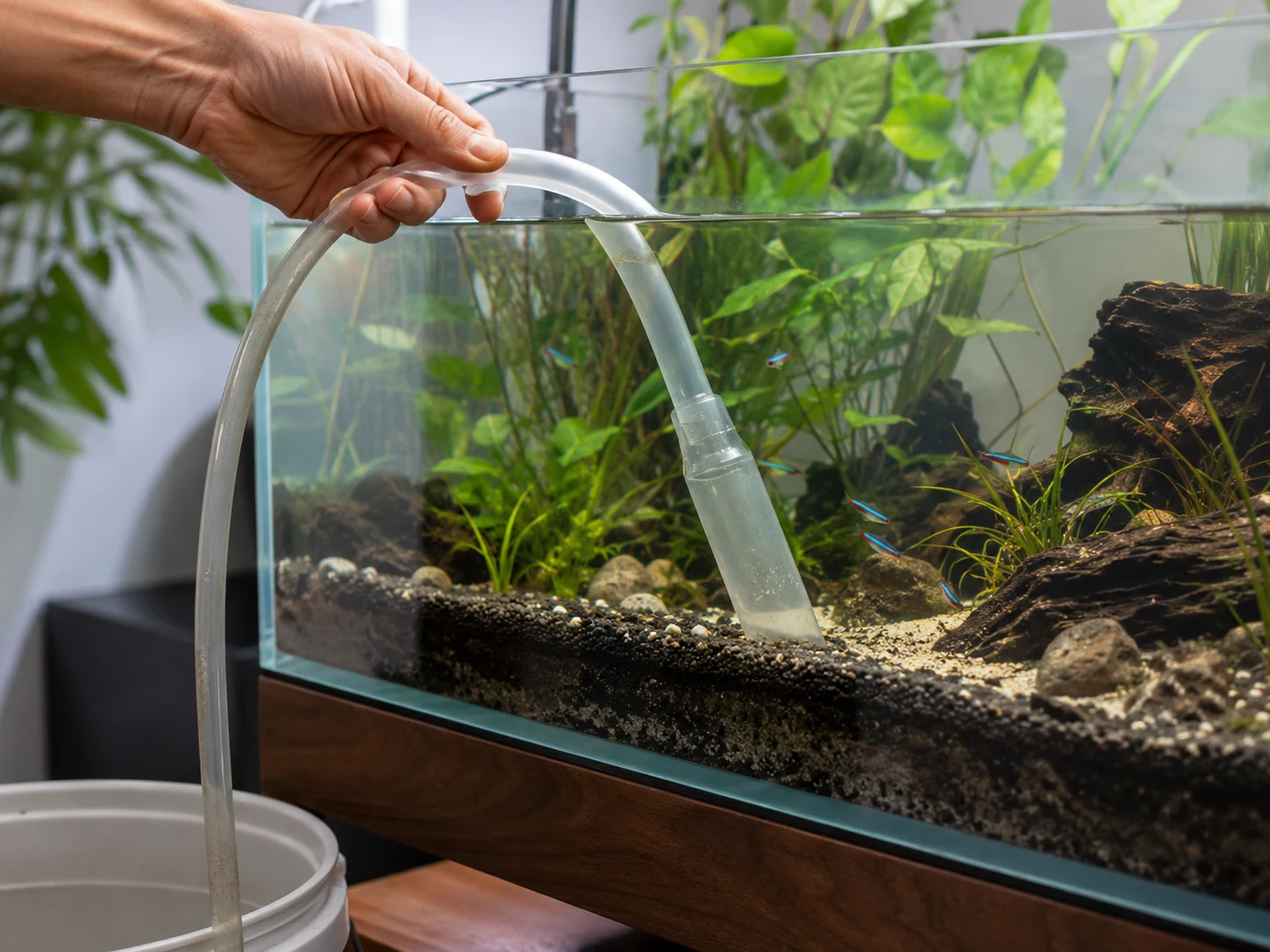
For a normal beginner freshwater tank, start here:
| Tank condition | Starting point |
|---|---|
| Cycled tank, moderate stocking | 20–30% weekly |
| New tank with fish | Test daily or near-daily; change as needed |
| Tank smells bad | Test first; partial change plus source removal |
| Cloudy new tank | Test; avoid overcleaning filter |
| High nitrate | Increase frequency or percentage |
| Fish gasping | Test ammonia/nitrite/oxygen first |
| After overfeeding accident | Remove food, test, partial change |
| After medication | Follow medication label |
| Planted tank | Keep routine stable and adjust by tests |
This schedule is not a law.
It is a safe starting rhythm.
Your test kit tells you how to adjust.
Use Nitrate to Adjust the Schedule
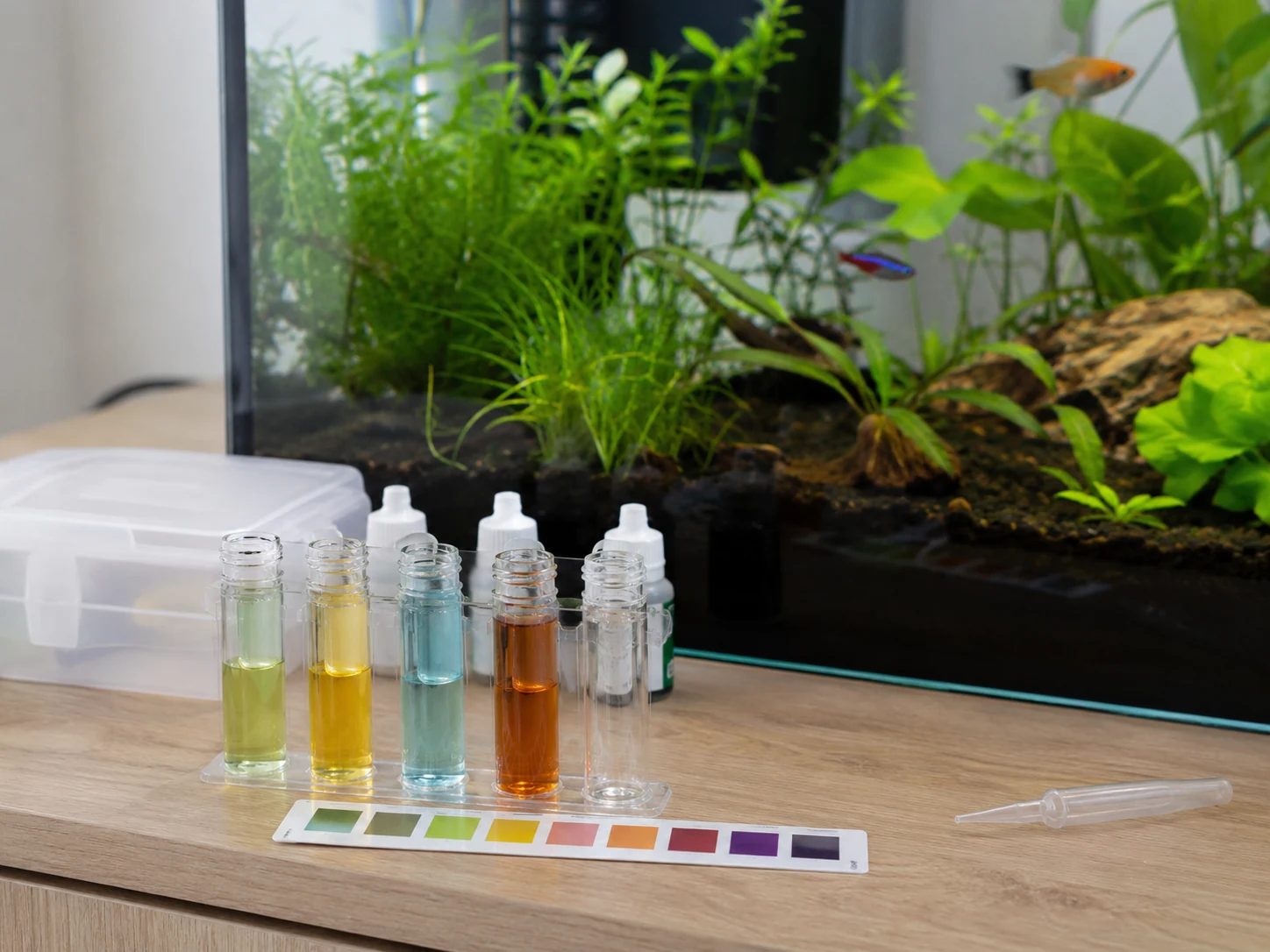
Nitrate is one of the best routine clues for water change frequency.
In a cycled aquarium, ammonia and nitrite should be 0 ppm. Nitrate usually rises over time as the final common waste product of the nitrogen cycle.
| Nitrate pattern | What it suggests |
|---|---|
| Nitrate stays low and fish are healthy | Current schedule may be fine |
| Nitrate rises quickly | More waste than routine removes |
| Nitrate high before weekly change | Increase water change amount or frequency |
| Nitrate high even after changes | Overstocking, overfeeding, dirty substrate, weak routine |
| Nitrate near 0 in planted tank | Plants may be using it, but still watch fish and organics |
| Nitrate suddenly changes | Test error, plant change, stocking change, or water source issue |
A practical beginner goal is to keep nitrate from building continuously higher week after week. Many freshwater keepers try to keep nitrate below roughly 20–40 ppm depending on species, tank type, and source water, with more sensitive livestock needing cleaner, steadier conditions.
Do not chase one number blindly.
Watch the trend.
Ammonia or Nitrite Changes the Rules
If ammonia or nitrite is present in a stocked aquarium, you are not doing routine maintenance anymore.
You are protecting fish from toxins.
| Test result | Meaning |
|---|---|
| Ammonia 0 ppm, nitrite 0 ppm | Routine schedule applies |
| Ammonia above 0 ppm | Unsafe; act |
| Nitrite above 0 ppm | Unsafe; act |
| Both present | Cycle problem or overload |
| Ammonia after filter cleaning | Possible biofilter disturbance |
| Nitrite in new tank | Cycling phase |
| Ammonia with high pH/temp | More urgent due to NH3 toxicity |
When ammonia risk is present, consider pH and temperature. Higher pH and higher temperature make a greater fraction of total ammonia exist as toxic NH3. That is why a warm, high-pH tank with ammonia is more dangerous than the same reading in cooler, lower-pH water.
Safer response:
- Increase aeration.
- Stop feeding temporarily.
- Dose an ammonia-detoxifying conditioner according to the label if ammonia is present or fish are distressed. Choose a conditioner that clearly treats chlorine/chloramine and temporarily detoxifies ammonia when that is the goal.
- Do a controlled partial water change with dechlorinated, temperature-matched water.
- Protect filter media.
- Test again.
- Repeat as needed until ammonia and nitrite are 0 ppm.
Do not respond by replacing all filter media.
That can make the cycle problem worse.
How Much Water Should You Change?
The right percentage depends on why you are changing water.
| Purpose | Typical range |
|---|---|
| Routine weekly maintenance | 20–30% |
| Mild nitrate reduction | 25–40% |
| High nitrate | 30–50%, possibly repeated |
| Ammonia/nitrite present | Controlled partial changes based on severity |
| Shrimp/sensitive livestock | Smaller, steadier changes |
| After overfeeding | Remove food plus partial change |
| After medication | Follow label |
| Dirty substrate sections | Small targeted water changes |
| Emergency contamination | Case-specific, may require larger changes |
A 50% water change is not automatically bad.
A careless 50% water change with cold, untreated, very different water can be bad.
Technique matters.
Small Tanks Need More Attention
Small tanks change faster.
A little extra food, one dead snail, or a missed water change can affect a 5-gallon tank much more quickly than a 40-gallon tank.
| Tank size | Water change reality |
|---|---|
| 2–3 gallons | Very unstable for most fish; needs close attention |
| 5 gallons | Weekly changes often necessary; stocking must be light |
| 10 gallons | Good beginner size, but still test regularly |
| 20 gallons | More stable, easier to manage |
| 40+ gallons | More dilution, but still needs routine |
| Any overstocked tank | Size advantage disappears |
A small tank is not less work.
It is less forgiving.
Goldfish, Messy Fish, and Heavy Bioload Tanks
Some fish produce more waste than beginners expect.
Goldfish are the classic example. Large cichlids, plecos, messy feeders, and heavily stocked livebearer tanks can also load the water quickly.
| High-waste factor | What to expect |
|---|---|
| Goldfish | More frequent/larger water changes |
| Large fish | More waste per fish |
| Plecos | Heavy waste output |
| Overfeeding | Nitrate and organics rise |
| Messy frozen foods | More debris |
| Crowded tank | Waste accumulates faster |
| Weak filtration | Water quality declines faster |
For high-bioload tanks, do not rely on a calendar alone.
Test nitrate.
Watch filter flow.
Look at substrate buildup.
Planted Tanks Are Not Exempt
Plants help.
They do not excuse neglect.
A healthy planted tank can use nitrate and absorb some nutrients. But melting plants, dead leaves, trapped mulm, and high light can still create water quality problems.
| Planted tank situation | Water change approach |
|---|---|
| New planted tank | Weekly changes help stability |
| Melting new plants | Remove dead leaves, water change as needed |
| Low-tech mature tank | Adjust by nitrate and plant health |
| High-tech CO2 tank | Often benefits from consistent larger changes |
| Heavy floating plants | Watch gas exchange and nitrate trend |
| Rooted plants in dirted substrate | Avoid deep disturbance |
| Algae outbreak | Fix light/nutrients; water changes help but are not enough |
Do not deep-stir planted substrate broadly.
If a pocket smells rotten, work only in a small area while siphoning directly at that disturbance point so foul water leaves the tank.
Shrimp Tanks and Sensitive Fish
Shrimp and some sensitive fish often prefer stability.
They may react poorly to large sudden changes in temperature, TDS, pH, or hardness.
| Livestock | Safer water change style |
|---|---|
| Neocaridina shrimp | Small steady changes |
| Caridina shrimp | Very stable remineralized water |
| Wild-type sensitive fish | Match parameters carefully |
| Fry | Gentle changes, avoid suction injury |
| Sick fish | Stable temperature and oxygen |
| Bettas | Warm, gentle, conditioned water |
| Corydoras | Avoid dirty substrate and sudden swings |
For sensitive livestock, slower is often safer.
Clean water still matters.
Stability matters too.
Safe Water Change Technique
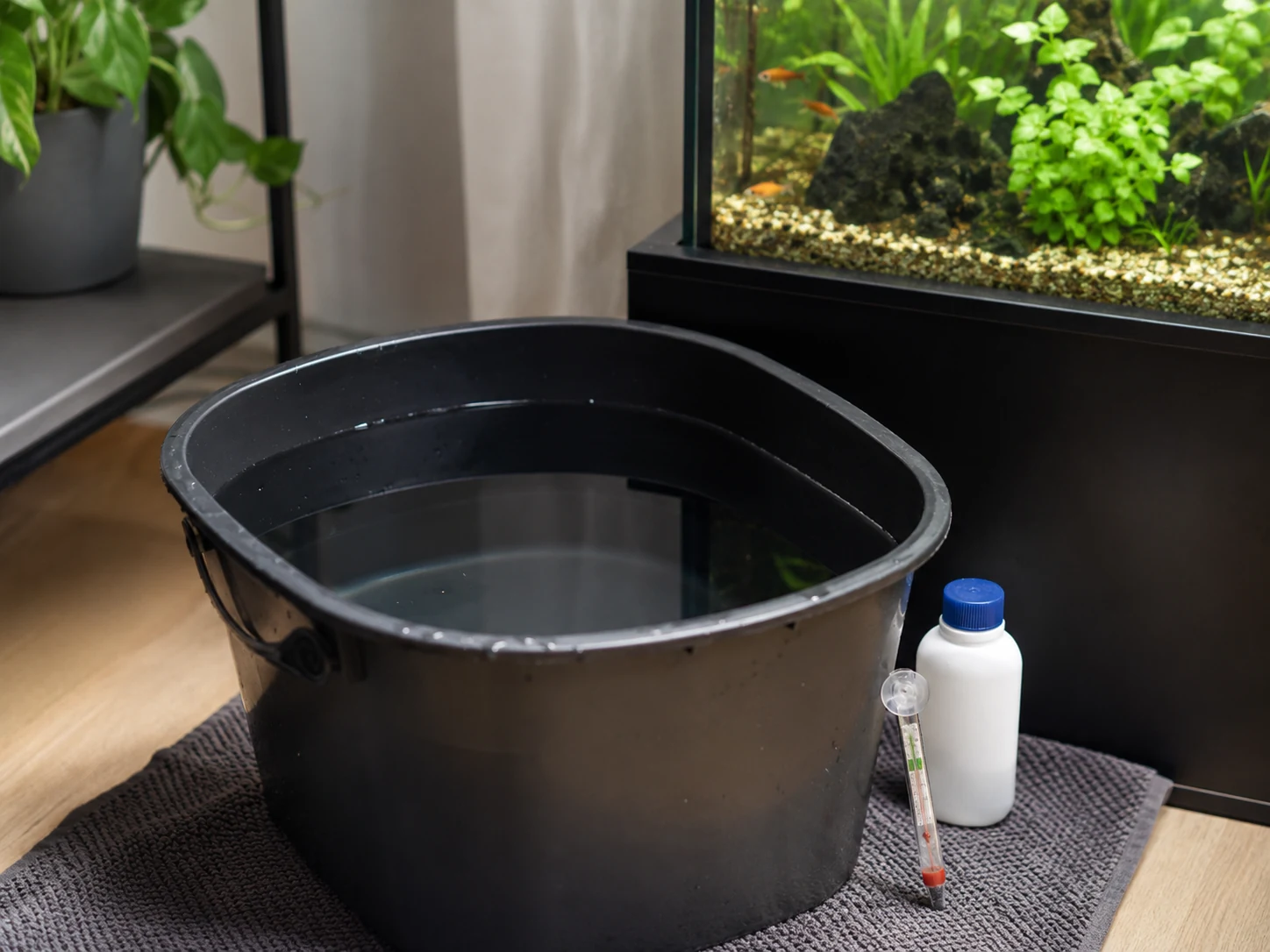
A good water change is controlled.
| Step | Why |
|---|---|
| Wash hands without soap residue | Avoid contamination |
| Unplug heaters if water level will drop | Prevent heater damage |
| Use aquarium-only bucket/hose | Avoid chemical residue |
| Test source water when troubleshooting | Finds pH/nitrate/ammonia surprises |
| Siphon visible debris | Removes waste source |
| Avoid deep-stirring whole substrate | Prevents waste release |
| Match temperature within ±1°C | Reduces hidden thermal shock |
| Use conditioner that treats chlorine and chloramine | Protects fish and biofilter |
| Refill slowly | Reduces stress |
| Restart equipment | Restores flow/heat |
| Check fish behavior | Confirms recovery |
Do not use household cleaning buckets.
Do not use soap.
Do not trust your hand to match temperature. Human skin is a poor aquarium thermometer. Use a digital thermometer or aquarium thermometer and keep new water within about ±1°C of the tank water before adding it.
Do not rely on “aging water” alone unless you know your source water uses only free chlorine. Free chlorine can dissipate with aeration and time, but chloramine is designed to remain stable in municipal water. Chloramine does not reliably gas off just because water sits for 24–72 hours. Use a proper aquarium water conditioner that neutralizes chlorine and chloramine, and follow the label.
Do not pour cold, hot, or untreated tap water into a tank and hope the fish adjust.
Siphoning Substrate Without Crashing the Tank
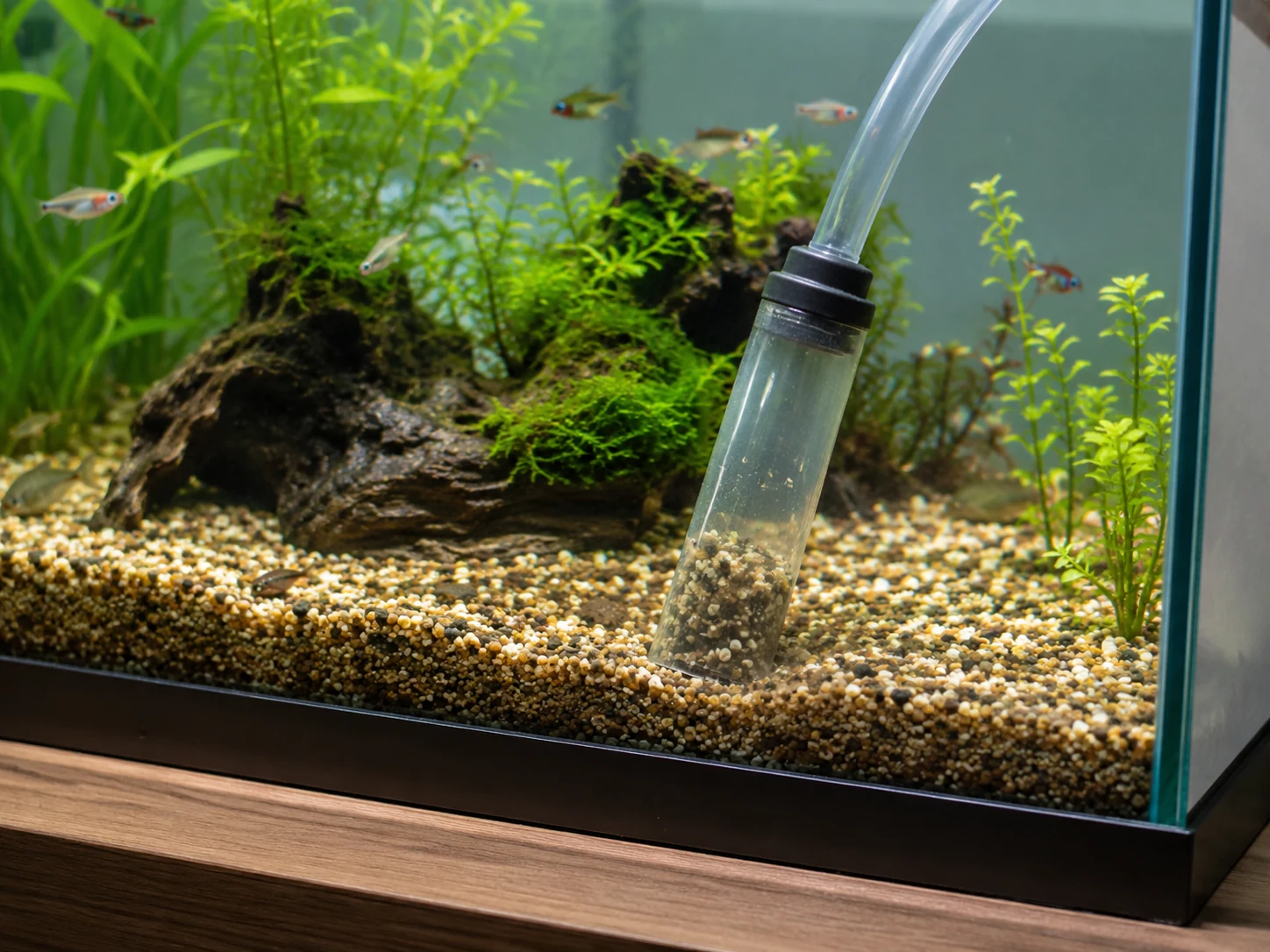
Substrate cleaning is useful.
Aggressive substrate destruction is not.
| Substrate type | Safer method |
|---|---|
| Gravel | Vacuum sections |
| Sand | Hover siphon above surface |
| Planted substrate | Light surface cleanup |
| Dirted tank | Avoid deep disturbance |
| Deep sand | Do not stir broadly |
| Under decor | Lift small areas during water change |
| Rotten smell area | Localized siphon while disturbing gently |
Clean one section at a time.
If the tank is very dirty, do not try to fix months of buildup in one session. That can release too much trapped waste and destabilize the system.
This is the same double-crash problem seen in smelly tanks: aggressive substrate cleaning plus large water changes plus filter-media cleaning can remove stability at the exact moment the tank needs it most.
Protect the biofilter.
Filter Media During Water Changes
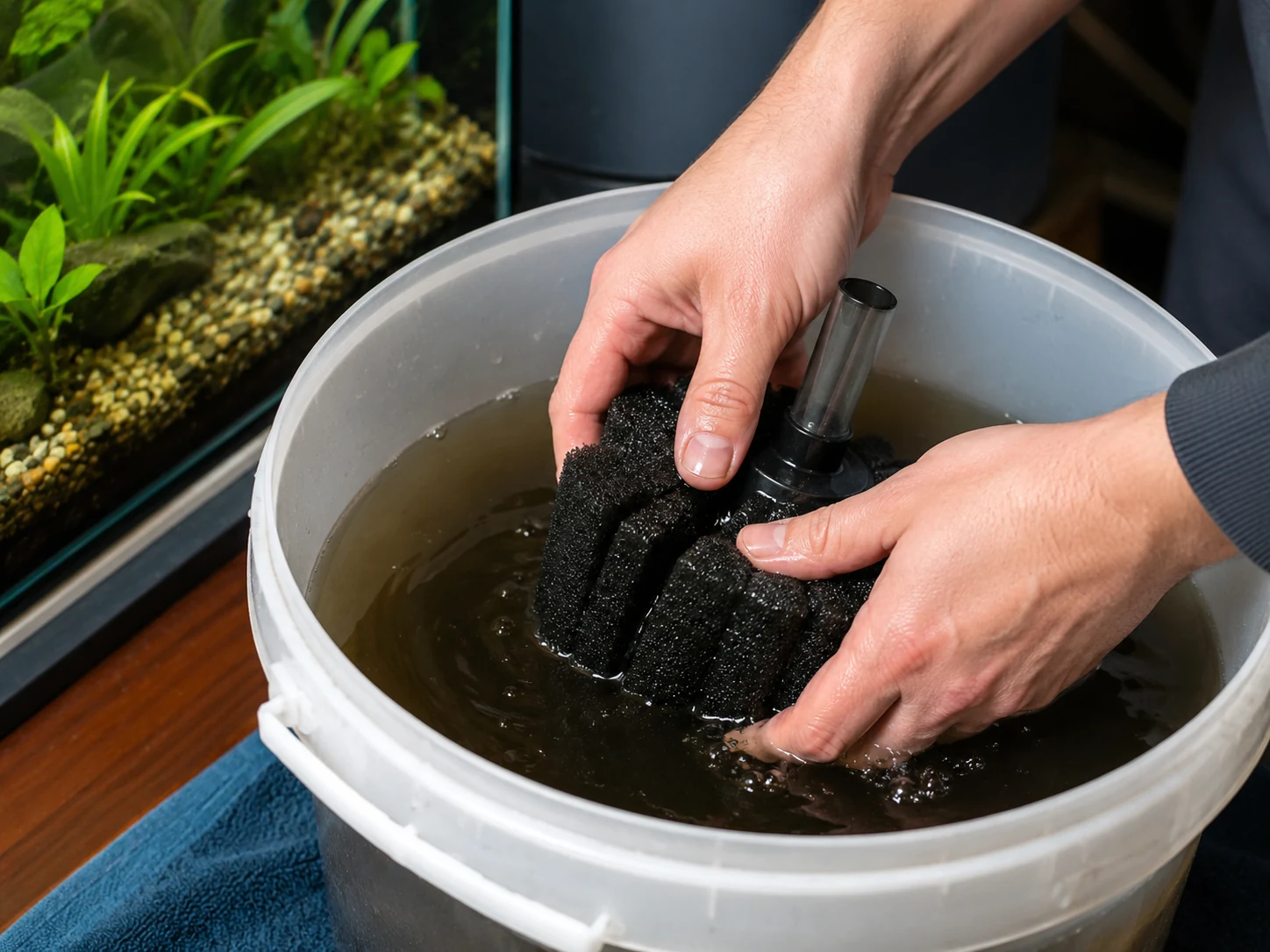
Water changes and filter cleaning should not always happen aggressively on the same day.
| Media type | What to do |
|---|---|
| Filter floss | Replace/rinse when clogged |
| Pre-filter sponge | Rinse in old tank water |
| Sponge filter | Squeeze gently in old tank water |
| Ceramic rings | Leave alone unless flow is blocked |
| Bio-balls | Leave alone |
| Chemical media | Replace based on purpose/instructions |
| Carbon/Purigen | Replace/regenerate as directed |
Do not rinse biological media under untreated tap water.
Do not replace all media because the tank looks dirty.
Most of the “good bacteria” you need are living where water flows through oxygen-rich surfaces. Preserve that.
Water Change After Overfeeding
Overfeeding accidents happen.
Do not wait for the filter to “handle it.”
| Action | Why |
|---|---|
| Remove visible food immediately | Stops decay |
| Use siphon/turkey baster | Targets food without tearing tank apart |
| Test ammonia/nitrite | Checks damage |
| Skip next feeding | Reduces waste |
| Do partial water change | Dilutes dissolved waste |
| Rinse mechanical media if clogged | Restores flow |
| Keep bio-media intact | Protects cycle |
Food left in the tank can rot quickly.
When fish are not eating, remove test food within 5 minutes.
Never leave uneaten food overnight.
Water Change After Medication
Medication changes the rules.
Some treatments require no water changes during dosing. Others require a water change before the next dose. Some should be removed with activated carbon after treatment.
| Medication situation | What to do |
|---|---|
| Antibiotic in hospital tank | Follow exact label |
| Ich medication | Follow schedule carefully |
| After treatment ends | Water change/carbon may be needed |
| Fish gasping during treatment | Increase aeration, read label |
| Display tank treatment | Watch biofilter closely |
| Unknown reaction | Stop guessing; stabilize water |
Do not mix treatments casually.
Do not do a big water change in the middle of a medication schedule unless the label or fish safety requires it.
Emergency Water Change Toolkit
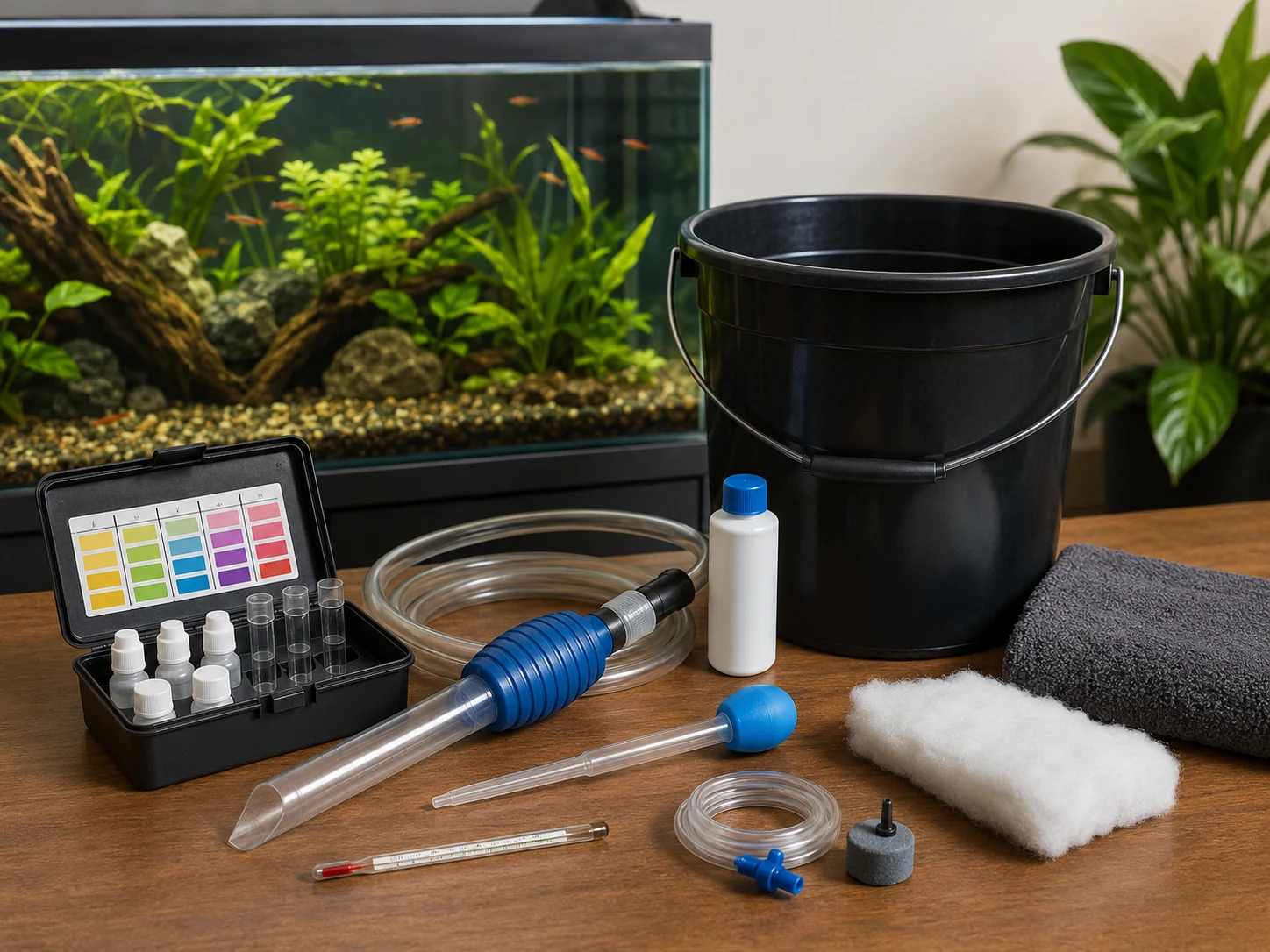
This small kit prevents panic and makes the advice in this guide actually usable.
| Tool | Why it helps | Strong buying note |
|---|---|---|
| Liquid ammonia test | Finds invisible toxic ammonia | More useful than guessing from clear water |
| Liquid nitrite test | Detects cycle trouble | Critical in new or disturbed tanks |
| Liquid nitrate test | Shows routine water-change demand | Better for trends than vague schedules |
| pH test | Helps spot pH crash and Old Tank Syndrome risk | Essential before large changes in neglected tanks |
| KH/GH test | Shows buffering and mineral stability | Useful for shrimp, livebearers, and old tanks |
| Digital thermometer | Matches new water within ±1°C | Better than using your hand |
| Water conditioner for chlorine/chloramine | Makes tap water fish-safe | Must handle chloramine, not just chlorine |
| Ammonia-detoxifying conditioner | Temporary protection when ammonia risk is present | Use according to label; not a cycle replacement |
| Gravel siphon | Removes waste at the source | Choose a size that fits the tank |
| Aquarium-only bucket | Avoids chemical contamination | Never share with household cleaners |
| Turkey baster | Removes uneaten food in small tanks | Very useful for betta/shrimp/nano tanks |
| Filter floss | Catches fine debris after cleanup | Mechanical support, not bio-media |
| Air stone/spare pump | Supports oxygen during emergencies | Helpful during ammonia, heat, or medication stress |
| Towels | Prevents rushed mistakes | Boring but necessary |
This is the testing toolkit readers actually need: ammonia, nitrite, nitrate, pH, KH/GH, and a thermometer. Without these, “change more water” becomes guesswork.
If you need a hospital or emergency setup, keep it simple: a small clean container or tank, dechlorinated water, stable heat when needed, gentle aeration, and basic test supplies. The goal is controlled observation and safe water, not a complicated second display tank.
- a freshwater liquid master test kit
- separate KH/GH test kit
- digital aquarium thermometer
- water conditioner that treats chloramine
- ammonia-detoxifying conditioner
- gravel siphon
- aquarium-only bucket
- air stone and small air pump
A toolkit does not replace judgment.
It gives you safer options when fish are already stressed.
A Practical Weekly Routine
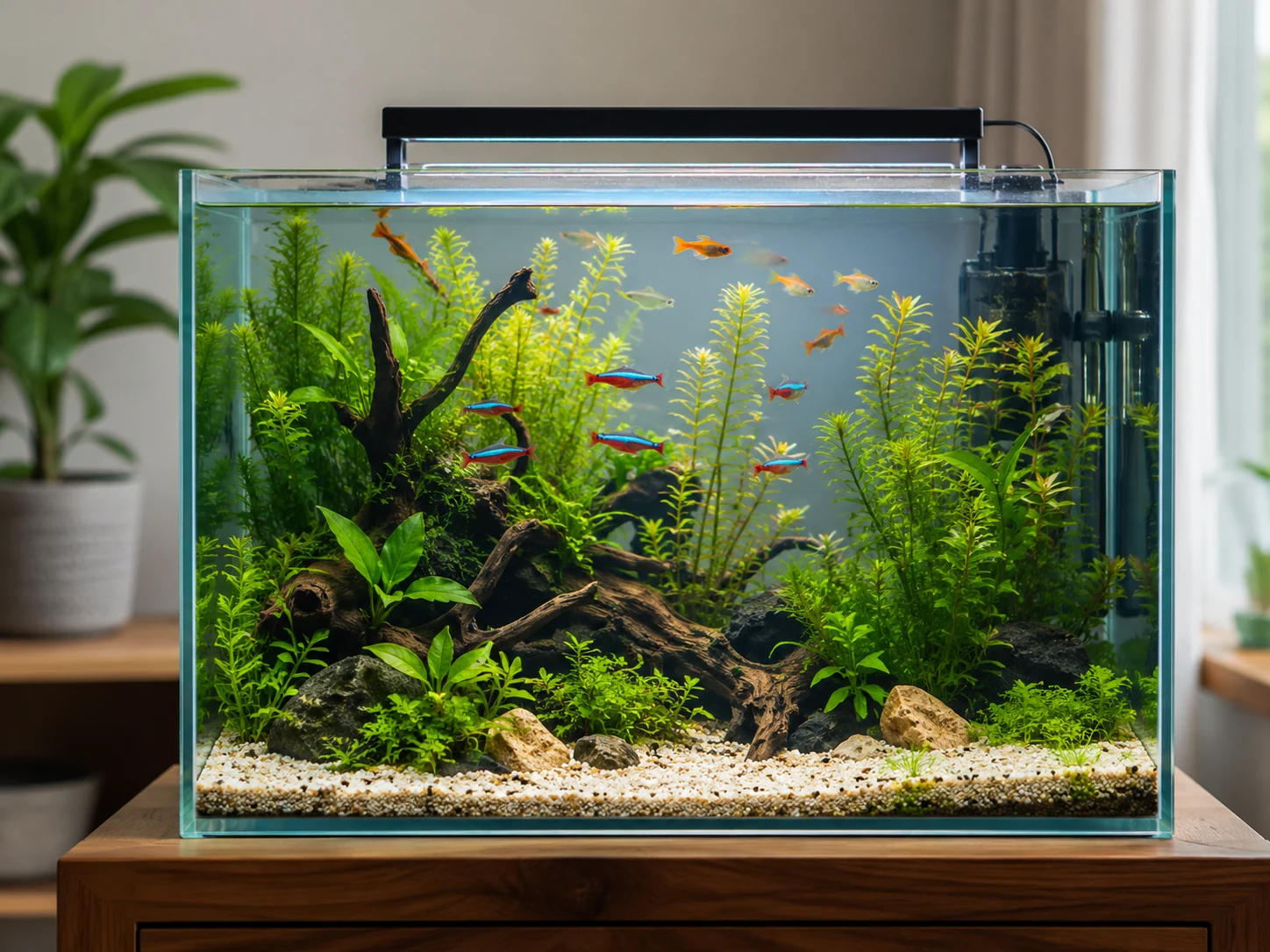
For many beginner tanks:
Once a week
- Test nitrate if you are still learning the tank.
- Check ammonia and nitrite in new or unstable tanks.
- Change 20–30% water.
- Siphon visible debris.
- Remove dead leaves.
- Check filter flow.
- Top off only after the water change.
- Feed lightly afterward.
Every few weeks
- Rinse pre-filter sponge if flow slows.
- Inspect impeller if filter noise changes.
- Review stocking.
- Check plant growth or melting.
- Compare nitrate trend.
Every day
- Count fish.
- Watch breathing.
- Check appetite.
- Confirm filter and heater are running.
- Remove obvious uneaten food.
Good maintenance is not dramatic.
It is consistent.
What Not to Do
| Mistake | Why it is risky |
|---|---|
| Change 100% every week | Stress and instability |
| Use untreated tap water | Chlorine/chloramine damage |
| Match no temperature | Shock |
| Replace all filter media | Cycle crash |
| Deep-stir whole substrate | Waste release |
| Clean everything at once | Double-crash risk |
| Ignore ammonia/nitrite | Fish may be poisoned |
| Overfeed after water change | Adds waste immediately |
| Chase perfect nitrate with huge swings | Stress |
| Stop water changes because plants exist | Organics still build |
The goal is not the biggest water change.
The goal is the safest improvement.
FAQ
How often should I change aquarium water?
For many beginner freshwater aquariums, 20–30% once per week is a good starting point. Adjust based on nitrate, stocking, feeding, tank size, plants, and fish behavior.
Can I change aquarium water too often?
Yes, if the changes are large, poorly matched, or stressful. Frequent small controlled changes can be safe. Repeated large careless changes can cause temperature, pH, or mineral swings.
Should I ever change 100% of the water?
Not for routine maintenance. A 100% change is usually only for contamination, teardown, or special emergency cases. Normal aquariums do better with partial water changes.
How much water should I change weekly?
A common beginner range is 20–30%. Heavily stocked or high-nitrate tanks may need 30–50% or more frequent changes. Sensitive shrimp tanks may need smaller, steadier changes.
Do water changes remove beneficial bacteria?
Partial water changes do not remove much beneficial bacteria because most nitrifying bacteria live on filter media and surfaces. Replacing or washing filter media incorrectly is a much bigger risk.
Should I clean the filter during every water change?
Not aggressively. Clean mechanical media when flow slows, but protect biological media. Rinse sponge or media in old tank water, not untreated tap water.
What should I do if ammonia is present?
Increase aeration, stop feeding temporarily, use an ammonia-detoxifying conditioner according to label if fish are at risk, do a controlled partial water change, protect filter media, and retest.
Should I vacuum gravel every water change?
In gravel tanks, vacuuming sections is useful. Do not deep-clean the entire substrate aggressively every time, especially if the tank is dirty or planted.
Why do fish act stressed after a water change?
Common causes include temperature mismatch, chlorine/chloramine exposure, pH/mineral swing, too large a change, fast refill, or disturbed waste. Check water tests and technique.
Is topping off the same as a water change?
No. Topping off replaces evaporated water only. Waste and minerals stay behind. You still need water changes to remove nitrate and dissolved organics.
How often should I change water in a planted tank?
Many planted tanks do well with weekly changes at first. Mature low-tech tanks may be adjusted by nitrate and plant health. High-tech tanks often benefit from consistent larger changes.
Should I change water if the tank smells bad?
Yes, but first test ammonia/nitrite, increase aeration, remove the odor source, and protect the biofilter. Do not deep-stir the whole substrate or replace all media at once.
What is Old Tank Syndrome?
Old Tank Syndrome is when a neglected aquarium slowly drifts into extreme water chemistry, often with very high nitrate, depleted KH, and low pH. Fish may adapt slowly, but a sudden large water change can shock them. In a long-neglected tank, start with small changes around 10% per day while testing pH, nitrate, ammonia, and nitrite.
Is aging tap water enough for aquarium water changes?
Not reliably. Aging water may reduce free chlorine, but chloramine is much more stable and does not reliably disappear by sitting out for 24–72 hours. Use an aquarium water conditioner that treats both chlorine and chloramine.
How close should new water temperature be?
Aim to keep new water within about ±1°C of the aquarium water. Do not use your hand to guess. Use a digital thermometer or aquarium thermometer before adding new water.
Related Guides
- Smelly Fish Tank
- Cloudy Fish Tank Water
- Fish Gasping at the Surface
- Fish Not Eating
- Algae Problems in Fish Tanks
- How to Cycle a Fish Tank Without Guessing When It’s Safe for Fish
- Freshwater Aquarium Checklist
- Best Aquarium Test Kits
- Best Aquarium Filters
Author Box
Editorial Note
This guide is educational and intended for home freshwater aquariums. Water change schedules should be adjusted by water tests, livestock, stocking, feeding, filtration, plants, and fish behavior. If fish are gasping, ammonia or nitrite is present, or contamination is suspected, treat the situation as urgent rather than routine.
Healthy Aquariums does not recommend full water changes, replacing all filter media, or deep-stirring the entire substrate as normal maintenance.
References
- Aqueon. “Freshwater Aquarium Water Quality: The Nitrogen Cycle & More.” https://www.aqueon.com/articles/freshwater-aquarium-water-quality
- Aqueon. “Aquarium Filtration.” https://www.aqueon.com/articles/aquarium-filtration
- University of Florida IFAS Extension. “Ammonia in Aquatic Systems.” https://edis.ifas.ufl.edu/publication/FA031
- University of Florida IFAS Extension. “Dissolved Oxygen for Fish Production.” https://edis.ifas.ufl.edu/publication/FA002
- New Mexico State University Extension. “Important Water Quality Parameters in Aquaponics Systems.” https://pubs.nmsu.edu/_circulars/CR680/
- Oklahoma State University Extension. “Nitrification and Maintenance in Media Bed Aquaponics.” https://extension.okstate.edu/fact-sheets/nitrification-and-maintenance-in-media-bed-aquaponics
- Manufacturer instructions for any aquarium water conditioner, test kit, siphon, filter media, heater, medication, or remineralizer used by the reader.