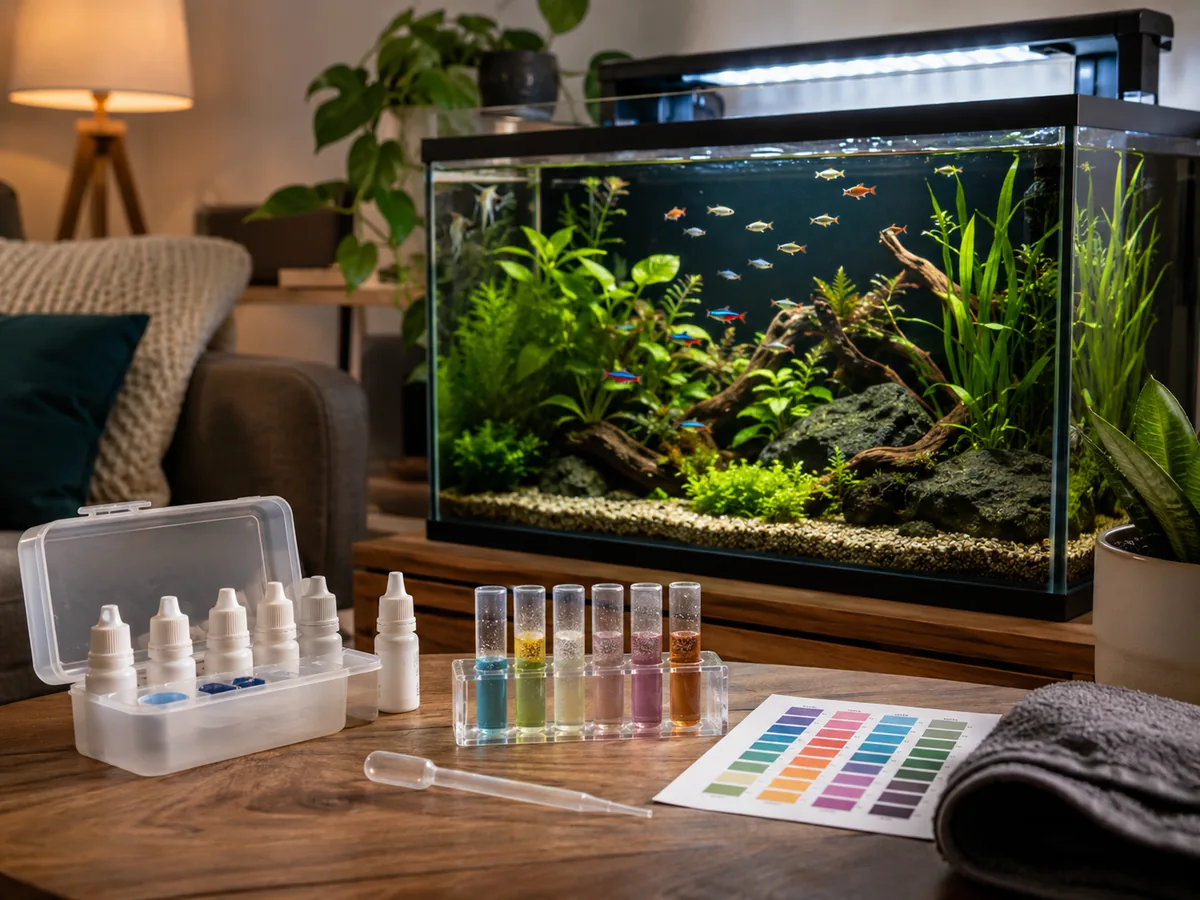
A test kit is most valuable before the tank looks bad. Clear water can still contain ammonia or nitrite, and a cloudy tank is not always the same problem every time. A good kit gives you numbers that stop guesswork from turning into medication, water-change, or chemical mistakes.
The best beginner test kit should cover ammonia, nitrite, nitrate, and pH. For planted tanks, sensitive fish, or tanks with unstable tap water, KH/GH or TDS tools can also help interpret what is changing between water changes.
Liquid Kits vs Strips
Liquid kits are usually better for diagnosing cycling and emergency problems because they provide clearer ranges for ammonia, nitrite, and nitrate. Strips are convenient for quick checks, but they are easier to misread and may not give enough detail during a crisis.
The best choice is not the most complicated kit. It is the kit you will use correctly, record consistently, and read under proper lighting.
How to Read Tests More Accurately
Follow the timing instructions exactly. Reading too early or too late can change the apparent color. Rinse tubes after use, keep caps clean, and avoid cross-contamination between reagents.
Do not read colorimetric tests directly under RGB aquarium LEDs. A blue-heavy or red-heavy fixture can distort yellow, green, orange, and red samples. Use indirect daylight or a neutral white household bulb instead.
Avoid RGB lighting when reading color tests
Colorimetric liquid tests depend on your eyes comparing a sample against a printed chart. RGB aquarium fixtures can distort those colors because a visually white aquarium light may still be built from strong blue, green, and red wavelength peaks. A slightly green ammonia sample or orange nitrate sample can look safer or worse than it really is under colored aquarium lighting.
For fewer diagnostic mistakes, step away from the tank and read test tubes under indirect daylight or a neutral white room light. Keep the tube against the chart background, follow the kit timing exactly, and repeat the test if a result would change a major action such as medication, large water changes, or filter cleaning.
What Numbers Matter Most
Ammonia and nitrite should read zero in an established aquarium. Nitrate should be tracked as a trend, not treated as a single panic number. pH matters most when it changes quickly or when ammonia is present, because pH influences how toxic ammonia becomes.
Water Testing Starter Kit: Keep liquid ammonia, nitrite, nitrate, and pH tests together with clean tubes, a notebook, a pipette, and a neutral reading light. Add KH/GH or TDS tools only when the tank needs deeper stability tracking.
Practical Upgrade Scenarios
If fish are gasping, flashing, clamping fins, hiding, or refusing food, test before treating. The result may point to ammonia, nitrite, pH change, chlorine/chloramine exposure, or a maintenance shock rather than a pathogen.
If nitrate keeps rising quickly, the kit is telling you about the whole system, not only water-change frequency. Feeding volume, stocking level, plant mass, filter maintenance, and trapped detritus all affect the nitrate trend.
If pH changes after water changes, add KH tracking before trying pH-adjusting chemicals. A stable pH that is slightly outside an ideal number is often safer than repeated chemical corrections that swing the tank.
When a Test Result Should Change the Plan
A small ammonia or nitrite reading should stop feeding upgrades, medication experiments, and major cleaning plans until the cause is understood. The safest response is usually conditioner support, aeration, reduced feeding, and controlled water changes matched for temperature.
A high nitrate reading is different from ammonia or nitrite. It usually points to accumulated waste, feeding volume, stocking level, and water-change rhythm. Fix it gradually rather than trying to make the number perfect overnight.
Related Guides
- Ammonia, Nitrite, and Nitrate
- Nitrogen Cycle Explained
- How Often Water Change
- Green Aquarium Water
- Fish Flashing and Scratching
- Aquarium Salt for Freshwater Fish
FAQ
What should a beginner test first?
Ammonia, nitrite, nitrate, and pH are the core beginner tests.
Are test strips good enough?
They are useful for quick checks, but liquid kits are better for diagnosing cycling and fish health problems.
Why does my ammonia result look slightly green?
Check under neutral light and repeat the test. RGB aquarium lighting can create false color impressions.
Should ammonia always be zero?
In a cycled tank with fish, yes. Any detectable ammonia deserves attention.
Should nitrite always be zero?
Yes. Nitrite interferes with oxygen transport and can harm fish quickly.
How often should I test a new tank?
Test every few days during cycling, and anytime fish act abnormal.
Do I need KH and GH tests?
They are helpful if pH swings, plants struggle, shrimp are kept, or tap water is inconsistent.
Is TDS useful?
TDS is useful for tracking dissolved solids changes, but it does not identify which substance changed.
Can test kits expire?
Yes. Old reagents can become unreliable. Replace kits that are expired or stored poorly.
Should I medicate before testing?
No. Test water first unless the fish is in immediate life-threatening distress and you already know the cause.
References
- Merck Veterinary Manual. Aquarium fish health and environmental disease guidance. https://www.merckvetmanual.com/exotic-and-laboratory-animals/aquarium-fish
- University of Florida IFAS Extension. Aquarium fish management and water quality resources. https://edis.ifas.ufl.edu/
- API Fishcare. Freshwater aquarium testing and water-care education. https://www.apifishcare.com/