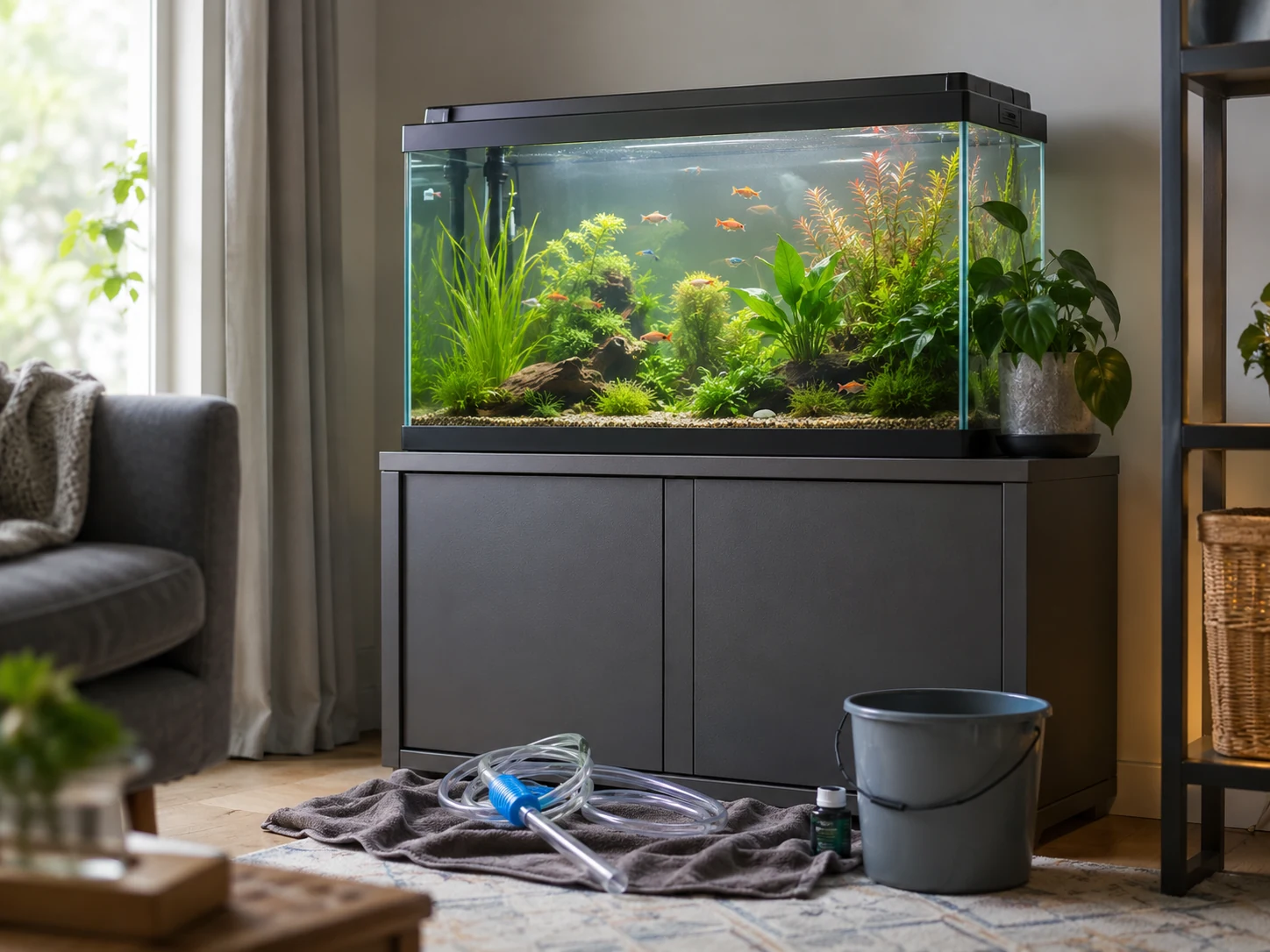
Water changes are not just about making water look clean. They remove dissolved waste, restore mineral balance, dilute hormones and organic buildup, and prevent slow water-quality drift.
But water changes can also hurt fish when done carelessly. A sudden “fresh” correction can shock fish that have slowly adapted to poor water. The right schedule depends on fish load, feeding, nitrate, tank age, plants, filtration, and tap-water chemistry.
Quick answer
Many beginner freshwater tanks do well with 20–30% water changes once per week, but the real answer should be guided by nitrate, fish behavior, stocking, and tank stability.
Do smaller, repeated changes for old neglected tanks. Match temperature within about ±1°C when possible, always condition tap water, and avoid combining a huge water change with aggressive substrate and filter cleaning.
Why water changes matter
A filter processes ammonia and nitrite, but it does not remove everything. Nitrate, dissolved organics, tannins, minerals, and waste byproducts still accumulate.
Plants help, but most beginner aquariums still need water changes.
Water changes are the export system. Feeding adds nutrients. Fish produce waste. Water changes remove what the tank cannot permanently process.
A practical schedule
| Tank type | Starting water-change routine |
|---|---|
| Lightly stocked planted tank | 15–25% weekly or as nitrate requires |
| Average beginner community tank | 20–30% weekly |
| Goldfish tank | 30–50% weekly, often more if nitrate rises |
| Betta tank under 10 gallons | 20–30% weekly |
| Shrimp tank | Smaller, steadier changes |
| New cycling tank with fish | As needed based on ammonia/nitrite |
| Old neglected tank | Small repeated changes, not one huge reset |
This table is a starting point. Testing decides whether the schedule is enough.
The nitrate test tells the truth
If nitrate keeps climbing, your water-change routine is not removing enough waste. The cause may be too many fish, too much food, too little water volume, weak maintenance, or tap water that already contains nitrate.
A good routine keeps nitrate from rising endlessly. The exact target depends on livestock, but lower and stable is usually better than high and neglected.
The Old Tank Syndrome trap
Old Tank Syndrome happens when a neglected aquarium slowly drifts into poor chemistry. Fish may survive because the change happened gradually. Then the keeper performs a massive water change and the fish crash.
The shock can come from sudden changes in pH, mineral concentration, temperature, or osmotic pressure. Clean water is not always safe when introduced too abruptly.
If a tank has not been maintained for a long time, test first. Then perform smaller changes over several days or weeks. Stability saves fish.
Beyond nitrate: TDS and osmotic shock
Nitrate is useful, but it is not the only reason old aquarium water becomes dangerous. Over time, fish food, mineral inputs, evaporation, waste products, and dissolved organics can raise total dissolved solids (TDS). The water may still look clear while its dissolved load becomes very different from the source water.
Fish regulate water and salts through the gills, kidneys, and internal fluids. If a tank has gone months without proper water changes, fish may have adjusted to a higher-TDS environment. A sudden large water change with much lower-TDS tap water can create osmotic stress: the surrounding water changes faster than the fish can regulate.
This is one of the real mechanisms behind Old Tank Syndrome. The fish may die after a big “clean water” correction because the dissolved-solids gradient changed too abruptly.
The operational rule is conservative: in neglected tanks, avoid changing TDS by more than roughly 10–15% in 24 hours when you can measure it. A simple TDS pen is useful for comparing tank water to source water. If the gap is large, use smaller repeated changes or drip-style correction over several days instead of one large reset.
Temperature matching and oxygen
Temperature matters because fish are sensitive to sudden thermal shifts. Match new water within about ±1°C when possible.
Also remember the oxygen connection. Warmer water holds less oxygen while fish metabolism increases. During warm seasons or after a large maintenance session, increase surface movement or aeration if fish breathe faster or gather near flow.
Chlorine vs chloramine
Tap water must be conditioned before it enters the aquarium.
Chlorine may dissipate with time, but chloramine is more stable and does not reliably disappear just because water sits out overnight. Many municipalities use chloramine. Use a water conditioner that handles both chlorine and chloramine unless you know your supply and treatment method.
Do not add untreated tap water to the tank.
How to do a safe water change
- Turn off equipment if water level will expose heater or filter intake.
- Siphon water into an aquarium-only bucket.
- Remove visible debris without deep-stirring the whole substrate.
- Prepare new water with conditioner.
- Match temperature closely.
- Refill slowly enough that fish are not blasted.
- Restart equipment and confirm filter/heater operation.
- Watch fish behavior for 15–30 minutes.
For deep substrate concerns, clean only localized areas while siphoning directly at the disturbance point. Do not randomly poke deep substrate throughout the tank.
Do not combine every correction at once
A common beginner mistake is doing a heroic reset: huge water change, deep gravel cleaning, filter media replacement, new chemicals, and decor scrubbing on the same day.
That can remove bacteria, release trapped waste, change chemistry, and stress fish at the same time.
Fix tanks in controlled steps. Water change first. Test. Restore oxygen. Protect filter media. Then adjust the next variable.
Keep an aquarium-only bucket, gravel siphon, thermometer, conditioner for chlorine/chloramine, liquid test kit, towel, TDS pen, and backup air stone. These tools make water changes safer than guessing by appearance.
FAQ
How often should I change aquarium water?
Many beginner tanks start with 20–30% weekly, then adjust based on nitrate, fish load, and behavior.
Can I change too much water?
Yes, especially in old neglected tanks where sudden chemistry shifts can shock fish.
Should I remove fish during a water change?
Usually no. Removing fish often causes more stress than a careful water change.
Do I need conditioner every time?
Yes, if using tap water that may contain chlorine or chloramine.
Is water sitting overnight enough?
Not if your tap water contains chloramine. Use conditioner.
Should new water match temperature?
Yes. Aim close, ideally within about ±1°C for routine changes.
Can I clean the filter during a water change?
Yes, but gently. Rinse media in old tank water and do not replace all bio-media.
How do I lower high nitrate safely?
Use repeated controlled water changes, reduce feeding, remove waste, and check stocking.
Do planted tanks need water changes?
Yes. Plants help but do not eliminate all maintenance.
Why do fish act strange after a water change?
Possible causes include temperature shock, chlorine/chloramine, pH/mineral swing, low oxygen, or disturbance of waste.
Related Guides
- Ammonia, Nitrite, and Nitrate
- Aquarium Maintenance Schedule
- Aquarium Water Care Guide
- Can You Wash Filter Media in Tap Water?
- Goldfish Care Guide
Author Box
Written by the Healthy Aquariums editorial team. We teach water changes as controlled ecosystem maintenance, not a cosmetic reset.
Editorial Note
Water-change percentages should be adapted to the tank. Fish in old, neglected, or unstable aquariums may need gradual correction.
References
- Aqueon. Water Changes in Aquariums. https://www.aqueon.com/articles
- EPA. Chloramines in Drinking Water. https://www.epa.gov/dwreginfo/chloramines-drinking-water
- Merck Veterinary Manual. Environmental Diseases of Aquatic Animals in Aquatic Systems. https://www.merckvetmanual.com/exotic-and-laboratory-animals/aquatic-systems/environmental-diseases-of-aquatic-animals-in-aquatic-systems