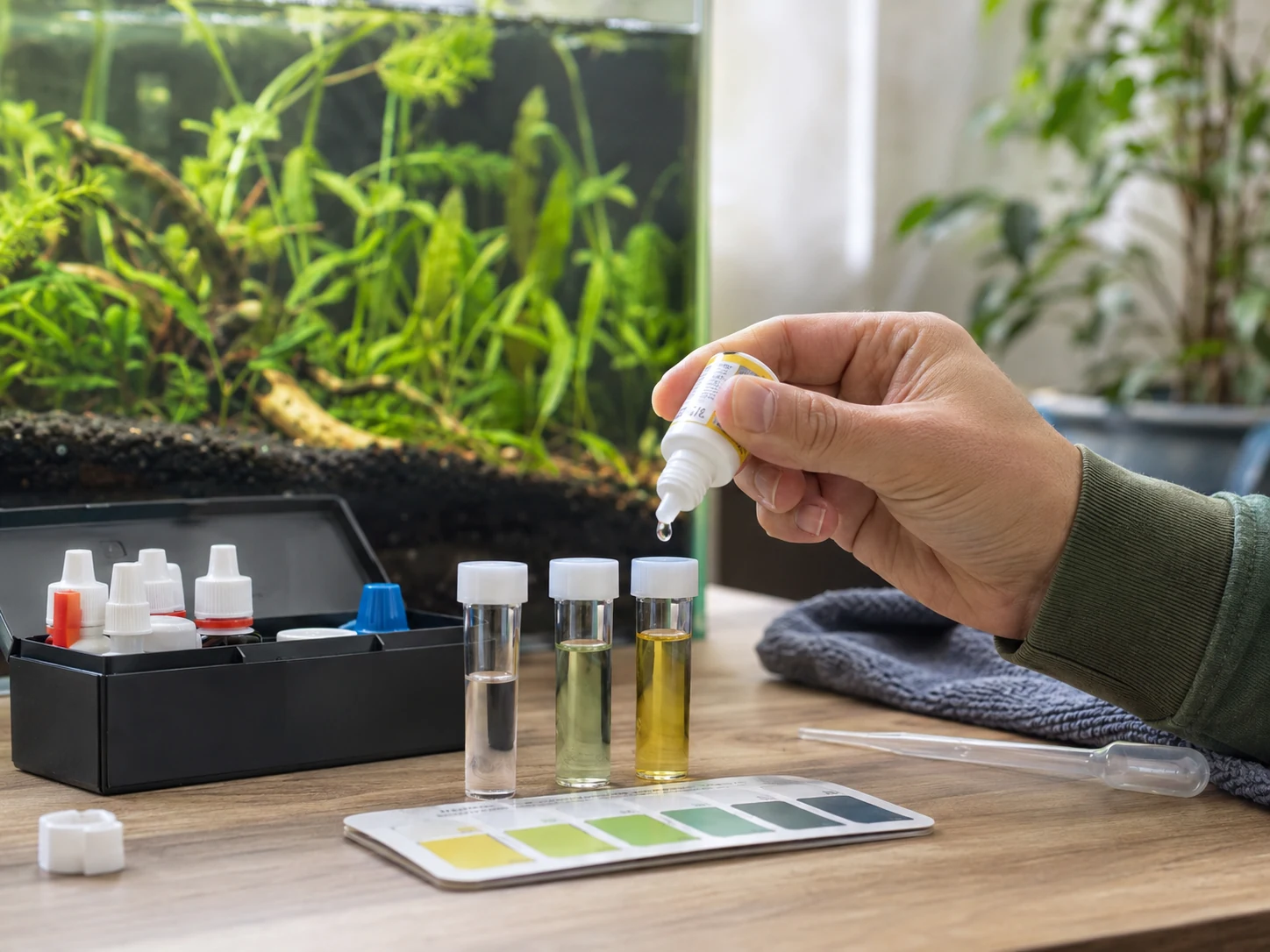
Most aquarium disasters do not begin with fish suddenly getting sick. They begin with invisible waste building up faster than the tank can process it.
Ammonia, nitrite, and nitrate are the three nitrogen numbers beginners must understand. They are not random test-kit colors. They are a timeline of how well the aquarium is handling fish waste, uneaten food, plant decay, and filter bacteria.
If you learn to read these three numbers together, you stop guessing.
Quick answer
Ammonia and nitrite should read 0 ppm in a stocked freshwater aquarium. Nitrate should usually stay low and controlled through water changes, plants, stocking control, and feeding discipline.
If ammonia or nitrite appears, treat it as urgent. Test again, reduce feeding, increase aeration, use water conditioner according to the label if needed, and perform controlled water changes with temperature-matched, conditioned water. Do not deep-clean the whole tank and filter at the same time.
What ammonia means
Ammonia is the first dangerous waste product in the aquarium. Fish release ammonia through their gills, and more ammonia comes from fish waste, uneaten food, dead plants, dead snails, and rotting organic matter.
A mature biofilter converts ammonia into nitrite. A weak, new, damaged, or oxygen-starved biofilter lets ammonia accumulate.
Ammonia is especially dangerous because its toxicity depends on pH and temperature. At higher pH and higher temperature, a larger portion of total ammonia becomes un-ionized ammonia, which is more toxic to fish. This is why warm, alkaline tanks can become dangerous faster.
What nitrite means
Nitrite is produced when bacteria convert ammonia. It is also toxic.
Nitrite interferes with oxygen transport in fish. A fish can be in oxygen-rich water and still suffer internally if nitrite is high. This is one reason nitrite problems often look like oxygen problems: fish gasp, hang near flow, become weak, or act stressed.
If nitrite appears, do not only add more bubbles and hope. Test water, reduce feeding, protect the biofilter, and correct the cause.
What nitrate means
Nitrate is the end product of the normal freshwater nitrogen cycle. It is less immediately toxic than ammonia or nitrite, but it is not meaningless.
High nitrate often tells you that the aquarium is being loaded faster than maintenance removes waste. It may come from overstocking, overfeeding, weak water-change habits, dirty substrate, neglected filter debris, or tap water that already contains nitrate.
Nitrate is also connected to algae. It is not the only algae trigger, but excess nutrients plus too much light can turn a tank green quickly.
How to read the three numbers together
| Test result | What it usually means | First response |
|---|---|---|
| Ammonia 0, nitrite 0, nitrate rising slowly | Tank is cycled but needs routine export | Water changes and feeding control |
| Ammonia present, nitrite 0 | New tank, sudden waste, damaged biofilter, pH/temperature risk | Test daily, reduce feeding, condition water, aerate |
| Ammonia present, nitrite present | Cycle is incomplete or biofilter is overwhelmed | Emergency water-quality response |
| Ammonia 0, nitrite present | Cycle is halfway working but not stable | Protect bacteria, reduce load, monitor |
| Nitrate very high | Waste export is behind | Gradual water changes, avoid sudden shock in old tanks |
The pH and temperature trap
A beginner may see the same ammonia reading in two tanks and assume the risk is identical. It is not.
Warm water holds less dissolved oxygen, while fish metabolism increases. At the same time, higher pH shifts more total ammonia toward the more toxic form. This means a warm, high-pH tank can punish fish faster than a cooler, lower-pH tank with the same total ammonia reading.
The fix is not to chase pH suddenly. Sudden pH swings can shock fish. The fix is to remove the ammonia source, support oxygen, and use controlled water changes.
The pH-ammonia inversion trap during emergency water changes
Total ammonia is not one single risk. It exists mainly as two forms: un-ionized ammonia, NH3, and ionized ammonium, NH4+. The dangerous form is NH3 because it crosses gill membranes far more easily. The balance between NH3 and NH4+ is controlled by pH and temperature.
This creates a trap in neglected tanks. A tank with heavy organic waste may accumulate carbon dioxide and acids that push pH downward. At a low pH, a high total ammonia reading may be held mostly as less-toxic NH4+. The fish are not safe, but they may be surviving in a fragile low-pH stasis.
If the keeper panics and performs one large water change with higher-pH tap water, the pH can rise quickly. That shift can convert more NH4+ into toxic NH3 within minutes. The fish may die after the “clean” water change, not because water changes are bad, but because the ammonia chemistry changed too fast.
If you find high ammonia together with a collapsed pH below about 6.5, do not treat the tank like a normal dirty aquarium. Dose an ammonia-binding conditioner according to the label, increase aeration, and lower total ammonia with small repeated water changes of about 10–15%, spaced out over time. The goal is to reduce TAN and normalize pH gradually, not to swing the chemistry in one rescue attempt.
What to do if ammonia appears
Do this in order:
- Test ammonia, nitrite, nitrate, pH, and temperature.
- Stop feeding for 24 hours unless fry or medically fragile fish require food.
- Remove uneaten food, dead plants, or dead livestock.
- Increase aeration or surface movement.
- Dose a conditioner that detoxifies ammonia if the product label supports it.
- Perform a controlled water change with dechlorinated, temperature-matched water.
- Keep filter media wet and running.
- Retest daily.
Do not replace all filter media. Do not scrub the substrate aggressively. Do not change 70% of the water in an old neglected tank unless fish are in immediate lethal distress and you understand the shock risk.
What to do if nitrite appears
Nitrite means oxygen transport is at risk. Increase aeration immediately.
A measured salt dose can sometimes reduce nitrite uptake in certain freshwater fish, but salt is not universally safe. Corydoras, many plants, shrimp, and some soft-water fish can be sensitive. Do not dump aquarium salt into a community tank as a reflex.
The safer beginner response is water testing, controlled water changes, feeding reduction, oxygen support, and protecting the biofilter.
What to do if nitrate is high
High nitrate usually calls for waste export, not panic.
In a normal maintained tank, a water change can lower nitrate. In an old neglected tank, large sudden changes can create osmotic or pH shock because fish have adapted to poor water slowly. This is Old Tank Syndrome territory.
If nitrate is extremely high in an old tank, use smaller repeated water changes. Match temperature within about ±1°C when possible, condition water properly, and avoid deep-cleaning the substrate and filter on the same day.
Testing routine
For new tanks, test ammonia and nitrite frequently until both stay at zero. For established tanks, test when fish act abnormal, after filter mistakes, after adding fish, after overfeeding, after power outages, or before major maintenance.
Test strips are convenient but less precise. Liquid test kits are usually better for ammonia, nitrite, nitrate, and pH decisions.
Keep a liquid ammonia/nitrite/nitrate test kit, thermometer, water conditioner that handles chlorine and chloramine, a clean bucket, siphon, and backup aeration. These tools solve more real fish emergencies than most bottled quick-fix products.
FAQ
What should ammonia be in a fish tank?
Ammonia should be 0 ppm in a stocked aquarium.
What should nitrite be in an aquarium?
Nitrite should be 0 ppm. Any nitrite in a stocked aquarium deserves attention.
Is nitrate safe for fish?
Nitrate is less toxic than ammonia or nitrite, but high nitrate is still a long-term stress signal and should be controlled.
Why is ammonia worse at high pH?
Higher pH shifts more total ammonia toward the more toxic un-ionized form.
Can clear water still have ammonia?
Yes. Water can look clear and still contain toxic ammonia or nitrite.
Should I change all the water if ammonia is high?
Not automatically. Use controlled, conditioned, temperature-matched water changes and consider the tank’s age and fish condition.
Can dirty filters cause ammonia?
Yes, if flow is blocked or the biofilter is damaged. Clean mechanical blockages gently without sterilizing bio-media.
Does nitrate cause algae?
Nitrate contributes to algae when combined with light imbalance and other nutrients, but it is not the only cause.
Can plants remove nitrate?
Plants can help, but they do not replace testing, water changes, or proper stocking.
What test kit should beginners buy first?
A liquid kit that measures ammonia, nitrite, nitrate, and pH is the best first water-quality tool.
Related Guides
- Nitrogen Cycle Explained
- How Often Should You Change Aquarium Water?
- Aquarium Maintenance Schedule
- Can You Wash Aquarium Filter Media in Tap Water?
- Filter Not Working
Author Box
Written by the Healthy Aquariums editorial team. We explain water chemistry through fish behavior, biofilter biology, and practical maintenance rather than vague “water quality” advice.
Editorial Note
This article is educational and does not replace veterinary advice. If fish show severe distress, combine water testing with immediate oxygen support and species-appropriate care.
References
- API Fishcare. The Nitrogen Cycle. https://www.apifishcare.com/blog/the-nitrogen-cycle-keeping-your-aquarium-healthy
- Aqueon. The Nitrogen Cycle. https://www.aqueon.com/articles/the-nitrogen-cycle
- Merck Veterinary Manual. Environmental Diseases of Aquatic Animals in Aquatic Systems. https://www.merckvetmanual.com/exotic-and-laboratory-animals/aquatic-systems/environmental-diseases-of-aquatic-animals-in-aquatic-systems