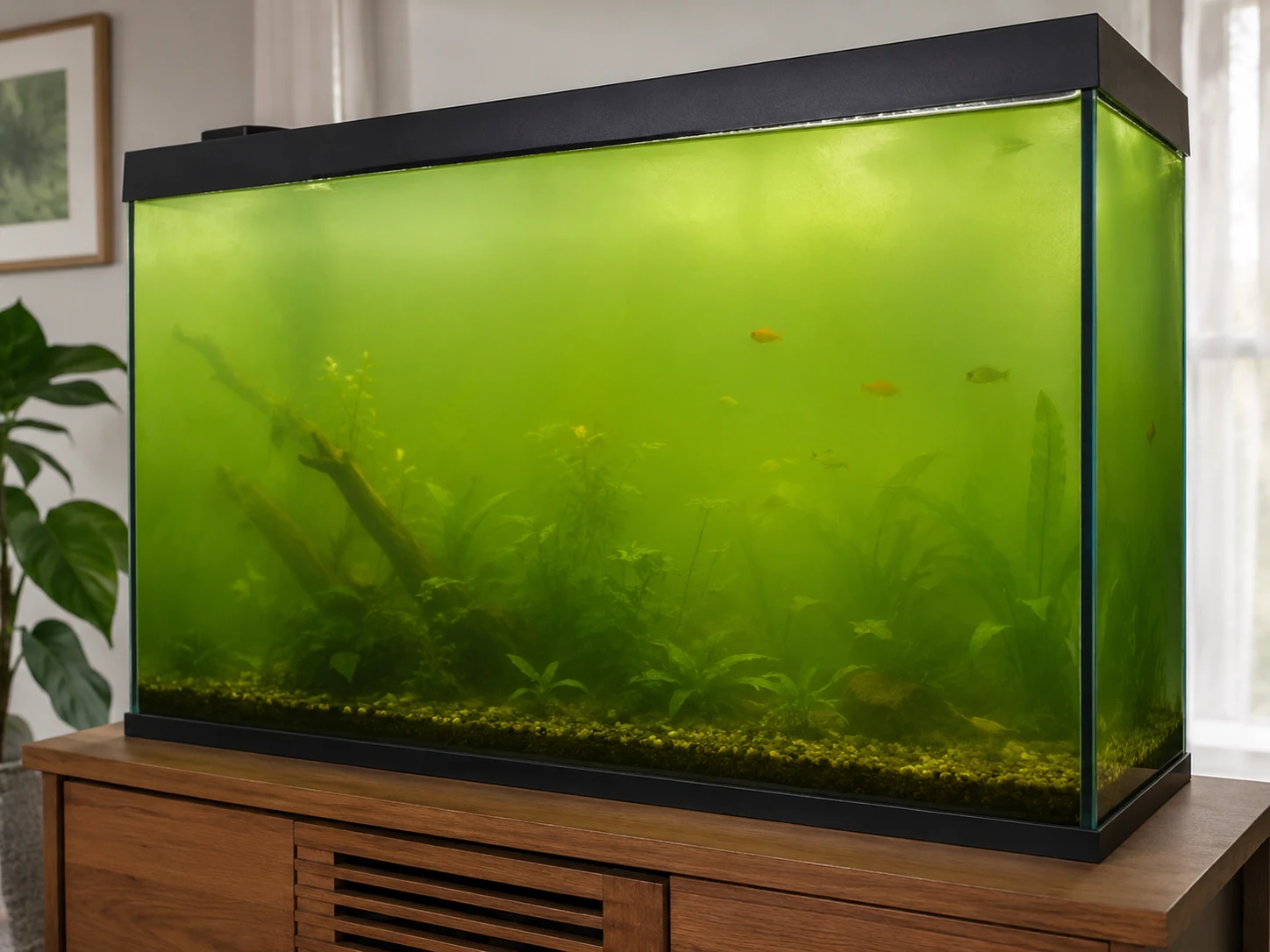
Green aquarium water looks like the tank has turned into pea soup. The fish may still be alive, the filter may still be running, and the glass may even be clean. But the water itself becomes green because free-floating algae are multiplying in the water column.
The mistake is treating green water like dirt. It is not dirt. It is algae using light and nutrients.
Quick answer
Green aquarium water is usually caused by too much light, excess nutrients, direct sunlight, overfeeding, high nitrate/phosphate, or an immature tank. Fix it by reducing light, removing nutrient sources, testing water, improving maintenance, and using blackout or UV carefully when appropriate.
Do not do a full tank reset unless there is a separate emergency. Resetting the tank can damage the biofilter and make the next algae bloom worse.
What green water actually is
Green water is usually a bloom of microscopic algae suspended in the water. These algae use light as energy and nutrients as fuel.
That means the solution is not only mechanical filtration. A normal sponge or HOB filter may not catch all microscopic algae cells. You must correct the energy and nutrient imbalance.
Common causes
| Cause | Why it feeds green water |
|---|---|
| Direct sunlight | Strong uncontrolled light |
| Long photoperiod | Algae get too much energy |
| Overfeeding | Extra nutrients decay |
| High nitrate | Nutrient fuel |
| Dirty substrate | Hidden organic waste |
| Immature tank | Unstable microbial balance |
| Weak plant growth | Plants fail to compete |
| Blue night light | Extends algae energy window |
Green water usually has more than one cause.
Light control comes first
Start by reducing light duration. Many beginner tanks do better at 6–8 hours of controlled light. Fish-only tanks do not need bright plant-level lighting.
Avoid direct window sunlight. A tank near a window can receive hours of uncontrolled light even if the aquarium light is on a timer.
Do not leave blue moonlight on overnight. Fish need darkness to rest, and algae can use extended light energy. Night should be dark unless there is a short viewing period.
Nutrient control
Algae blooms also need nutrients.
Check:
- overfeeding;
- uneaten food;
- dead plant leaves;
- dirty substrate pockets;
- clogged mechanical media;
- high nitrate;
- tap water nitrate;
- overstocking.
Feed less for a few days while correcting green water. Remove uneaten food. Siphon visible debris, but do not deep-stir the whole substrate.
Blackout method
A blackout can help because algae need light. But it must be done carefully.
A safe beginner blackout usually means turning aquarium lights off and blocking outside light for 2–3 days while maintaining filtration and aeration. Do not stop the filter. Do not starve fish for a week without reason. Do not wrap the tank in a way that traps heat.
During a blackout, algae die-off can consume oxygen and release organic waste. Increase surface movement or aeration, especially in warm tanks.
After blackout, resume a shorter light schedule. If you return to the same lighting and feeding, green water returns.
UV sterilizer
A UV sterilizer can clear green water effectively by damaging free-floating algae cells as water passes through the unit. It can be useful for persistent blooms.
But UV does not fix the cause. If light and nutrients stay excessive, algae pressure remains. UV is a tool, not a license to overfeed or run lights all day.
Useful tools include a liquid nitrate test, timer or dimmable light control, gravel siphon, filter floss for temporary polishing, water conditioner, backup aeration, and an optional UV sterilizer for persistent blooms. Use them with a shorter light schedule, not instead of fixing the cause.
Oxygen depletion after green water die-off
The most dangerous moment in a green-water correction may happen after the water begins to clear.
When a blackout or UV sterilizer kills large numbers of single-celled algae, those dead cells become organic waste. Heterotrophic bacteria multiply to decompose that material, and that bacterial bloom consumes dissolved oxygen. At night, algae and plants also respire rather than photosynthesize, pulling more oxygen from the water.
This can create a nocturnal hypoxia event: fish look acceptable in the evening, then gasp or die near dawn when dissolved oxygen is lowest.
Any aggressive green-water correction should include oxygen support. Increase surface agitation, add an air stone, keep the filter running, and watch fish closely in the early morning. In warm tanks, this is even more important because warm water holds less oxygen.
What not to do
Do not replace all filter media. The biofilter is not the enemy.
Do not scrub the whole tank and remove every surface. That can destabilize the microbial community.
Do not overdose algaecides casually. Some livestock, plants, and biofilters may react badly.
Do not perform repeated huge water changes without addressing light. Green water often returns because the algae cells and cause remain.
Step-by-step fix
- Test ammonia, nitrite, nitrate, pH, and temperature.
- Remove the tank from direct sunlight if possible.
- Reduce aquarium light to 6 hours temporarily.
- Stop blue moonlight at night.
- Feed lightly and remove leftovers.
- Siphon visible debris.
- Rinse clogged mechanical media in old tank water.
- Increase aeration if algae die-off is expected.
- Consider blackout or UV for stubborn blooms.
- Resume controlled light slowly.
FAQ
Is green aquarium water dangerous?
It can become dangerous if it reduces oxygen or hides water-quality problems. Test water.
Will a filter clear green water?
Normal filters may not catch microscopic algae well. You must control light and nutrients.
Does sunlight cause green water?
Direct sunlight is one of the most common triggers.
Should I do a full water change?
No. Large resets can shock fish and do not fix the underlying light/nutrient problem.
Does blue moonlight cause algae?
Extended blue night lighting can contribute to algae pressure and disrupt fish rest.
How long should aquarium lights be on?
Many tanks do well around 6–8 hours, depending on plants and algae response.
Is blackout safe for fish?
Short blackouts can be safe if filtration and oxygen continue and temperature remains stable.
Does UV sterilizer work?
UV can clear suspended algae, but it does not remove the cause.
Should I stop feeding?
Feed lightly, but do not starve fish unnecessarily. Remove leftovers.
Why did green water come back?
The original light and nutrient imbalance likely remained.
Related Guides
- Aquarium Lights Guide
- Ammonia, Nitrite, and Nitrate
- How Often Should You Change Aquarium Water?
- Aquarium Maintenance Schedule
- Best Aquarium Lights
Author Box
Written by the Healthy Aquariums editorial team. We treat algae problems as ecosystem imbalances involving light, nutrients, plants, oxygen, and maintenance.
Editorial Note
Algae fixes should protect fish first. Avoid chemical shortcuts that create oxygen or biofilter problems.
References
- The Spruce Pets. Causes and Cures for Green Aquarium Water. https://www.thesprucepets.com/causes-and-cures-for-green-aquarium-water-1378633
- Aqueon. Green Water — Causes and Cures. https://www.aqueon.com/articles/green-water----causes-and-cures
- Merck Veterinary Manual. Environmental Diseases of Aquatic Animals in Aquatic Systems. https://www.merckvetmanual.com/exotic-and-laboratory-animals/aquatic-systems/environmental-diseases-of-aquatic-animals-in-aquatic-systems