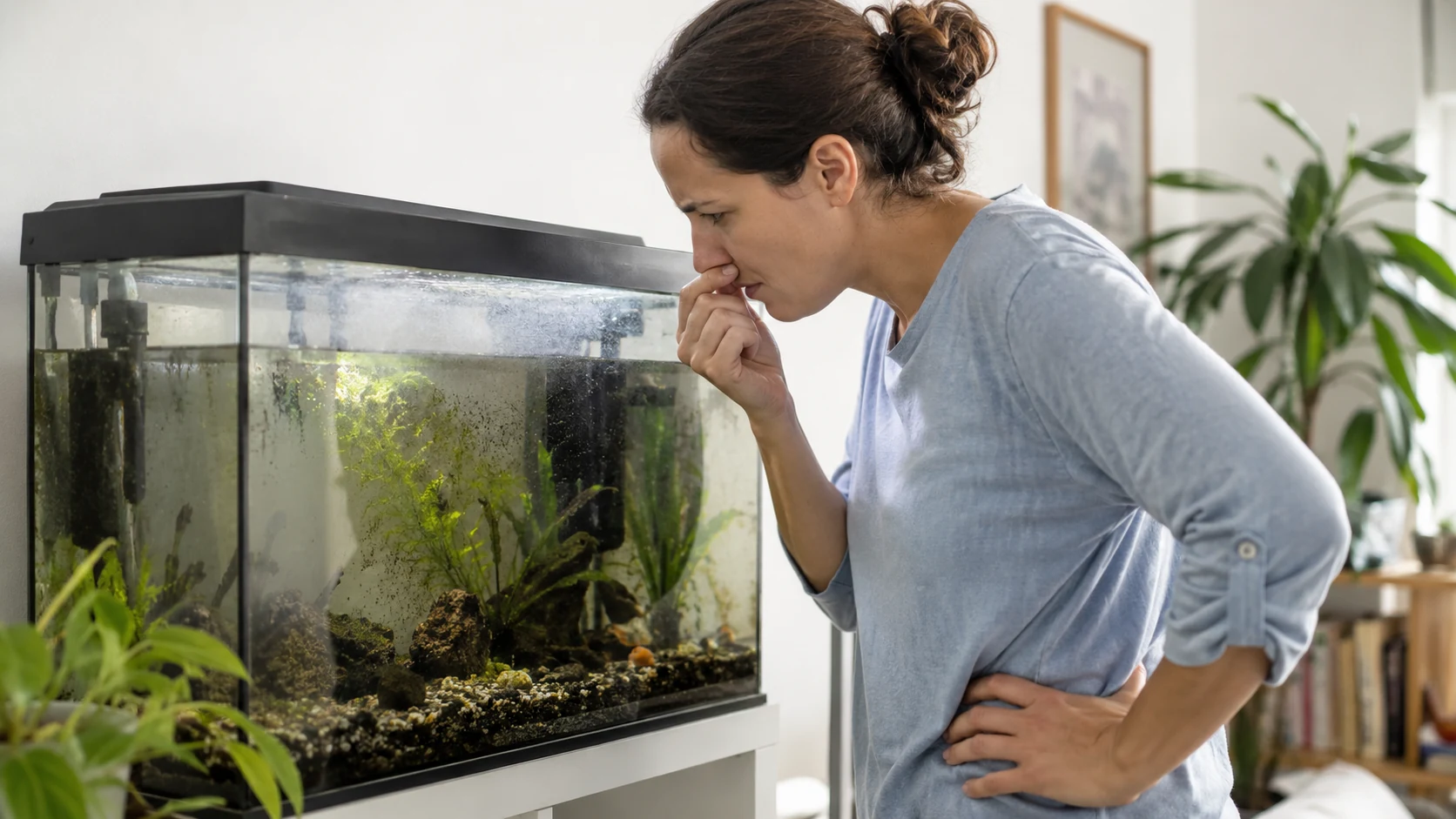
A healthy aquarium should not stink.
It may have a light earthy or pond-like smell when you open the lid. That can be normal. But it should not smell like rotten eggs, sewage, sour food, dead fish, mold, chemicals, or a dirty drain.
A bad smell is not just a comfort problem.
It is information.
Something is breaking down, trapped, dying, rotting, or being processed faster than the aquarium can handle. The smell may come from uneaten food, fish waste, dead plant leaves, a dead snail, a clogged filter, dirty substrate, an uncycled tank, anaerobic pockets, overstocking, or a filter that stopped during a power outage.
The mistake is trying to cover the smell.
Do not add perfume.
Do not dump in random “odor remover.”
Do not tear the whole tank apart unless there is true contamination.
A smelly aquarium needs diagnosis.
Fix the cause, protect the filter bacteria, and the smell usually fades.
Normal Aquarium Smell vs Bad Smell
Not every aquarium smell is a problem.
A mature planted tank may smell faintly earthy. A tank with driftwood may have a light natural smell. A lid may smell a little damp when opened.
That is different from odor that spreads into the room.
| Normal-ish | Not normal |
|---|---|
| Light earthy smell only when lid opens | Smell fills the room |
| Mild pond-like smell | Rotten egg smell |
| Damp smell from lid area | Sewage smell |
| Tannin/wood smell | Dead animal smell |
| Brief smell after light substrate cleaning | Persistent sour smell |
| No fish stress | Fish gasping, hiding, clamping fins |
A tank can look clear and still smell bad.
Clear water does not prove clean substrate, clean filter flow, or safe ammonia and nitrite.
Emergency Signs: When a Smelly Tank Is Urgent
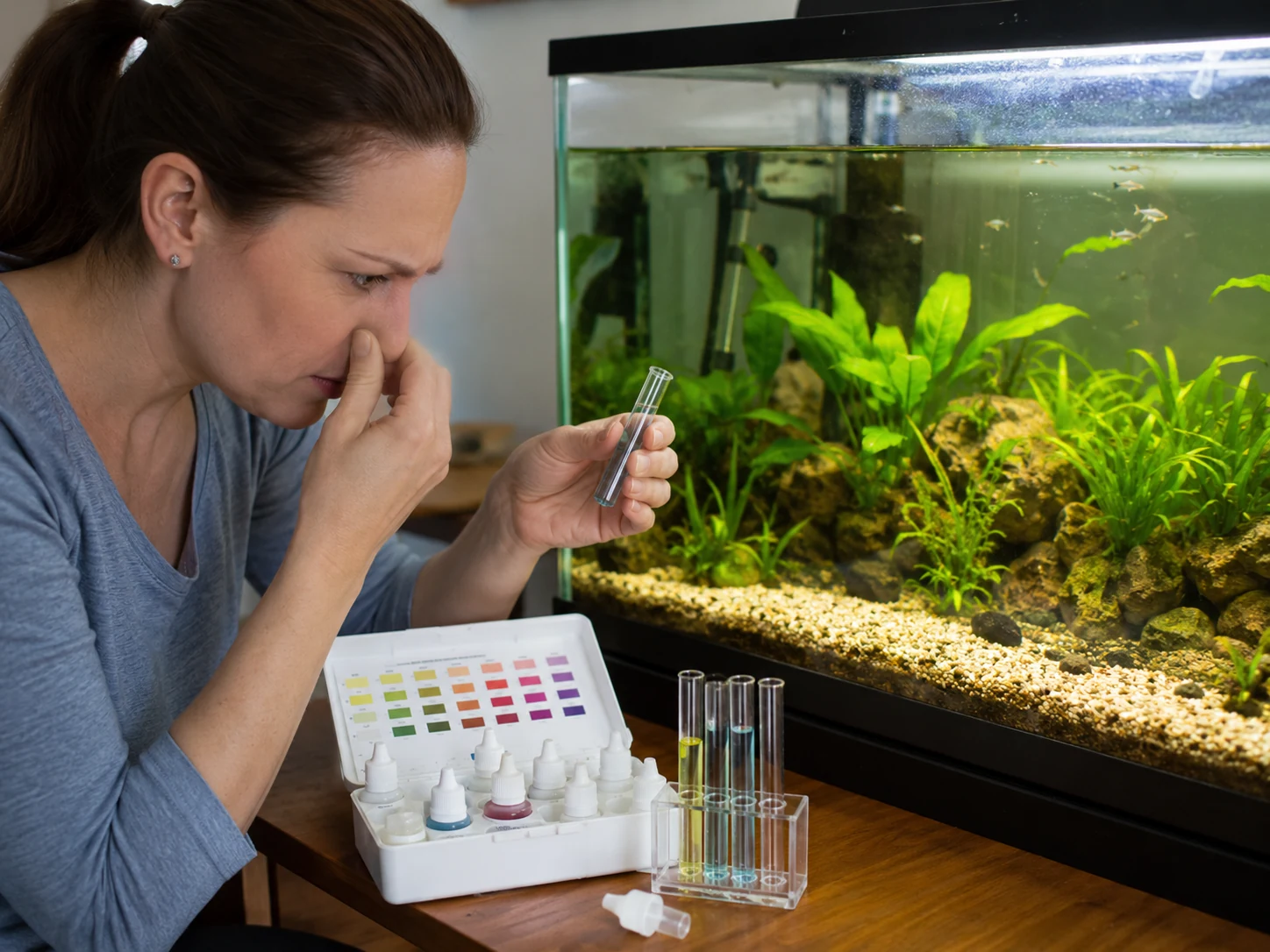
A smell alone may not be an emergency.
A smell plus fish stress is different.
| Emergency sign | Why it matters |
|---|---|
| Fish gasping at surface | Low oxygen or water toxins |
| Ammonia above 0 ppm | Unsafe in stocked tank |
| Nitrite above 0 ppm | Unsafe in stocked tank |
| Rotten egg smell | Possible anaerobic pocket or severe decay |
| Dead fish/snail found | Sudden waste spike |
| Filter stopped | Oxygen and biofilter risk |
| Cloudy water plus smell | Bacterial bloom/organic overload |
| Fish lying on bottom | Serious stress |
| Multiple fish affected | Shared water problem |
| Chemical smell | Possible contamination |
Emergency response:
- Increase aeration.
- Test ammonia, nitrite, and pH.
- If ammonia is present or the smell is strong and fish are stressed, dose a trusted water conditioner/ammonia detoxifier according to the label before disturbing the tank.
- Remove dead organisms or rotting food.
- Check filter flow.
- Prepare dechlorinated, temperature-matched water.
- Do a controlled partial water change if tests or fish behavior justify it.
- Stop feeding temporarily.
- Do not add medication or deodorizer first.
This matters because ammonia toxicity is affected by pH and temperature. In some dirty tanks, a sudden water change with higher-pH water can shift more total ammonia toward the more toxic NH3 form. A conditioner that temporarily detoxifies ammonia, used exactly as directed, can buy time while you remove waste and dilute the problem safely.
Bad smells often come from waste.
Waste problems are water problems.
Cause 1: Overfeeding

Overfeeding is the most common beginner cause of smelly water.
Fish food is concentrated organic matter. If fish do not eat it quickly, it sinks, softens, rots, feeds bacteria, and turns into waste. The tank starts to smell fishy or sour. The filter clogs faster. Ammonia may rise. Oxygen can drop.
Signs of overfeeding:
| Sign | Meaning |
|---|---|
| Food on substrate after meals | Too much food |
| Cloudy water after feeding | Organic load spike |
| Filter sponge gets dirty fast | Excess particles |
| Snail population explodes | Extra food available |
| Fish still look bloated | Feeding too much |
| Smell gets worse after meals | Rotting food |
| Substrate has brown debris pockets | Trapped waste |
Fix:
- Remove visible uneaten food.
- Feed less for one week.
- Skip one feeding if fish are healthy and the tank is dirty.
- Siphon dirty substrate areas gently.
- Test ammonia and nitrite.
- Rinse mechanical filter media if flow is blocked.
- Do not add more fish.
Most aquarium fish need less food than beginners think.
A hungry-looking fish is not always an underfed fish.
Cause 2: Dirty Substrate
Substrate traps waste.
That is normal. The problem starts when food, fish waste, dead leaves, and fine debris collect faster than you remove them.
Dirty substrate can smell sour, fishy, swampy, or rotten when disturbed.
| Substrate clue | What it suggests |
|---|---|
| Debris lifts during siphoning | Waste buildup |
| Bubbles rise when stirred | Gas pockets or trapped organics |
| Rotten smell when disturbed | Decay in substrate |
| Plants covered in mulm | Excess organic matter |
| Fish waste visible everywhere | Under-cleaning or overstocking |
| Food trapped under decor | Hidden decay source |
Clean gently.
Do not deep-clean the entire substrate at once in an established tank unless there is contamination. Beneficial bacteria live on surfaces throughout the aquarium, including substrate. A full reset can destabilize water quality.
Better approach:
- Siphon one section at a time.
- Remove waste under decorations.
- Lift hardscape carefully during maintenance.
- Avoid stirring deep substrate aggressively.
- Repeat over several water changes if the tank is very dirty.
Slow and consistent beats violent cleaning.
Cause 3: Clogged or Dirty Filter Media
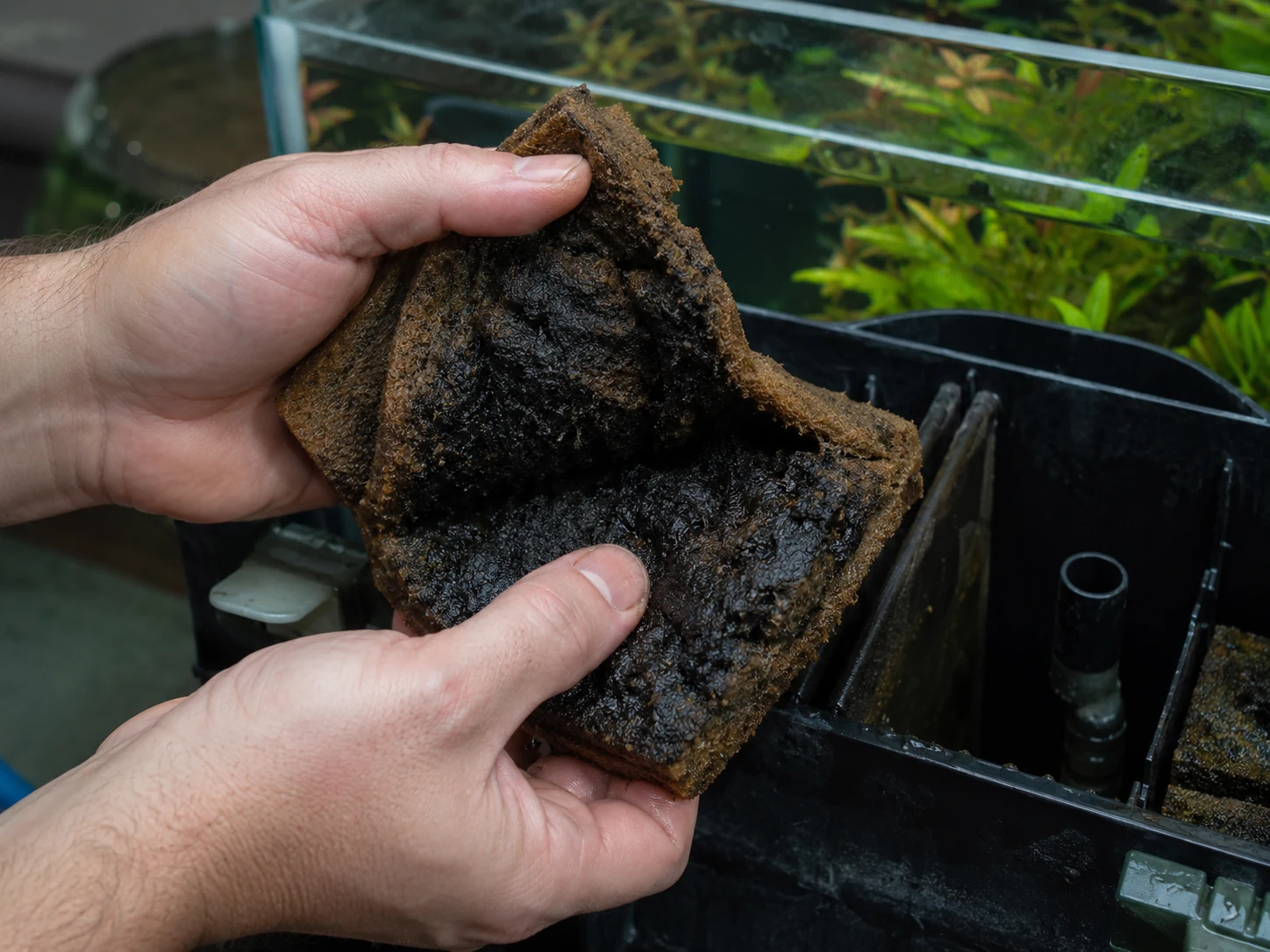
A filter is supposed to collect waste.
That means it can smell if it becomes clogged, stagnant, or packed with decaying debris.
A dirty filter may smell bad when opened. Some smell is normal during maintenance. Strong rotten or sour smell means the filter is holding too much organic waste or has poor flow.
| Filter clue | Direction |
|---|---|
| Flow is weak | Intake/media may be clogged |
| Filter smells rotten | Decay or stagnant zone |
| Water bypasses media | Media packed poorly |
| HOB gurgles or runs unevenly | Clog/low water/air issue |
| Canister smells terrible after being off | Stagnant filter water |
| Sponge filter covered in sludge | Needs gentle rinse |
| Cartridges clog quickly | Too much waste or overfeeding |
How to clean safely:
- Clean only the clogged mechanical media first.
- Rinse sponge, pre-filter foam, or filter floss gently in old tank water.
- Do not wash filter media under untreated tap water.
- Do not replace all media at once.
- Do not disturb biological media unless flow is actually blocked.
- Keep ceramic rings, bio-balls, sponge biomedia, or other bio-media wet.
- Clean the intake and impeller if flow is weak.
- Restore flow before chasing perfect cleanliness.
- Test ammonia and nitrite after major filter work.
This is the double-crash trap.
A smelly aquarium is already overloaded. If you deep-vacuum the substrate, do a large water change, and sterilize the filter media at the same time, you can remove the remaining nitrifying bacteria the tank still has. The smell may improve for a few hours, but ammonia can spike hard afterward.
Clean the waste.
Protect the biofilter.
Do not make the filter sterile.
Make it flowing.
Cause 4: Dead Fish, Snails, or Hidden Organisms
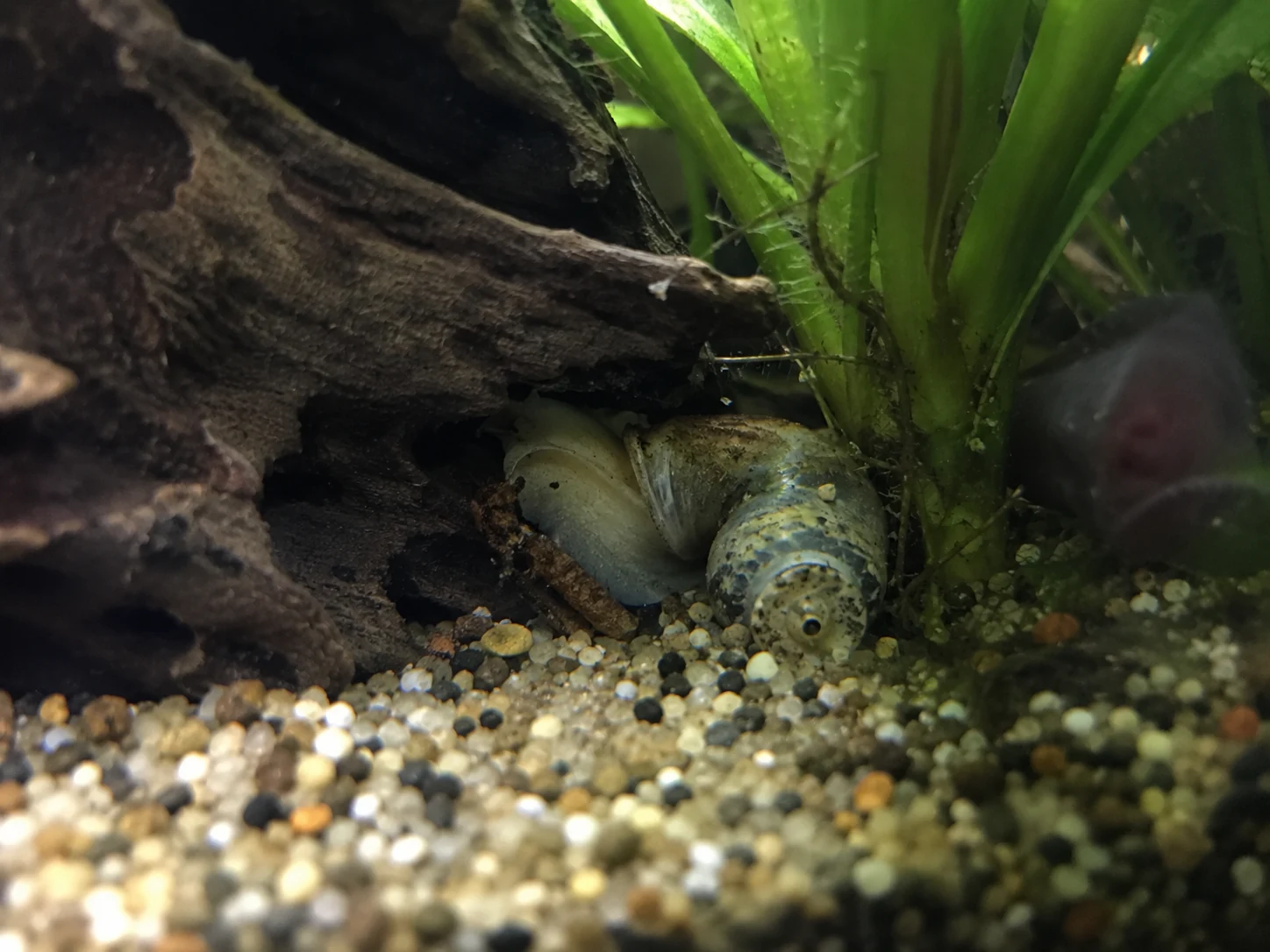
A dead fish or snail can make a tank smell bad quickly.
Snails are especially easy to miss. A dead snail trapped behind decor, inside a filter intake area, or under wood can produce a strong rotten smell.
| Hidden source | Where to look |
|---|---|
| Dead fish | Behind plants, under wood, filter intake |
| Dead snail | Shells, caves, substrate, filter area |
| Dead shrimp | Moss, plants, behind rocks |
| Dead feeder insects | Floating plants or corners |
| Rotting plant clump | Dense plant bases |
| Food tablet | Under decor |
| Dead algae after treatment | Filter and substrate |
Remove the source immediately.
Then test ammonia and nitrite.
A dead organism is not just odor. It is a waste spike.
Cause 5: Rotting Plants or Melting Leaves
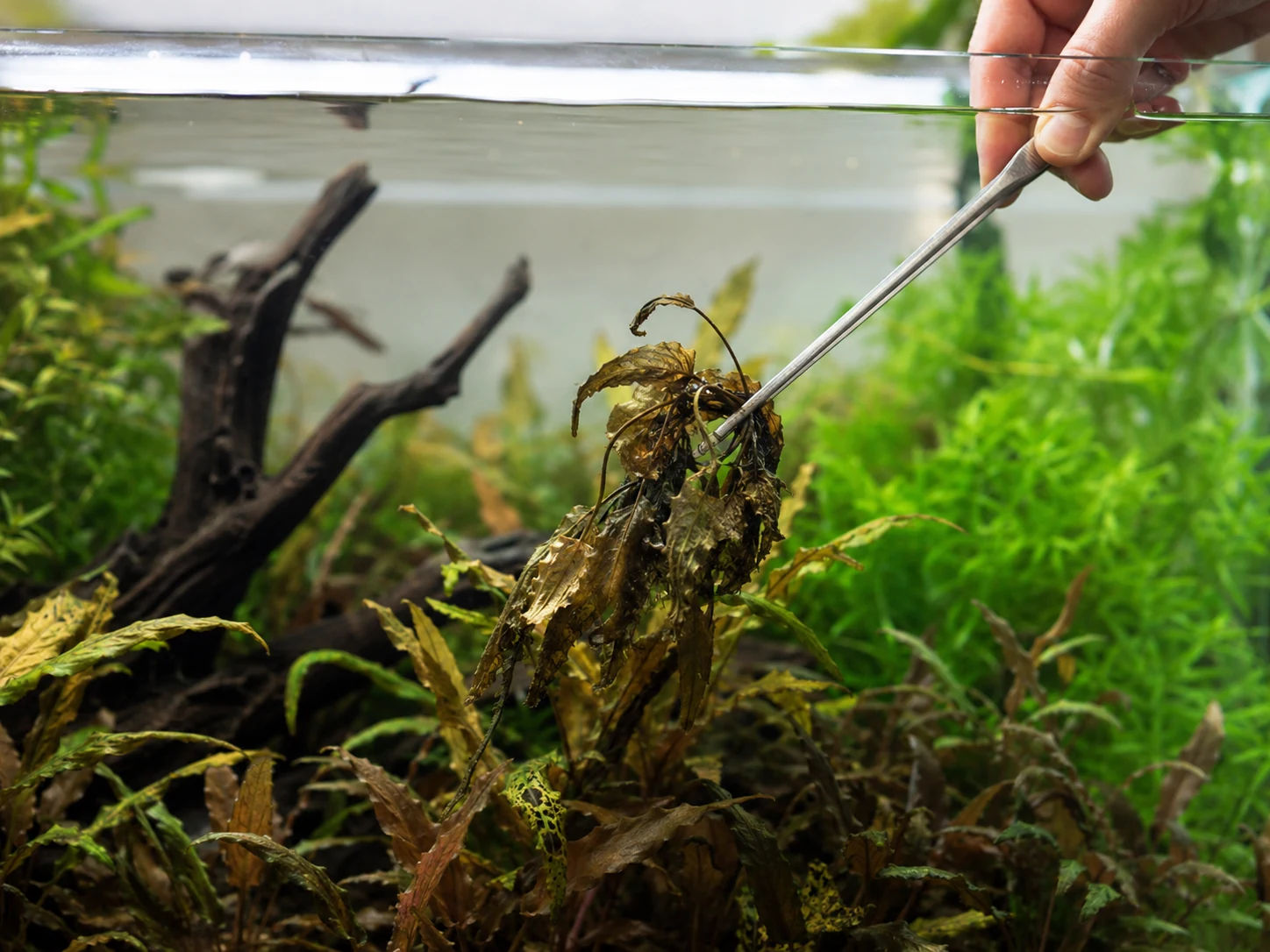
Live plants help aquariums when they are growing.
Dying plants add waste when they melt.
New plants sometimes melt after being moved. Old leaves die. Stem plants drop leaves when light or nutrients are poor. Floating plants can decay in hidden corners.
Rotting plants smell earthy, sour, or swampy.
| Plant issue | Fix |
|---|---|
| Melting leaves | Trim dead tissue |
| Old yellow leaves | Remove during maintenance |
| Dead floating plants | Net out quickly |
| Stem bases rotting | Replant healthy tops |
| Rhizome buried | Unbury Anubias/Java fern rhizome |
| Plants covered in algae | Trim old leaves |
| Plant debris in filter | Clean intake and media gently |
Do not let dead leaves “become fertilizer” in a small beginner tank.
That advice can work in balanced planted systems, but in a small stocked aquarium, rotting plant matter can become an odor and water-quality problem.
Cause 6: Weak Cycle or Biofilter Crash
A tank can smell bad when the biological filter cannot keep up.
This can happen in new tanks, overstocked tanks, after replacing filter media, after washing media under tap water, after medication, after a long power outage, or after a full tank reset.
The smell may be fishy, sour, or generally dirty.
| Biofilter risk | Why it matters |
|---|---|
| New tank | Bacteria not established |
| Filter media replaced | Bacteria removed |
| Filter off too long | Oxygen inside media drops |
| Antibiotics in display tank | Can harm biofilter |
| Overcleaning | Removes bacterial surfaces |
| Overstocking | Waste exceeds processing |
| Overfeeding | Waste spikes |
| Dead organism | Sudden ammonia source |
Check:
- ammonia
- nitrite
- nitrate
- filter flow
- fish behavior
- recent maintenance history
If ammonia or nitrite is present, the smell is not the main issue.
The water is unsafe.
Cause 7: Rotten Egg Smell and Anaerobic Pockets
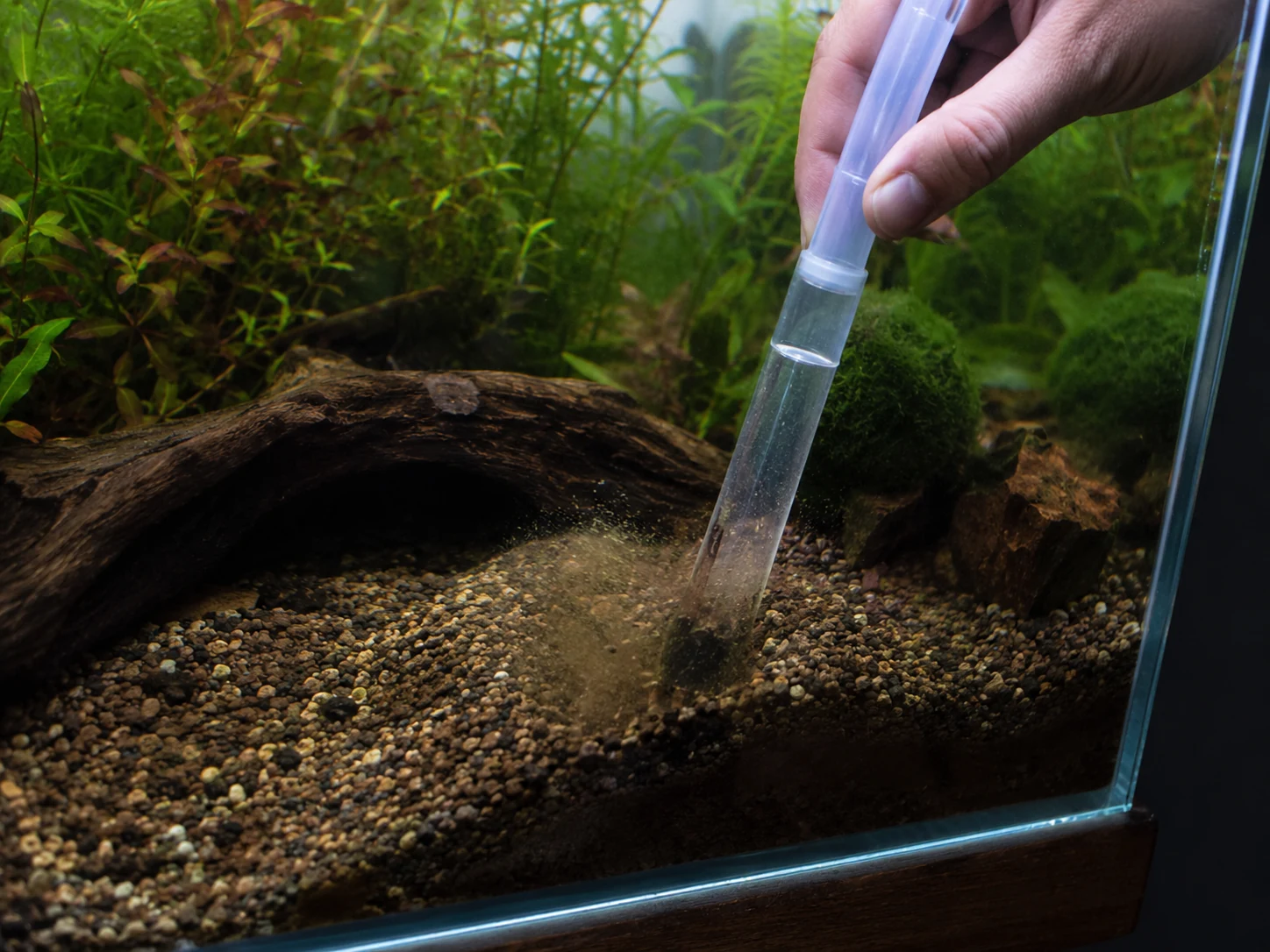
A rotten egg smell is a red flag.
It may point to hydrogen sulfide or anaerobic decay in areas where organic matter is trapped without enough oxygen. This can happen in deep compacted substrate, under large rocks, under decor, or in stagnant filter areas.
Do not aggressively stir the entire tank if you smell rotten eggs.
That can release trapped waste into the water.
| Risk area | Why |
|---|---|
| Deep sand bed | Compacted low-oxygen zones |
| Heavy decor sitting on substrate | Traps waste |
| Under rocks/wood | Dead spots |
| Dirty canister after power outage | Stagnant organic water |
| Thick mulm layer | Decay |
| No flow behind decorations | Stagnant pocket |
Safer response:
- Increase aeration.
- Stop feeding temporarily.
- Test ammonia and nitrite.
- Prepare dechlorinated, temperature-matched water.
- Work on one small area at a time.
- Hold the siphon directly over the suspect substrate pocket.
- Disturb the substrate only gently while the siphon is already pulling water out.
- Lift decor carefully during a water change, not all at once.
- Never stir the whole substrate bed into the aquarium water.
- Repeat cleanup over multiple sessions if needed.
The important part is this: do not “release the gas” into the tank.
If hydrogen sulfide is trapped in a deep, dirty, low-oxygen pocket, stirring it aggressively can send foul water and gas into the aquarium at once. That can stress fish fast. The safer method is to disturb only a small localized area while you siphon directly from that spot, so the dirty water leaves the aquarium instead of spreading through it.
Rotten egg smell is one case where “just wait” is not good advice.
Find the source, but remove it carefully.
Anaerobic pocket safety: do not deep-stir the whole tank
If the tank smells like rotten eggs, do not plunge a siphon deep into the entire substrate and stir everything at once. Deep compacted sand, trapped mulm under decor, and stagnant filter zones can hold anaerobic decay byproducts. Releasing a large pocket suddenly can stress fish and worsen oxygen demand fast.
The safer method is controlled removal: increase aeration, work in one small area at a time, siphon directly where you disturb the substrate, and pause if fish gasp, clamp fins, or dart. This is the same stability-first logic as water changes: remove the source without creating a second shock event.
Cause 8: Overstocking
Overstocking makes every odor problem worse.
More fish means more waste, more oxygen demand, more filter load, faster nitrate rise, and more debris in the substrate.
| Overstocking clue | What you may see |
|---|---|
| Nitrate rises fast | Too much waste load |
| Filter clogs quickly | Excess particles |
| Tank smells between water changes | Waste accumulation |
| Fish gasp during heat or at night | Oxygen stress |
| Aggression or stress | Crowding |
| Water changes never feel enough | System overloaded |
A stronger filter can help.
It does not erase fish waste.
If the tank is overstocked, the real fix may be fewer fish, a larger tank, better filtration, more maintenance, or a combination.
Cause 9: Smell After a Water Change
A tank may smell after a water change for several reasons.
Sometimes you disturbed dirty substrate. Sometimes source water has a smell. Sometimes the filter was stopped and restarted. Sometimes debris hidden under decor was lifted.
| Timing | Possible cause |
|---|---|
| Smells immediately after refill | Tap/source water or conditioner smell |
| Smells after gravel vacuuming | Disturbed waste |
| Smells after moving decor | Hidden debris |
| Smells after cleaning filter | Dirty media exposed |
| Fish stressed too | Check chlorine, temperature, ammonia/nitrite |
| Smell fades quickly | Mild disturbance |
| Smell persists | Source remains |
If fish act normal and tests are safe, a brief mild smell after cleaning may pass.
If the smell is strong or fish are stressed, test water and check for disturbed decay.
Cause 10: Smell After Power Outage or Filter Failure
Power outages can create smell problems fast.
Without flow, oxygen drops. Filters stop moving water. Waste processing slows. In canister filters or sealed filter compartments, stagnant water and organic debris can become foul.
| Outage issue | Risk |
|---|---|
| Filter off for hours | Reduced oxygen and biofilter function |
| Canister stagnant | Rotten smell when restarted |
| Fish gasping | Low oxygen |
| Warm weather outage | Oxygen drops faster |
| Dead organisms | Waste spike |
| Cloudy water after power returns | Bacterial bloom/instability |
After an outage:
- Restore aeration.
- Check fish behavior.
- Smell filter water before dumping stagnant canister water into the tank.
- Clean/rinse filter media gently in old tank water if foul.
- Restart filtration.
- Test ammonia and nitrite.
- Feed lightly for a day or two.
Do not assume everything is fine because the filter turned back on.
Emergency Odor Toolkit
This is the practical kit worth having before a smell problem becomes a panic cleaning session.
| Tool | What it helps with | What it does not replace |
|---|---|---|
| Liquid water test kit | Confirms ammonia, nitrite, nitrate, and pH | Observation |
| Ammonia-detoxifying conditioner | Temporarily protects fish during ammonia risk | Waste removal |
| Gravel siphon | Removes trapped food, waste, and dirty pocket water | Filter maintenance |
| Activated carbon | Adsorbs some dissolved odor compounds and chemical residue | Finding the decay source |
| Seachem Purigen or similar adsorbent resin | Helps polish dissolved organics and odor-causing compounds | Cycling and cleaning |
| Filter floss or mechanical pad | Catches fine debris after cleanup | Biological filtration |
| Air stone or spare air pump | Adds emergency oxygen support | Water changes when toxins are present |
Activated carbon and adsorbent resins can be very useful after you remove the source of the smell. They can help the room smell better faster and polish dissolved organic compounds from the water.
But they are not a license to leave rotting food, dead snails, clogged media, or dirty substrate in the tank.
Remove the cause first.
Then polish the water.
Should You Use Activated Carbon?
Activated carbon can remove some odors and dissolved organics.
It can be useful after medication removal, tannin reduction, or certain odor issues. But it does not remove the cause of rotting food, dead organisms, overstocking, or a dirty substrate.
| Carbon can help | Carbon will not fix |
|---|---|
| Mild dissolved odor | Dead fish hidden under decor |
| Medication removal after treatment | Overfeeding |
| Yellow tint/tannins | Dirty substrate |
| Some chemical smells | Biofilter crash |
| Short-term polishing | No water changes |
Use carbon as a support tool, not a substitute for maintenance.
For odor cases, place fresh activated carbon in a high-flow area of the filter after you remove the main waste source. If you use Purigen or a similar resin, follow the manufacturer’s instructions exactly and do not treat it like biological media.
Replace or regenerate odor-control media as directed.
Exhausted carbon is not magic.
What Not to Do
Avoid these common mistakes.
| Mistake | Why it is risky |
|---|---|
| Add fragrance or deodorizer | Can poison fish |
| Use household cleaners | Toxic residue |
| Tear down the tank immediately | Can crash stability |
| Replace all filter media | Removes beneficial bacteria |
| Deep-stir all substrate at once | Can release trapped foul water or hydrogen sulfide into the tank |
| Ignore dead snails | Strong ammonia source |
| Feed more to “check appetite” | Adds waste |
| Use medication for smell | Wrong problem |
| Turn off filter because it smells | Makes oxygen/filtration worse |
| Assume clear water is safe | Ammonia/nitrite can be invisible |
Fish do not need a perfumed tank.
They need clean, oxygenated, biologically stable water.
A Safe 48-Hour Smell Fix Plan
Use this when the tank smells bad but there is no confirmed chemical contamination.
First hour
- Increase aeration.
- Test ammonia, nitrite, and pH.
- If ammonia is present or fish are stressed, use an ammonia-detoxifying conditioner according to the label before major disturbance.
- Remove dead organisms, uneaten food, and rotting plant leaves.
- Check filter flow.
- Stop feeding temporarily.
- Prepare dechlorinated, temperature-matched water.
Same day
- Do a controlled partial water change if ammonia/nitrite is present or the odor is strong.
- Siphon the dirtiest visible areas in sections.
- If you suspect a rotten pocket, keep the siphon over that exact area while gently disturbing it.
- Rinse clogged mechanical media in old tank water.
- Do not replace all filter media.
- Do not clean biological media unless water flow is actually blocked.
- Check under decor for trapped waste.
Next day
- Test again.
- Feed lightly or skip feeding if fish are healthy and water is still recovering.
- Clean another small substrate section if needed.
- Check whether the smell is fading.
- Keep aeration and filtration stable.
After 48 hours
- If smell persists, look for hidden dead organisms, deep waste pockets, stagnant filter sections, source water issues, or overstocking.
- Reassess maintenance schedule.
- Consider activated carbon only after removing the cause.
Do not try to fix months of waste in one violent cleaning session.
Prevention: How to Keep a Fish Tank From Smelling
| Habit | Why it helps |
|---|---|
| Feed lightly | Less waste |
| Remove uneaten food | Prevents decay |
| Vacuum substrate in sections | Removes trapped waste |
| Maintain filter flow | Prevents stagnant media |
| Preserve biological media | Keeps cycle stable |
| Remove dead leaves | Prevents rot |
| Count fish and snails | Catches missing/dead animals |
| Avoid overstocking | Lowers waste load |
| Do weekly water changes | Removes dissolved waste |
| Test water regularly | Finds invisible problems |
| Keep equipment running | Supports oxygen and bacteria |
| Use aquarium-only buckets | Prevents contamination |
A clean-smelling tank is not sterile.
It is balanced.
FAQ
Why does my fish tank smell bad?
A fish tank usually smells bad because organic waste is rotting somewhere. Common sources include overfeeding, dirty substrate, clogged filter media, dead fish or snails, rotting plants, weak filtration, or an unstable cycle.
What should a healthy aquarium smell like?
A healthy aquarium may have a light earthy or pond-like smell when opened. It should not smell rotten, sour, fishy, chemical, sewage-like, or like rotten eggs.
Why does my aquarium smell like rotten eggs?
A rotten egg smell can point to anaerobic decay or trapped waste in low-oxygen areas, especially deep substrate, under decor, or stagnant filter sections. Increase aeration, test water, and clean affected areas carefully.
Can a dead snail make a tank smell bad?
Yes. Dead snails can smell very strong and can release a sudden waste spike. Remove the snail and test ammonia and nitrite.
Why does my tank smell fishy even after a water change?
The source may still be present. Check dirty substrate, clogged media, hidden food, dead organisms, overstocking, and filter flow. A water change helps, but it will not fix a hidden decay source.
Should I replace all filter media if the filter smells bad?
No. Replacing all media can remove beneficial bacteria and trigger ammonia or nitrite problems. Rinse media gently in old tank water and preserve biological media.
Can overfeeding make an aquarium smell?
Yes. Uneaten food rots, feeds bacteria, clogs filters, and increases ammonia risk. Overfeeding is one of the most common causes of smelly aquariums.
Is activated carbon good for aquarium smell?
Activated carbon can help remove some dissolved odors, but it does not fix rotting food, dead organisms, dirty substrate, or poor filtration. Use it after removing the cause.
Why does my tank smell after a power outage?
During an outage, oxygen drops and filter water can become stagnant. A canister or filter full of organic debris may smell bad when restarted. Check fish behavior, aerate, and test ammonia/nitrite.
Can plants make my aquarium smell bad?
Healthy plants usually help. Rotting or melting plants can smell sour or swampy and add organic waste. Remove dead leaves during maintenance.
Should I deep clean the entire tank to remove smell?
Usually not. A full deep clean can destabilize the aquarium. Clean the worst areas first, protect filter bacteria, and repeat gentle maintenance over time.
Is a smelly fish tank dangerous for fish?
It can be. The smell may come from waste that also raises ammonia, nitrite, or lowers oxygen. Test water and watch fish behavior, especially if the smell is sudden or strong.
Related Guides
- Cloudy Fish Tank Water
- Fish Gasping at the Surface
- Noisy Aquarium Filter
- Algae Problems in Fish Tanks
- How to Cycle a Fish Tank Without Guessing When It’s Safe for Fish
- How to Set Up a Fish Tank Without Making the Beginner Mistakes That Kill Fish
- Freshwater Aquarium Checklist
- Best Aquarium Filters
- Best Aquarium Test Kits
- Fish Not Eating
- How Often Should You Change Aquarium Water?
Author Box
Editorial Note
This guide is educational and intended for home freshwater aquariums. A bad aquarium smell can be harmless, moderate, or urgent depending on the source and fish behavior. Always prioritize ammonia, nitrite, oxygen, filter flow, and livestock health over cosmetic odor removal.
Healthy Aquariums does not recommend using household cleaners, fragrances, deodorizing sprays, or full tank resets as the first response to aquarium odor.
References
- Aqueon. “Freshwater Aquarium Water Quality: The Nitrogen Cycle & More.” https://www.aqueon.com/articles/freshwater-aquarium-water-quality
- Aqueon. “Aquarium Filtration.” https://www.aqueon.com/articles/aquarium-filtration
- New Mexico State University Extension. “Important Water Quality Parameters in Aquaponics Systems.” https://pubs.nmsu.edu/_circulars/CR680/
- Oklahoma State University Extension. “Nitrification and Maintenance in Media Bed Aquaponics.” https://extension.okstate.edu/fact-sheets/nitrification-and-maintenance-in-media-bed-aquaponics
- University of Florida IFAS Extension. “Dissolved Oxygen for Fish Production.” https://edis.ifas.ufl.edu/publication/FA002
- The Spruce Pets. “Causes and Cures for Smelly Aquarium Water.” https://www.thesprucepets.com/stinky-aquarium-water-1381225
- Manufacturer instructions for any aquarium filter, water conditioner, test kit, activated carbon, substrate, or medication used by the reader.