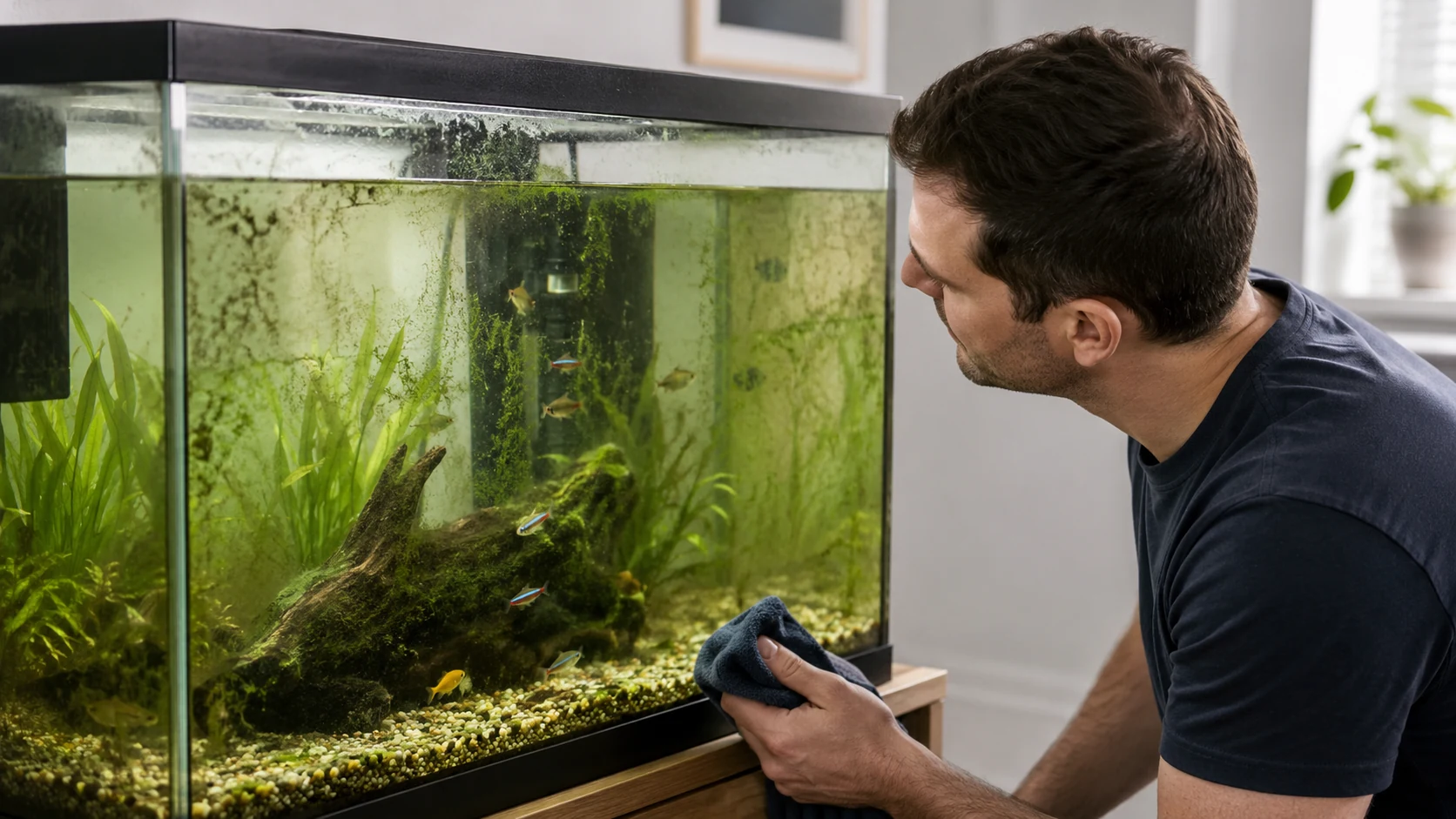
Algae is not proof that you are a bad fishkeeper.
That is the first thing to understand.
Every aquarium has algae pressure. A healthy tank can still grow a little green film on the glass, a little brown dust in the first month, or a few strands on slow-growing leaves. That does not mean the tank is ruined.
The problem starts when algae becomes the tank.
Green water blocks visibility. Brown dust covers every surface. Hair algae tangles through plants. Black beard algae grips wood, rocks, filters, and leaf edges. The owner panics, buys an algae eater, cuts the light, pours in a chemical, does a huge water change, cleans the filter too hard, and somehow the tank looks worse two weeks later.
Algae is feedback.
It is usually telling you that light, nutrients, organic waste, plant growth, stocking, or maintenance are out of balance.
The solution is not always “kill the algae.”
Sometimes the real solution is:
- shorten the light schedule,
- block window sunlight,
- feed less,
- remove decaying leaves,
- clean filter media correctly,
- stop overstocking,
- add fast-growing plants,
- improve water changes,
- or let a new tank mature.
A little algae is normal.
A tank that keeps growing algae faster than you can remove it is telling you something.
Algae Is Normal. Losing Control Is the Problem.
A small amount of algae belongs in most aquariums.
It grows because the tank has light, water, surfaces, nutrients, and time. That is not automatically bad. Snails, shrimp, grazing fish, and microorganisms may use some of it as part of the tank’s ecology.
The goal is not a sterile tank.
The goal is control.
| Normal algae | Problem algae |
|---|---|
| Light film on glass every week or two | Glass turns green in a few days |
| Brown dust in a new tank | Brown coating returns thick after every cleaning |
| A little algae on old leaves | Algae smothers live plants |
| Small patches on rocks | Algae covers hardscape and equipment |
| Minor green spots | Hard green spots cover most glass |
| Occasional strands | Long hair algae tangles through plants |
| Clear water | Water turns green and opaque |
A tank with zero visible algae forever is not the standard.
A tank where algae tells you something useful is a better goal.
Start With the Big Three: Light, Food, and Waste
Before identifying the exact algae type, check the three boring causes.
They solve more algae problems than most bottled treatments.
| Factor | What to check | Better beginner target |
|---|---|---|
| Light duration | How many hours per day? | 6–8 hours for most beginner tanks |
| Direct sun | Does window light hit the tank? | No direct sunlight |
| Feeding | Is food left after meals? | Fish finish food quickly |
| Stocking | Too many fish for the tank? | Stock for adult size and waste |
| Water changes | Are they consistent? | Often 20–30% weekly or as tests require |
| Dead leaves/organics | Any rotting plant matter? | Remove weekly |
| Filter flow | Weak, clogged, or dead spots? | Gentle but consistent circulation |
| Testing | Nitrate rising? Ammonia/nitrite present? | Ammonia 0, nitrite 0, nitrate controlled |
Do not start with an algae killer.
Start with the system.
Diagnose by Appearance
Use the look of the algae as a first clue.
Then confirm with your tank history.
| What you see | More likely issue | First response |
|---|---|---|
| Brown dusty film in a new tank | Diatoms | Clean gently, wait, keep routine stable |
| Hard green dots on glass | Green spot algae | Scrape, review light/nutrients |
| Soft green glass film | Light/nutrient excess | Reduce light, clean regularly |
| Long green threads | Hair algae | Remove manually, reduce light/waste |
| Dark fuzzy tufts | Black beard algae | Manual removal, stabilize organics/flow |
| Blue-green slimy sheets | Cyanobacteria-like growth | Improve flow, remove sheets, clean waste |
| Water is green | Suspended algae bloom | Reduce light/nutrients; consider UV if persistent |
The appearance matters.
The timeline matters too.
A new tank with brown dust is usually different from a mature tank suddenly exploding with green hair algae.
Brown Algae / Diatoms in a New Tank
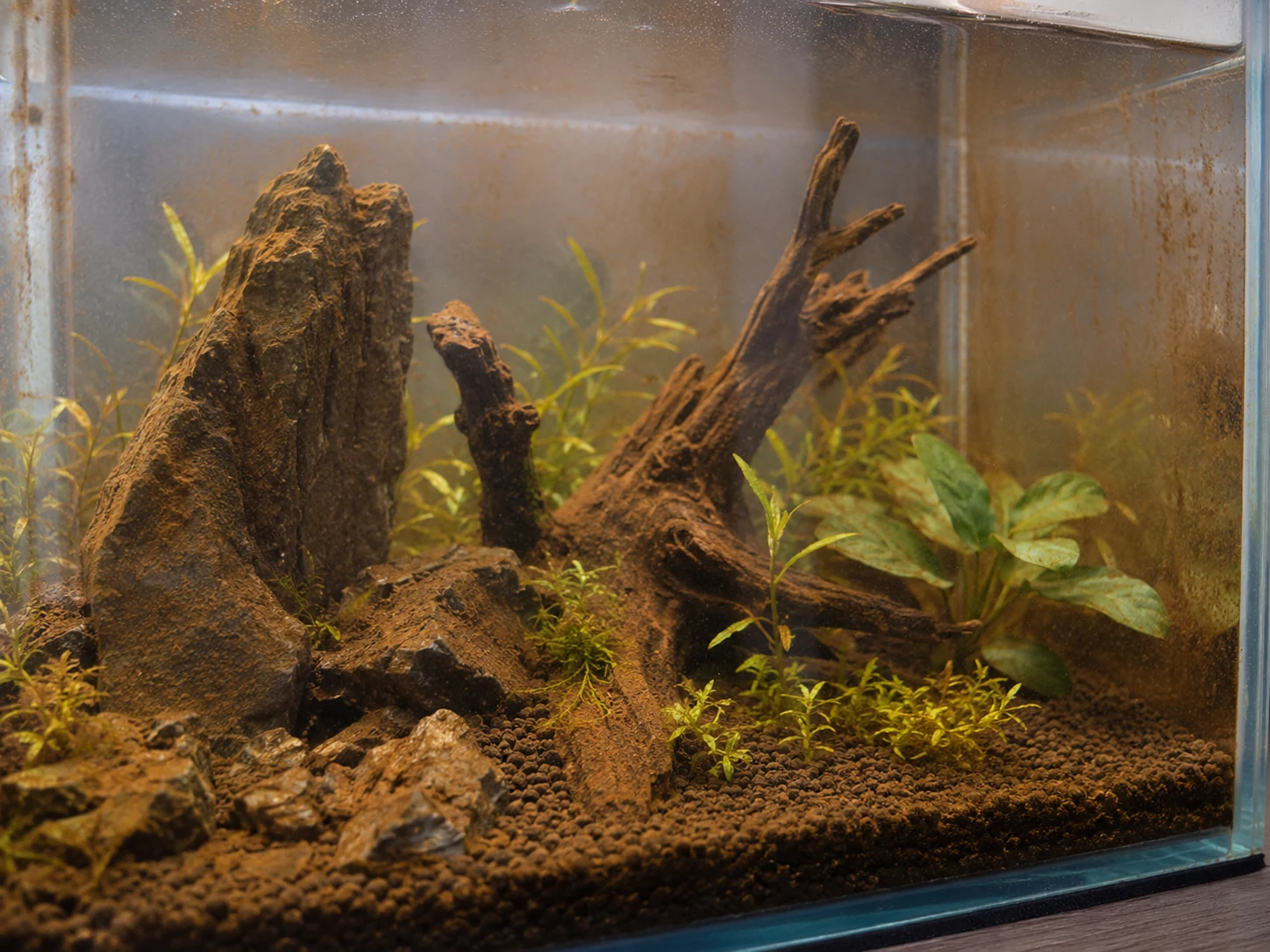
Brown algae is usually what beginners call the dusty brown coating on glass, rocks, substrate, and plant leaves.
In many new aquariums, it is diatoms.
Diatoms often appear in young tanks as the system matures. They can feed on available silicates and take advantage of low plant competition. They usually wipe off easily.
| Clue | Brown diatoms likely? |
|---|---|
| Tank is new | Yes |
| Brown dusty coating | Yes |
| Wipes off easily | Yes |
| Grows on glass, substrate, rocks | Yes |
| Water tests otherwise stable | Often |
| Tank has low plant growth | Common |
| Coating is slimy blue-green sheet | Probably not diatoms |
What to do:
- Wipe glass gently.
- Siphon loose dust during water changes.
- Keep the light moderate.
- Do not overfeed.
- Add hardy plants if appropriate.
- Wait for the tank to mature.
Do not tear down the aquarium because of brown dust in the first month.
That often makes the tank less stable.
Green Spot Algae
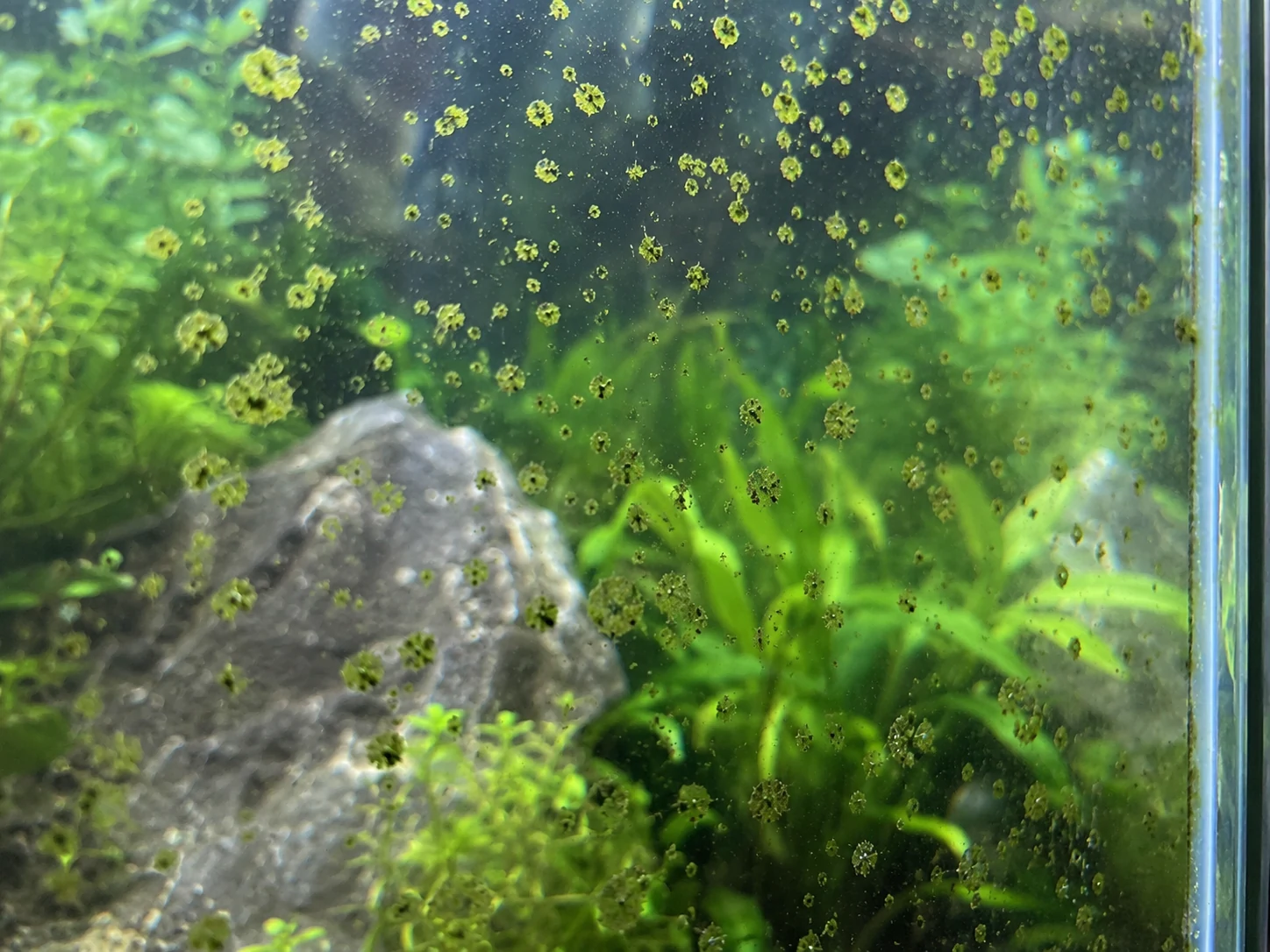
Green spot algae looks like hard green dots on glass, slow-growing leaves, rocks, or equipment.
It does not wipe away as easily as soft film algae. You usually need a scraper for glass.
Common triggers:
| Trigger | Why it matters |
|---|---|
| Strong light | Encourages hard algae on exposed surfaces |
| Long photoperiod | Gives algae more time |
| Slow-growing leaves | Anubias/Java fern leaves are easy targets |
| Nutrient imbalance | Plants struggle while algae persists |
| Low phosphate in planted tanks | Often discussed by planted-tank keepers |
| Old leaves | Algae colonizes older, slower tissue |
What to do:
- Scrape glass with a safe scraper.
- Remove old leaves that are heavily covered.
- Reduce light intensity or duration if it is excessive.
- Avoid placing slow rhizome plants directly under intense light.
- Keep fertilizer consistent in planted tanks rather than swinging between starvation and excess.
- Use floating plants for shade if appropriate.
Do not scrub plant leaves aggressively.
Damaged leaves become worse algae magnets.
Green Film Algae on Glass
Soft green film on glass is common.
If it appears slowly, it may only need routine cleaning. If the glass turns green every few days, the tank has too much algae pressure.
Common causes:
| Cause | Fix |
|---|---|
| Light on too long | Use a timer and shorten photoperiod |
| Direct sunlight | Move tank or block sun |
| Overfeeding | Feed less |
| High nitrate/organics | Improve water changes and cleaning |
| Too few plants | Add fast-growing plants if suitable |
| Overstocking | Reduce waste load |
Green film algae is usually not an emergency.
But fast regrowth is a signal.
Hair Algae
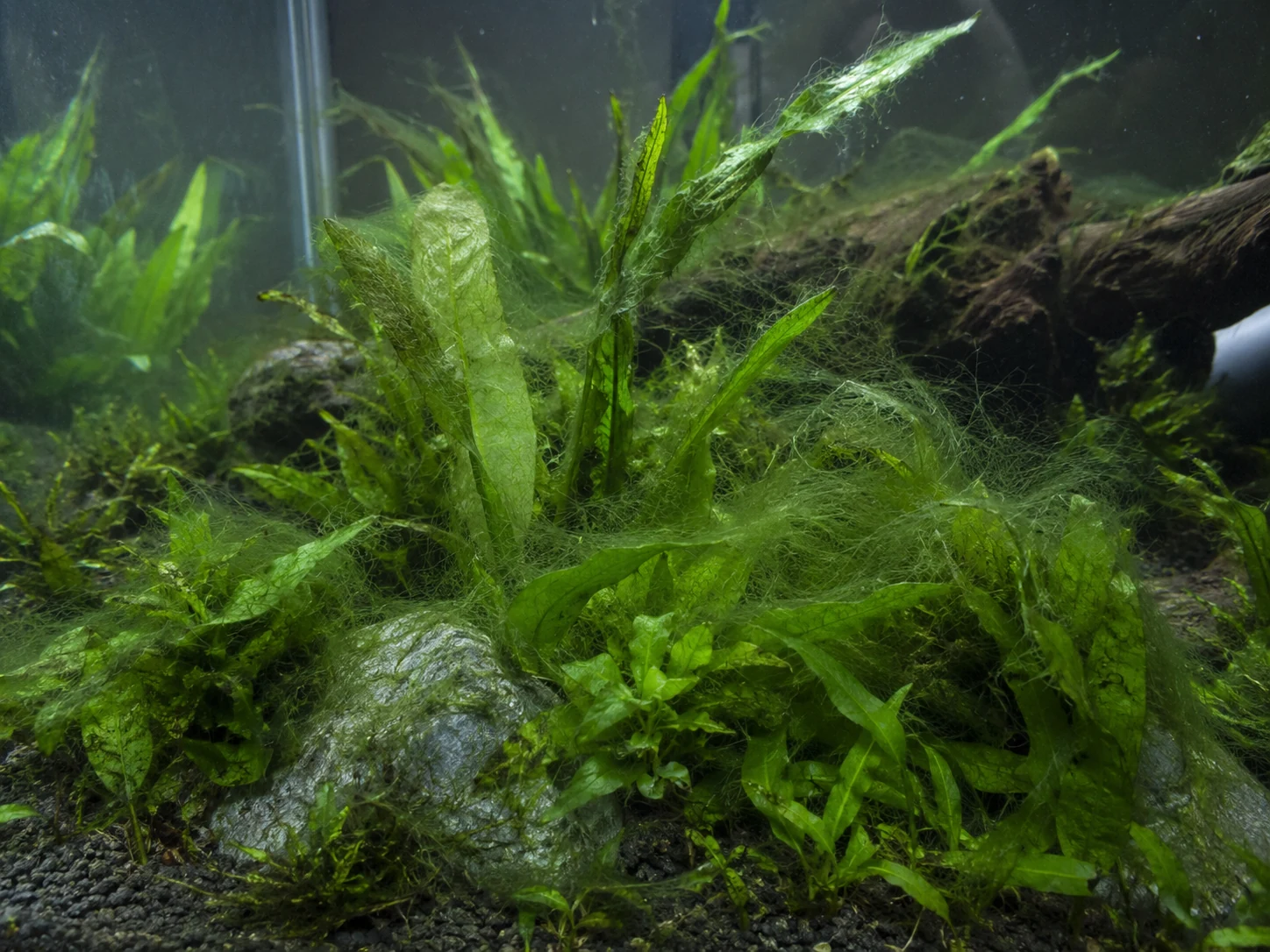
Hair algae forms long green threads, strands, or tangles.
It may attach to plants, wood, rocks, filters, or decorations. It is especially annoying in planted tanks because it weaves through leaves and moss.
Common triggers:
| Trigger | Why hair algae likes it |
|---|---|
| Too much light | Drives fast algae growth |
| Excess nutrients | Feeds algae |
| Overfeeding | Adds organics |
| New tank instability | Plants not competing strongly yet |
| Weak plant growth | Algae uses the gap |
| Inconsistent maintenance | Waste accumulates |
| Moss and fine plants | Easy surfaces to tangle through |
What to do:
- Remove as much as possible by hand.
- Twirl strands with a toothbrush.
- Trim heavily infested plant leaves.
- Reduce light duration.
- Feed less.
- Clean trapped waste.
- Improve plant growth rather than starving the entire tank.
- Repeat weekly.
Hair algae rarely disappears from one dramatic action.
It loses when your routine becomes more consistent than its growth.
Black Beard Algae
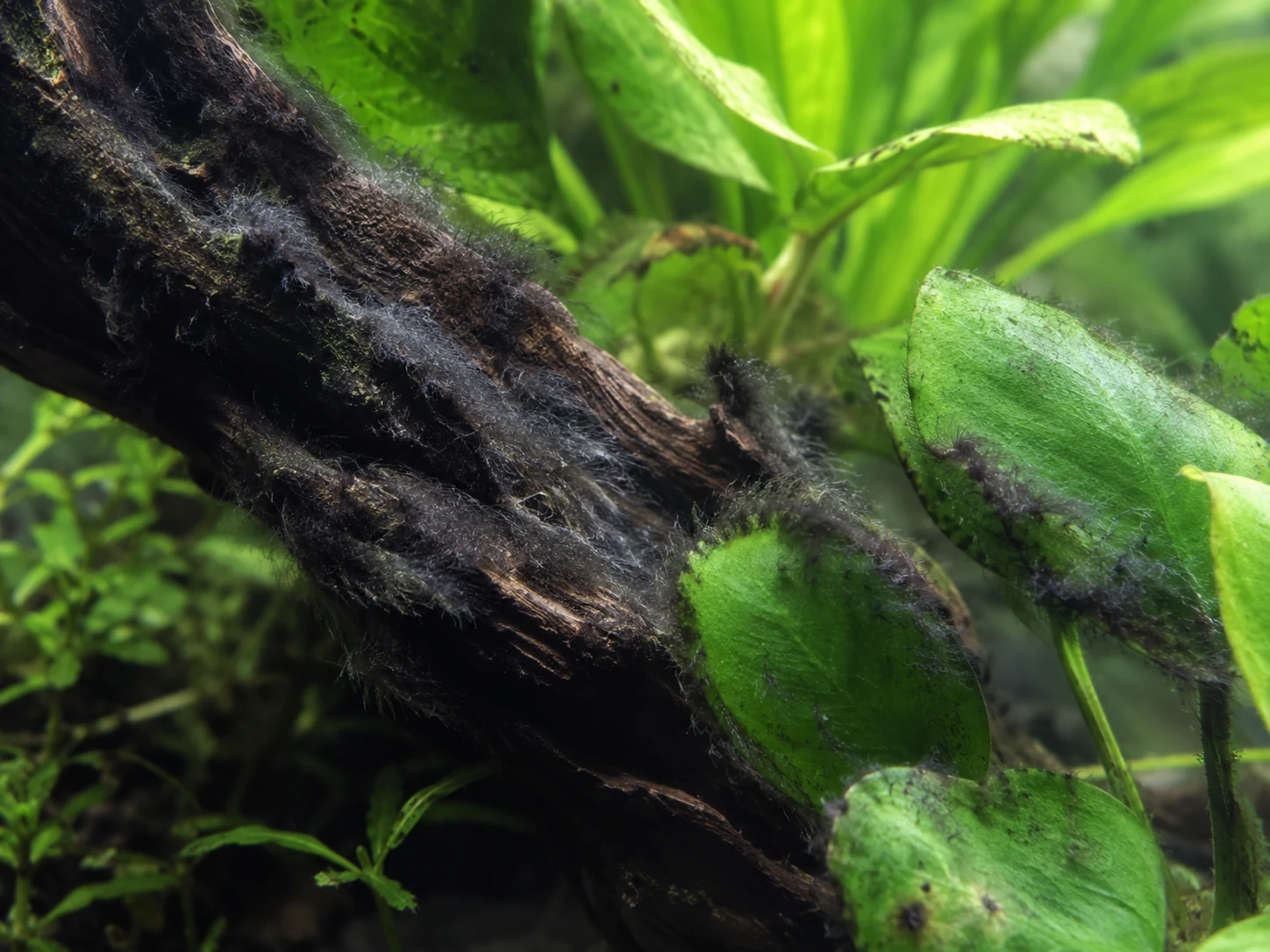
Black beard algae, often called BBA, appears as dark gray, black, or deep green fuzzy tufts.
It grips hardscape, filter outlets, slow-growing plant leaves, and equipment. It is difficult to remove because it attaches strongly.
Common patterns:
| Pattern | What it suggests |
|---|---|
| On filter outlets | Flow/organics issue |
| On Anubias or Java fern | Slow leaves under too much light |
| On wood/rock | Hard surfaces exposed to light |
| Spreading after neglect | Organic buildup |
| Appears in planted tank with unstable carbon/light | Imbalance |
What to do:
- Remove affected hardscape if possible and scrub outside the tank.
- Trim affected plant leaves rather than scraping delicate tissue.
- Improve maintenance.
- Reduce excessive light.
- Clean filters without destroying biological media.
- Remove trapped debris.
- Keep plant growth steady.
- Avoid repeated chemical shocks.
Some aquarists spot-treat BBA with products such as hydrogen peroxide or liquid carbon-type products, but these can harm plants, fish, shrimp, or beneficial organisms if misused. That is not the first step for beginners.
Fix the conditions first.
Blue-Green Slime: Algae or Cyanobacteria?
Blue-green algae is often cyanobacteria, not true algae.
It can appear as slimy sheets, often dark green, blue-green, or almost black. It may peel off in sheets and can have a bad smell.
Common triggers:
| Trigger | Why it matters |
|---|---|
| Low flow | Dead spots form |
| Dirty substrate | Waste supports growth |
| Excess organics | Feeds slime growth |
| Poor maintenance | Lets sheets spread |
| Imbalance in nutrients | Can encourage outbreaks |
| Stagnant areas | Common starting point |
What to do:
- Remove sheets manually.
- Siphon affected areas.
- Improve flow in dead spots.
- Remove decaying organic matter.
- Reduce overfeeding.
- Keep the light reasonable.
- Repeat cleaning consistently.
If it keeps returning hard, reassess the tank’s flow and waste patterns.
Do not just stir it into the water.
Remove it.
Green Water Is Different
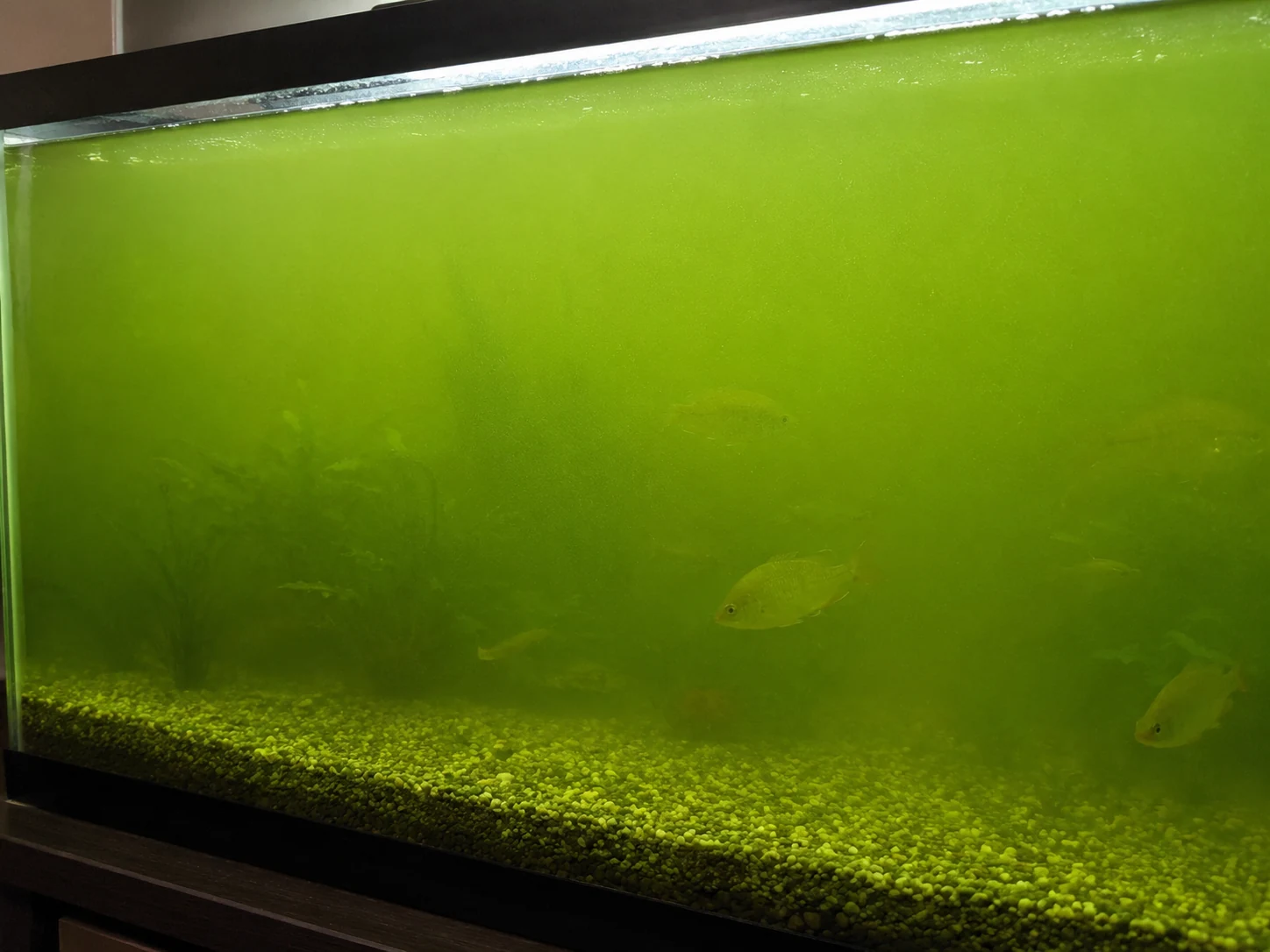
Green water is not algae on surfaces.
It is algae suspended in the water column.
The whole tank turns green, cloudy, or pea-soup colored. You may not see the back of the tank. Fish may still swim normally, but visibility is poor.
Common causes:
| Cause | Why it causes green water |
|---|---|
| Direct sunlight | Strong uncontrolled light |
| Long light schedule | Too much energy for algae |
| Nutrient excess | Supports algae bloom |
| Overfeeding | Adds nutrients |
| New tank instability | Competing biology not mature |
| Dirty substrate/filter | Organic load |
| Weak plant competition | More nutrients available |
Green water is often linked to light plus nutrients.
A water change can make it look better for a short time, but it often returns if the cause remains.
Green water fix order
| Step | Why |
|---|---|
| Block direct sunlight | Stops the strongest trigger |
| Reduce light duration | Reduces algae energy |
| Feed less | Reduces nutrients |
| Remove waste | Lowers organic load |
| Test nitrate | Checks nutrient pressure |
| Add fast plants if appropriate | Helps compete |
| Consider blackout | Useful if done carefully |
| Consider UV sterilizer | Targets suspended algae directly |
A UV sterilizer can clear green water because it treats waterborne organisms as water passes through the unit. It does not solve overfeeding, direct sun, or long lighting by itself.
Should You Do a Blackout?
A blackout means keeping the tank dark for a short controlled period to weaken photosynthetic algae.
It can help with green water or some algae outbreaks.
But it is not harmless.
Plants also need light. Fish still need oxygen. Dead algae can decay and lower water quality. In planted tanks or heavily stocked tanks, blackout should be done carefully.
| Blackout may help | Be careful if |
|---|---|
| Green water bloom | Fish are already gasping |
| Light-driven outbreak | Tank is overstocked |
| No sensitive plants | Plants are weak or rare |
| Aeration is good | Oxygen is low |
| You can monitor water | You cannot test water |
A safer beginner blackout plan is conservative:
- Clean visible waste first.
- Do a partial water change if needed.
- Increase aeration.
- Turn lights off.
- Block external light.
- Do not feed heavily.
- Monitor fish behavior.
- Resume with a shorter light schedule.
Do not use blackout while ignoring the cause.
If the light schedule returns to 12 hours and the tank sits in a sunny window, algae comes back.
Should You Buy an Algae Eater?
Algae eaters are animals.
Not tools.
This is where many beginner tanks go wrong. A shop says, “Get a pleco.” The customer buys one for a small tank. The pleco grows, produces more waste, ignores the algae type, and creates a bigger filtration problem.
Use this rule:
| Animal | Reality check |
|---|---|
| Common pleco | Grows far too large for most beginner tanks |
| Bristlenose pleco | Useful in suitable tanks, still produces waste |
| Otocinclus | Needs mature tank and group; sensitive |
| Amano shrimp | Good algae grazers, not a magic fix |
| Nerite snails | Good glass/film grazers, eggs may appear |
| Siamese algae eater | Needs space; not for tiny tanks |
| Mystery snail | Eats some algae but adds waste |
| “Cleaner fish” | Not a category you should trust blindly |
Buy an algae eater only if you want to care for that animal long-term and your tank fits its adult needs.
Do not buy one as a chemical-free algae remover.
Are Algae Killers Safe?
Algae killers can work.
They can also create new problems.
When algae dies quickly, it can decay. Decay can lower oxygen and raise organic load. Some chemicals can stress fish, shrimp, snails, plants, and beneficial organisms if overdosed or used in the wrong tank.
Use caution:
| Before using algae killer | Why |
|---|---|
| Identify the algae | Not all algae responds the same |
| Test water | Unsafe water comes first |
| Improve oxygen | Dying algae can affect oxygen |
| Remove as much algae manually as possible | Less decay |
| Read the label fully | Dose and livestock warnings matter |
| Avoid shrimp/snail risk if product warns | Invertebrates can be sensitive |
| Fix light/feeding cause | Otherwise algae returns |
An algae killer should not be your first plan.
It should be a controlled tool after diagnosis.
Algae in Planted Tanks
Planted tanks are not immune to algae.
They are just a different balancing act.
Plants compete with algae for light and nutrients. But if plants are weak, melting, newly planted, starving, shaded poorly, or under intense light without enough support, algae can take advantage.
Common planted tank algae mistakes:
| Mistake | Result |
|---|---|
| Strong light without CO2 | Algae pressure rises |
| Too many slow plants only | Low nutrient uptake |
| No root tabs for root feeders | Plants decline |
| Inconsistent fertilizer | Plants stall |
| Overcorrecting nutrients | Swings encourage imbalance |
| Ignoring dead leaves | Organics rise |
| New plants melting | Temporary waste and weak competition |
In a low-tech planted tank, the safer path is moderate light, easy plants, steady maintenance, and patience.
Do not try to run a no-CO2 tank like a high-tech aquascape.
Water Changes and Algae
Water changes help, but they are not the whole solution.
They reduce nitrate, dissolved organics, and some free-floating debris. They also help reset the tank after overfeeding or neglect. But water changes alone will not solve algae if the light is too long, fish are overfed, and the tank is in direct sun.
| Algae issue | Water change role |
|---|---|
| Green film | Helps if nutrients/organics are high |
| Hair algae | Helps with waste control, not enough alone |
| Brown diatoms | Gentle cleaning and time matter too |
| Green water | Temporary help; cause often returns |
| BBA | Helps organics, not a direct cure |
| Cyanobacteria-like slime | Helps after manual removal |
Do not do huge daily water changes only because algae is ugly.
Use water changes as part of a system correction.
A Practical 2-Week Algae Reset
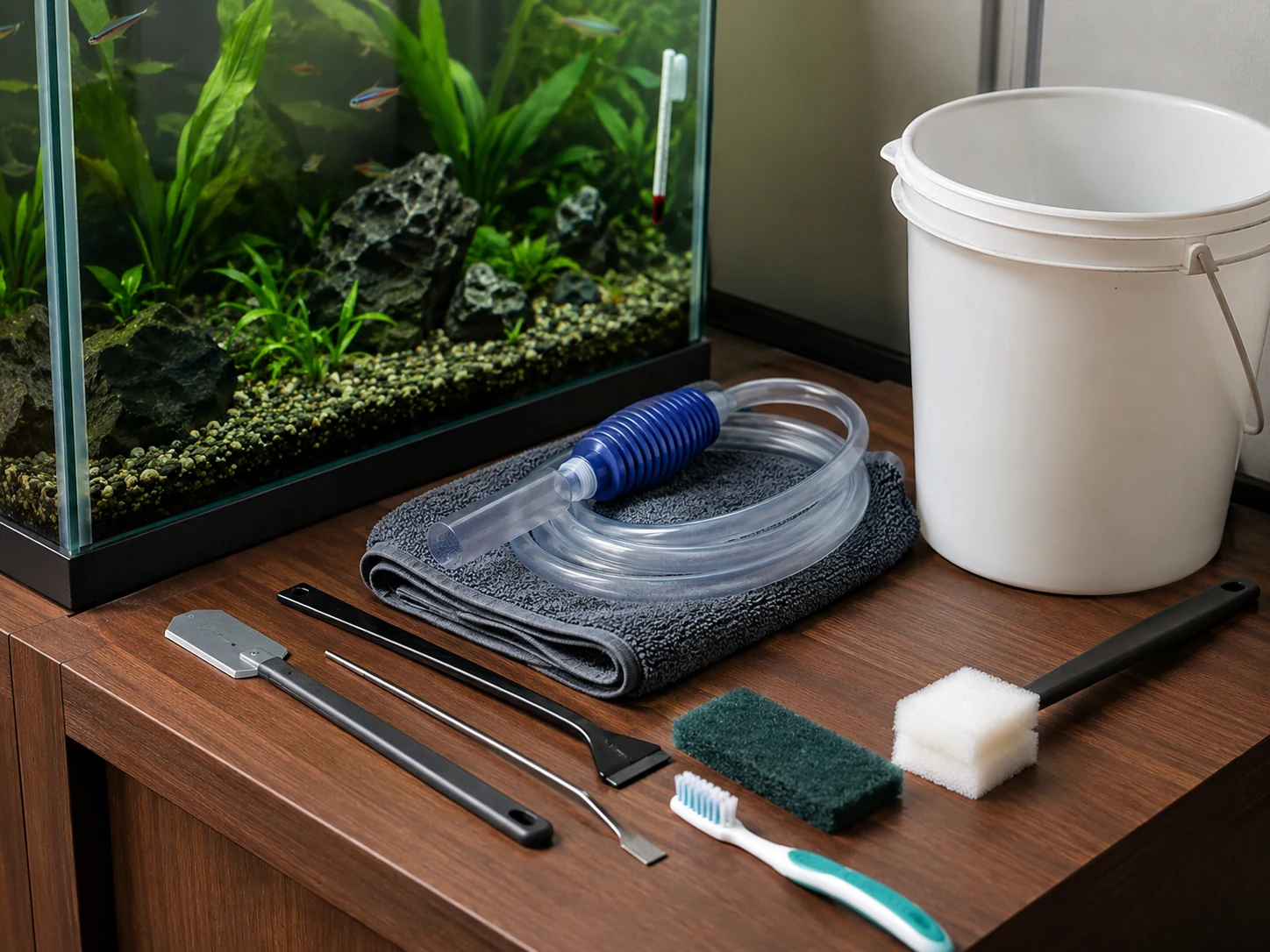
This is a safe beginner plan for most non-emergency algae problems.
Day 1
- Test ammonia, nitrite, nitrate, and pH.
- Remove obvious algae by hand.
- Scrape glass.
- Trim badly affected old leaves.
- Remove dead plant matter.
- Siphon dirty areas lightly.
- Do a normal partial water change if needed.
- Set light to 6 hours.
- Block direct sunlight.
Days 2–7
- Feed lightly.
- Keep the light schedule consistent.
- Remove new hair algae by hand.
- Watch fish behavior.
- Do not add new fish.
- Do not add random chemicals.
Day 7
- Test again.
- Clean glass.
- Check filter flow.
- Rinse mechanical media only if clogged.
- Continue 6-hour lighting if algae is still fast.
Days 8–14
- Keep routine stable.
- Add fast-growing plants if the tank suits them.
- Remove old leaves.
- Adjust fertilizer only if plants clearly show deficiency.
- Increase light only after algae slows.
This is boring.
That is why it works.
Prevention: Keep Algae From Taking Over Again
| Habit | Why it helps |
|---|---|
| Use a timer | Prevents accidental 12-hour light days |
| Avoid window sunlight | Stops green water and film algae triggers |
| Feed less | Reduces nutrients and organics |
| Stock realistically | Keeps waste manageable |
| Maintain the filter | Keeps flow and biological filtration stable |
| Do weekly water changes | Controls nitrate/organics |
| Remove dead leaves | Prevents decay |
| Add healthy plants | Competes with algae |
| Clean glass early | Prevents buildup |
| Do not overreact | Stability beats panic |
Algae control is not about one perfect product.
It is about reducing the reasons algae is winning.
FAQ
Is algae bad for fish?
A small amount of algae is usually not bad for fish. The bigger issue is what caused the algae outbreak. Overfeeding, low oxygen, unstable water, high waste, or poor maintenance can hurt fish even if the algae itself is not the direct cause.
Why does my fish tank get algae so fast?
Fast algae growth usually means too much light, direct sunlight, excess nutrients, overfeeding, dirty areas, weak plant growth, or a new unstable tank. Start with light schedule, feeding, and water testing.
How many hours should aquarium lights be on to reduce algae?
For many beginner tanks, 6–8 hours per day is a safer range. If algae is growing fast, start closer to 6 hours and use a timer.
Does green water mean the tank is dirty?
Not always. Green water is usually suspended algae in the water column. It is often caused by light and nutrients. The tank may also have waste problems, so test ammonia, nitrite, and nitrate instead of judging by color alone.
What is the brown algae in my new tank?
Brown dusty algae in new tanks is often diatoms. It usually wipes off easily and often improves as the aquarium matures, especially with steady maintenance and moderate lighting.
Should I buy an algae eater?
Only if the animal fits your tank and you want to care for it long-term. Algae eaters are not tools. Many produce waste, outgrow small tanks, or do not eat the algae you have.
Do snails help with algae?
Some snails graze on film algae and soft algae, but they do not fix the cause. If the tank is overfed or overlit, algae can keep growing even with snails.
Will turning off the light kill algae?
Reducing light helps many algae problems, but it does not solve overfeeding, dirty filters, dead plant matter, or high nutrients. A blackout can help some cases, especially green water, but it should be controlled.
Is algae killer safe for aquariums?
It depends on the product, livestock, dose, and tank condition. Algae killers can stress fish, shrimp, snails, or plants if misused. They also do not fix the root cause, so algae may return.
How do I remove hair algae?
Remove it manually, twirl it with a toothbrush, trim affected plants, reduce excessive light, clean waste, feed less, and improve plant growth. Repeat weekly rather than expecting one treatment to solve it.
What causes black beard algae?
Black beard algae often appears on slow-growing leaves, hardscape, and filter outlets when light, organics, flow, or planted-tank balance is off. It is stubborn, so manual removal and long-term correction matter.
Can water changes remove algae?
Water changes help reduce nutrients and organic waste, but they are not a complete fix if the tank still has too much light, overfeeding, or poor maintenance. Use them as part of a routine, not as the only solution.
Related Guides
- Cloudy Fish Tank Water
- Low-Tech Planted Tank Setup
- How to Cycle a Fish Tank Without Guessing When It’s Safe for Fish
- How to Set Up a Fish Tank Without Making the Beginner Mistakes That Kill Fish
- Freshwater Aquarium Checklist
- Fish Tank Size Guide
- Best Aquarium Lights
- Best Aquarium Filters
- Best Aquarium Test Kits
- Fish Gasping at the Surface
- Noisy Aquarium Filter
- Smelly Fish Tank
- How Often Should You Change Aquarium Water?
Author Box
Editorial Note
This guide is educational and intended for home freshwater aquariums. Algae problems are usually caused by a combination of light, nutrients, organic waste, plant growth, and tank stability. Product recommendations should always be matched to tank size, livestock, planted-tank status, and water test results.
Healthy Aquariums does not recommend buying algae-eating animals, using algae killers, or doing repeated full resets as the first response to algae. Diagnose the cause first.
References
- University of Florida IFAS Extension. “Algae in Aquatic Systems.” https://edis.ifas.ufl.edu/publication/FA184
- Penn State Extension. “Algae and Aquatic Plants.” https://extension.psu.edu/algae-and-aquatic-plants
- Aquarium Co-Op. “How to Get Rid of Algae in Aquariums.” https://www.aquariumcoop.com/blogs/aquarium/aquarium-algae
- Aqueon. “How to Fix Cloudy Water in a New & Existing Tank.” https://www.aqueon.com/articles/fix-cloudy-water-in-a-new-and-existing-tank
- Tropica. “Aquarium Plants.” https://tropica.com/en/plants/
- Oklahoma State University Extension. “Nitrification and Maintenance in Media Bed Aquaponics.” https://extension.okstate.edu/fact-sheets/nitrification-and-maintenance-in-media-bed-aquaponics
- Manufacturer instructions for any aquarium light, fertilizer, algae scraper, UV sterilizer, algae treatment, filter media, test kit, or water conditioner used by the reader.