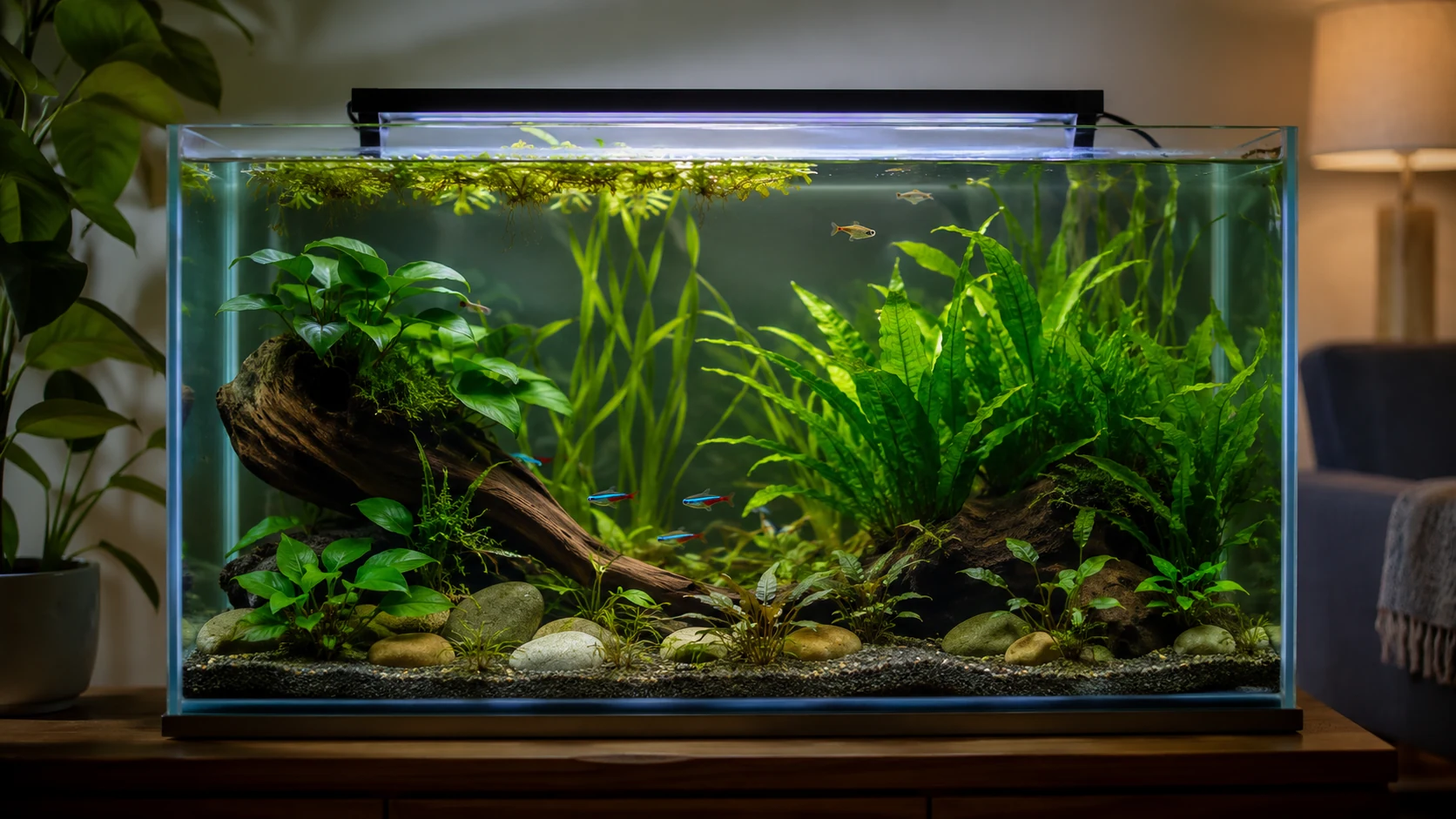
A low-tech planted tank sounds simple.
No CO2 cylinder. No complicated dosing schedule. No high-powered light. No pressure to build an award-winning aquascape on your first try.
That is the appeal.
But “low-tech” does not mean “no planning.”
A planted aquarium without CO2 grows more slowly. That can be a strength. Slower growth means less trimming, less equipment, and fewer sudden crashes. It also means the tank is less forgiving when the light is too strong, the fish are overfed, or the plant choices are wrong.
Most beginner planted tank failures are not caused by a lack of CO2.
They are caused by too much light, unstable new-tank water, weak plant choices, buried rhizomes, melting plants, overfeeding, and panic changes.
This guide is not about building a perfect aquascape.
It is about building a planted aquarium that can stay alive after the excitement of setup day is gone.
A good low-tech tank is calm.
It is not lazy.
Who Should Choose a Low-Tech Planted Aquarium?
A low-tech planted tank is a good fit if you want:
| You want | Low-tech fit? |
|---|---|
| A natural-looking aquarium | Yes |
| Beginner-friendly live plants | Yes |
| No CO2 cylinder | Yes |
| Lower maintenance than high-tech aquascaping | Yes |
| A tank for bettas, guppies, tetras, shrimp, or small community fish | Often yes |
| Fast carpeting plants in a few weeks | Usually no |
| Red plants under intense lighting | Usually no |
| Dense aquascape contest growth | Not the easiest route |
| Almost no maintenance at all | No |
Low-tech is best for people who want plants to support the tank, not dominate their life.
If you want a lush underwater garden with weekly trimming and bright red stems, you may eventually want CO2.
If you want a healthy, green, beginner-friendly aquarium that looks better over time, low-tech is enough.
The Core Rule: Light Drives Everything
In a planted tank, light is not decoration.
Light is the accelerator.
More light makes plants demand more carbon and nutrients. If CO2 and nutrients cannot keep up, algae takes the opportunity. Beginners often buy a strong light because the tank looks better on day one. Then the plants melt, algae blooms, and they blame the plants.
The safer low-tech approach is:
| Setting | Beginner target |
|---|---|
| Light intensity | Low to moderate |
| Photoperiod | 6–8 hours per day |
| CO2 | None |
| Fertilizer | Light, consistent, adjusted slowly |
| Plant growth expectation | Slow to moderate |
| Algae expectation | Some algae is normal early |
Do not run the light 12 hours because you want the plants to “eat more.”
That usually feeds algae.
Start modest.
Increase only if the plants are clearly healthy and algae is controlled.
Best Tank Size for a Beginner Low-Tech Planted Tank
A 10–20 gallon tank is often the easiest starting point.
A 5-gallon planted tank can work, especially for one betta or shrimp, but the water changes faster. A 20-gallon long gives more planting room, more swimming room, and more stability.
| Tank size | Best use | Beginner notes |
|---|---|---|
| 5 gallons | Betta, shrimp, small plant layout | Works, but less forgiving |
| 10 gallons | Betta, small community, beginner planted setup | Good starting size |
| 20 gallon long | Small community, more planting space | Excellent beginner choice |
| 29 gallons | Community tank, taller background plants | More stable, more cost |
| 40 breeder | Larger planted community | Great footprint, more planning |
Choose the tank for the fish first.
Plants help, but they do not cancel stocking mistakes.
A planted 5-gallon tank is still a 5-gallon tank.
Filter and Flow: Keep It Gentle, Not Weak
Plants do not replace a filter for most beginner tanks.
A filter gives water movement, oxygen exchange, and a home for beneficial bacteria. In a low-tech tank, you want enough flow to prevent dead spots but not so much that fish are exhausted or plants are uprooted.
Good beginner options:
| Filter type | Where it works well |
|---|---|
| Sponge filter | Bettas, shrimp, fry, gentle tanks |
| Hang-on-back filter | 10–29 gallon tanks if flow is adjustable or baffled |
| Internal filter | Small tanks if not too strong |
| Canister filter | Larger tanks, cleaner look, more budget |
The filter should move water through the plants without blasting them.
If fish are pushed around, the flow is too strong.
If debris settles everywhere and the surface is still, the flow may be too weak.
Substrate: Keep It Simple
Substrate can make a planted tank easier or harder.
There are three common beginner routes:
| Substrate type | Pros | Cons | Best for |
|---|---|---|---|
| Inert sand or gravel | Stable, simple, cheap | Root feeders need root tabs | Beginner community tanks |
| Aquarium soil | Nutrient-rich, good plant growth | Can release ammonia early, more expensive | Plant-focused setups |
| Dirted/Walstad-style soil cap | Strong plant nutrition | More risk if done poorly | Patient hobbyists who research first |
For most beginners, inert sand or fine gravel plus root tabs is the least stressful route.
Aquarium soil can work very well, but it can also release nutrients or ammonia early. That is not ideal if you plan to add fish quickly.
Do not choose substrate only by appearance.
Choose it by how you will maintain it.
Easy Plants That Actually Fit Low-Tech Tanks
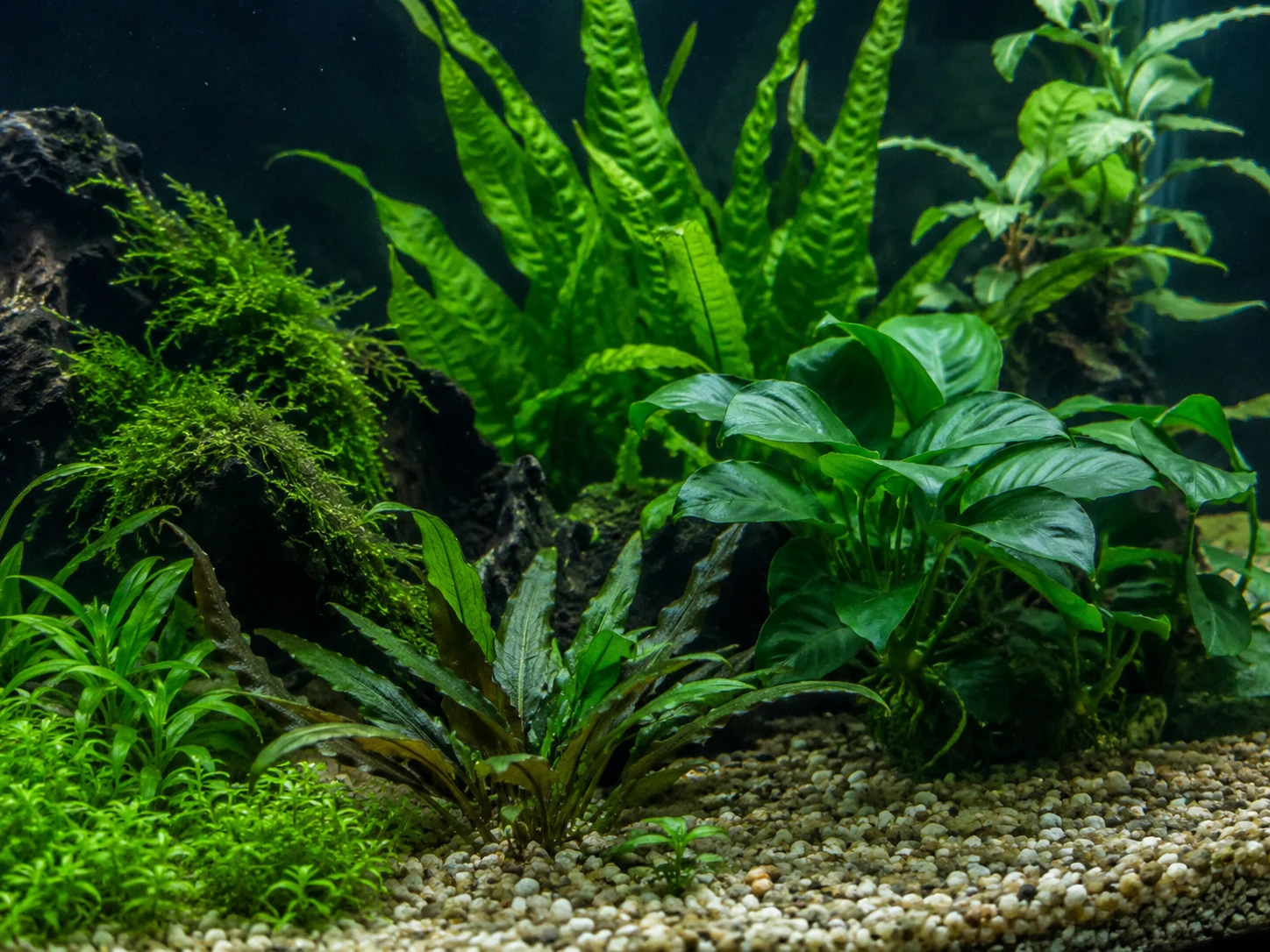
Pick plants that match the tank you are building.
Not the tank you saw in a contest photo.
Beginner-friendly low-tech plants often grow slowly, tolerate low to moderate light, and do not demand CO2 injection.
| Plant | Type | Why it works |
|---|---|---|
| Anubias | Rhizome | Hardy, slow, attaches to wood/rock |
| Java fern | Rhizome | Tolerates low light, not planted in substrate |
| Cryptocoryne wendtii | Root feeder | Good low-tech midground plant |
| Amazon sword | Root feeder | Strong background plant for larger tanks |
| Java moss | Moss | Flexible, shrimp/fry cover |
| Water sprite | Stem/floating | Fast, useful nutrient uptake |
| Hornwort | Floating/stem | Fast growth, good for beginners |
| Vallisneria | Rosette/runner | Background grass-like growth |
| Bucephalandra | Rhizome | Slow, attractive, low-tech capable |
| Salvinia / frogbit | Floating | Helps shade and absorb nutrients |
Aquarium Co-Op lists several easy beginner plants that do not require CO2, and Tropica also categorizes plants by difficulty, which is useful when shopping for realistic beginner choices. The common pattern is the same: hardy plants first, demanding plants later.
Rhizome Plants: Do Not Bury Them
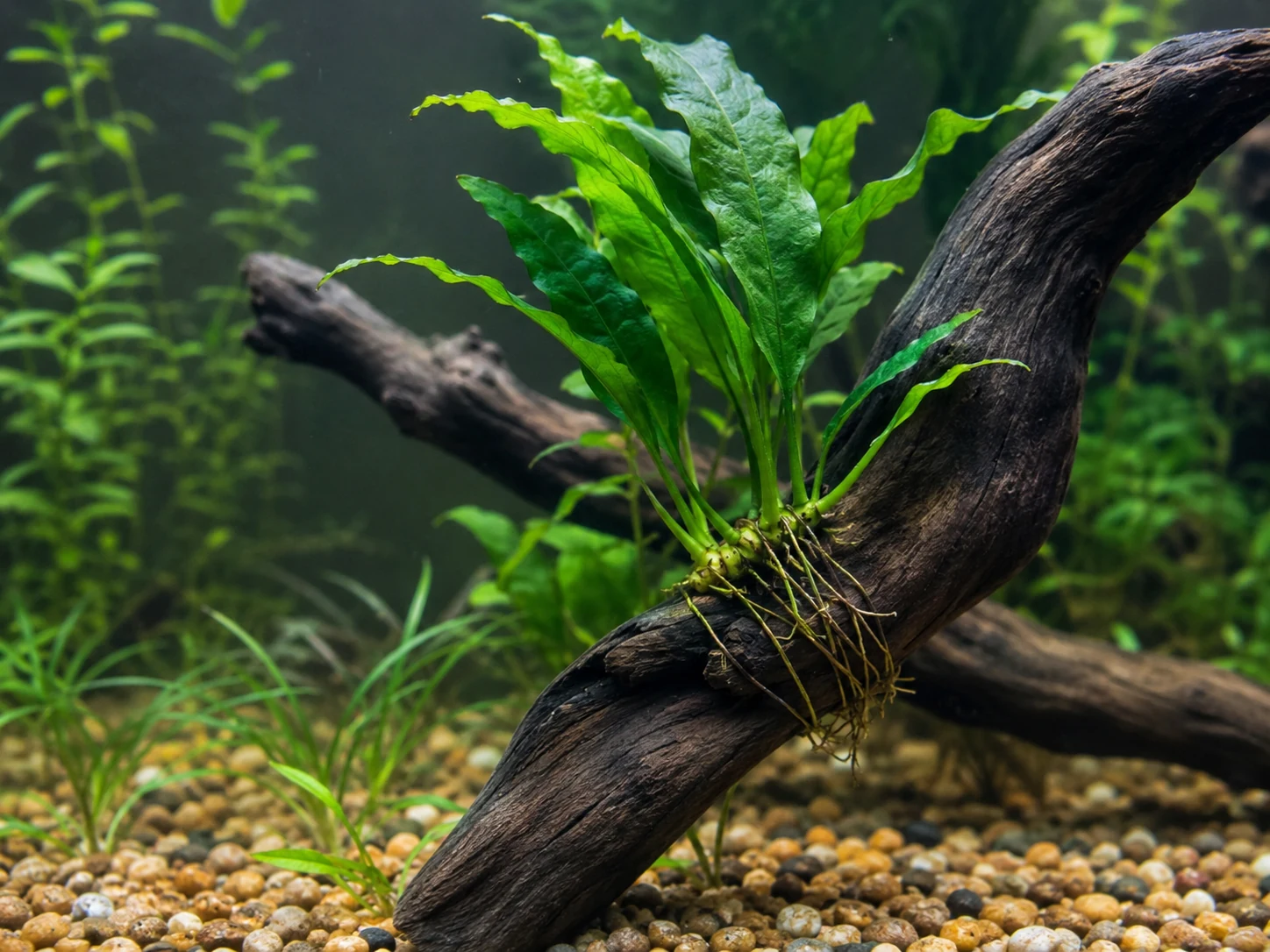
This beginner mistake kills a lot of Anubias and Java fern.
Anubias, Java fern, and Bucephalandra have a thick horizontal stem called a rhizome. The roots can attach to wood, rock, or rough surfaces, but the rhizome should not be buried under substrate.
If you bury the rhizome, it may rot.
| Plant | Correct placement |
|---|---|
| Anubias | Tie or glue to wood/rock; rhizome exposed |
| Java fern | Attach to hardscape; rhizome exposed |
| Bucephalandra | Attach to hardscape; rhizome exposed |
| Crypts | Plant roots in substrate; crown not buried too deep |
| Amazon sword | Plant roots in substrate; crown above substrate |
This is one of the simplest ways to improve success.
Do not plant every plant the same way.
Root Feeders vs Water Column Feeders
Plants feed in different ways.
Some take more nutrition from their roots. Others take plenty from the water column.
| Plant type | Examples | What they usually need |
|---|---|---|
| Root feeders | Crypts, Amazon swords, Vallisneria | Root tabs or nutrient substrate |
| Water column feeders | Java fern, Anubias, mosses, floating plants | Light liquid fertilizer if needed |
| Fast stem plants | Water sprite, hornwort, hygrophila | Nutrients and trimming |
| Floating plants | Salvinia, frogbit, red root floaters | Surface access, gentle flow, nutrients |
Do not add liquid fertilizer and expect a starving Amazon sword in plain gravel to suddenly thrive.
It may need root tabs.
Do not bury Anubias and expect root tabs to help.
It needs the rhizome exposed.
Lighting Schedule: Start Lower Than You Think
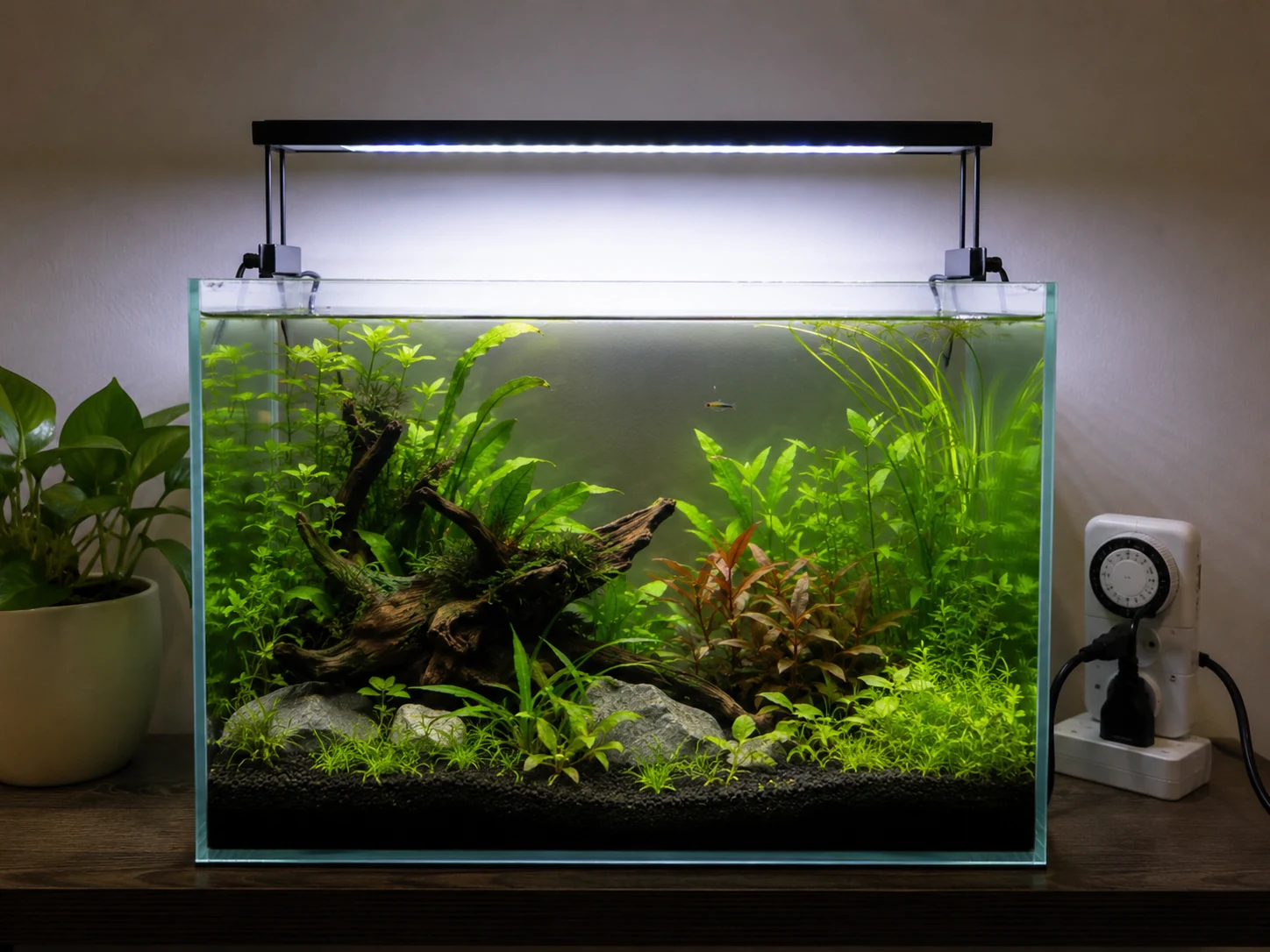
Most beginners run too much light.
A better starting point:
| Tank stage | Light duration |
|---|---|
| First 2–4 weeks | 6 hours/day |
| Stable, plants adapting | 6–7 hours/day |
| Plants growing, algae controlled | 7–8 hours/day |
| Algae increasing | Reduce duration/intensity |
| Plants stretching and weak | Adjust slowly after checking nutrients |
Use a timer.
Do not rely on memory.
Consistency beats enthusiasm.
If the tank gets window sunlight, count that as part of the light picture. Direct sunlight can push algae hard.
Fertilizer: Do Not Starve the Plants, Do Not Feed Algae
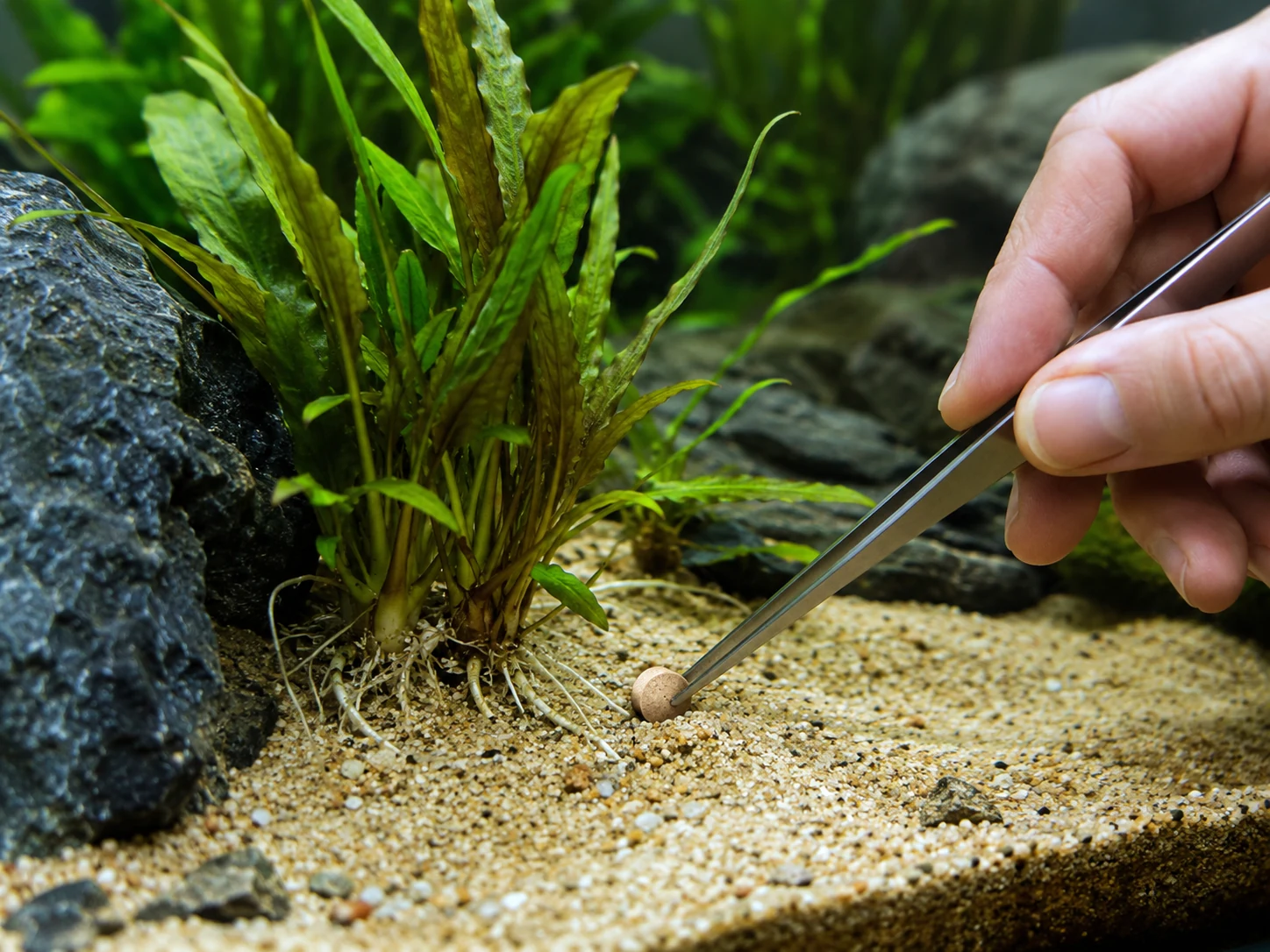
Low-tech tanks still need nutrients.
Fish waste can provide some nitrogen and phosphorus. Tap water may provide some minerals. But many tanks still become short on potassium, iron, or trace elements. Root feeders may also need root tabs.
A simple beginner routine:
| Situation | Fertilizer direction |
|---|---|
| Mostly Anubias/Java fern/moss | Light liquid fertilizer may be enough |
| Crypts/swords/val plants in inert substrate | Add root tabs |
| Floating plants yellowing | Check nutrients and light |
| Stem plants pale or stunted | Consider light liquid dosing |
| Algae increasing fast | Do not automatically add more fertilizer; check light/feeding |
| Shrimp tank | Use shrimp-safe dosing and avoid copper-heavy products |
Fertilizer is not magic plant food.
It is a correction tool.
Start light. Watch plants. Adjust slowly.
Cycling a Low-Tech Planted Tank
Plants can help a new aquarium, but they do not erase the nitrogen cycle.
Fish waste and uneaten food produce ammonia. Beneficial bacteria convert ammonia to nitrite and then nitrate. Ammonia and nitrite should be 0 ppm before a tank is considered safe for normal stocking. Nitrate is less immediately toxic and can be used by plants, but it still needs monitoring.
| Cycling point | Practical meaning |
|---|---|
| Plants may absorb some ammonia/nitrate | Helpful, but not a full safety guarantee |
| Fast-growing plants help more than slow rhizome plants | Hornwort/water sprite/floating plants are useful |
| Aquarium soil may release ammonia early | Test before adding fish |
| Clear water does not prove safety | Use a test kit |
| Fish-in cycling requires extra care | Test often and change water as needed |
A planted tank can still hurt fish if it is uncycled.
Do not let green leaves give you false confidence.
The First Month: What to Expect
The first month is messy.
Some plants melt. Some leaves yellow. Diatoms may appear. The tank may look worse before it looks better.
That does not always mean failure.
| What happens | Normal or problem? | What to do |
|---|---|---|
| Crypt leaves melt | Often normal | Leave roots, wait for new growth |
| Java fern older leaves spot | Common | Remove dying leaves if needed |
| Brown diatoms | Common in new tanks | Keep light moderate, clean gently |
| Floating plants melt | Often flow/light/nutrient issue | Reduce surface agitation |
| Algae on glass | Normal in small amounts | Wipe and adjust light |
| Fish gasping | Not normal | Test water/oxygen immediately |
| Ammonia/nitrite present | Not safe | Water change and cycle management |
Do not rip everything out at the first sign of melting.
Plants often adapt by shedding old growth and producing new leaves suited to your water.
Algae Control Without Panic
Algae is not a moral failure.
It is feedback.
In low-tech tanks, algae usually means light, nutrients, organic waste, or plant mass are out of balance.
| Algae trigger | Common fix |
|---|---|
| Light too long | Reduce photoperiod |
| Too much direct sun | Move tank or block sun |
| Overfeeding | Feed less, remove waste |
| Weak plant mass | Add more easy plants |
| New tank instability | Be patient, keep maintenance steady |
| Dirty filter/substrate | Clean gently, do not overclean |
| Too much fertilizer | Reduce dose slowly |
| Not enough nutrients for plants | Dose lightly and consistently |
Do not buy an algae eater as your first solution.
Algae eaters produce waste too. Many grow larger than beginners expect. Some do not eat the algae you have.
Fix the cause.
Fish and Stocking for Low-Tech Planted Tanks
Plants make fish feel safer, but they do not increase tank size.
Good fish choices depend on tank volume, temperature, water hardness, flow, and social needs.
| Tank | Better stocking direction |
|---|---|
| 5 gallons | One betta, shrimp, snails depending on setup |
| 10 gallons | Betta, guppies, small group of suitable nano fish, shrimp |
| 20 gallon long | Small community, corydoras, tetras, rasboras, livebearers |
| 29 gallons | More flexible community |
| 40 breeder | Excellent planted community footprint |
Do not add fish just because the tank looks planted.
Fish still need space.
Schooling fish still need groups.
Bottom dwellers still need floor area.
Best Layout for a First Low-Tech Tank
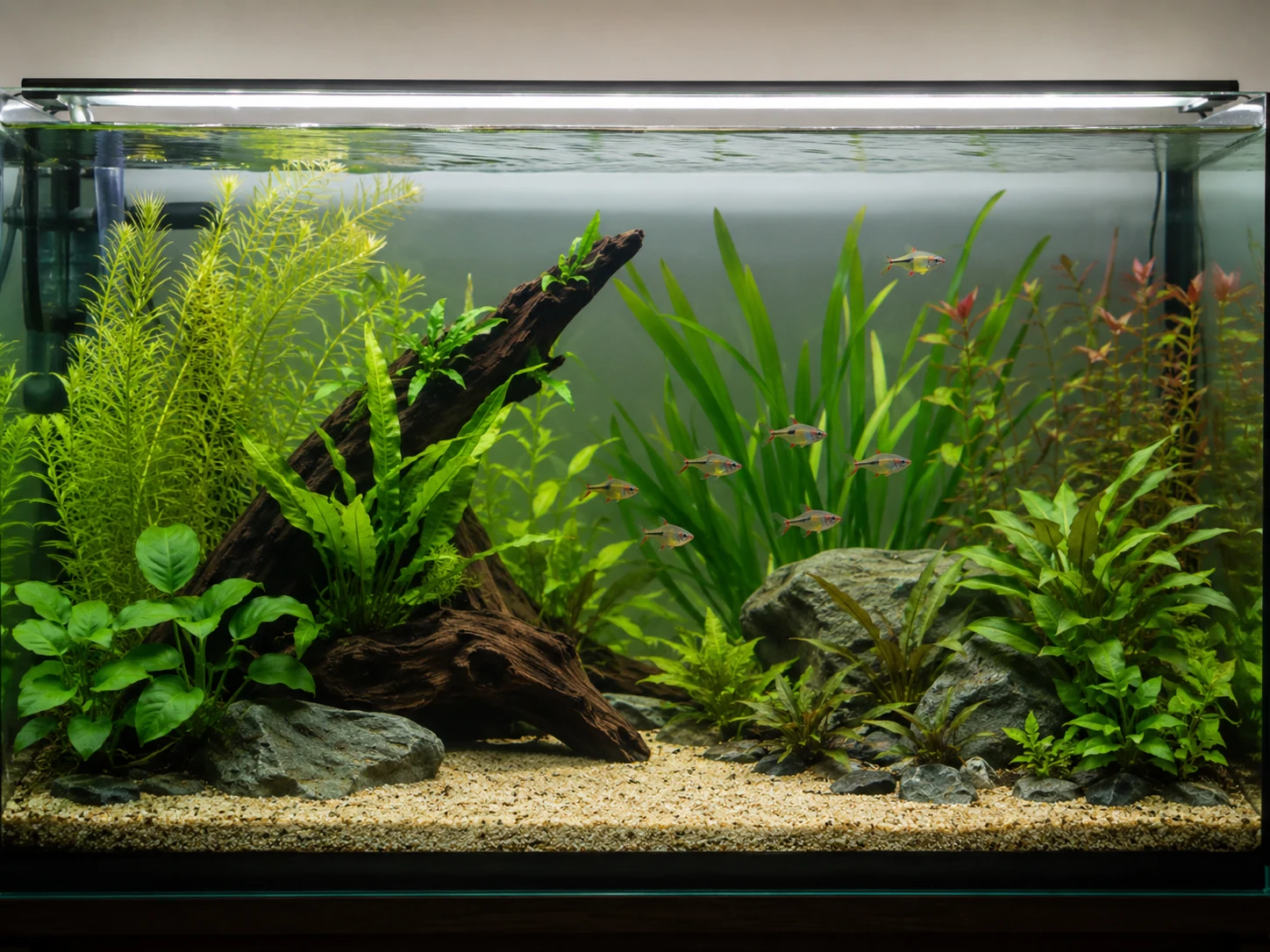
Keep the layout simple.
A beginner-friendly layout:
| Zone | Good choices |
|---|---|
| Background | Vallisneria, Amazon sword, water sprite |
| Midground | Cryptocoryne, Java fern on wood |
| Foreground | Small crypts, moss on rock, open sand area |
| Hardscape | Smooth wood, rounded stones |
| Surface | Floating plants if flow is gentle |
| Open space | Leave room for fish to swim |
Do not fill every inch on day one.
Plants grow.
Fish need open water.
Maintenance needs access.
Maintenance Routine
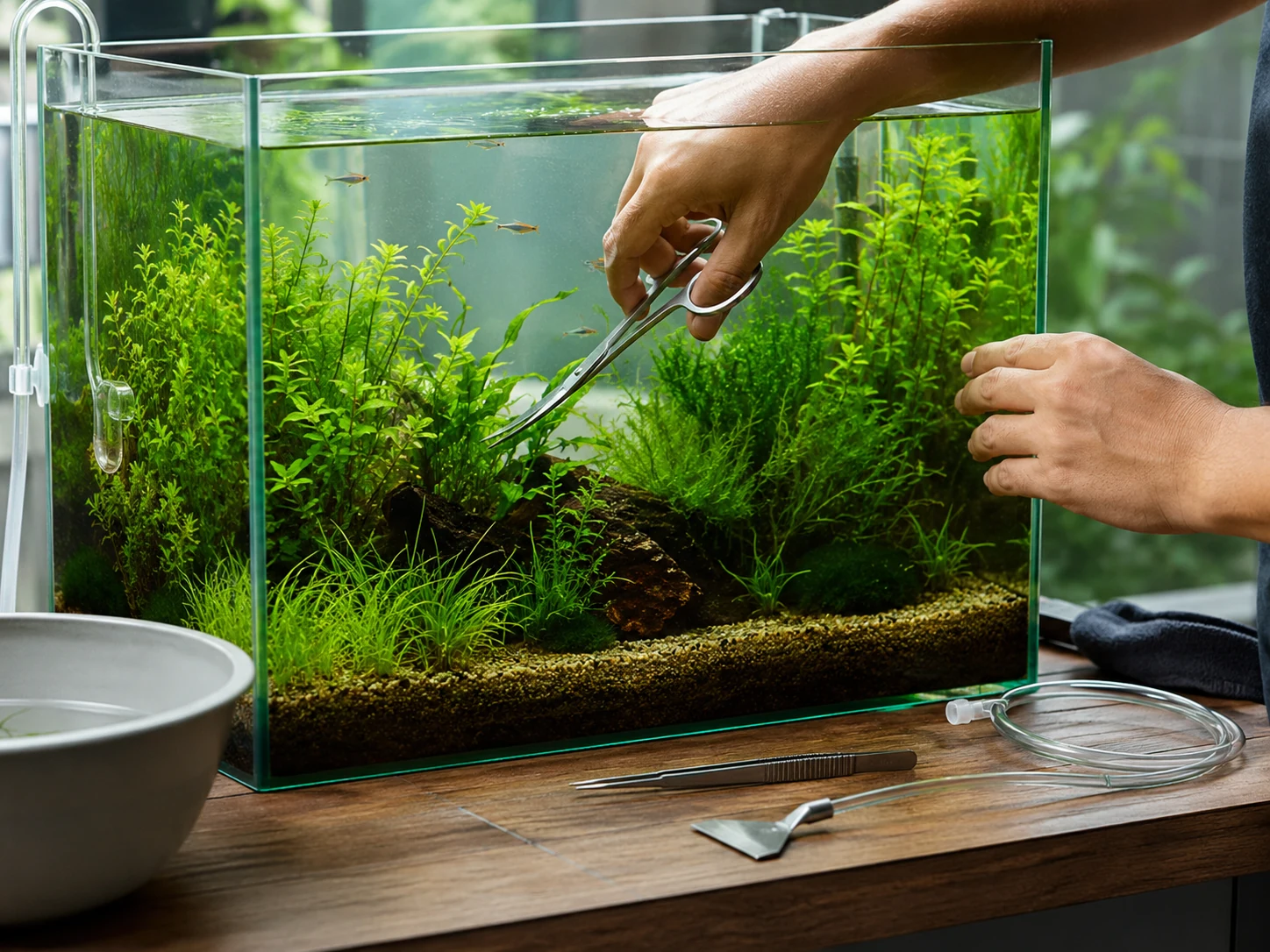
A low-tech planted tank does not need constant interference.
It needs consistent care.
| Task | Beginner rhythm |
|---|---|
| Feed fish | Small amounts, once or twice daily depending on species |
| Check fish behavior | Daily |
| Remove dead leaves | Weekly |
| Water change | Often 20–30% weekly or as tests require |
| Test water | Weekly early on; more often if problems appear |
| Clean glass | As needed |
| Trim plants | When they shade too much or decay |
| Rinse filter media | Only when flow slows; rinse in old tank water |
| Add root tabs | Every few months depending on product and plant needs |
Do not deep-clean the whole tank.
The goal is steady correction.
Not sterile reset.
Common Beginner Mistakes
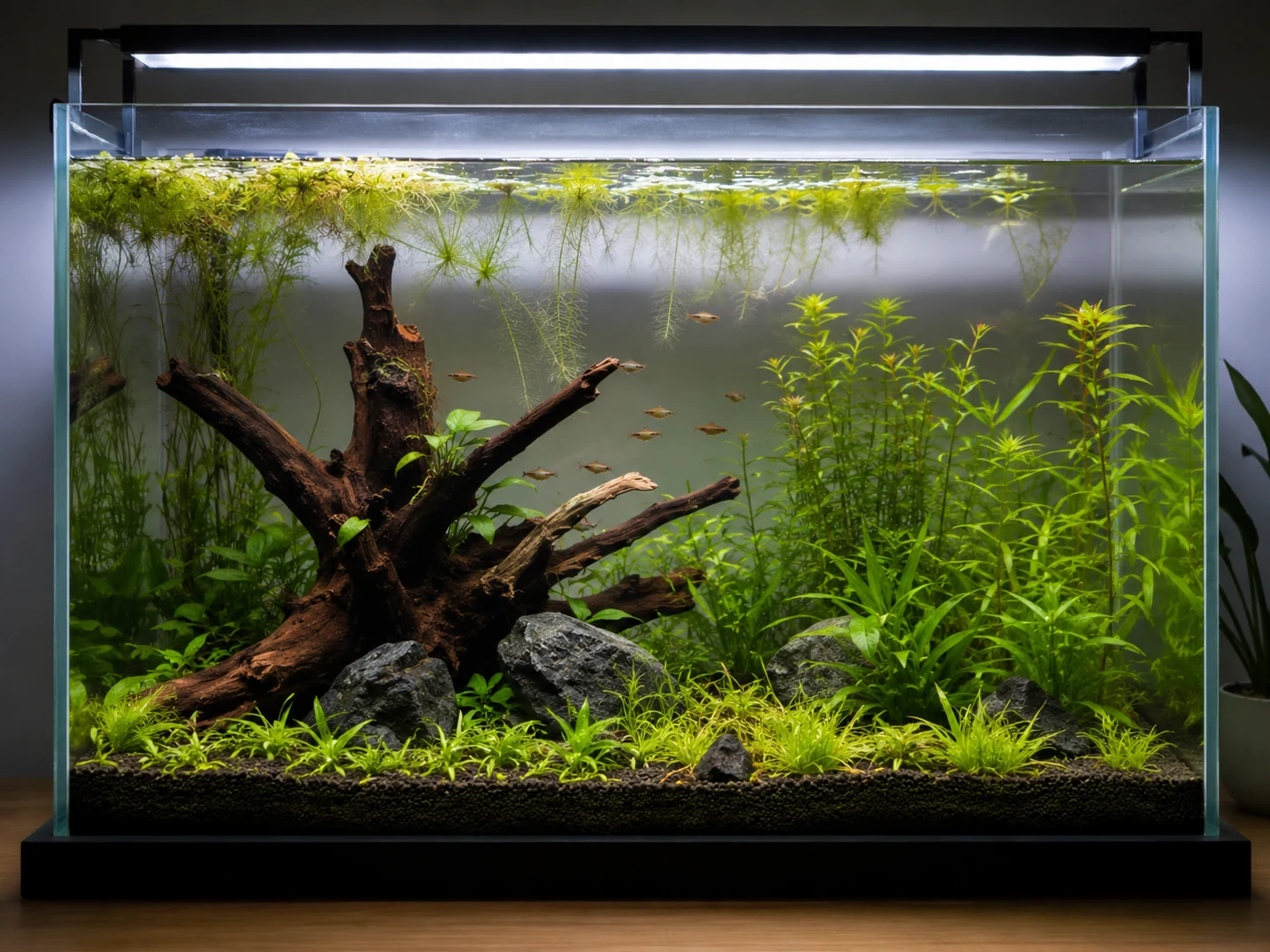
Avoid these and your odds improve a lot.
| Mistake | Why it causes trouble |
|---|---|
| Too much light too soon | Algae outbreak |
| Buying demanding plants | Melt and disappointment |
| Burying rhizomes | Rot |
| No root tabs for root feeders | Slow decline |
| Adding fish before cycling | Ammonia/nitrite stress |
| Overfeeding because plants “use waste” | Water quality problems |
| Constant rearranging | Plant stress |
| Replacing filter media | Cycle disruption |
| No timer | Inconsistent light |
| Expecting instant growth | Low-tech tanks are slow |
The tank does not need perfection.
It needs restraint.
Simple Shopping List
Here is a practical starting list.
| Item | Beginner recommendation |
|---|---|
| Tank | 10–20 gallons if space allows |
| Filter | Sponge or gentle adjustable filter |
| Heater | Needed for tropical fish |
| Light | Adjustable or timer-controlled LED |
| Substrate | Sand/fine gravel plus root tabs, or aquarium soil if you understand it |
| Plants | Anubias, Java fern, crypts, water sprite, hornwort, floating plants |
| Fertilizer | Light all-in-one liquid fertilizer if needed |
| Root tabs | For crypts, swords, vallisneria |
| Test kit | Ammonia, nitrite, nitrate, pH |
| Water conditioner | For every water change |
| Timer | For consistent lighting |
| Tools | Tweezers, scissors, algae scraper, siphon |
Buy the boring tools.
They save more tanks than fancy decorations do.
FAQ
Do low-tech planted tanks need CO2?
No. A low-tech planted tank is usually built specifically to avoid pressurized CO2. The tradeoff is slower plant growth and the need for moderate lighting, hardy plants, and patient maintenance.
What plants are best for a low-tech aquarium?
Good beginner choices include Anubias, Java fern, Cryptocoryne, Java moss, water sprite, hornwort, Vallisneria, Amazon sword in larger tanks, and floating plants such as salvinia or frogbit.
How many hours should the light be on?
Start around 6 hours per day. If plants are healthy and algae is controlled, you can slowly move toward 7–8 hours. Avoid 10–12 hour schedules in a new low-tech tank.
Can plants cycle a fish tank?
Plants can help absorb nitrogen compounds, but they do not replace cycling. You still need to test ammonia and nitrite. A planted tank can still be unsafe for fish if the biological filter is not ready.
Do I need fertilizer in a low-tech tank?
Often, yes, but lightly. Fish waste may provide some nutrients, but many tanks still need trace nutrients, potassium, or root tabs for heavy root feeders like crypts and swords.
Why are my new aquarium plants melting?
Some plants melt while adapting to new water or changing from emersed-grown leaves to underwater growth. Remove dying leaves, keep water stable, and watch for new growth before assuming the plant is dead.
Can I use gravel for a planted tank?
Yes. Inert gravel or sand can work well if you choose appropriate plants and use root tabs for root feeders. Rhizome plants such as Anubias and Java fern should be attached to wood or rock, not buried.
How do I prevent algae in a low-tech tank?
Start with moderate light, use a timer, avoid overfeeding, add enough plant mass, remove dead leaves, and keep water changes consistent. Do not treat algae only by buying algae-eating fish.
Are floating plants good for low-tech tanks?
Yes, if the surface flow is not too strong. Floating plants can absorb nutrients, shade the tank, and help fish feel secure. They can also block too much light if allowed to cover the entire surface.
What is the easiest low-tech tank setup?
A 10–20 gallon tank with a gentle filter, heater if needed, 6-hour light schedule, inert substrate, root tabs, Anubias or Java fern on wood, crypts in the substrate, and a few floating plants is a strong beginner setup.
Related Guides
- How to Set Up a Fish Tank Without Making the Beginner Mistakes That Kill Fish
- Freshwater Aquarium Checklist
- Fish Tank Size Guide
- How to Cycle a Fish Tank Without Guessing When It’s Safe for Fish
- Betta Tank Setup for Beginners
- Betta Fish Care Guide
- Best Aquarium Lights
- Best Aquarium Filters
- Best Aquarium Test Kits
- Cloudy Fish Tank Water
- Algae Problems
Author Box
Editorial Note
This guide is educational and intended for beginner freshwater aquariums. Low-tech planted tanks can be simple, but they still depend on stable water, appropriate lighting, safe stocking, and basic testing. Product recommendations should always be matched to tank size, fish species, and the keeper’s maintenance routine.
Healthy Aquariums does not recommend using live plants as an excuse to skip cycling, overstock the tank, run excessive lighting, or ignore ammonia and nitrite readings.
References
- Tropica. “Aquarium Plants.” https://tropica.com/en/plants/
- Aquarium Co-Op. “Top 10 Easy Aquarium Plants that Every Beginner Should Try.” https://www.aquariumcoop.com/blogs/aquarium/easy-aquarium-plants
- Aquarium Science. “Low Tech Planted Aquariums.” https://aquariumscience.org/15-14-low-tech-planted-aquariums/
- Oklahoma State University Extension. “Nitrification and Maintenance in Media Bed Aquaponics.” https://extension.okstate.edu/fact-sheets/nitrification-and-maintenance-in-media-bed-aquaponics
- New Mexico State University Extension. “Important Water Quality Parameters in Aquaponics Systems.” https://pubs.nmsu.edu/_circulars/CR680/
- RSPCA Knowledgebase. “How should I care for my Siamese fighting fish?” https://kb.rspca.org.au/categories/companion-animals/fish/how-should-i-care-for-my-siamese-fighting-fish
- Manufacturer instructions for any aquarium light, fertilizer, root tab, substrate, filter, heater, water conditioner, or test kit used by the reader.