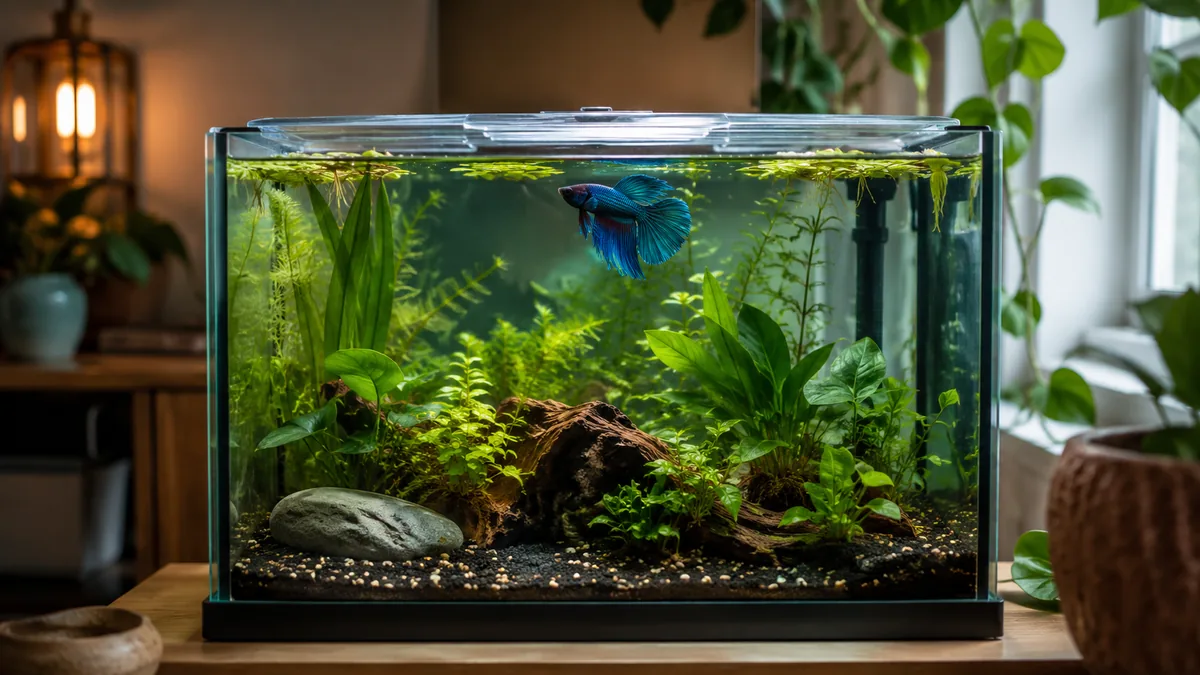
The Care Mistake That Slowly Wears Bettas Down
The most common betta care mistake is not one dramatic disaster.
It is slow neglect disguised as “easy care.”
Bettas are marketed as low-maintenance fish, and in one sense they can be. A single betta in a properly heated, filtered, cycled 5–10 gallon tank can be much easier to care for than a crowded community aquarium.
But “low maintenance” does not mean “no maintenance.”
A betta still produces waste. Food still breaks down. Water still evaporates. Nitrate still rises. Filters still clog. Heaters still fail. Plants still shed leaves. The fish still reacts to stress.
The bowl myth makes this worse. If someone believes a betta can live happily in a tiny container, they often underestimate the importance of water quality, temperature, and routine.
A betta can tolerate bad conditions for a while.
That does not mean the fish is fine.
Care begins when you stop asking, “Is the fish still alive?” and start asking, “Is the tank making it easy for this fish to stay healthy?”
What Good Betta Care Actually Means
Good betta care is built on five things:
| Care pillar | What it means in practice |
|---|---|
| Stable warm water | Keep the tank around 76–80°F or 24–27°C for most beginner setups |
| Clean, tested water | Ammonia/ammonium (NH3/NH4+) and nitrite (NO2-) should stay at 0 ppm |
| Gentle filtration | Enough biological filtration without exhausting the fish |
| Appropriate feeding | Small portions of quality betta food, not random overfeeding |
| Low-stress environment | Safe cover, resting places, gentle flow, no constant harassment |
If you already built the tank correctly, care becomes much easier.
If the tank is too small, unheated, unfiltered, or uncycled, every care routine becomes harder. You will spend more time rescuing the tank than enjoying the fish.
That is why this guide assumes your betta already has a proper setup: ideally 5 gallons / ~19 L minimum, better at 10 gallons / ~38 L, heated, gently filtered, covered, and cycled.
Related guide: Betta Tank Setup
The Best Daily Routine for a Betta
A good daily routine should be simple enough that you actually do it.
You do not need to test every parameter every morning once the tank is mature and stable. You do need to look at the fish and the equipment with attention.
A healthy daily routine takes less than two minutes.
| Daily check | What to look for |
|---|---|
| Fish behavior | Swimming normally, alert, not hiding constantly |
| Breathing | Not gasping, not rapid gill movement |
| Appetite | Interested in food, not ignoring or spitting everything out |
| Temperature | Heater working, thermometer in normal range |
| Filter flow | Gentle flow still running |
| Surface access | Betta can reach the surface easily |
| Visible waste/food | Remove uneaten food if you see it |
This is where experience starts to build.
You learn what normal looks like for your specific betta. Some bettas are active. Some are calmer. Some rest often on leaves. Some patrol the glass. Some flare occasionally.
The key is change.
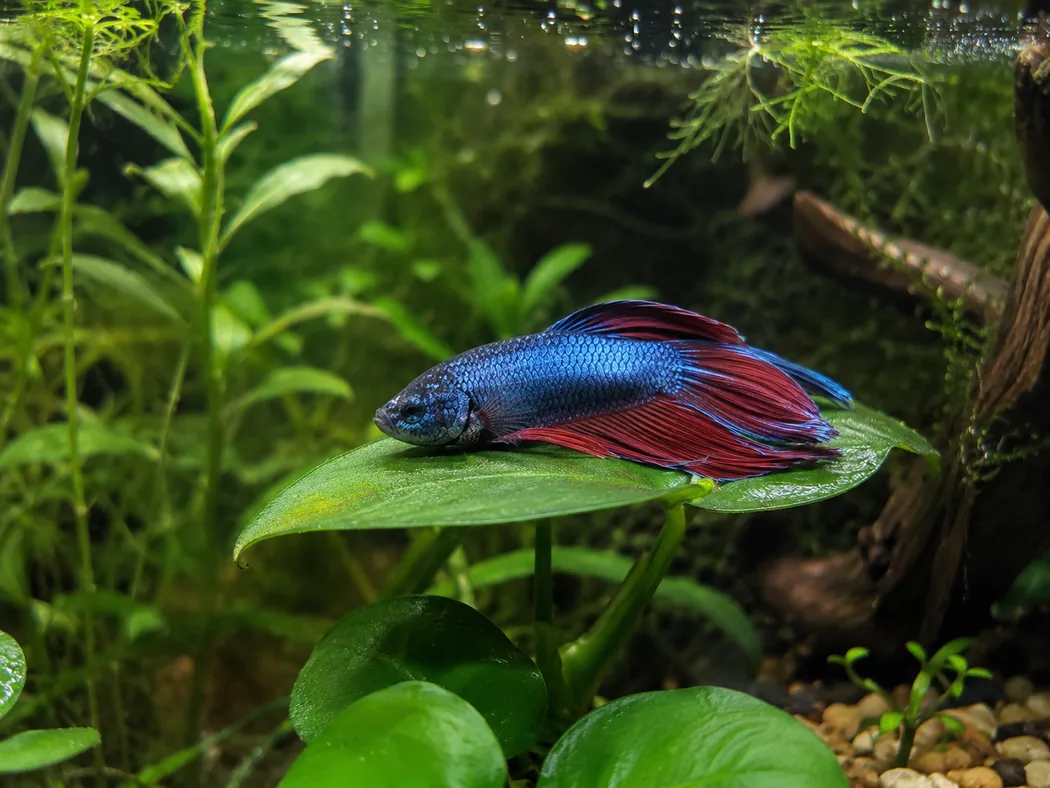
A betta resting on an Anubias leaf may be normal. A betta suddenly lying on the bottom all day after weeks of activity is not the same thing.
Do not stare at the tank looking for problems.
Just notice the fish.
That habit catches more issues than most products do.
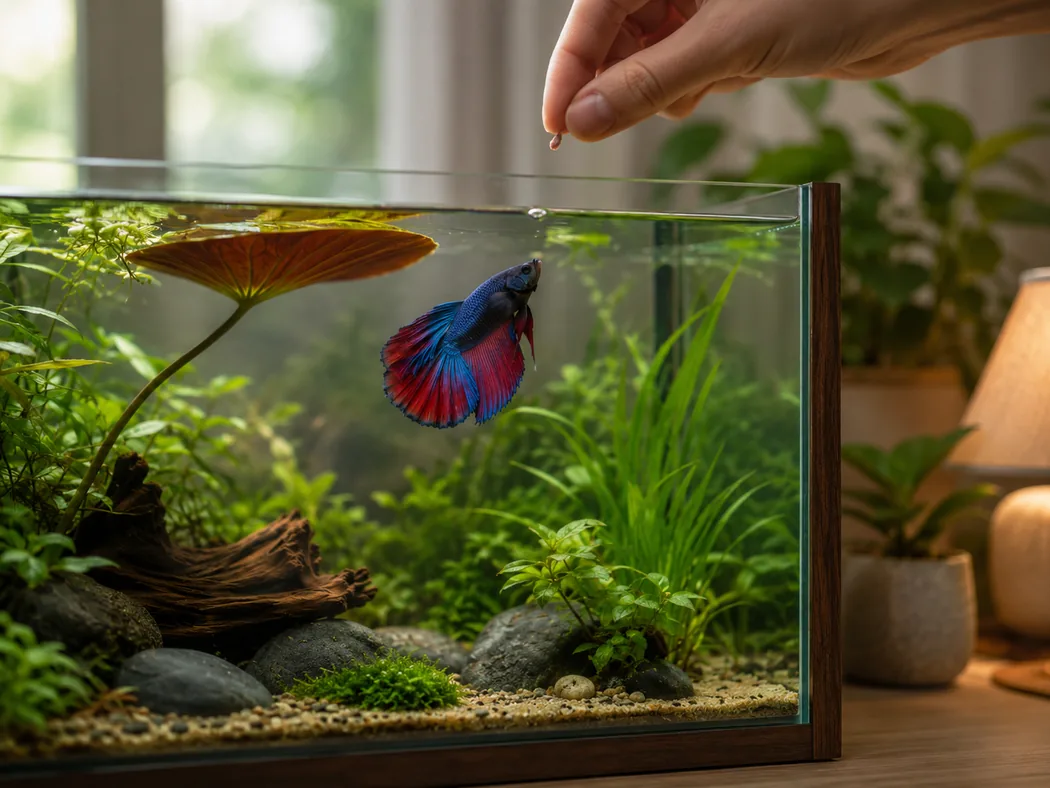
How Much and How Often to Feed a Betta
Most betta feeding problems come from too much food, not too little.
Bettas are small fish with small stomachs. They are also very good at convincing people they are starving. Many will rush to the front of the tank every time you walk by.
That does not mean they need food every time.
For most adult bettas, a practical beginner feeding routine is:
| Feeding routine | Beginner guidance |
|---|---|
| Meals per day | 1–2 small meals |
| Portion size | Only what the fish finishes quickly |
| Pellet amount | Often 2–4 small betta pellets per meal, depending on pellet size |
| Uneaten food | Remove it |
| Fasting day | Optional; useful for some overfed fish, not a cure-all |
The better rule is not “five pellets” or “three pellets.” Pellet sizes vary too much.
The better rule is:
Feed a small amount, watch the fish eat, and stop before food sinks and disappears into the tank.
If the belly looks swollen after every meal, you are probably feeding too much. If the fish becomes sluggish, floats oddly, or produces long waste after frequent heavy feeding, reduce the amount and check the food quality.
Do not use feeding as entertainment.
That is how many bettas get bloated in clean-looking tanks.
What to Feed a Betta
Bettas are carnivorous/insectivorous fish by nature. In an aquarium, they usually do best on a high-quality betta pellet or small floating food designed for bettas, with occasional protein-rich treats.
A simple feeding plan can work very well:
| Food type | Use |
|---|---|
| Betta pellets | Main staple food |
| Frozen bloodworms | Occasional treat |
| Frozen or live brine shrimp | Occasional variety |
| Daphnia | Useful occasional food, especially for variety |
| Freeze-dried foods | Treat only; soak first if needed |
| Generic tropical flakes | Not ideal as the main food |
The mistake is turning treats into the diet.
Bloodworms are popular because bettas love them. That does not mean they should be the daily staple. Think of them as rich food, not everyday nutrition.
Also, watch pellet size. Some betta pellets are too large for smaller bettas or short-bodied varieties. If the fish chews, spits, and re-chews, the food may be too big or too hard. Pre-soaking can help in some cases, but soaking everything for too long can make food messy.
Do not leave food sitting in the tank.
In a small betta tank, uneaten food is not harmless. It becomes waste.
A practical beginner feeding rhythm might look like this:
| Day | Feeding idea |
|---|---|
| Most days | Small portion of quality betta pellets |
| 1–2 times per week | Small treat such as frozen bloodworms, daphnia, or brine shrimp |
| After overfeeding | Feed lighter, test water, and remove waste |
| When appetite drops | Check temperature and water before changing food randomly |
If the betta refuses one meal, do not panic. If it refuses food repeatedly, check temperature, ammonia/ammonium (NH3/NH4+), nitrite (NO2-), recent stress, and whether the food is too large or stale.

How to Handle Water Changes Without Stressing Your Betta
Water changes are one of the best things you can do for a betta.
They are also one of the easiest things to overdo badly.
The goal is not to shock the tank with huge random changes. The goal is steady, boring maintenance.
For a cycled, filtered betta tank:
| Tank size | Practical water-change starting point |
|---|---|
| 5 gallons / ~19 L | Around 20–30% weekly, sometimes twice weekly if nitrate rises or feeding is messy |
| 10 gallons / ~38 L | Around 20–30% weekly is a strong beginner routine |
| 20 gallons / ~76 L | Often 20–25% weekly or bi-weekly, depending on stocking and nitrate |
These are starting points, not laws.
Your test results decide the real schedule. If nitrate rises quickly, increase maintenance or reduce feeding. If the tank is planted, lightly stocked, and stable, it may need less. If the tank is small and messy, it may need more.
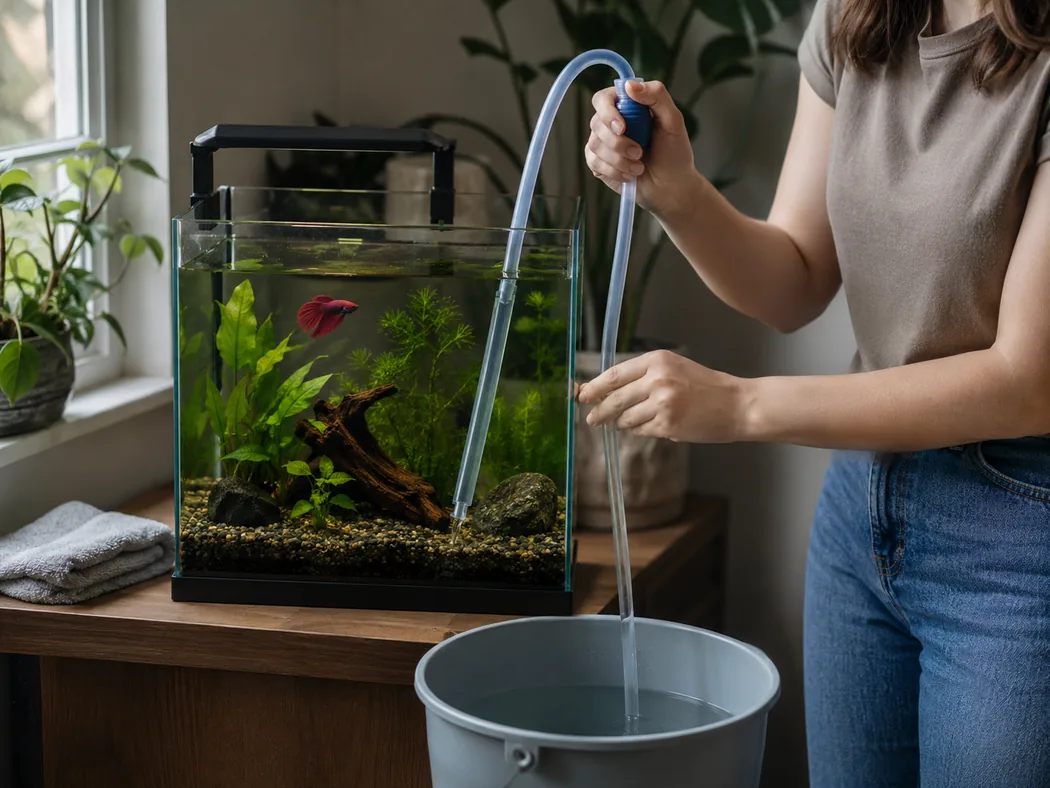
A safe water change routine looks like this:
- Unplug or protect equipment if water level will drop near the heater.
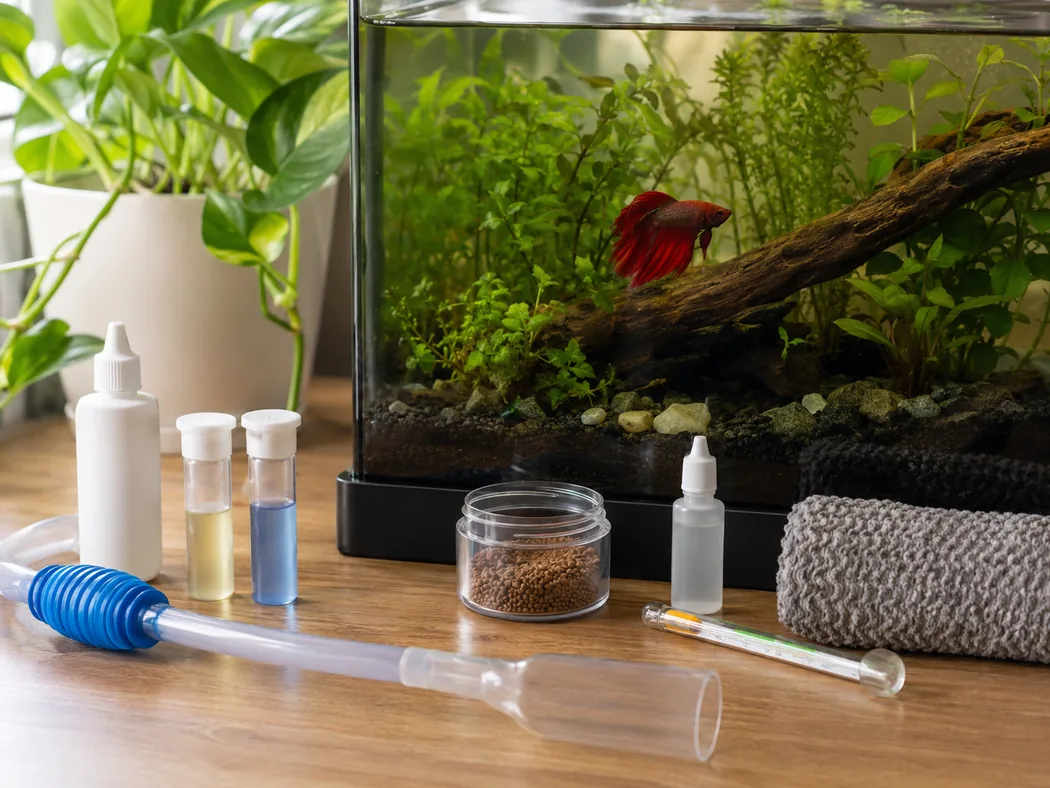
- Remove water with a siphon.
- Gently remove visible debris from the substrate surface.
- Treat new tap water with conditioner.
- Match temperature as closely as practical.
- Refill slowly.
- Restart equipment safely.
- Check the betta after the change.
Avoid giant emergency water changes unless water tests or symptoms truly justify it. Sudden temperature or pH shifts can stress fish.
Small, consistent water changes beat occasional panic cleaning.
Water Parameters That Matter Most
You do not need to chase perfect numbers every day.
You do need to know the numbers that can hurt the fish quickly.
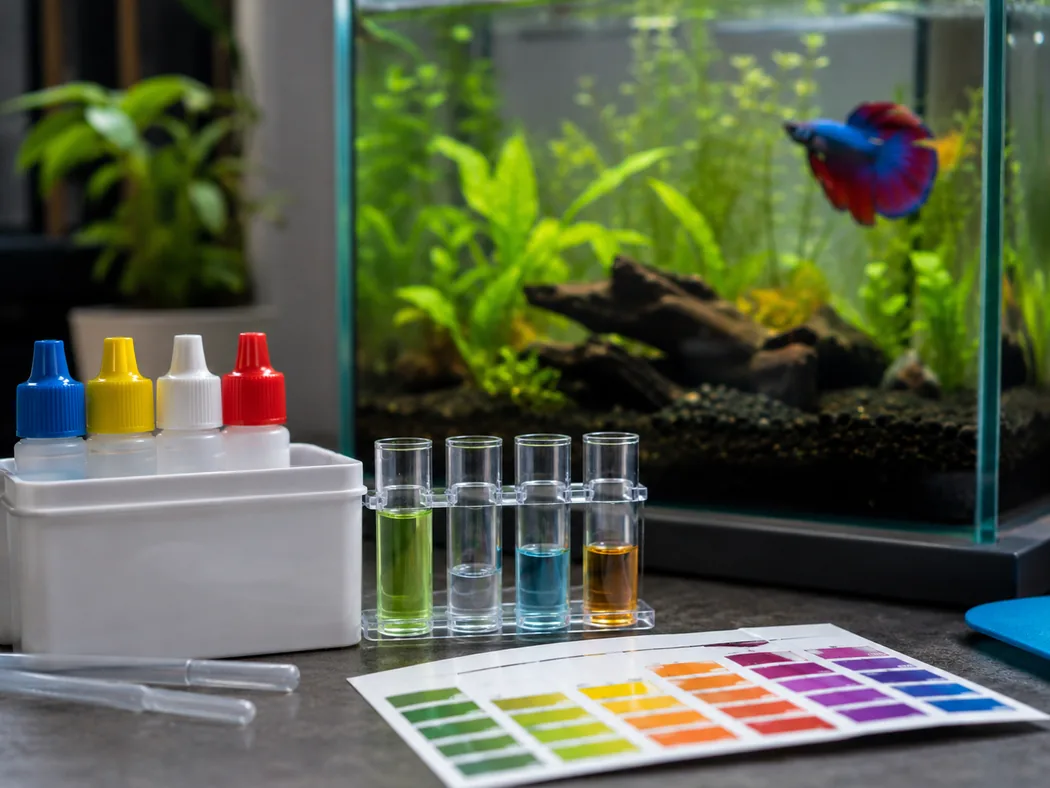
For betta care, these are the most important water parameters:
| Parameter | Practical target |
|---|---|
| Ammonia/Ammonium (NH3/NH4+) | 0 ppm |
| Nitrite (NO2-) | 0 ppm |
| Nitrate (NO3-) | Keep controlled with water changes; lower is usually better |
| Temperature | 76–80°F or 24–27°C |
| pH | Stable; many beginner betta tanks do well around 6.5–7.5 |
A stable pH is usually more important than forcing a “perfect” pH. Betta splendens can tolerate a broader range than many beginners think, but sudden pH swings are stressful.
If your pH keeps drifting down, learn about KH. KH means carbonate hardness, and it helps buffer pH. Low KH can make a tank more vulnerable to pH swings, especially if you use aquasoil, driftwood, or very soft water.
For most beginner betta keepers, the first priority is simpler:
Keep ammonia and nitrite at zero.
Keep temperature stable.
Keep nitrate under control.
Do not let the tank swing wildly because you are chasing numbers you do not fully understand yet.
Temperature and Heater Checks
A betta can look “lazy” when the real problem is cold water.
Cold water slows a betta down. It can reduce appetite, affect digestion, and make the fish more vulnerable to stress. Warm unstable water is also a problem. The goal is not heat for heat’s sake. The goal is steady tropical water.
Check the thermometer daily at first, then regularly once the tank is stable.
A quick heater check:
| Check | What it tells you |
|---|---|
| Thermometer reads stable range | Heater is likely keeping up |
| Betta rests near heater constantly | Tank may be too cool elsewhere |
| Temperature drops overnight | Room may be too cold or heater undersized |
| Heater light always on | Heater may be struggling |
| Heater never turns on | Heater may be broken, unplugged, or set too low |
Do not assume the heater is working because it is plugged in.
Cheap heaters fail. Old heaters fail. Preset heaters can be inaccurate. Thermometers are not optional.
Also be careful during water changes. Unplug the heater if the water level will drop below it. Let it cool before removing it from water. A heater running dry can crack or fail.
This is basic safety, not advanced fishkeeping.

How to Read Betta Behavior
A betta’s behavior is one of your best care tools.
Healthy bettas are not all identical, but they usually show interest in their environment. They may patrol the tank, rest on leaves, come to the front when you approach, inspect new objects, build bubble nests, and eat with interest.
Normal behavior can include:
- Resting on a leaf or hammock
- Slow cruising around the tank
- Occasional flaring
- Short naps near plants or hides
- Coming to the front during feeding time
- Exploring the same route each day
Concerning behavior can include:
- Constant hiding after the adjustment period
- Clamped fins
- Gasping at the surface
- Rapid gill movement
- Sitting on the bottom all day
- Refusing food repeatedly
- Scratching against objects
- Floating oddly or struggling to sink
- Torn fins getting worse over time
Do not diagnose from behavior alone.
Behavior tells you where to look first. Water tests and temperature checks tell you what the tank is doing.
The right first response to strange behavior is usually not medicine.
It is:
Test the water.
Check the temperature.
Look at the filter flow.
Think about recent changes.
Common Signs Something Is Wrong
When a betta acts off, beginners often jump straight to disease.
Sometimes disease is involved. But many betta problems start with water, temperature, stress, flow, or feeding.
Use this table as a first-check guide:
| Symptom | What to check first |
|---|---|
| Betta not eating | Temperature, water quality, food size, stress, recent move |
| Sitting at bottom | Temperature, ammonia/nitrite, flow exhaustion, illness |
| Gasping at surface | Ammonia/nitrite, low oxygen, heat, poor water quality |
| Clamped fins | Stress, water quality, temperature, illness |
| Torn fins | Sharp décor, filter intake, fin nipping, fin rot |
| Bloated belly | Overfeeding, constipation, poor diet, illness |
| Glass surfing | Reflection, stress, new environment, tank size |
| Fading color | Stress, age, poor water quality, illness |
The pattern matters.
A betta that skips one meal after moving homes is different from a betta that refuses food for a week. A torn fin after adding a sharp cave is different from fins melting away over several days.
Look for causes before buying treatments.
A clean tank with stable water makes every health problem easier to evaluate.
Fin Health: What Is Normal and What Is Not
Betta fins can be dramatic, and that makes them easy to misread.
Some fin changes are mechanical. The fish tore a fin on décor. The filter intake caught an edge. The betta bit its own tail. Another animal nipped it.
Other changes may be water-quality or infection related.
A clean tear often looks like a split with otherwise healthy tissue. With clean water and the cause removed, it may improve.
Fin rot is more concerning. It often looks like the fin edges are receding, fraying, darkening, reddening, or becoming fuzzy over time. The key word is “progressing.”
Do not treat every torn fin like a major disease. But do not ignore fins that keep getting worse.
First checks:
| Check | Why it matters |
|---|---|
| Ammonia and nitrite | Poor water slows healing and worsens tissue damage |
| Decorations | Sharp edges cause repeat tearing |
| Filter intake | Long fins can catch on strong intake flow |
| Tank mates | Nipping can look like fin damage |
| Feeding and stress | Weak fish heal more slowly |
The best “fin repair product” is often not a bottle.
It is clean, warm, stable water and removal of the cause.
How to Reduce Stress in a Betta Tank
Stress is not always dramatic.
A stressed betta may still eat. It may still swim. It may still look colorful for a while.
But chronic stress wears fish down.
Common stress sources include:
- Strong current
- Cold water
- Sudden water changes
- Open-top tank with jumping risk
- No hiding places
- Constant reflection
- Sharp décor
- Bright light with no shade
- Tank mates in too little space
- Unstable water quality
A calmer betta tank usually has:
| Stress reducer | Why it helps |
|---|---|
| Gentle flow | Lets the betta rest without fighting current |
| Broad leaves or hammock | Gives surface resting spots |
| Floating plants | Soft shade and cover |
| Smooth hides | Security without fin damage |
| Stable temperature | Reduces metabolic stress |
| Lid or mesh cover | Prevents jumping |
| Predictable feeding | Reduces overfeeding and waste |
Light matters too.
Bettas need a normal day/night rhythm. They do not need the light on all day. For many beginner tanks, 6–8 hours of light is a reasonable starting point, especially with live plants.
Darkness at night is not neglect.
It is rest.
Weekly Betta Care Checklist
A weekly routine keeps small problems from becoming emergencies.
| Task | Weekly care habit |
|---|---|
| Water change | Change about 20–30% in many 5–10 gallon tanks, adjusted by test results |
| Test water | Check ammonia/nitrite in newer tanks; nitrate and pH as part of routine |
| Inspect fins | Look for new tears, fraying, redness, or fuzzy edges |
| Check equipment | Confirm heater, thermometer, and filter are working |
| Clean gently | Remove debris; avoid scrubbing the tank sterile |
| Rinse filter sponge only if flow slows | Use old tank water, not untreated tap water |
| Trim dead plant leaves | Prevent decay and excess waste |
| Review feeding | Reduce food if waste or bloating appears |
Do not replace filter media just because a package says monthly.
Your filter media holds beneficial bacteria. Replacing it too often can damage the biological stability you worked to build.
If the sponge or media is clogged, gently swish it in old tank water during a water change. Do not clean everything at once.
Consistency beats intensity.
Common Betta Care Mistakes
Mistake 1: Feeding Too Much
Overfeeding is one of the fastest ways to ruin a small betta tank. The fish may beg, but the filter still has to process the waste.
Mistake 2: Treating Clear Water as Safe Water
Clear water can still contain ammonia or nitrite. Test the water before guessing.
Mistake 3: Letting the Tank Get Cold
Cold bettas often look lazy, but the issue may be temperature. Check the thermometer.
Mistake 4: Cleaning the Filter Too Aggressively
Filter media is not just dirt. It is biological filtration. Rinse gently only when needed.
Mistake 5: Adding Random Tank Mates
A single betta tank is complete. Do not add fish just because the tank looks empty.
Mistake 6: Using Medicine Before Checking Water
Many “sick betta” cases begin with water quality or temperature. Test first unless the fish is clearly injured or in urgent distress.
Mistake 7: Leaving the Light On Too Long
Too much light can increase algae and stress, especially in tanks without floating plants or shade.
Mistake 8: Ignoring Small Behavior Changes
A betta that slowly hides more, eats less, or rests in odd places is giving you information. Notice the pattern early.
Related Guides
Continue with these guides:
- Betta Tank Setup
- How to Cycle a Fish Tank
- Freshwater Aquarium Checklist
- Best Filter for a 10-Gallon Tank
- Best Aquarium Heaters
- Best Aquarium Test Kits
- Why Is My Fish Tank Cloudy?
- Why Is My Fish Gasping at the Surface?
- Betta Fin Rot
- Betta Fish Popeye
- Betta Dropsy
Final Advice
Betta care is not about doing complicated things.
It is about doing the simple things consistently.
Feed lightly.
Keep the water warm.
Test when something changes.
Change water before the tank looks bad.
Keep the filter alive.
Watch the fish closely enough that you learn what normal looks like.
A betta does not need a perfect owner.
It needs a steady one.
FAQ
How often should I feed my betta?
Most adult bettas do well with 1–2 small meals per day. Feed only what the fish finishes quickly, and adjust based on body condition, pellet size, and waste.
How many pellets should I feed a betta?
It depends on pellet size. Many bettas do well with a few small pellets per meal, but the better rule is to feed a small amount and stop before food sinks or the belly looks swollen.
Can I feed bloodworms every day?
No. Bloodworms are better as an occasional treat, not a daily staple.
How often should I change betta water?
For many cycled 5–10 gallon tanks, 20–30% weekly is a strong starting point. Adjust based on nitrate, feeding, plants, and test results.
What temperature should a betta tank be?
A practical beginner range is 76–80°F or 24–27°C. Stability matters as much as the exact number.
Why is my betta not eating?
Check temperature, ammonia/ammonium (NH3/NH4+), nitrite (NO2-), food size, recent stress, and whether the fish was recently moved.
Why is my betta sitting at the bottom?
Possible causes include cold water, ammonia/nitrite, strong current, stress, illness, or normal resting. Test water and temperature first.
Do bettas need a filter if they breathe air?
Yes. Breathing air does not remove waste from the water. A gentle filter supports biological filtration and helps keep the tank stable.
Should I clean the whole tank every week?
No. Regular partial water changes are better than full clean-outs. Avoid replacing all filter media or scrubbing everything sterile.
Can bettas live with tank mates?
Sometimes in larger, mature, carefully planned tanks. A 5-gallon betta setup should usually be one betta only.
How do I know if my betta is stressed?
Common signs include clamped fins, hiding constantly, glass surfing, rapid breathing, loss of appetite, fading color, and unusual resting.
Do bettas need light at night?
No. Bettas need a normal day/night rhythm. Turn the aquarium light off at night.
This article is written for beginner Betta splendens care in home freshwater aquariums. Individual fish vary in age, fin type, activity level, health, temperament, and response to water conditions. Use your own water test results and fish behavior when making care decisions.
References
This guide was written for beginner betta keepers and should be cross-checked against fish welfare, aquarium husbandry, and species-reference sources when publishing.
- RSPCA Knowledgebase — Siamese fighting fish care
- RSPCA — Fish environment and aquarium welfare guidance
- FishBase — Betta splendens species data
- Merck Veterinary Manual — Environmental Diseases of Aquatic Animals in Aquatic Systems
- RSPCA Knowledgebase — Aquarium water quality and biological filtration basics
- Manufacturer instructions for any specific heater, filter, conditioner, test kit, or food mentioned in future buying guides.