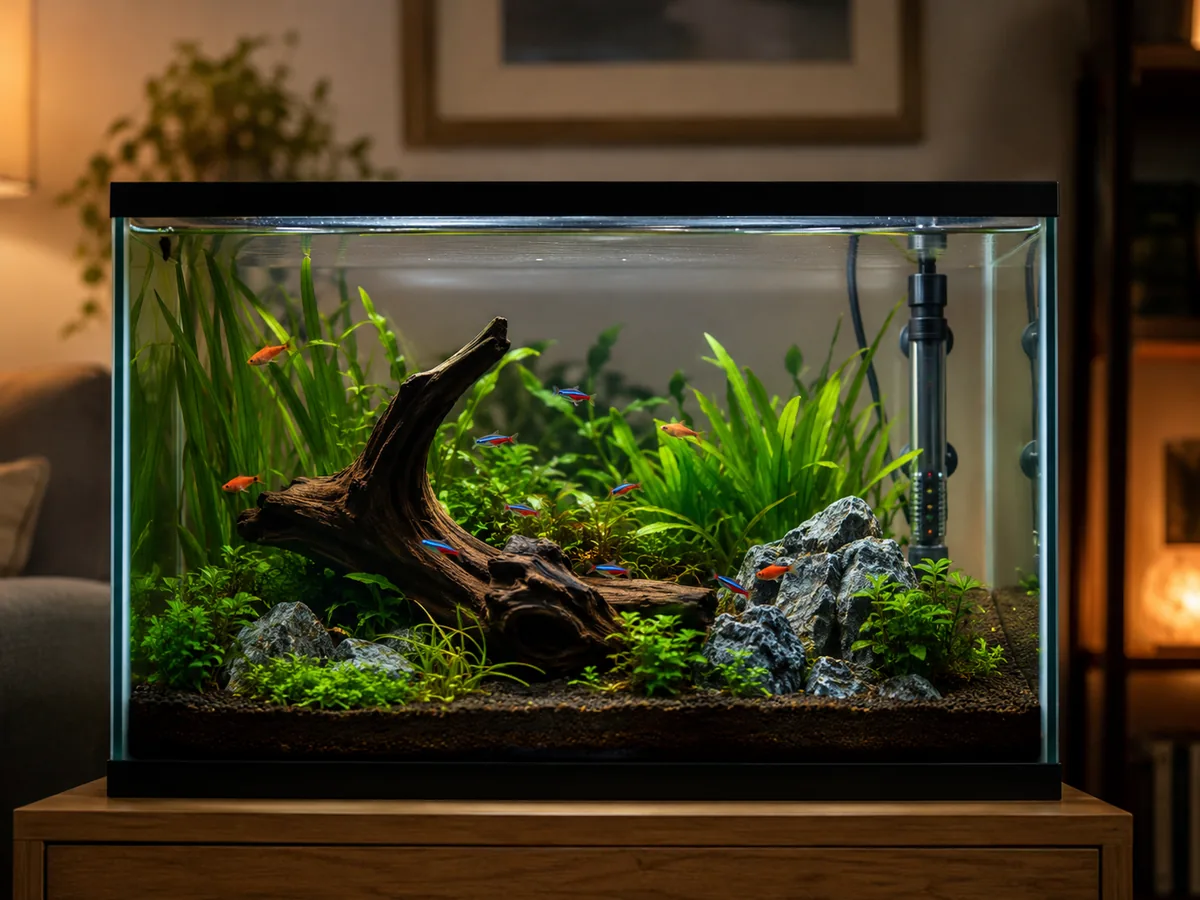
A heater is not just a warm glass tube. In a small aquarium, it changes water temperature, oxygen demand, fish metabolism, and ammonia toxicity all at once. The safest heater is the one that keeps the whole tank stable, not just the water beside the heater warm.
Many beginners choose a heater by wattage alone. Wattage matters, but placement, circulation, external verification, and water-change habits decide whether the tank actually stays safe.
What Makes a Heater Safe
A good heater should be adjustable, reliable, easy to read, and paired with a separate thermometer. The heater’s built-in dial is a setting, not proof. Always verify the real tank temperature with a thermometer placed away from the heater.
In low-flow tanks, warm water can collect around the heater while colder water remains near the substrate or opposite end. This is especially important in betta tanks and small planted tanks where flow is often reduced. Place the heater near gentle circulation so heat spreads through the tank rather than forming a warm pocket.
Heater Placement and Thermal Lag
Internal thermostats react to the water immediately around the heater body. If circulation is poor, the heater may shut off while the rest of the tank is still cool. During warm-up, the heater core can also overshoot before the thermostat catches up.
That temperature swing is not only a comfort issue. Warmer water holds less dissolved oxygen while fish metabolism rises. Higher temperature and higher pH also shift more total ammonia toward toxic un-ionized ammonia. A tank with marginal water quality can become more dangerous when heated too quickly.
Advanced safety note: flow, sensor lag, and ammonia risk
A heater is not only a comfort device. It changes the physics and chemistry around the fish. Most aquarium heaters sense the water immediately around the heater body, so poor circulation can create a warm pocket near the heater while the rest of the tank remains cooler. That is why heater placement near steady flow is safer than hiding the heater in a stagnant corner.
Warm water also holds less dissolved oxygen, while fish metabolism rises. If pH is high and the tank already has measurable total ammonia, faster heating can shift a greater share of that ammonia toward the more toxic un-ionized form. Do not use a heater to “fix” a cold tank quickly. Raise temperature gradually, keep water moving, and test ammonia/nitrite before making aggressive changes.
Water Change Safety
Always unplug the heater before lowering the water level. Let it sit off for several minutes before exposing it to air, and do not plug it back in until it is fully submerged again. A hot heater exposed to air or splashed with cooler water can crack, fail, or create a shock risk.
Match new water within about ±1°C of the tank. In small tanks, even a small mismatch can move the entire system quickly.
Stable Heating Kit: Pair the heater with a separate thermometer, a spare suction cup set, a timer or safe power strip, and a dedicated water-change thermometer for replacement water.
Practical Upgrade Scenarios
If the tank temperature swings every day, check the room first. A heater cannot fully compensate for a tank placed next to a drafty window, direct sun, an air-conditioner vent, or an unheated night room without working harder and cycling more often.
If the heater seems inaccurate, do not immediately chase the dial. Move a separate thermometer to the far side of the aquarium and measure after the tank has had time to mix. A heater can look wrong when the real issue is poor circulation.
If livestock are gasping after a temperature increase, treat it as an oxygen and water-quality warning, not just a heater setting issue. Warmer water reduces oxygen capacity while fish demand more oxygen. Increase surface movement gently and test ammonia and nitrite before making further changes.
Related Guides
- Best Heater for Betta Tank
- How Often Water Change
- How to Acclimate New Fish
- Ammonia, Nitrite, and Nitrate
- Betta Swim Bladder Disease
- Aquarium Maintenance Schedule
FAQ
What wattage heater do I need?
A common starting point is about 3–5 watts per gallon, but room temperature, tank size, lid use, and circulation matter too.
Can I trust the heater dial?
No. Treat the dial as a rough setting and verify with a separate thermometer.
Where should I place the heater?
Place it near gentle filter flow or circulation so warm water spreads through the tank.
Should I unplug the heater during water changes?
Yes. Unplug it before lowering water and only restart it once fully submerged.
Can a heater make ammonia more toxic?
Indirectly, yes. Higher temperature and pH can increase the toxic NH3 fraction of total ammonia.
Is a preset heater safe?
Preset heaters can work, but adjustable heaters with verification are more flexible and usually safer.
Do betta tanks need heaters?
Most betta tanks do unless the room stays consistently tropical. Stability matters more than brief warm periods.
Why is one side of my tank colder?
Poor circulation can create temperature gradients. Add gentle flow or adjust heater placement.
Can I use two smaller heaters?
In larger tanks, two smaller heaters can improve redundancy and distribution, but both must be monitored.
How fast should I raise temperature?
Raise temperature gradually. Sudden increases can stress fish and change oxygen and ammonia risk.
References
- Merck Veterinary Manual. Aquarium fish health and environmental disease guidance. https://www.merckvetmanual.com/exotic-and-laboratory-animals/aquarium-fish
- University of Florida IFAS Extension. Aquarium fish management and water quality resources. https://edis.ifas.ufl.edu/
- API Fishcare. Freshwater aquarium testing and water-care education. https://www.apifishcare.com/