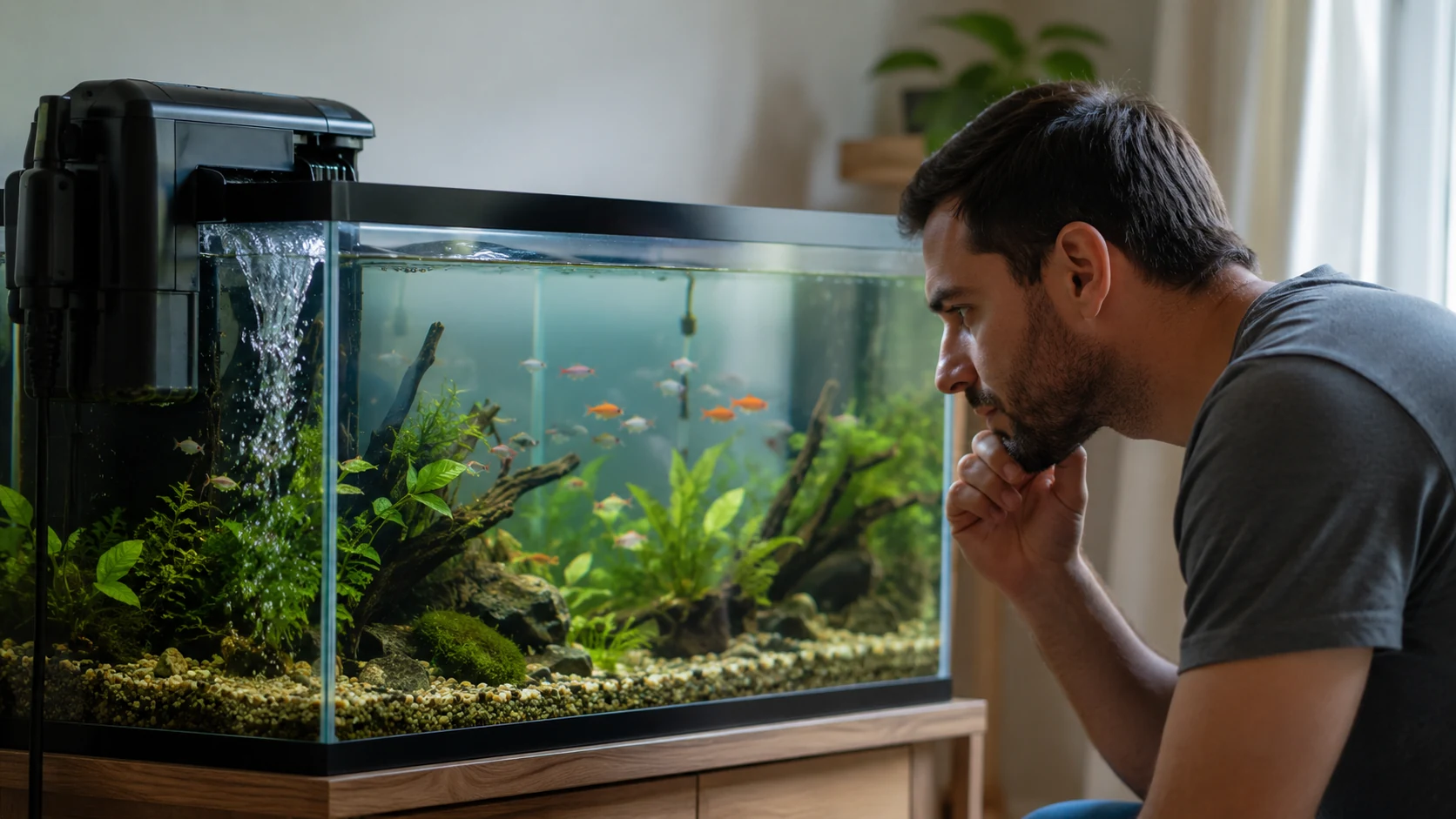
A noisy aquarium filter is annoying.
It can also be useful.
A filter that suddenly starts rattling, grinding, buzzing, splashing, gurgling, or vibrating is often telling you something has changed. The water level dropped. Air got trapped. The intake clogged. The impeller is dirty. The filter is touching the glass or lid. The media is packed too tightly. A sponge filter is bubbling too hard. A canister filter has air inside. A hang-on-back filter is struggling to prime.
Do not ignore a new filter noise.
But do not panic either.
Most noisy filter problems are mechanical and fixable. The danger is when the noise means water flow has dropped, oxygen exchange is weak, or the biological filter is being interrupted.
A quiet filter is nice.
A running filter is more important.
The goal is not silence at any cost. The goal is stable flow, safe oxygen exchange, protected beneficial bacteria, and a sound level you can live with.
First: Do Not Turn the Filter Off and Forget It
If the filter is loud, you may want to unplug it.
Sometimes you need to unplug it briefly to inspect the impeller or prevent damage. But do not turn it off for hours because the sound is irritating.
Your filter supports:
| Filter job | Why it matters |
|---|---|
| Water movement | Helps oxygen exchange |
| Mechanical filtration | Traps debris |
| Biological filtration | Houses beneficial bacteria |
| Circulation | Prevents stagnant areas |
| Surface agitation | Helps fish breathe |
| Waste processing | Helps keep ammonia/nitrite controlled |
If you must stop the filter, keep it brief. If fish are stressed or the filter cannot run, add temporary aeration with an air stone or backup sponge filter if available.
The sound matters.
The water matters more.
Check Water Level First
Low water level is one of the easiest causes of filter noise.
In a hang-on-back filter, low tank water creates a longer waterfall drop. That makes splashing louder and can reduce smooth flow. If the water gets too low, the intake may pull air, making slurping or gurgling sounds.
| Symptom | Likely issue |
|---|---|
| Loud waterfall sound | Water level too low |
| Slurping near intake | Intake pulling air |
| Bubbles from HOB outlet | Air entering system |
| Filter runs louder after evaporation | Water level dropped |
| Noise improves after topping off | Water level was the cause |
Fix:
- Top off evaporated water with dechlorinated water if needed.
- Keep the waterline high enough for the filter design.
- Use a lid if evaporation is rapid.
- Check water level more often in small tanks.
- Do not let a HOB filter run dry.
Top-off replaces evaporated water.
It does not replace water changes.
Minerals and waste do not evaporate.
Hang-on-Back Filter Noise
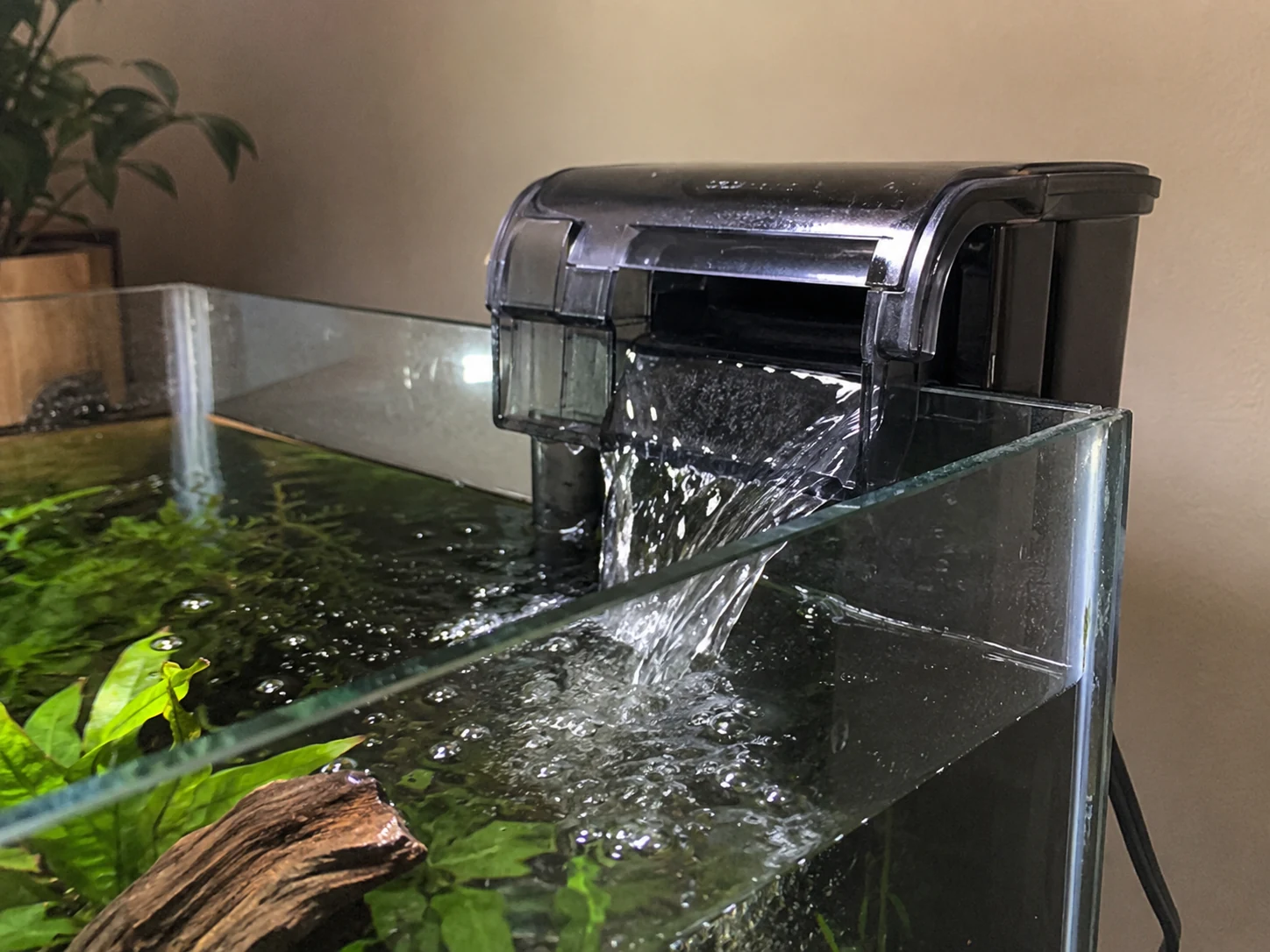
Hang-on-back filters are common, useful, and sometimes noisy.
Their noise usually comes from waterfall splash, impeller rattle, trapped air, vibration against the glass, or clogged media.
| HOB noise | Common fix |
|---|---|
| Waterfall splash | Raise tank water level |
| Rattling motor | Clean impeller and shaft |
| Gurgling after restart | Re-prime filter |
| Vibration against glass | Add soft spacer or reposition |
| Flow reduced | Rinse mechanical media in old tank water |
| Intake slurping | Check intake depth and waterline |
| Lid buzzing | Reseat filter lid |
To quiet a HOB filter, start with water level and impeller cleaning.
Do not overpack media so tightly that flow is restricted. Slow flow can create noise and weaken filtration.
If you use filter floss, replace or rinse it before it blocks the entire water path.
Sponge Filter Noise
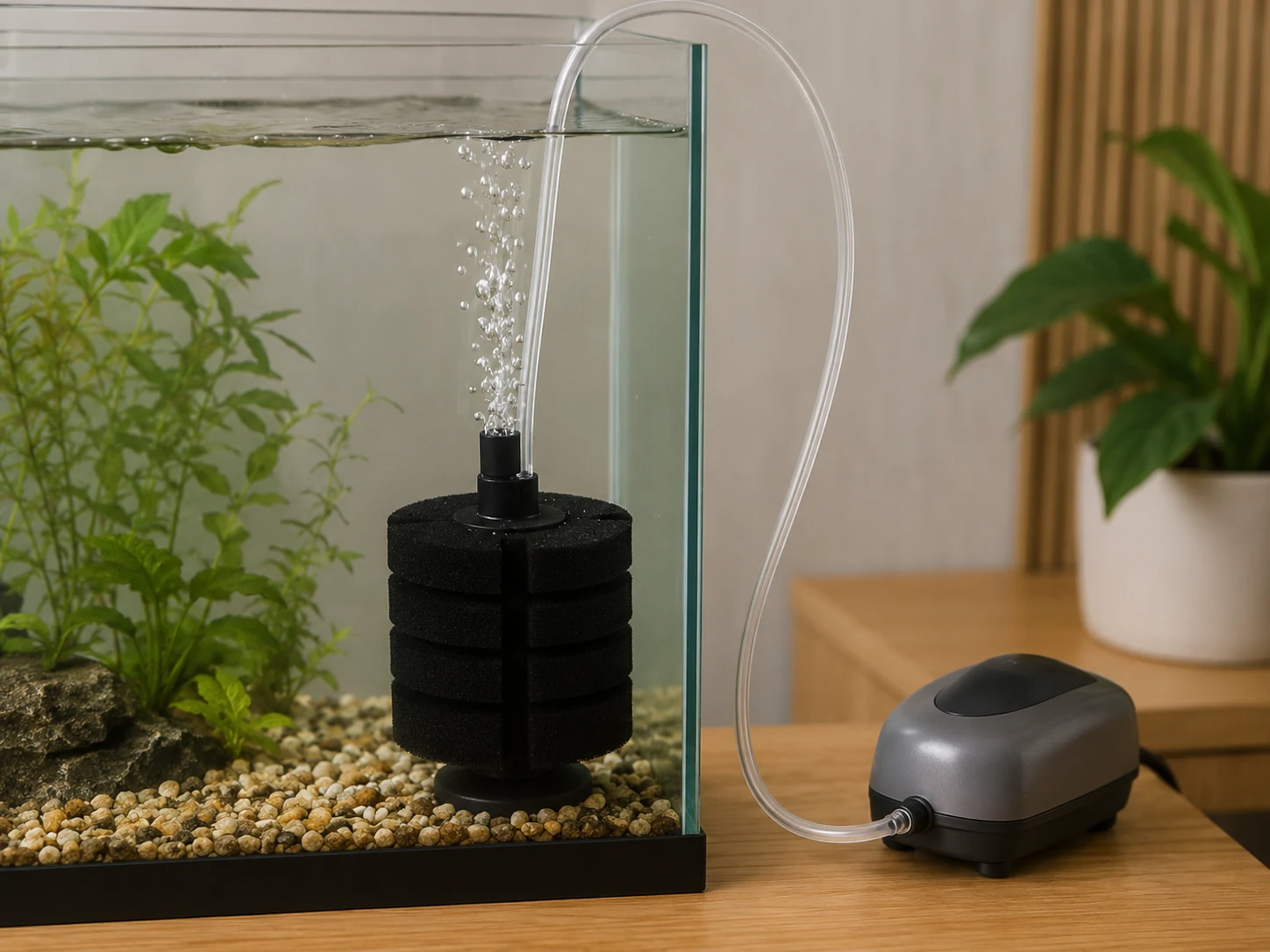
A sponge filter is usually one of the safest and simplest aquarium filters.
But it can still be loud.
Most sponge filter noise comes from the air pump, bubbling, vibration through the surface it sits on, or an air flow that is too strong.
| Noise source | Fix |
|---|---|
| Loud air pump hum | Place pump on soft pad |
| Pump touching cabinet/wall | Move it away from hard surfaces |
| Bubble noise too loud | Add air control valve |
| Large harsh bubbles | Use better air stone/diffuser if design allows |
| Tubing vibration | Secure tubing gently |
| Back-siphon risk | Use check valve |
| Sponge filter too strong for betta/shrimp | Reduce air flow |
Never restrict air pump output completely without giving air somewhere to go. Use an air control valve or bleed valve setup if needed.
For bedrooms, sponge filters can be quiet, but the air pump quality and placement matter.
A cheap loud pump can make a good sponge filter feel bad.
Canister Filter Noise
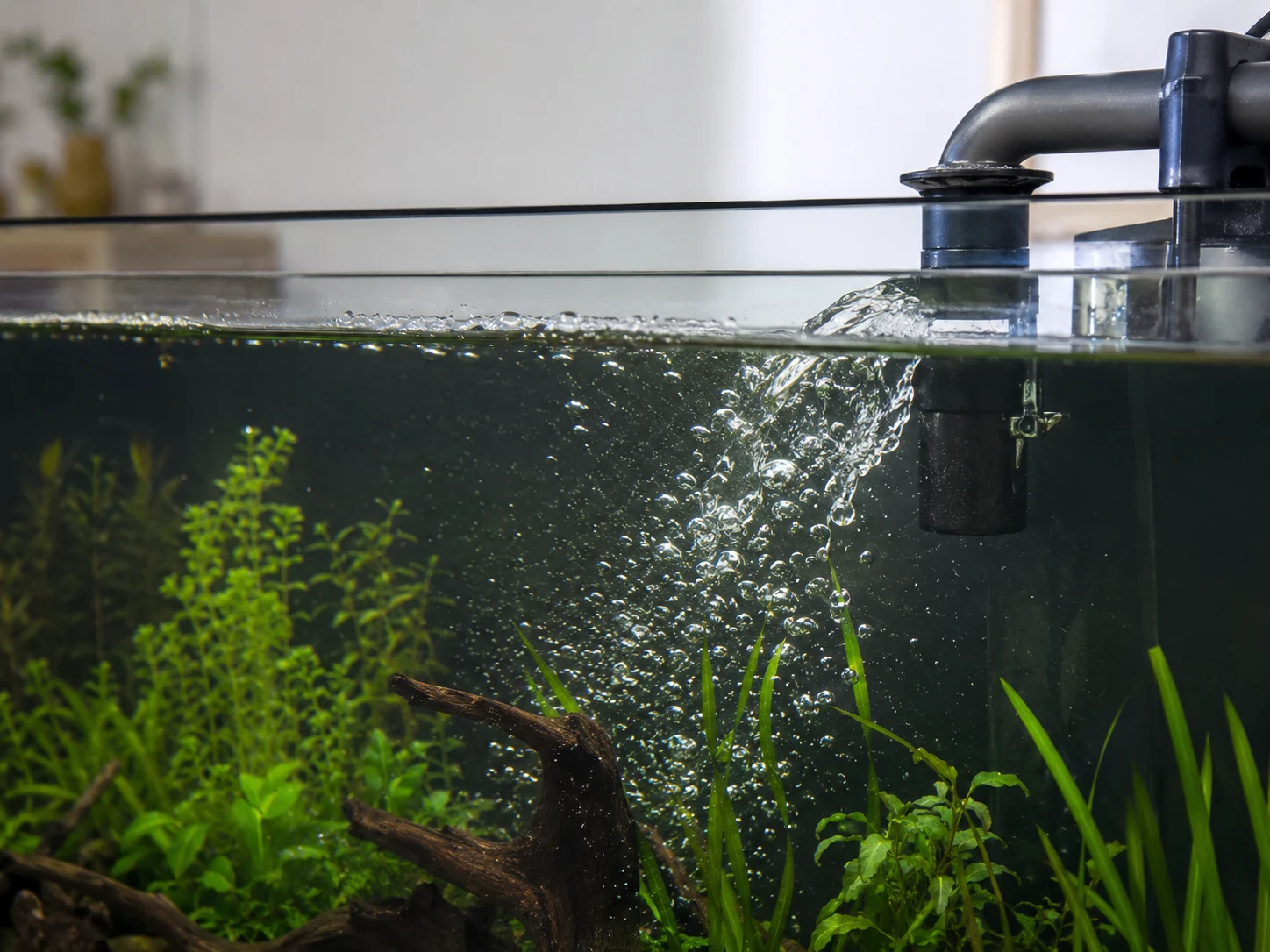
A canister filter should usually be steady and relatively quiet after it is primed.
If it rattles, burps, grinds, or gurgles, check for trapped air, clogged hoses, impeller issues, loose fittings, or media packed incorrectly.
| Canister symptom | Likely cause |
|---|---|
| Gurgling/burping | Air trapped inside |
| Rattling | Impeller or air pocket |
| Grinding | Impeller debris or worn part |
| Humming cabinet | Vibration transfer |
| Weak output | Clogged media, hose, intake, or impeller |
| Noise after cleaning | Air not fully purged |
| Noise after moving hoses | Intake/outflow position issue |
Fix order:
- Confirm intake and output are underwater.
- Check hose kinks.
- Purge trapped air following the manufacturer’s method.
- Clean intake strainer.
- Clean impeller chamber.
- Rinse mechanical media if clogged.
- Make sure media baskets are seated correctly.
- Check O-rings and fittings for air leaks.
Do not shake a canister violently.
Gentle tilting may help purge air, but always follow the product instructions.
Internal Filter or Submersible Pump Noise
Internal filters and submersible pumps can transmit vibration directly into the glass or hardscape.
A buzzing pump may not be failing. It may simply be touching something.
| Cause | Fix |
|---|---|
| Pump touching glass | Reposition suction cups |
| Suction cups hardened | Replace suction cups |
| Intake clogged | Clean intake guard |
| Impeller dirty | Clean impeller chamber |
| Air trapped | Tilt pump underwater to release air |
| Output blasting surface | Adjust direction |
| Pump touching decor | Move decor away |
Make sure the pump is fully submerged if the design requires it.
Running a submersible pump partially dry can damage it and make it loud.
Impeller Noise: The Most Important Mechanical Check
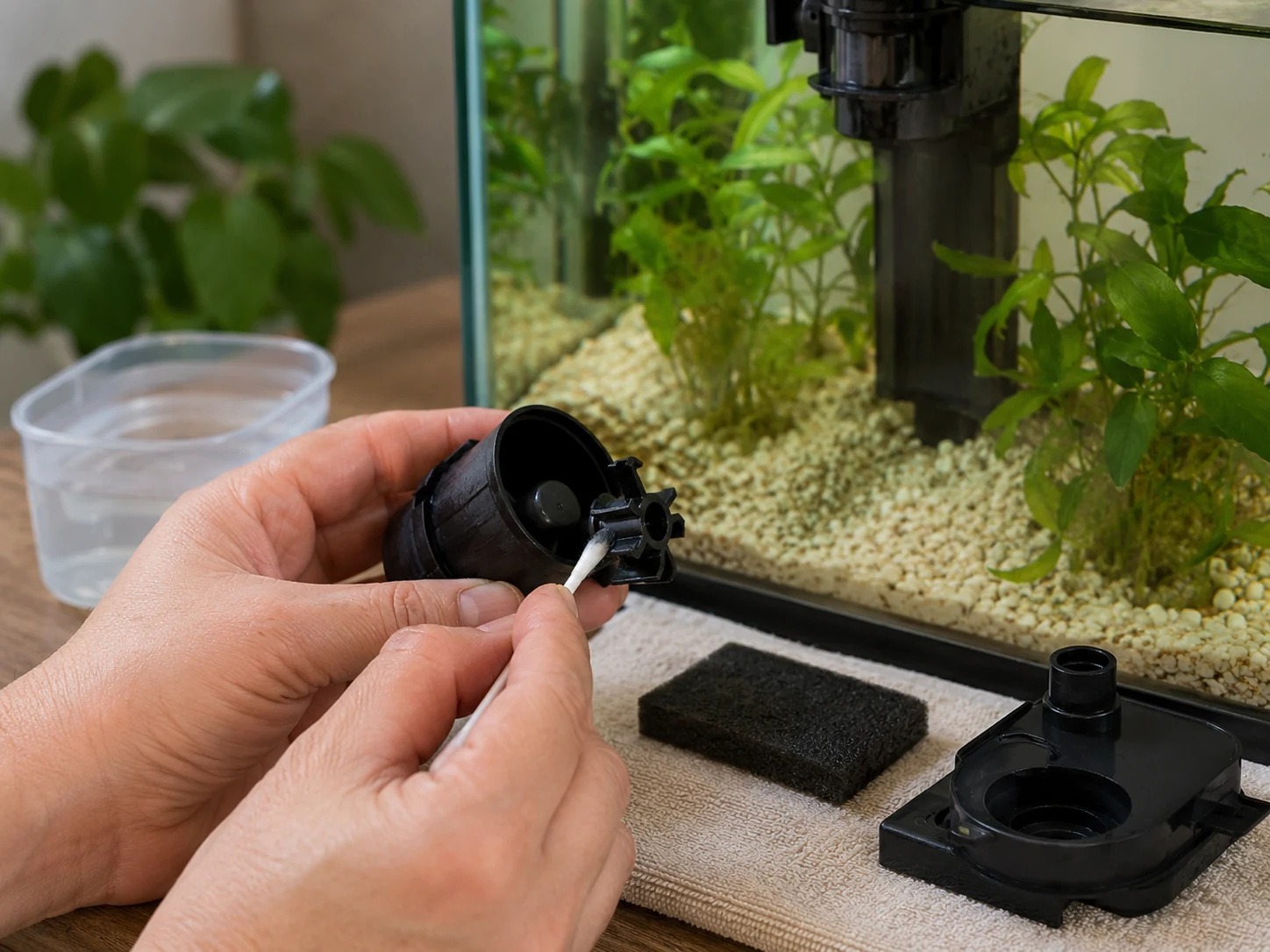
The impeller is the spinning part that moves water.
A dirty or damaged impeller is one of the most common causes of rattling, grinding, buzzing, and poor flow.
Debris can get into the impeller chamber. Snail shells, sand, plant fragments, fish food, or mineral buildup can interfere with smooth movement.
| Impeller clue | What to do |
|---|---|
| Rattle from motor area | Inspect impeller |
| Grinding sound | Turn off and clean immediately |
| Filter flow weak | Check impeller and intake |
| Filter fails to restart | Impeller may be stuck |
| Noise after sand disturbance | Sand may be in chamber |
| Old filter suddenly louder | Shaft or impeller may be worn |
Basic impeller cleaning:
- Unplug filter.
- Remove motor or impeller access cover.
- Take out impeller carefully.
- Rinse debris in old tank water or clean water.
- Use a small brush for the chamber.
- Check shaft and rubber bushings.
- Reassemble correctly.
- Prime and restart.
Do not force fragile parts.
If the impeller shaft is cracked, swollen, missing bushings, or badly worn, cleaning may not fix it.
Trapped Air and Priming Problems
Trapped air causes gurgling, rattling, burping, and intermittent flow.
It is common after water changes, filter cleaning, canister maintenance, or when a HOB filter loses prime.
| Filter type | Air problem |
|---|---|
| HOB filter | Not enough water in filter box |
| Canister filter | Air trapped inside canister or hoses |
| Internal filter | Air pocket around impeller |
| Sponge filter | Usually not the issue; bubbles are intended |
| Surface skimmer | Pulling air if water level is low |
Fix:
- Fill the HOB filter box before restarting.
- Make sure intake is submerged.
- Check for loose intake connections.
- Purge air from canister according to instructions.
- Tilt internal filter underwater to release air.
- Keep water level stable.
A filter that keeps sucking air may have a water level problem, loose fitting, cracked intake tube, or incorrect setup.
Clogged Media and Weak Flow
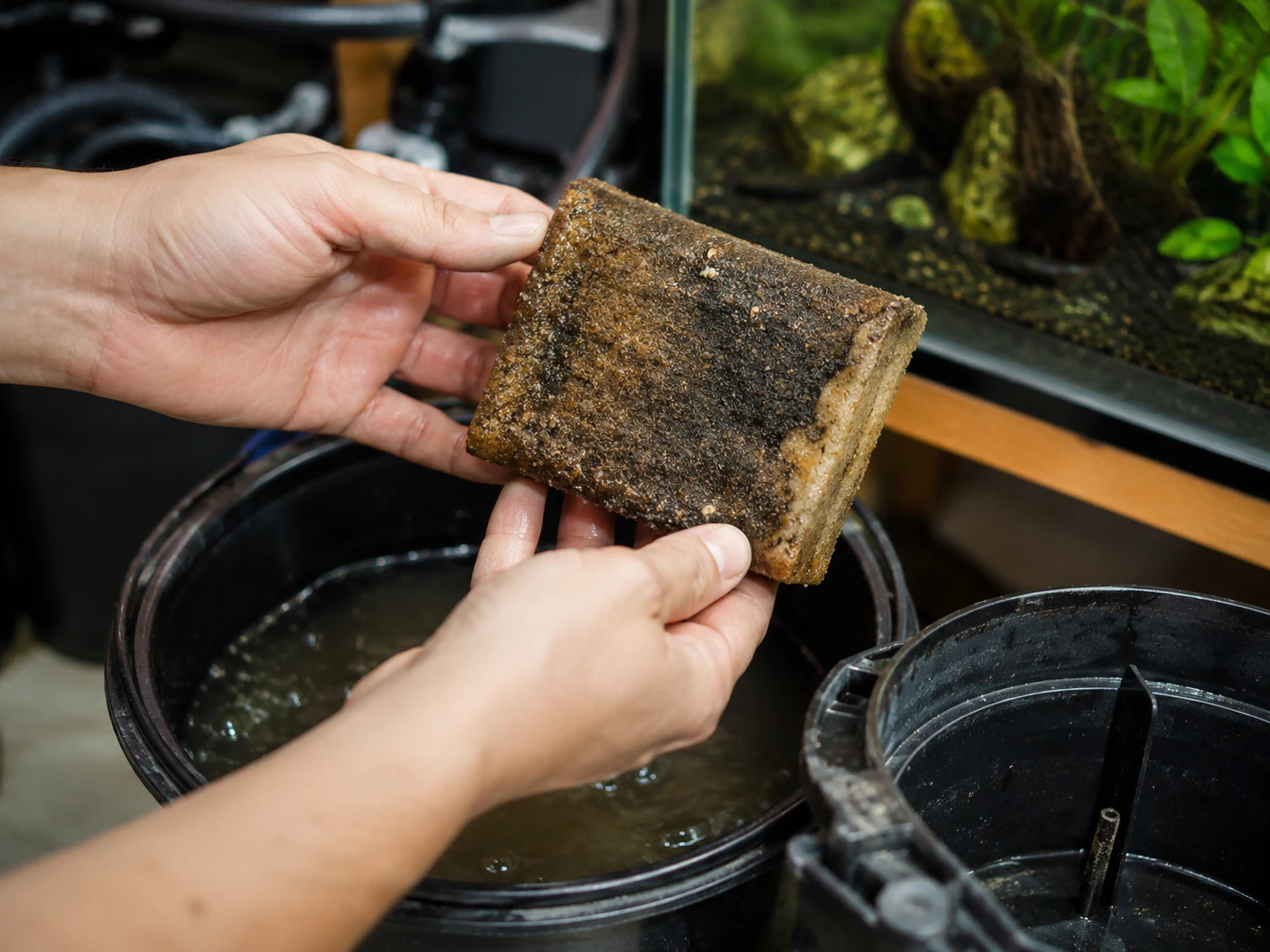
Filters often get louder when flow is blocked.
The motor works against restriction. Water may bypass media, gurgle, or trickle unevenly. A clogged intake can also make the impeller cavitate or pull air.
| Clog location | Clue |
|---|---|
| Intake strainer | Debris stuck outside |
| Pre-filter sponge | Dark, compacted, low flow |
| Filter floss | Water backing up |
| Cartridge | Flow reduced after weeks |
| Ceramic media packed too tight | Poor water path |
| Canister hoses | Low output despite clean media |
| Impeller chamber | Rattle and weak flow |
Clean gently.
Rinse mechanical media in old tank water when possible. Do not replace all biological media at once. Beneficial bacteria live on filter media, and throwing everything away can cause ammonia and nitrite problems.
Quieting the filter should not crash the cycle.
Vibration Through the Stand, Lid, or Glass
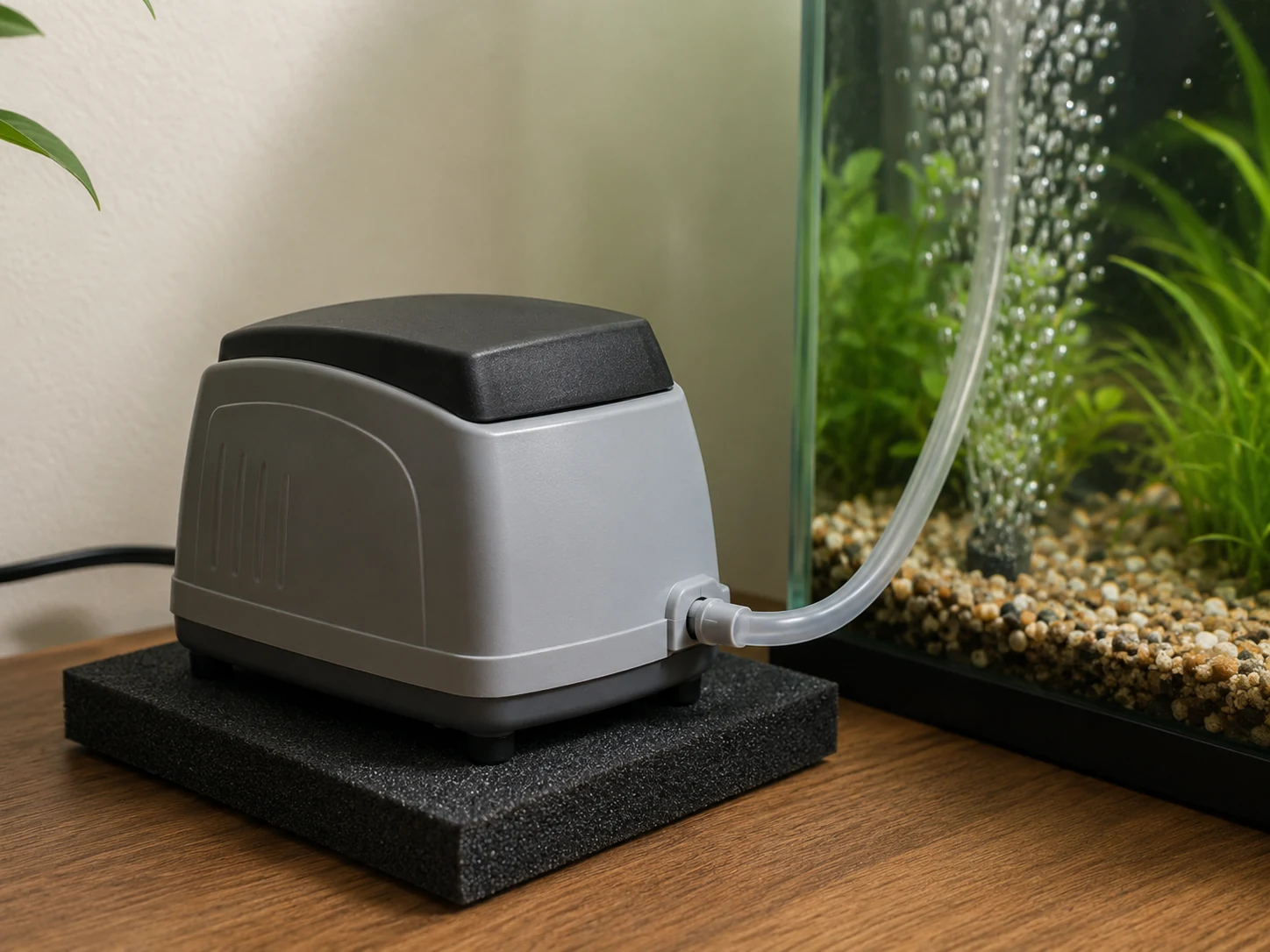
Sometimes the filter is not loud by itself.
The stand is amplifying it.
A small vibration can become a loud hum if it transfers into a cabinet, glass panel, wall, or plastic lid.
| Vibration point | Fix |
|---|---|
| Air pump on wood cabinet | Place on foam pad |
| Filter touching tank rim | Reposition or cushion carefully |
| Lid buzzing | Reseat lid |
| Cords touching hard surface | Move cords |
| Pump touching glass | Adjust suction cups |
| Canister touching cabinet wall | Add space/padding |
| Hoses vibrating | Secure gently |
Use aquarium-safe, non-toxic, water-resistant materials near the tank.
Do not block ventilation around motors or power supplies.
Waterfall and Splashing Noise
Some aquariums are loud because water is falling too far.
This is common with hang-on-back filters when the water level is low. It can also happen with spray bars, outflows, and decorative waterfalls.
| Splashing cause | Fix |
|---|---|
| Low water level | Top off |
| Outlet too high | Adjust if possible |
| Strong flow hitting lid | Redirect output |
| Spray bar above surface | Lower or rotate |
| Baffle poorly placed | Reposition |
| Evaporation in open tank | Add lid or top off more often |
A little surface movement is good.
A loud waterfall is not required for oxygen.
You want ripple and gas exchange, not a constant stressful splash.
When Noise Means a Real Problem
Some filter sounds are just annoying.
Others mean you should act right away.
| Noise plus symptom | Concern |
|---|---|
| Grinding sound | Impeller damage or debris |
| Filter not moving water | Oxygen and filtration risk |
| Fish gasping | Low oxygen or water quality issue |
| Burning smell | Electrical/mechanical danger |
| Motor hot | Running dry or failing |
| Canister leaking | Water damage and air leak |
| HOB running dry | Motor damage |
| Sudden silence | Filter stopped |
| Noise after replacing media | Cycle disturbance possible |
If the filter is not moving water and fish are stressed, add aeration and test ammonia/nitrite.
A quiet dead filter is worse than a loud working one.
What Not to Do
Avoid these beginner mistakes.
| Mistake | Why it is risky |
|---|---|
| Turn filter off overnight | Oxygen and biofilter risk |
| Replace all media to make it “clean” | Can crash the cycle |
| Wash media under untreated tap water | Can harm bacteria |
| Ignore grinding | Can damage impeller |
| Let HOB run dry | Motor damage |
| Pack filter with too much floss | Flow restriction |
| Use soap on parts | Toxic residue risk |
| Silence surface movement completely | Oxygen exchange drops |
| Buy a stronger filter without diagnosing | May create more noise/current |
| Put pump in a closed padded box | Overheating risk |
Quiet is good.
Safe is first.
How to Make an Aquarium Filter Quieter
Use this order.
| Step | Action |
|---|---|
| 1 | Confirm flow is normal |
| 2 | Check water level |
| 3 | Clean intake and pre-filter sponge |
| 4 | Inspect and clean impeller |
| 5 | Re-prime filter and remove trapped air |
| 6 | Reseat lid, tubes, and filter housing |
| 7 | Reduce vibration contact points |
| 8 | Adjust outflow to reduce splash |
| 9 | Replace worn impeller or bushings |
| 10 | Consider a different filter type only after diagnosis |
If the filter has always been loud, the model may simply be noisy.
If it suddenly became loud, something changed.
Find that change.
Best Quiet Filter Choices by Tank Type
No filter type is silent in every setup.
But some are usually easier to quiet than others.
| Tank type | Quiet filter direction |
|---|---|
| Betta tank | Gentle sponge filter or adjustable low-flow HOB |
| Shrimp tank | Sponge filter with quiet air pump |
| 10-gallon community | Quiet HOB or sponge filter |
| Bedroom tank | Quality sponge filter/air pump or quiet internal filter |
| Planted tank | Gentle circulation, avoid splashing CO2 off excessively if using CO2 |
| Larger community | Canister filter or well-sized HOB |
| Goldfish tank | Strong filtration, but manage vibration and waterfall noise |
| Hospital tank | Sponge filter or air stone with cycled media if available |
Choose for the fish first.
A filter that is quiet but too weak is not a good filter.
Maintenance Routine to Prevent Filter Noise
| Task | Rhythm |
|---|---|
| Check water level | Several times per week |
| Listen for new sounds | Daily glance/listen |
| Check flow | Weekly |
| Rinse pre-filter sponge | When flow slows |
| Rinse mechanical media | When clogged |
| Inspect impeller | Monthly or when noisy |
| Clean intake strainer | Weekly or as needed |
| Check air pump tubing | Monthly |
| Replace worn suction cups | When loose |
| Replace impeller parts | When cleaning no longer helps |
Maintenance should be gentle and consistent.
Do not wait until the filter screams.
FAQ
Why is my fish tank filter making noise?
The most common causes are low water level, trapped air, clogged intake or media, dirty impeller, vibration against the tank or stand, excessive waterfall splash, or worn parts.
Is a noisy aquarium filter dangerous?
Not always. Some noise is only annoying. But noise with weak flow, grinding, fish gasping, filter overheating, or a filter that stops moving water should be treated seriously.
Why is my hang-on-back filter so loud?
HOB filters often get loud when the tank water level is low, the impeller is dirty, the filter is not primed, the media is clogged, or the lid/housing is vibrating.
How do I stop waterfall noise from my filter?
Raise the aquarium water level, adjust the outflow if possible, reduce unnecessary drop distance, and make sure the filter is flowing smoothly. Do not remove all surface movement.
Why is my aquarium filter rattling?
Rattling often comes from the impeller, trapped air, loose housing parts, vibration, or debris in the motor chamber. Unplug the filter before inspecting the impeller.
Why is my sponge filter loud?
The air pump may be vibrating, the bubbles may be too strong, the pump may be touching a hard surface, or the tubing may be transferring vibration. Use a soft pad and adjust air flow.
Why is my canister filter making gurgling sounds?
Gurgling usually means trapped air, air entering through a loose fitting, low intake level, or air left after cleaning. Purge air using the manufacturer’s instructions.
Can I turn off my aquarium filter at night?
No. The filter should normally run 24/7. Turning it off reduces oxygen, circulation, and biological filtration. If noise is the problem, fix the cause instead of shutting it down.
How often should I clean the filter impeller?
Clean the impeller whenever you hear rattling/grinding or see reduced flow. Many tanks benefit from a monthly check, but dusty substrates, sand, snails, and plant debris may require more frequent cleaning.
Should I replace filter cartridges to make the filter quieter?
Not usually. Replacing all media can remove beneficial bacteria and trigger ammonia or nitrite problems. Rinse clogged mechanical media gently and preserve biological media.
What is the quietest aquarium filter?
It depends on the tank. A quality sponge filter with a quiet air pump can be very quiet, while canister filters are often quiet for larger tanks. A poorly installed filter of any type can be noisy.
Why did my filter suddenly get loud after a water change?
The water level may be lower, air may be trapped, the filter may have lost prime, or debris may have entered the impeller. Check water level, prime, flow, and impeller chamber.
Related Guides
- Fish Gasping at the Surface
- Cloudy Fish Tank Water
- Algae Problems in Fish Tanks
- How to Cycle a Fish Tank Without Guessing When It’s Safe for Fish
- How to Set Up a Fish Tank Without Making the Beginner Mistakes That Kill Fish
- Freshwater Aquarium Checklist
- Best Aquarium Filters
- Best Filter for a 10-Gallon Tank
- Best Aquarium Test Kits
- Smelly Fish Tank
Author Box
Editorial Note
This guide is educational and intended for home freshwater aquariums. Filter noise can be harmless, mechanical, or a warning sign of reduced flow. Always prioritize water movement, oxygen exchange, biological filtration, and fish behavior over silence.
Healthy Aquariums does not recommend turning off a filter overnight, replacing all filter media at once, or blocking surface movement simply to reduce sound.
References
- Aqueon. “Freshwater Aquarium Water Quality: The Nitrogen Cycle & More.” https://www.aqueon.com/articles/freshwater-aquarium-water-quality
- Aqueon. “Aquarium Filtration.” https://www.aqueon.com/articles/aquarium-filtration
- Fluval. “Canister Filter Maintenance.” https://fluvalaquatics.com/us/care-guides/
- Tetra. “Aquarium Filter Maintenance.” https://www.tetra-fish.com/learning-center/getting-started/filter-maintenance.aspx
- Oklahoma State University Extension. “Nitrification and Maintenance in Media Bed Aquaponics.” https://extension.okstate.edu/fact-sheets/nitrification-and-maintenance-in-media-bed-aquaponics
- New Mexico State University Extension. “Important Water Quality Parameters in Aquaponics Systems.” https://pubs.nmsu.edu/_circulars/CR680/
- Manufacturer instructions for the exact aquarium filter, air pump, impeller, media, hose, and replacement parts used by the reader.