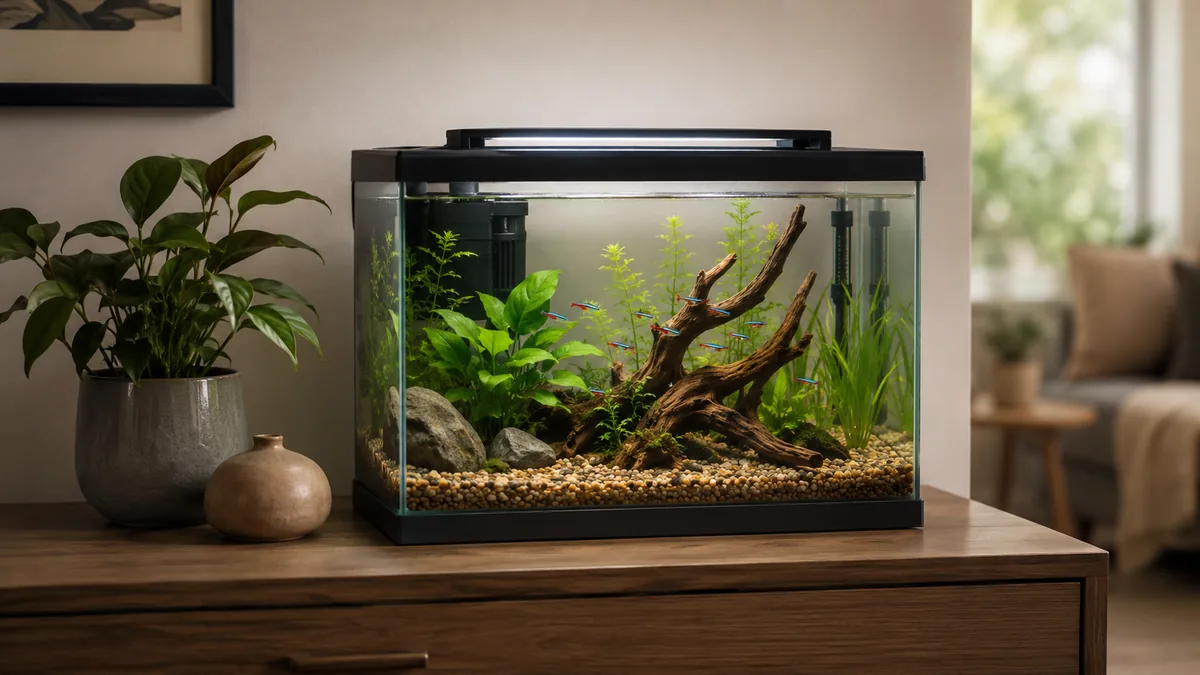
A 10-gallon aquarium looks simple until it starts acting like a small chemical container with fish inside it. The water volume is not huge. A little extra food, one uncycled filter, one heater mistake, or one rushed cleaning session can move ammonia, temperature, oxygen, and pH faster than a beginner expects.
That is why a good 10-gallon setup is not about buying the prettiest kit. It is about building a small system that stays stable when real life happens: you miss one feeding, the filter clogs a little, the room gets colder at night, or a new fish adds more waste than the bacteria can handle.
Quick answer
For most beginners, the safest 10-gallon fish tank setup is a rectangular tank with a reliable adjustable heater, a gentle filter with room for biological media, a tight lid, dechlorinated water, a basic test kit, and a light schedule that does not encourage algae. Cycle the tank before adding a full fish load, stock lightly, and make water changes small, regular, and temperature-matched.
A 10-gallon tank is best treated as a small ecosystem, not a small decoration. The filter protects the nitrogen cycle. The heater protects metabolic stability. The light affects fish rhythm, plant growth, and algae. Water changes reset dissolved waste, but they can also shock fish if done carelessly.
What a 10-gallon tank is actually good for
A 10-gallon aquarium can work very well for one betta, a small group of hardy nano fish, shrimp in the right conditions, or a low-tech planted tank. It is not a good home for goldfish, common plecos, most cichlids, bala sharks, or “they are small at the store” fish that grow into heavy waste producers.
The common beginner mistake is thinking 10 gallons means “ten small fish.” It does not. Stocking depends on adult size, behavior, oxygen demand, waste output, swimming style, and the maturity of the biofilter.
Good beginner directions include:
- One betta with plants and gentle filtration.
- A small group of male guppies in hard, alkaline water.
- A small school of white cloud mountain minnows if the tank is kept cooler.
- Zebra danios only if the tank is long enough and the flow is not excessive.
- Shrimp after the tank has matured and water parameters are stable.
Neon tetras are often recommended online, but they are not the ideal first fish for a brand-new 10-gallon tank. They can be more sensitive to transport stress, immature tanks, and unstable water than guppies, zebra danios, platies, or white cloud mountain minnows. If you want neons, let the tank mature first and keep water stable rather than treating them as “starter fish.”
The equipment that matters most
A 10-gallon setup needs fewer gadgets than beginners are usually sold, but the core pieces need to be right.
Tank and lid
Choose a standard rectangular tank if possible. Tall novelty tanks look attractive, but they often reduce swimming space and surface area. Surface area matters because oxygen enters and carbon dioxide leaves mainly at the water surface.
Use a lid, especially for bettas, small active fish, or shrimp tanks. Fish can jump when startled, when water quality is poor, or when chasing food. Leave a normal air gap below the lid so gas exchange still works.
Filter
A gentle hang-on-back filter, sponge filter, or small internal filter can all work. The key is not just flow rate. The filter must hold biological media and move water through it consistently.
Avoid treating disposable cartridges as the heart of the filter. If a cartridge contains most of the useful bacteria and you throw it away, you may remove part of the biofilter. Keep permanent sponge, ceramic rings, or other biological media in the filter and clean them gently in old tank water only when flow is reduced.
If using a hang-on-back filter, fill the chamber with water before plugging it in. Running it dry can damage the motor. If the flow slows later, check the intake, impeller, media clogging, and possible bypassing before assuming the filter is too small.
Heater and thermometer
A 10-gallon tropical tank usually needs a reliable adjustable heater and a separate thermometer. Do not trust the dial alone. Small tanks can change temperature faster than large tanks.
Match new water within about ±1°C when doing water changes. Fish do not only react to the final temperature; they react to the speed of change. Warmer water also holds less oxygen while fish metabolism rises, so sudden heating can create a double stress: higher oxygen demand and lower dissolved oxygen.
Light
Use a timer. Most low-tech 10-gallon tanks do well with 6–8 hours of light per day. More light does not automatically mean healthier plants. It often means algae, especially when nutrients and plant mass are not balanced.
Do not blast a dark room with full LED intensity instantly if fish are resting. If the light has ramp-up/ramp-down, use 15–30 minutes. If you only have a mechanical timer, turn on the room light about 10 minutes before the aquarium light. Do not leave blue moonlight on all night. Fish need a dark rest period.
The thermal stratification trap in small tanks
Small tanks do not just change temperature faster than larger tanks. They can also heat unevenly when flow is reduced too far. This matters in 10-gallon betta layouts, shrimp tanks, and quiet planted tanks where the filter is deliberately softened to avoid blasting livestock around the aquarium.
Warm water rises. If the heater sits in a low-flow corner, the water near the heater and upper layer can become noticeably warmer than the lower, quieter zones near the substrate. The exact difference depends on heater placement, room temperature, tank shape, and circulation, but even a few degrees of vertical swing can stress fish that move between resting places, feeding areas, and the surface.
This is not just a comfort issue. Temperature affects metabolism, digestion, oxygen demand, immune response, and ammonia toxicity. A fish kept in unstable microclimates may look "randomly" stressed: clamped fins, hiding, poor appetite, surface breathing, or recurring fin and skin problems even though the heater dial looks correct.
The safe fix is gentle circulation, not strong current. Place the heater near the filter intake or return so heat is carried across the tank. In a betta tank, angle the heater slightly and use a sponge prefilter, baffled HOB return, small sponge filter, or micro-bubbler at the opposite side to break thermal dead zones without creating high-velocity flow. Always verify the result with a separate thermometer away from the heater, and check again after water changes and seasonal room-temperature shifts.
The setup sequence
Step 1: Place the tank before filling it
Put the aquarium on a level stand that supports the full base. Ten gallons of water plus glass, substrate, and decor is heavy enough to cause problems on weak furniture.
Keep the tank away from direct window sunlight. Window light often causes algae swings and temperature changes that the beginner then tries to fix with chemicals.
Step 2: Rinse substrate, but do not obsess over sterile cleanliness
Rinse gravel or sand until the worst dust is gone. You are not trying to sterilize the tank. A fish tank becomes biologically stable because bacteria colonize surfaces. Clean is good; sterile is not the goal.
If using sand, keep it shallow unless you know how to manage planted substrates. Do not deep-stir old substrate later. If a tank has been running for months and smells rotten when disturbed, work in small localized areas while siphoning directly at the disturbance point so foul water leaves the tank.
Step 3: Add hardscape and plants with fish safety in mind
Avoid sharp decor with bettas and long-finned fish. Make sure rocks are stable. Live plants such as Java fern, Anubias, Java moss, water sprite, and floating plants can help with stability, but they do not replace cycling or water changes.
Step 4: Fill with conditioned water
Use water conditioner every time tap water enters the tank. Chlorine can damage fish and bacteria. Chloramine is more persistent and also needs a conditioner that handles it according to the label.
Do not assume leaving water in a bucket overnight solves everything. That may help chlorine in some places, but it does not reliably handle chloramine.
Step 5: Start the filter and heater
Prime the filter if needed, start it, and confirm flow. Put the heater where water movement distributes heat. Wait for the temperature to stabilize before adding fish.
Step 6: Cycle the tank
The nitrogen cycle is not optional. Fish waste and uneaten food produce ammonia. Bacteria convert ammonia to nitrite, then nitrate. Ammonia and nitrite should read 0 ppm in a stocked tank. Nitrate should be controlled with water changes, plants, and sensible feeding.
A fishless cycle is safest. Add an ammonia source, test water, and wait until the tank can process ammonia and nitrite back to 0 ppm. If fish are already in the tank, test more often, feed lightly, and use water changes plus conditioner carefully to protect fish while the bacteria catch up.
Stocking a 10-gallon tank without creating a waste problem
The safest first stocking plan is boring on purpose. Add one species or one focal fish first, then wait. A filter that handled an empty tank yesterday may not handle a sudden full fish load tomorrow.
For a betta tank, start with the betta and plants. Do not rush tankmates. Many 10-gallon betta community attempts fail because the tank is small, the betta is territorial, and extra fish add waste.
For livebearers, choose one sex unless you are prepared for fry. Guppies and platies can overpopulate quickly. In 10 gallons, babies are not a cute bonus for long; they become ammonia pressure.
Water change routine
A typical 10-gallon beginner tank does well with 20–30% weekly water changes once cycled, adjusted by test results and stocking. Heavily stocked tanks may need more frequent maintenance, but the better answer is often lighter stocking.
Do not do the beginner “reset day” where you remove most of the water, scrub the substrate aggressively, replace all media, and wash everything under the tap. That can create a double crash: the water chemistry shifts quickly and the biofilter is damaged at the same time.
Siphon visible debris lightly. Clean clogged mechanical media only when flow drops. Preserve biological media. Match temperature within about ±1°C. Condition new water before it reaches fish.
Testing schedule
During cycling, test ammonia, nitrite, and nitrate every few days. After the tank is stable, test weekly for a while, then any time fish act differently.
Test before guessing. Gasping, clamped fins, hiding, flashing, jumping, and food spitting can all point to water or oxygen problems. Do not treat those signs as personality quirks.
A basic kit should include ammonia, nitrite, nitrate, pH, and a thermometer. KH/GH and TDS are useful when you keep shrimp, livebearers, soft-water fish, or when your tap water varies.
Useful tools for a stable 10-gallon setup
A practical 10-gallon starter kit should include an adjustable heater, separate thermometer, gentle filter or sponge filter for heat distribution, dechlorinator that treats chlorine and chloramine, ammonia/nitrite/nitrate test kit, gravel siphon, bucket used only for aquarium water, timer, plant tweezers for removing decay, and a backup air pump for emergencies.
Choose products that support stability, maintenance access, and fish safety before considering convenience or appearance. Avoid hard-selling yourself extra gear; the right purchase should solve a real tank problem without creating sudden changes in flow, temperature, oxygen, or water chemistry.
Common mistakes to avoid
Do not buy fish the same day you buy the tank unless you are prepared for fish-in cycling. Do not replace all filter media because it looks dirty. Do not use soap, perfume, glass cleaner, or household sprays near aquarium equipment. Do not chase perfect pH with chemicals when the fish are otherwise suited to your water.
The better beginner tank is not the one that looks perfect on day one. It is the one that still has clear water, normal fish behavior, and stable test results after two months.
FAQ
Is a 10-gallon tank good for beginners?
Yes, if it is stocked lightly and maintained consistently. It is less forgiving than a 20-gallon tank, but much better than tiny bowls or novelty tanks.
How many fish can I put in a 10-gallon tank?
There is no reliable inch-per-gallon rule. Choose by adult size, behavior, waste output, oxygen needs, and filtration. One betta or one small nano community is usually safer than a mixed group of many species.
Do I need a heater for a 10-gallon tank?
For tropical fish such as bettas, yes. Use an adjustable heater and a separate thermometer. Room temperature often swings more than beginners realize.
What filter is best for a 10-gallon tank?
A sponge filter or gentle hang-on-back filter is usually safest. The filter should provide steady flow, oxygen exchange, and space for biological media.
Can I add fish right after setting up the tank?
It is safer to cycle the tank first. If fish are already in, test ammonia and nitrite often, feed lightly, and use careful water changes to prevent poisoning.
Are neon tetras good for a new 10-gallon tank?
They are not the best first choice for a brand-new tank. Neons are more sensitive than many hardy beginner fish and do better in stable, mature aquariums.
How often should I change water in a 10-gallon tank?
Most lightly stocked tanks do well with 20–30% weekly changes. Test results should guide adjustments.
Should I clean the filter every week?
Only clean it when flow is reduced or debris is clearly clogging mechanical media. Rinse media gently in old tank water, not tap water.
Can live plants replace water changes?
No. Plants help consume some nutrients and stabilize the tank, but water changes still remove dissolved waste and refresh minerals.
Why does my new 10-gallon tank turn cloudy?
New tanks often go cloudy from bacterial blooms, dust, overfeeding, or immature filtration. Test ammonia and nitrite before adding chemicals.
Related Guides
- Aquarium Filter Guide:
/aquarium-equipment/filters/aquarium-filter-guide/ - Best Filter for 10-Gallon Tank:
/best-products/best-filter-for-10-gallon-tank/ - Nitrogen Cycle Explained:
/guides/nitrogen-cycle-explained/ - Ammonia, Nitrite, and Nitrate:
/guides/ammonia-nitrite-nitrate/ - How Often Should You Change Aquarium Water?:
/guides/how-often-water-change/ - Betta Tank Setup:
/fish-care/betta-tank-setup/
Author Box
Written by the Healthy Aquariums editorial team. This guide is based on practical freshwater aquarium care, beginner tank troubleshooting, and the principle that small tanks need stable biological filtration more than quick cosmetic fixes.
Editorial Note
This article avoids one-size-fits-all stocking formulas because 10-gallon tanks fail from combined pressure: fish waste, immature bacteria, oxygen demand, temperature swings, and maintenance shocks. Recommendations should be adjusted for local tap water, species choice, and test results.
References
- Aquarium nitrogen cycle and nitrifying bacteria basics from established aquarium husbandry literature.
- Fish stress and dissolved oxygen principles from general aquatic animal health guidance.
- Manufacturer-style safety guidance for heaters, filters, and water conditioners.
- Practical freshwater maintenance standards used by experienced hobbyists and aquarium retailers.