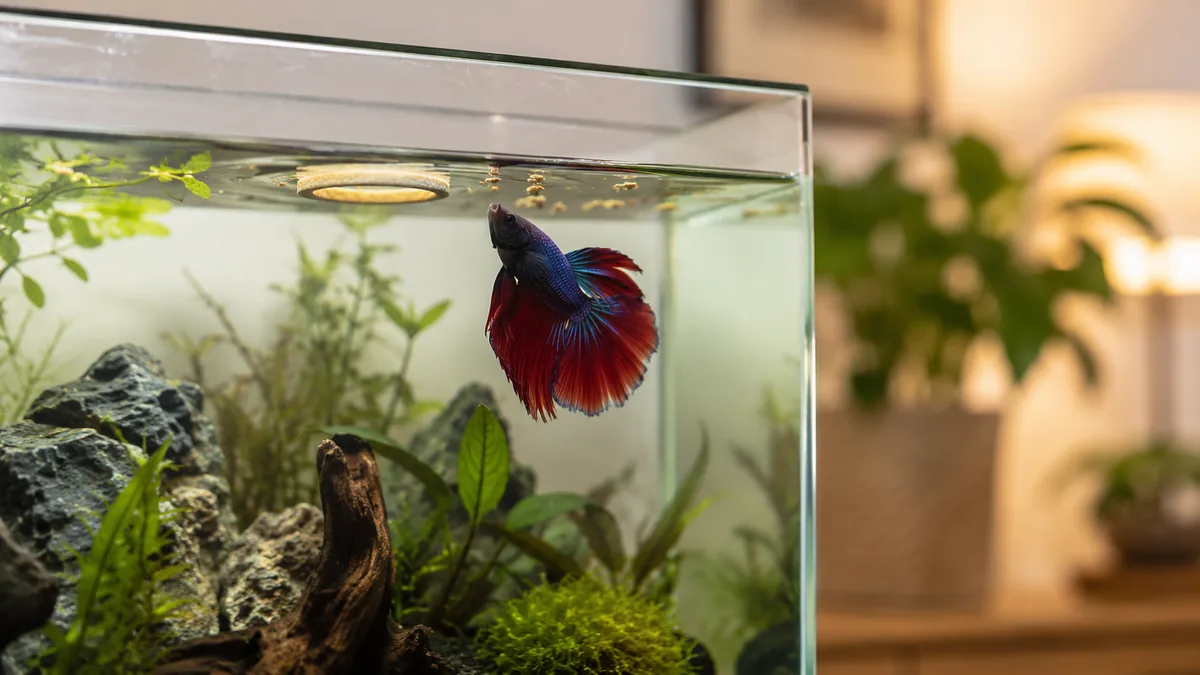
Betta food advice often turns into a brand list, but the real problem is usually smaller and more practical: the fish is overfed, the food swells, leftovers rot behind decor, or the tank is too immature to handle the waste. A betta can look hungry every time you walk by. That does not mean the tank can safely process extra meals.
The best betta food is nutritious, easy to portion, accepted by the fish, and not so messy that it quietly turns into ammonia.
Quick answer
For most bettas, a high-quality betta pellet or micro pellet should be the staple food, supported by occasional frozen or freeze-dried treats used carefully. Feed small portions the fish can finish quickly, remove uneaten food within about 5 minutes, and test water if appetite changes, food is spit out, or the fish becomes bloated.
Food quality matters, but portion control and water quality matter just as much.
What bettas need from food
Bettas are insect-eating carnivorous fish. They need protein-rich food with digestible animal ingredients. They do not thrive on generic tropical flakes as the main diet if those flakes are built mostly for mixed community fish.
A good betta staple should be small enough to swallow, consistent in size, not dusty, and easy to portion. Large pellets can cause problems if a small betta gulps them dry and they expand. Crumbly food can dissolve before the fish eats it.
Pellets vs flakes
Pellets are usually easier to portion. You can count them, observe the fish, and adjust. Flakes are more likely to break apart, float into corners, and pollute the tank if overused.
That does not mean every pellet is good. Some are too large, too hard, or too filler-heavy. Look for betta-specific pellets or micro pellets with animal protein sources and sensible size.
Frozen and freeze-dried foods
Frozen bloodworms, brine shrimp, daphnia, and similar foods can be useful variety. They should be treats or rotation foods, not an uncontrolled daily dump.
Freeze-dried foods can be convenient but may expand and contribute to bloating if used carelessly. Soak them briefly before feeding and keep portions small.
Daphnia is often gentler than rich bloodworms when a betta is prone to constipation, but do not treat any food as medicine without checking water and temperature first.
The feeding amount problem
Most beginner bettas are overfed because they beg well. A practical starting point is a few small pellets once or twice daily, adjusted for body condition, pellet size, temperature, and activity.
The belly should not stay swollen. The fish should not become sluggish after meals. If food is left uneaten, you fed too much or something is wrong.
Remove experimental foods within about 5 minutes. Leftovers become ammonia pressure. In a small betta tank, a few missed crumbs every day can matter.
When a betta spits food out
Spitting food is not always “picky behavior.” It can mean the pellet is too large, too hard, stale, unfamiliar, or physically difficult to swallow. It can also be an early warning sign of stress, poor water, temperature issues, mouth irritation, or illness.
Before buying five new foods, check temperature and test ammonia, nitrite, and nitrate. A betta in bad water may refuse food for reasons that have nothing to do with flavor.
Feeding and water quality
Every meal becomes waste. Some of it passes through the fish. Some dissolves uneaten. The biofilter must process the ammonia that follows.
In a cycled, stable tank, normal feeding is safe. In a new tank, overfeeding can push ammonia or nitrite up quickly. If the filter was recently cleaned too aggressively, the tank may not process food waste normally.
Do not respond to appetite problems by adding medication first. Test water first. Medication in a small tank can stress fish and sometimes harm the biofilter, especially when the real issue is ammonia, temperature, or oxygen.
The organic phosphate problem in tiny betta tanks
Protein quality matters, but it is not the only food issue. Cheap, stale, dusty, or poorly bound pellets can leach dissolved organics and phosphate into the water before the fish eats them. In a small betta tank, that invisible waste can accumulate faster than it would in a larger aquarium.
Phosphate itself is not usually the direct emergency toxin that ammonia or nitrite is, but it is part of the algae-and-biofilm equation. Excess food dust, softened pellets, and leftover frozen-food juice feed heterotrophic bacteria, surface film, nuisance algae, and debris in the filter. The tank may then look dirty even when the betta eats most of the meal.
Use the five-minute rule with extra discipline in small tanks: if food is not eaten quickly, remove it. Thaw frozen food in a separate cup and feed the solids, not the dirty thaw water. Buy small containers, keep them sealed and dry, and replace food that smells rancid, clumps, or has been open too long. Better food is not only about growth; it is about reducing dissolved waste pressure on the biofilter.
Food rotation without chaos
A simple rotation is enough:
- Staple betta pellet most days.
- Frozen or thawed treat once or twice per week.
- Occasional daphnia if digestion is a concern.
- One light fasting day only if the fish is healthy and not underweight.
Do not change everything at once. If bloating appears after a new food, you need to know what caused it.
Storage
Fish food goes stale. Buy small containers unless you keep many tanks. Keep food dry, sealed, and away from heat. If it smells rancid, clumps, or has been open too long, replace it.
A fresh small container is usually better than a large “value” container that sits for a year.
Useful tools for cleaner betta feeding
A useful betta feeding kit includes a quality micro pellet, frozen or freeze-dried treat used sparingly, feeding tweezers or a tiny spoon for portion control, a turkey baster for removing leftovers, ammonia/nitrite/nitrate test kit, thermometer, and dechlorinator.
Choose products that support stability, maintenance access, and fish safety before considering convenience or appearance. Avoid hard-selling yourself extra gear; the right purchase should solve a real tank problem without creating sudden changes in flow, temperature, oxygen, or water chemistry.
What to avoid
Avoid feeding every time the fish begs. Avoid large floating pellets for small bettas. Avoid using bloodworms as the main diet. Avoid dumping thawed frozen food water into a tiny tank. Avoid treating refusal to eat with medication before testing water.
FAQ
What is the best food for betta fish?
A quality betta pellet or micro pellet is usually the best staple. Add occasional frozen or freeze-dried variety in small portions.
Are flakes good for bettas?
They can be eaten, but they are harder to portion and often messier. Betta-specific pellets are usually easier for daily feeding.
How often should I feed my betta?
Most adult bettas do well with small meals once or twice daily. Adjust based on body condition and waste control.
How many pellets should I feed?
It depends on pellet size. Start with a few small pellets and watch the belly. Do not let uneaten food remain in the tank.
Are bloodworms good for bettas?
They are useful as an occasional treat, not a staple. Too many rich treats can contribute to digestive problems and water pollution.
Should I soak betta pellets?
For large or hard pellets, a brief soak can help. With tiny soft pellets, it may not be necessary.
Why is my betta spitting out food?
The food may be too big, hard, stale, or unfamiliar. Also check water quality and temperature because stress can affect feeding.
Can overfeeding cause ammonia?
Yes. Uneaten food and extra fish waste both increase ammonia pressure, especially in small or new tanks.
Should bettas fast one day a week?
Some healthy adult bettas tolerate a light fasting day, but it is not a fix for poor food, cold water, or bad water quality.
What should I do if my betta stops eating?
Check temperature, ammonia, nitrite, nitrate, and behavior first. Do not jump straight to medication unless symptoms clearly support it.
Related Guides
- Betta Fish Care Guide:
/fish-care/betta-fish-care-guide/ - Betta Swim Bladder Disease:
/fish-care/betta-swim-bladder-disease/ - Betta Laying at Bottom:
/fish-care/betta-laying-at-bottom/ - Ammonia, Nitrite, and Nitrate:
/guides/ammonia-nitrite-nitrate/ - How Often Should You Change Aquarium Water?:
/guides/how-often-water-change/
Author Box
Written by the Healthy Aquariums editorial team. This guide focuses on practical feeding, water quality, and beginner mistakes that affect betta health.
Editorial Note
This article intentionally avoids ranking food by marketing claims alone. In a small betta tank, the best food is the one that supports nutrition without creating avoidable waste.
References
- Betta splendens feeding behavior and carnivorous dietary needs from freshwater aquarium care references.
- General aquarium nitrogen cycle and waste-management principles.
- Practical hobbyist feeding protocols for small tropical fish.