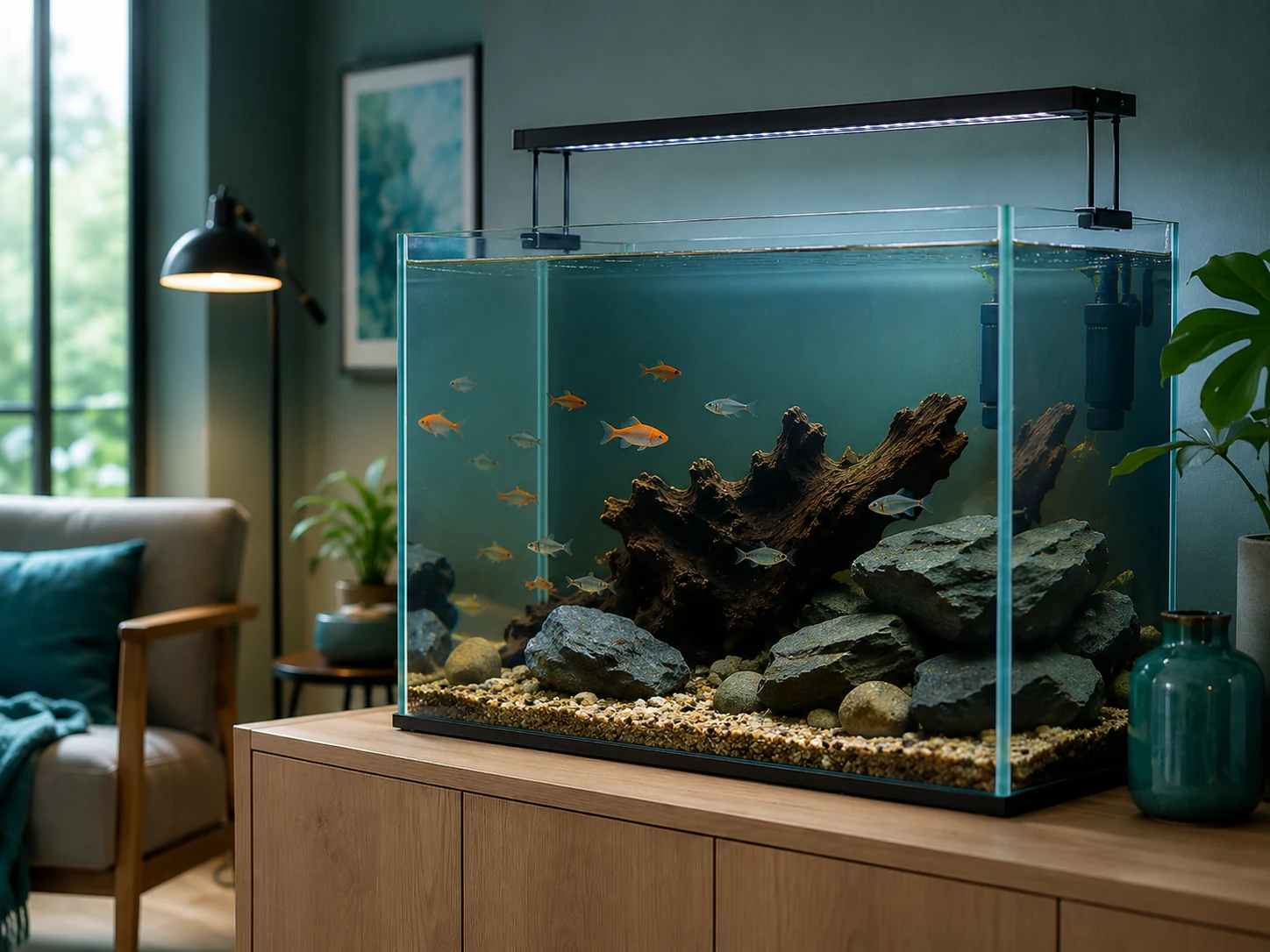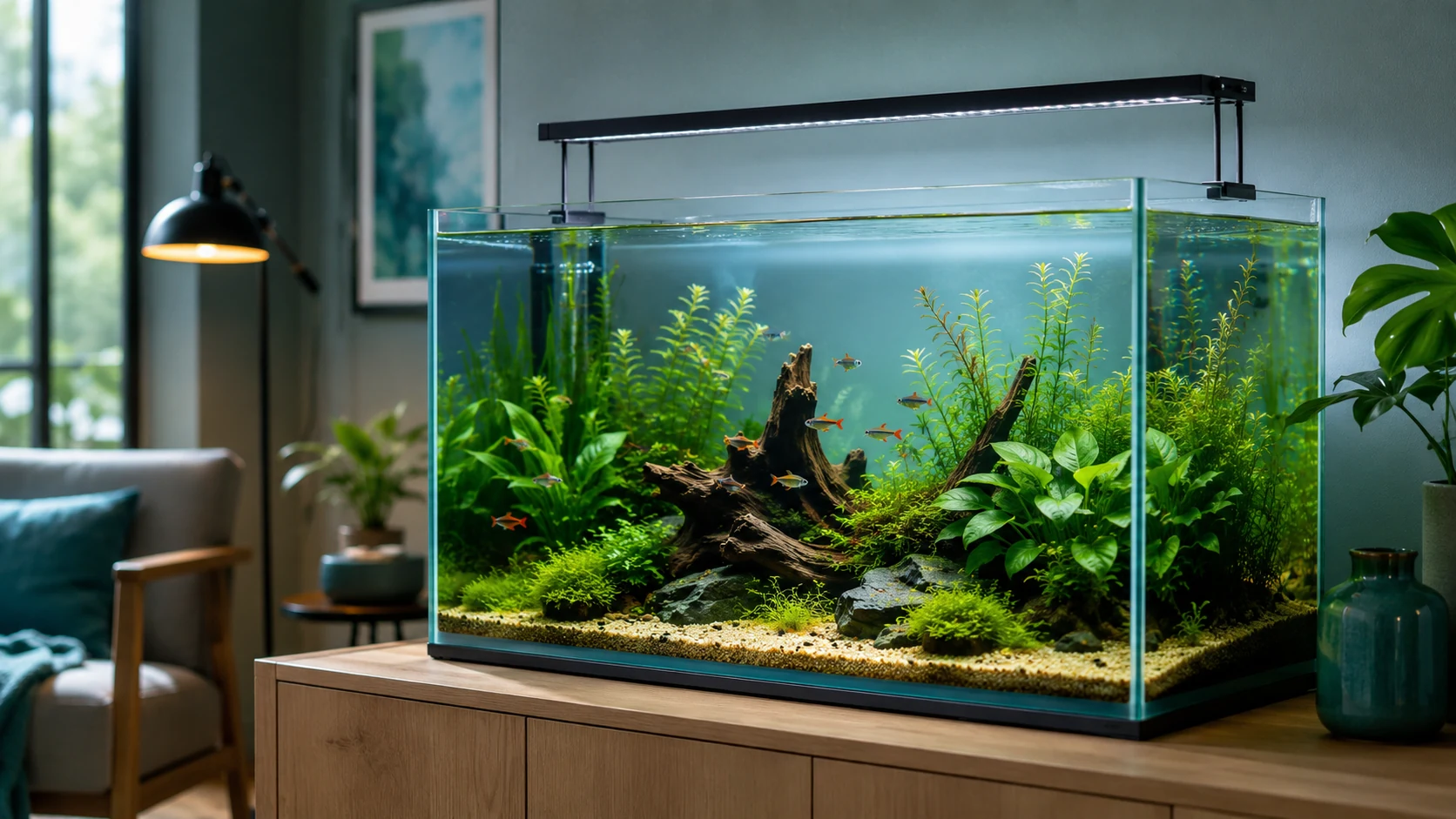
Most beginners buy aquarium lights for the wrong reason.
They want the tank to look brighter.
That makes sense. A new aquarium under a weak lid light can look dull. The fish look flat, the plants look ordinary, and the whole tank feels less exciting than the pictures online. So the beginner buys a stronger LED, runs it from morning until night, and assumes the aquarium is now “better lit.”
Then the glass turns green. Brown dust covers the leaves. Hair algae starts catching on slow-growing plants. The fish hide when the light snaps on. The owner reduces feeding, adds an algae eater, scrubs everything, buys a bottled fix, and still does not understand why the tank keeps fighting back.
The problem was not simply “too much algae.”
The problem was that the light was treated like decoration.
In a freshwater aquarium, light is a control knob. It affects fish behavior, plant growth, algae pressure, viewing quality, and daily rhythm. A good aquarium light makes the tank easier to enjoy and easier to maintain. A wrong light can make a simple tank feel unstable even when the filter and water changes are reasonable.
This guide is not about buying the most powerful light you can afford. It is about choosing the right amount of light for the kind of aquarium you actually keep.
For many beginner tanks, the safest lighting plan is simple: moderate brightness, a consistent schedule, no direct sunlight, a real dark period at night, and a light that does not shock fish from darkness to full brightness in one instant.
The Rule Beginners Miss: Light Must Match the Tank
There is no single “best aquarium light” for every freshwater tank.
A fish-only tank does not need the same light as a planted aquascape. A low-tech planted tank without CO2 does not need the same intensity as a high-tech stem-plant tank. A betta tank with floating plants may need softer light than a tall community tank with rooted plants. A goldfish tank may need enough light for viewing and algae control, but not a plant-growing spotlight that turns every surface green.
Start by identifying the job the light needs to do.
| Tank type | Main lighting goal | Beginner starting point |
|---|---|---|
| Fish-only freshwater tank | View fish, support day-night rhythm | Low to moderate light, 6–8 hours |
| Betta or shy fish tank | Gentle viewing with shade and rest areas | Dim to moderate light, floating plants helpful |
| Low-tech planted tank | Support easy plants without driving algae | Moderate full-spectrum light, 6–8 hours |
| High-tech planted tank | Strong plant growth with CO2 and fertilization | Higher intensity, but only with balance |
| Algae-prone beginner tank | Reduce excess light pressure | Shorter photoperiod, timer, no window sun |
| Quarantine or hospital tank | Observe fish clearly without stress | Simple low/moderate light, often shorter duration |
The mistake is buying for the tank you wish you had instead of the tank you are maintaining right now.
A strong light can be useful in the right aquarium. But strong light increases demand. Plants need more carbon and nutrients. Maintenance must be steadier. Fertilizer mistakes show faster. Algae gets more opportunity when plants cannot keep up.
In plain English: more light is not a free upgrade.
It is a faster accelerator.
If the tank is young, lightly planted, overfed, overstocked, hit by window sunlight, or inconsistent with water changes, a powerful light usually makes those problems louder.
Fish-Only Tanks: You Usually Need Less Light Than You Think
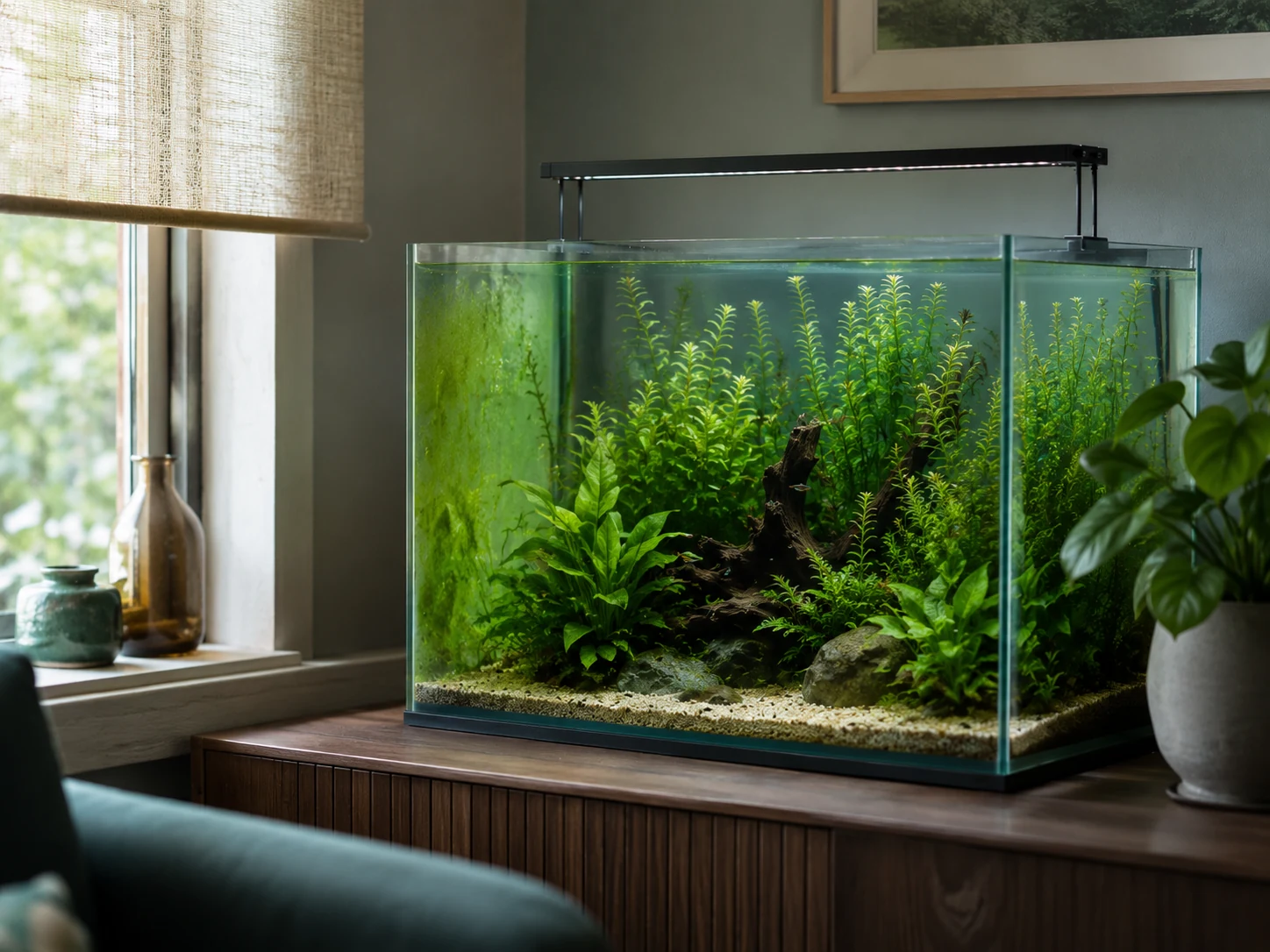
A fish-only freshwater tank needs light, but not usually for the same reason a planted tank does.
Fish do not need intense plant-grade lighting to survive. They need a predictable day-night cycle, enough light for normal activity and viewing, and enough dark time to rest. Constant brightness is not natural. Sudden bright light with no cover can also make shy fish more nervous, especially in bare tanks.
For most beginner fish-only tanks, the practical goal is:
- enough light to see fish clearly,
- enough shade so fish do not feel exposed,
- a consistent schedule,
- and no long photoperiod that fuels algae.
A fish-only tank can often run well on a basic LED fixture or the light included with a good aquarium lid. You do not need a high-output planted light unless you are also trying to grow demanding plants.
| Fish-only setup | Light intensity | Schedule | Notes |
|---|---|---|---|
| Betta tank | Low to moderate | 6–8 hours | Use shade, broad leaves, or floating plants |
| Guppy/platy community | Moderate | 6–8 hours | Bright enough for viewing; avoid direct sun |
| Goldfish tank | Moderate | 6–8 hours | Goldfish waste + long light can mean algae fast |
| Tetra/cory community | Moderate with shaded areas | 6–8 hours | Avoid harsh bare-tank brightness |
| Quarantine tank | Low to moderate | 4–8 hours | Observation matters more than beauty |
A common beginner question is, “Can I leave the aquarium light on all day?”
You can, in the same way you can leave a room light on all night.
That does not make it a good routine.
Fish benefit from a predictable light and dark pattern. Research on aquatic animals and broader vertebrate welfare consistently treats light-dark cycles as biologically important, not merely cosmetic. That does not mean a home aquarium needs laboratory-perfect lighting. It means fish should not live under random, endless, or constantly changing light.
A simple outlet timer is one of the best lighting upgrades for a beginner aquarium. It removes emotion from the schedule. The tank gets the same light every day, even when you forget.
But there is one detail that beginners often miss: a timer controls when the light turns on. It does not always control how the light turns on.
A strong LED that snaps from a dark room to full brightness can startle fish. Some fish only flinch and settle again. Others may bolt into glass, wood, rock, filter intakes, or the lid. Shy species, newly introduced fish, fish kept in bare tanks, and fish that already feel exposed are more likely to react badly. The same problem can happen at night when the aquarium light and the room light both switch off at once.
The better modern routine is a gradual transition.
If your light has a sunrise/sunset feature, use a 15–30 minute ramp-up and dim-down period. If it does not, use the room itself as the ramp: turn on the room light or open the curtains for 10 minutes before the aquarium light comes on, and leave a room light on briefly after the aquarium light turns off. This is not fancy aquascaping advice. It is basic fish-comfort advice.
Low-Tech Planted Tanks: Light Is the Accelerator
In a low-tech planted tank, light is not just for viewing.
It drives plant growth.
That sounds positive until the light becomes stronger than the tank can support. Plants need light, but they also need carbon, nutrients, healthy roots or rhizomes, reasonable water conditions, and time to adapt. If you push light too hard in a tank without CO2, the plants may not be able to use all that energy. Algae often responds faster than the plants do.
This is why many low-tech planted tanks do better with moderate lighting than with a powerful aquascaping light running all day.
| Low-tech plant type | Light need | Beginner note |
|---|---|---|
| Java fern | Low to moderate | Do not bury the rhizome |
| Anubias | Low to moderate | Slow-growing; prone to algae under strong light |
| Bucephalandra | Low to moderate | Slow-growing; likes stable conditions |
| Cryptocoryne | Low to moderate | May melt after changes; usually regrows |
| Amazon sword | Moderate | Root feeder; needs space and nutrients |
| Vallisneria | Moderate | Spreads well once settled |
| Water sprite | Low to moderate | Helpful fast grower; can be floated |
| Hornwort | Low to moderate | Fast-growing nutrient sponge; can shed needles |
| Red stem plants | Moderate to high | Often need stronger light, nutrients, and sometimes CO2 |
| Carpeting plants | Moderate to high | Usually harder without CO2 |
The beginner-friendly planted tank is not built by chasing red plants, dense carpets, and high light immediately.
It is built by choosing plants that fit the light level you can manage.
A low-tech tank usually does well with:
- low to moderate light,
- 6–8 hours of photoperiod,
- easy plants,
- slow fertilizer adjustments,
- stable water changes,
- and patience during the first months.
The first month is not the time to prove how powerful your light is. It is the time to let plants root, adjust, and start growing new healthy leaves.
If plants are melting, the answer is not always “more light.” New plants often melt because they were grown emersed, moved between water conditions, planted incorrectly, or stressed by unstable water. More light on melting leaves can simply give algae a better surface to colonize.
Understanding Brightness, Spectrum, PAR, and Kelvin Without Getting Lost
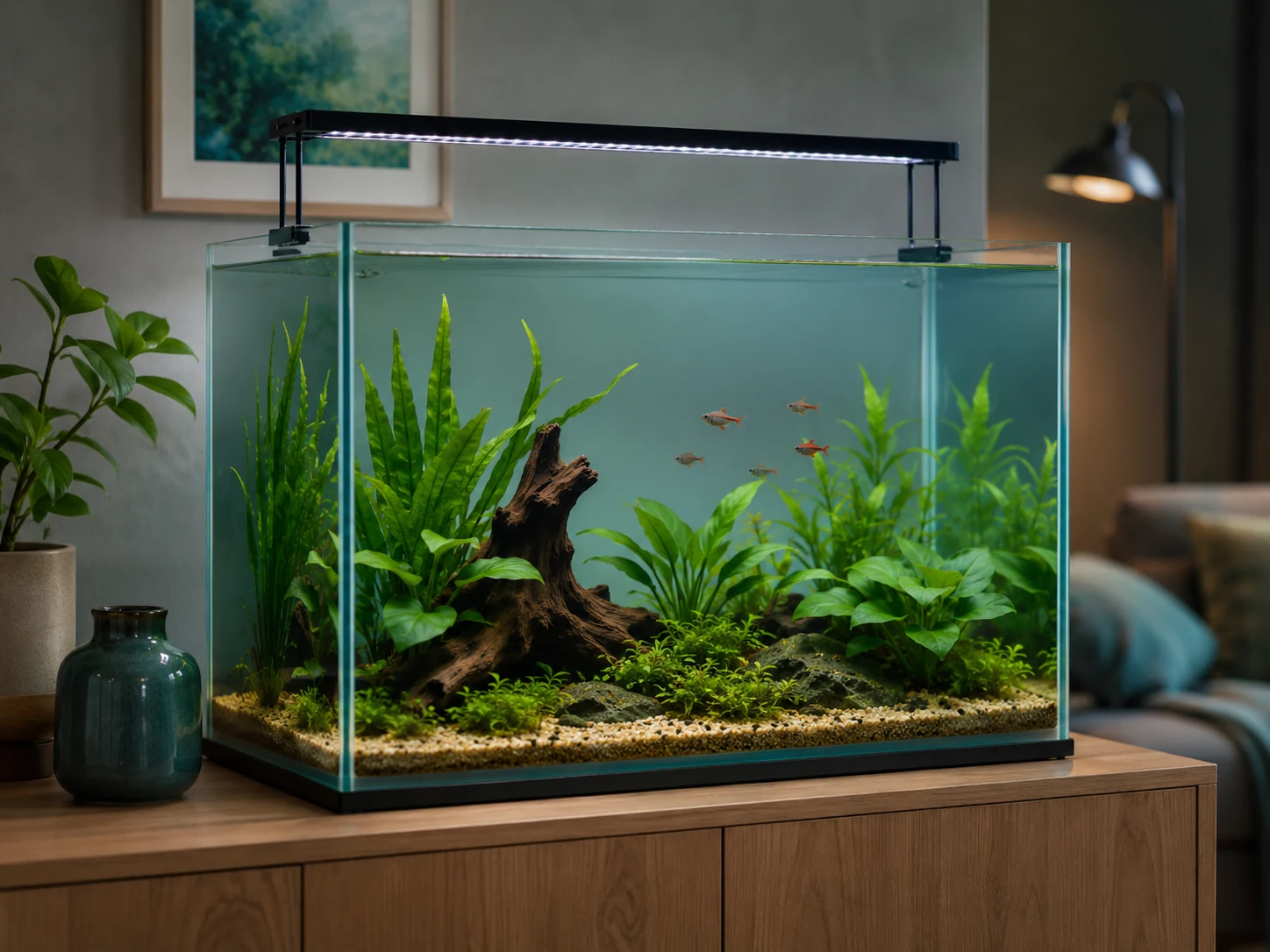
Aquarium lighting gets confusing because product pages use many numbers.
Lumens. Watts. PAR. Kelvin. RGB. WRGB. Full spectrum. Plant spectrum. Color rendering. App control. Sunrise mode. Moonlight mode.
Some of those matter. Some matter only if you know what you are trying to grow.
Here is the practical version.
| Term | What it means | Beginner takeaway |
|---|---|---|
| Watts | Power consumption, not plant light output | Do not choose by watts alone |
| Lumens | Visible brightness to human eyes | Useful for appearance, limited for plant growth |
| PAR | Photosynthetically active radiation | More useful for planted tanks, especially demanding plants |
| Kelvin | Color appearance: warm/yellow to cool/blue-white | 6500K-ish daylight often looks natural for freshwater |
| RGB/WRGB | Red, green, blue, sometimes white LED channels | Helps color rendering and plant appearance |
| Dimming | Ability to reduce intensity | Very useful for algae control and fish comfort |
| Timer/app | Controls schedule automatically | Almost essential for consistency |
Watts used to be a rough shortcut when many hobbyists used older fluorescent lights. It is a weak way to choose modern LEDs. Two lights with the same wattage can produce different spread, intensity, heat, and plant-growing usefulness.
Lumens are also limited because they measure brightness weighted toward human vision. A light can look bright to you without being ideal for plants, and a plant-focused light may not be represented perfectly by lumen numbers.
PAR is more meaningful for plant growth because it relates to the light range plants use for photosynthesis. But PAR is not always listed honestly or measured at your tank depth. A PAR chart from the manufacturer can help, but it is still a guide, not a guarantee.
For many beginner freshwater tanks, you do not need to obsess over technical numbers. You need a light that fits the tank length, has adjustable intensity if possible, has a timer or works with one, and is appropriate for fish-only or low-tech plant use.
A dimmable moderate light is often better than an overpowered light with no control.
The Best Light Schedule for Most Beginner Tanks
The safest beginner lighting schedule is boring.
That is a good thing.
For most freshwater tanks, start with 6–8 hours per day. Use a timer. Keep the schedule consistent for at least two or three weeks before making changes.
| Tank situation | Starting schedule | Adjustment |
|---|---|---|
| New fish-only tank | 6 hours | Increase only if algae stays controlled |
| Established fish-only tank | 6–8 hours | Keep consistent |
| New low-tech planted tank | 6 hours | Increase slowly if plants are growing well |
| Established low-tech planted tank | 6–8 hours | Adjust by plant growth and algae response |
| Tank with algae outbreak | 5–6 hours temporarily | Also fix feeding, waste, and sunlight |
| Quarantine tank | 4–8 hours | Keep fish calm; use light for observation |
A 10- or 12-hour schedule may work in some tanks, especially heavily planted systems that are balanced and stable. But it is not where I would start a beginner.
The first lighting schedule should be easy to control. You can always add time later. It is harder to undo a month of algae that started because the light ran too long from day one.
Do not use the light as a room lamp.
If you want to enjoy the aquarium in the evening, set the timer so the light is on when you are actually home. For example, noon to 7 p.m. is often more useful than 7 a.m. to 2 p.m. if nobody watches the tank during the day.
The fish do not care whether “daytime” in the aquarium matches sunrise outside. They care more that the routine is stable and includes real darkness.
Do Not Let the Timer Shock the Fish
A timer should make the day predictable. It should not turn the aquarium into a camera flash every morning.
This matters most with bright LEDs, dark rooms, timid fish, newly moved fish, open-top tanks, and aquariums with little cover. Discus, many tetras, Corydoras, wild-type or shy community fish, and fish that are still settling in may panic when the light jumps instantly from black to full power. The risk is not just “stress” in a vague sense. A startled fish can hit hardscape, scrape an eye, tear a fin, slam into the glass, or jump.
Use this rule:
| Lighting setup | Safer startup routine |
|---|---|
| Programmable LED | Use 15–30 minutes of ramp-up and dim-down |
| App-controlled LED | Start low, then slowly increase to the main setting |
| Basic LED on plug-in timer | Turn on the room light 10 minutes before the tank light |
| Bright tank in a dark room | Do not switch room and tank lights on/off at the same instant |
| Open-top tank with jumpy fish | Use a lid or mesh cover before relying on automation |
For most beginners, I would rather see a moderate light with dimming and a gentle ramp than a powerful light that only has a hard on/off switch.
Direct Sunlight Is Not a Free Aquarium Light
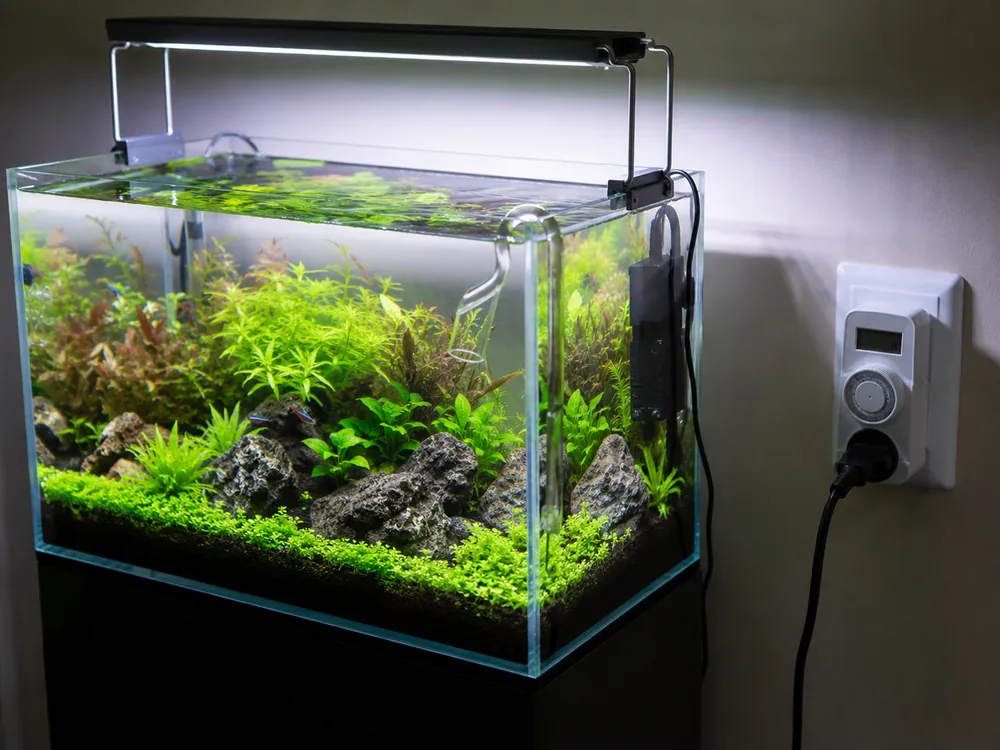
Window sunlight is one of the easiest ways to create an algae problem.
It is also one of the easiest problems to overlook.
A tank near a window may receive artificial light from the aquarium fixture plus natural light from the room. Even if the aquarium light runs only six hours, the tank may be receiving usable light for much longer.
Direct sun can also create temperature swings in smaller aquariums. That is especially risky for bettas, shrimp, and small community tanks where stability matters.
If algae keeps returning, check the room before blaming the light fixture.
Ask:
- Does direct sun hit the glass at any time of day?
- Is the tank near a bright window even without direct sun?
- Does one side of the tank grow algae faster than the other?
- Does algae appear strongest on the glass facing the window?
- Has the lighting problem changed with the season?
A tank does not need to sit in darkness. But it should not be placed where sunlight becomes an uncontrolled second light source.
Move the tank if possible before filling it. If it is already running, use curtains, background film, side panels, or a shorter artificial-light schedule.
Algae Control: Do Not Blame Only the Light
Light is a major algae factor, but it is rarely the only factor.
Algae uses light plus nutrients plus surfaces plus time. If the tank has excess food, decaying leaves, rising nitrate, dirty mechanical media, weak plant growth, or direct sunlight, reducing the photoperiod may help but may not solve the root problem.
Think of algae control as a balance problem, not a punishment problem.
| Algae pressure factor | What it looks like | Better first response |
|---|---|---|
| Too much light duration | Glass turns green quickly | Reduce to 6 hours; use timer |
| Direct sunlight | Algae stronger on one side | Block sun or move tank |
| Overfeeding | Food remains, dirty substrate | Feed less; siphon waste |
| High nutrients | Nitrate rising, messy tank | Water changes; remove debris |
| Weak plant growth | Plants melt while algae grows | Choose easier plants; reduce light temporarily |
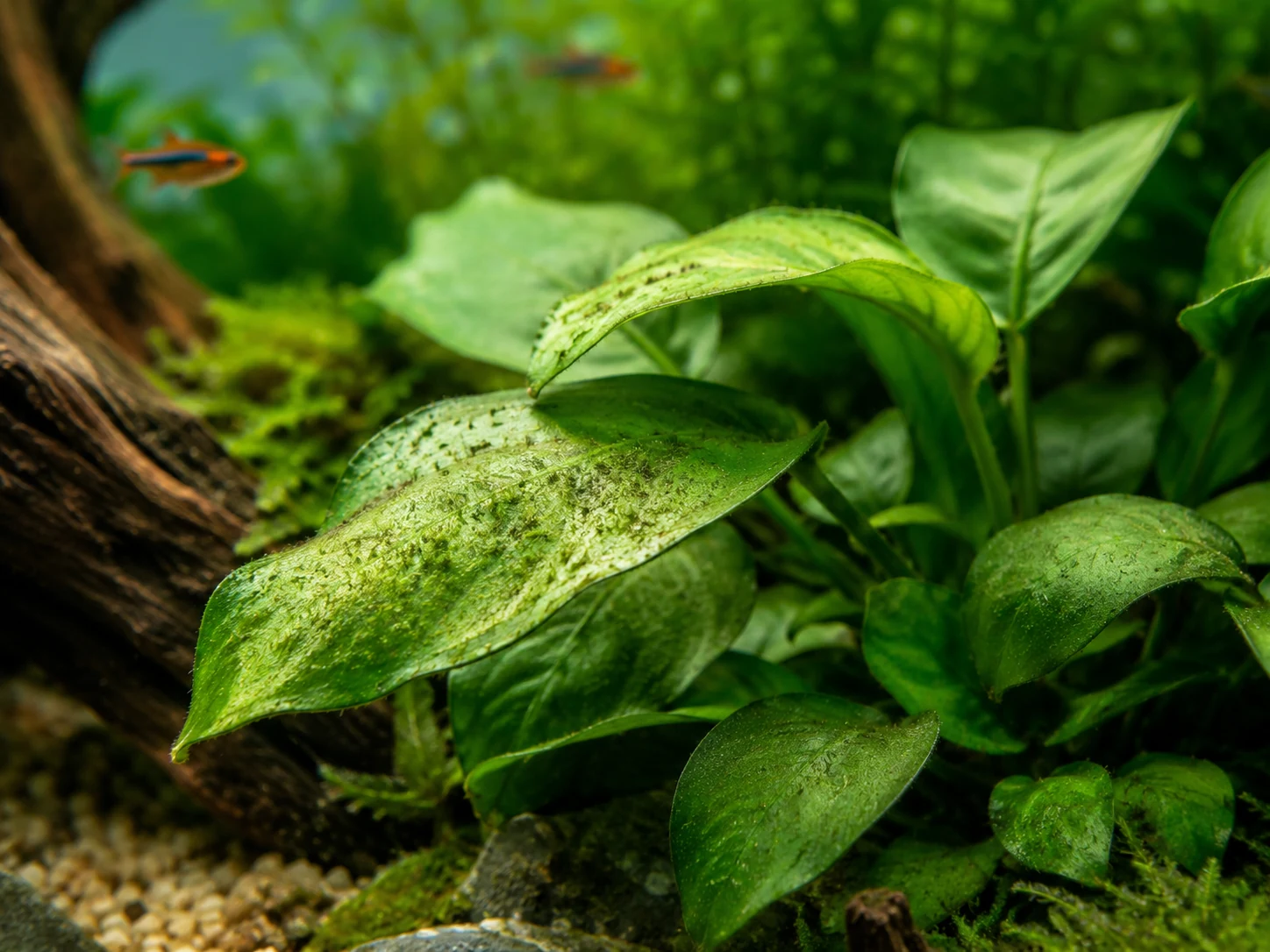
| Slow-growing plants under strong light | Anubias/Java fern leaves covered | Add shade; reduce intensity |
| New tank instability | Brown diatoms, patchy algae | Clean gently; avoid panic resets |
| Dirty filter flow | Dead spots, debris buildup | Clean mechanical media properly |
Do not respond to algae by doing everything aggressively at once.
A common beginner spiral looks like this:
The tank grows algae. The owner turns the light off for several days, scrubs all surfaces, replaces filter media, does a massive water change, stirs the substrate deeply, adds chemicals, and feeds less. The tank becomes unstable. Fish stress. Plants melt. Algae returns because the underlying balance is still poor.
That is not algae control.
That is a tank shock.
A better first plan is calmer:
- Set the light to 6 hours on a timer.
- Remove direct sunlight.
- Manually remove the worst algae.
- Remove dead leaves and obvious waste.
- Check ammonia, nitrite, nitrate, and pH if fish are present.
- Keep water changes steady.
- Clean clogged mechanical filter media without destroying biological media.
- Give the tank two weeks before making another major lighting change.
If ammonia or nitrite is present, treat that as a water-safety problem, not a lighting problem. Fish safety comes before algae aesthetics.
The Siesta Method: Only Use It If the Break Is Long Enough
Some low-tech planted-tank keepers use a split lighting schedule, often called a siesta schedule. A common version is something like 4 hours on, 3 hours off, then 4 hours on.
The idea is not magic. During the dark break, natural CO2 in the water can recover slightly because plants are not actively using it for photosynthesis. In some low-tech tanks, that can make the second lighting block easier for plants to use and less favorable to algae than one long uncontrolled photoperiod.
The mistake is making the break too short.
Turning the light off for 30–60 minutes in the middle of the day is usually just an interruption. It may annoy fish, confuse your schedule, and still give algae plenty of usable light across the day. If you are going to try a siesta schedule, make the dark break meaningful.
A practical low-tech rule:
| Schedule style | Better beginner use |
|---|---|
| Straight schedule | 6–8 continuous hours; simplest and best for most tanks |
| Siesta schedule | 4 hours on / at least 3 hours off / 3–4 hours on |
| Too-short break | Avoid 30–90 minute “breaks” and calling it algae control |
| Algae outbreak | Fix excess total light, feeding, waste, sunlight, and water quality first |
I would not start every beginner with a siesta schedule. A straight 6-hour schedule is easier to understand and troubleshoot. But if the tank is low-tech, planted, and you want evening viewing without running one long light block, a real 3-hour dark break is more defensible than a random short pause.
Choosing a Light for a Fish-Only Aquarium
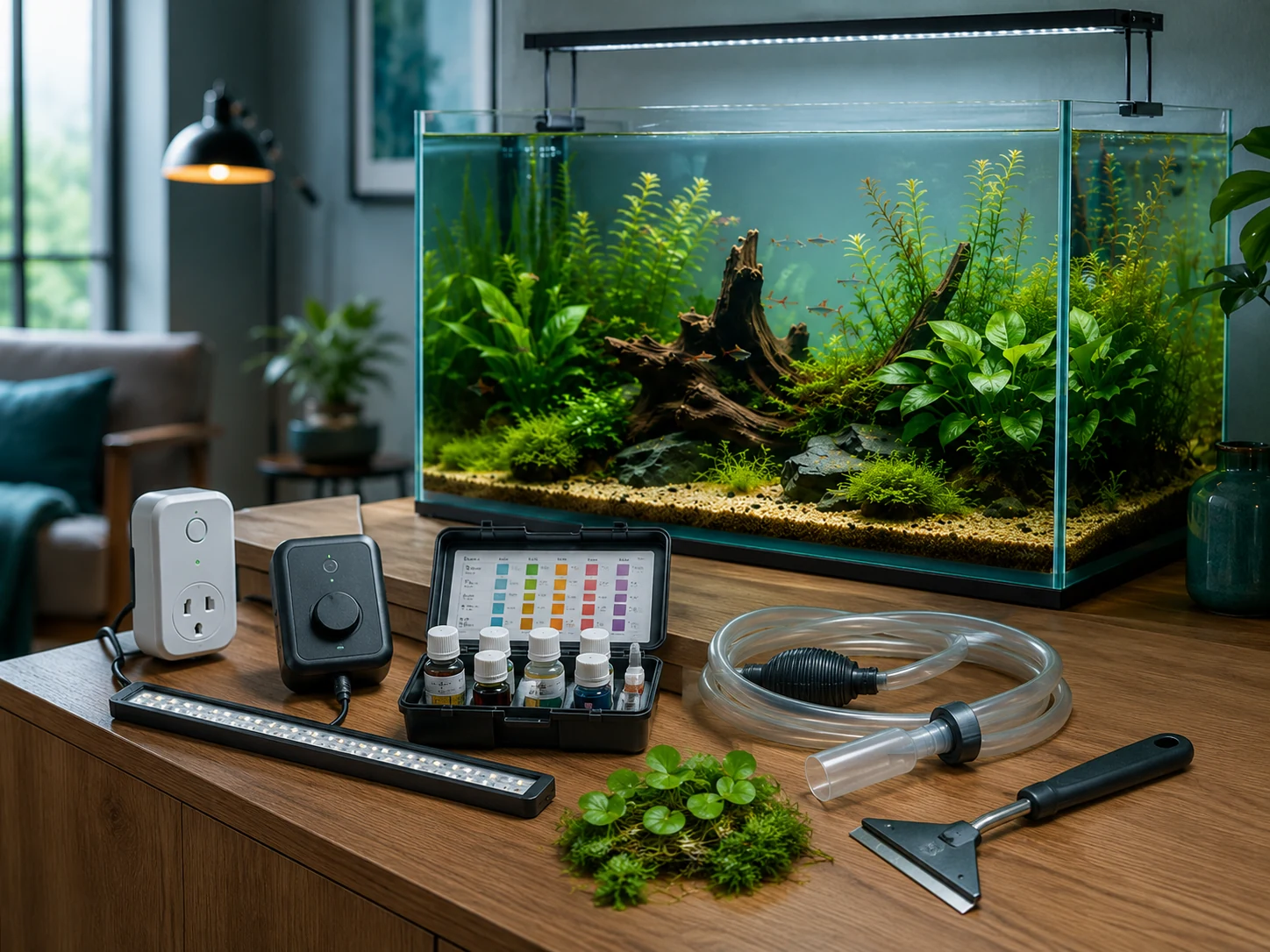
For a fish-only aquarium, the best beginner light is usually simple, reliable, and not too intense.
Look for:
- a fixture that fits the tank length securely,
- splash resistance appropriate for aquarium use,
- a built-in timer or compatibility with an outlet timer,
- adjustable brightness if possible,
- natural-looking white light,
- and enough spread to avoid harsh spotlighting.
You do not need premium app control for most fish-only tanks. You do not need an expensive plant spectrum if you have no live plants. You do not need a marine reef light for a freshwater community tank.
What matters more is consistency and comfort.
Fish-only light mistakes to avoid:
| Mistake | Why it causes problems | Better choice |
|---|---|---|
| Running lights 12+ hours | Algae pressure rises | Start 6–8 hours |
| No timer | Schedule changes daily | Use a timer |
| Harsh bright light on bare tank | Fish may hide or stress | Add plants, décor, shade |
| Buying reef/marine light for freshwater | Too much intensity/spectrum complexity | Freshwater LED fixture |
| Using light to heat tank | Unstable and unsafe | Use proper heater if needed |
| Leaving blue “moonlight” on all night | Extends the photoperiod, disrupts rest, and can still support algae/cyanobacteria | Use only briefly for viewing; keep the tank truly dark overnight |
Blue night mode looks pretty. It is also one of the easiest traps in modern aquarium lights.
Many budget LEDs market a blue channel as “moonlight.” The name makes it sound gentle, natural, and safe to leave on while you sleep. In a home aquarium, that is usually the wrong habit. Blue light is still light. It can disturb the fish’s dark period, keep shy fish from settling, and extend the usable light window for algae and cyanobacteria. If the tank is already fighting hair algae, film algae, or blue-green slime, an all-night blue channel is not harmless decoration.
Use moonlight only as a brief viewing mode. Then turn the aquarium fully dark.
Night should be night.
Choosing a Light for a Low-Tech Planted Aquarium
For low-tech plants, the best beginner light is not necessarily the strongest light.
It is the light that grows easy plants without forcing you into high-tech maintenance.
Look for:
- freshwater full-spectrum or planted-tank LED,
- adjustable intensity,
- timer or app schedule,
- good spread across the tank,
- enough output for your tank depth,
- and a color appearance you actually like.
A 6500K-style daylight appearance often looks natural for many freshwater tanks, but Kelvin alone does not prove plant performance. A good planted light uses a useful spectrum and enough intensity at the plant level. That depends on fixture design, tank depth, mounting height, and plant type.
For low-tech tanks, I prefer adjustability. If the light is too strong, you can dim it. If the plants are healthy and algae is controlled, you can slowly increase duration or intensity.
If the light has no dimmer and is obviously too bright, you may need to raise it, add floating plants, shorten the schedule, or replace it with a better-matched fixture.
Low-Tech Light Starting Settings
Use this as a practical starting point, not a permanent law.
| Setup | Intensity | Duration | Notes |
|---|---|---|---|
| New low-tech tank with slow plants | 40–60% if dimmable | 6 hours | Good for Anubias, Java fern, Buce, Crypts |
| Easy stem plants added | 50–70% | 6–7 hours | Watch new growth, not old damaged leaves |
| Floating plants present | Moderate | 6–8 hours | Floating plants reduce light below |
| Tall tank | Moderate to higher | 6–8 hours | Depth reduces light at substrate level |
| Algae-prone tank | Lower intensity | 5–6 hours temporarily | Fix nutrients and maintenance too |
Do not make daily changes. Plants respond slowly. Algae may respond faster. Change one thing, then observe.
If you increase the photoperiod, add 30 minutes at a time and wait one or two weeks. If you increase intensity, do it gradually. Sudden changes are one reason planted tanks become unstable.
What About Red, Blue, RGB, and WRGB Lights?
RGB and WRGB lights can make fish and plants look better. They can improve color rendering, especially with red plants, green plants, and colorful fish.
But beginners sometimes misunderstand this.
A light with red and blue LEDs is not automatically good for your tank. A “plant light” label does not mean algae cannot grow under it. Algae can use light too. The tank still needs balance.
For most beginner freshwater aquariums:
- white/full-spectrum daylight is enough for fish-only tanks,
- basic full-spectrum planted LEDs are enough for easy plants,
- RGB/WRGB is nice for appearance and better color control,
- very high intensity is unnecessary unless the tank is planned for it,
- and any light can grow algae if the schedule, nutrients, and maintenance are poor.
Do not buy a complicated app light if you will never adjust it properly.
A simple dimmable light on a timer beats an expensive light running at 100% for 12 hours because the preset looked impressive.
The Lighting Setup I Would Recommend for Most Beginners
If I were helping a beginner choose lighting before buying fish, I would keep it practical.
For a Fish-Only Tank
Choose a freshwater LED that fits the tank, has a timer or works with a plug-in timer, and is not excessively powerful.
Start at 6–8 hours per day.
Add shade with décor, hardscape, artificial plants, or easy live plants if the fish seem exposed.
For a Betta Tank
Choose a gentle, dimmable light if possible.
Use floating plants or broad-leaf plants to create shaded areas. Bettas often appreciate cover near the surface. Avoid blasting a bare tank with a harsh light just because the fish looks more colorful under it.
For a Low-Tech Planted Tank
Choose a moderate full-spectrum freshwater/planted LED with adjustable brightness.
Start with 6 hours. Grow easy plants first. Increase only when new plant growth is healthy and algae is controlled.
For a Goldfish Tank
Choose a durable, easy-to-clean freshwater LED for viewing.
Keep the schedule controlled. Goldfish produce a lot of waste, and long lighting over a nutrient-rich tank often creates algae pressure. Do not rely on goldfish to “clean” algae in a way that solves the real maintenance problem.
For a Shrimp Tank
Use moderate lighting with mosses, floating plants, and biofilm-friendly surfaces.
Shrimp graze on surfaces, but that does not mean the tank should be allowed to become an algae farm. Stability matters more than intensity.
Aquarium Lighting Troubleshooting
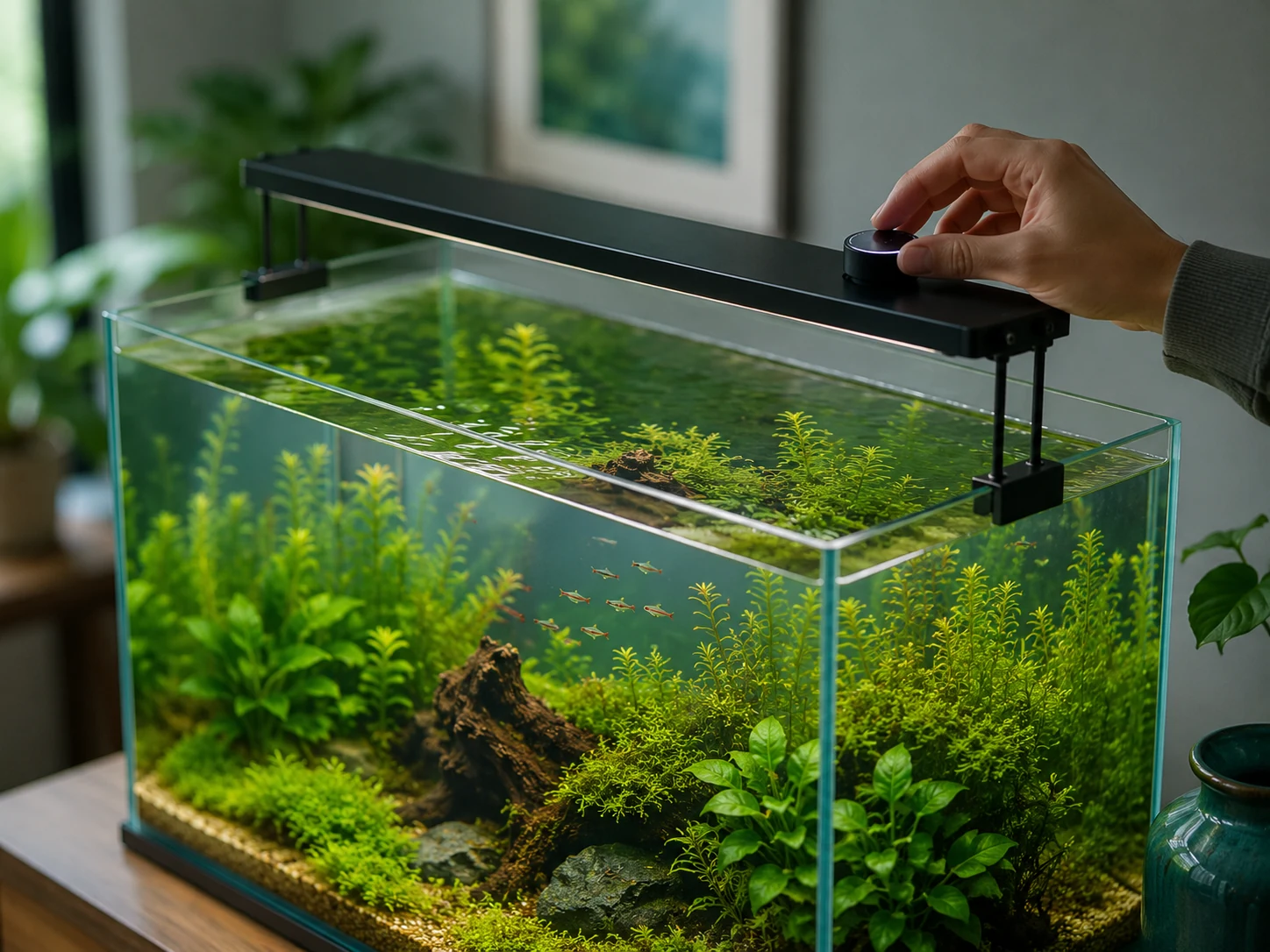
Use the tank’s response to adjust the light.
| Symptom | Possible lighting issue | What to do first |
|---|---|---|
| Green film on glass every few days | Too much light or nutrients | Reduce to 6 hours; check feeding and nitrate |
| Brown dusty coating in a new tank | Common new-tank diatoms | Clean gently; keep schedule stable |
| Hair algae on plants | Excess light, nutrients, weak plant growth | Shorten light; remove manually; improve plant balance |
| Anubias leaves covered in algae | Slow leaves under too much light | Add shade; reduce intensity |
| Plants tall and leggy | Light may be weak or poorly spread | Improve spread/intensity slowly |
| Plants melting after setup | Transition stress, unstable tank, planting issue | Do not jump straight to stronger light |
| Fish hide when light turns on | Light too sudden/harsh or tank too bare | Add cover; dim light; use ramp-up if available |
| Fish active late at night | Light schedule too long or irregular | Provide true darkness overnight |
| Algae on window-facing side | Sunlight exposure | Block sun or move tank |
The key is to avoid random changes.
Do not change the light schedule, fertilizer, feeding, water-change size, filter media, and stocking all in the same week unless there is an emergency. You will not know what helped or what made the problem worse.
Light and Water Quality Still Work Together
Lighting will not fix unsafe water.
A beautiful light over a tank with ammonia or nitrite is just a brighter emergency.
When fish look stressed, test the water before assuming the light is the only issue. Check ammonia/ammonium, nitrite, nitrate, pH, and temperature. If the tank is new, recently cleaned too aggressively, overfed, or has dead plant matter, water quality may be involved.
Lighting can make plant growth better, and plants can help use some nutrients, but plants are not a replacement for cycling, filtration, water changes, and sensible stocking.
If algae appears after adding stronger light, ask what changed:
- Did the light duration increase?
- Did intensity increase?
- Did feeding increase?
- Were more fish added?
- Did plants melt?
- Was fertilizer added without enough plant growth?
- Did direct sunlight hit the tank more as the season changed?
- Was filter flow reduced by clogged media?
This is how experienced fishkeepers diagnose lighting problems. They do not stare only at the light. They look at the system around the light.
A Simple Lighting Plan for the First 30 Days
New tanks need restraint.
Here is a safer beginner plan.
Week 1
Set the light to 6 hours per day.
Use a timer immediately. Do not manually turn the light on and off whenever you remember.
If the tank has live plants, remove melting leaves. Do not panic if some plants adjust poorly at first.
Week 2
Keep the schedule the same.
Watch for algae on glass, hardscape, and slow-growing leaves. Test water if fish are already present. If ammonia or nitrite appears, prioritize water safety.
Week 3
If plants show healthy new growth and algae is mild, keep the same schedule or increase by only 30 minutes.
If algae is increasing quickly, reduce intensity if possible or keep the light at 6 hours while you address feeding, waste, and sunlight.
Week 4
Decide based on the tank, not a preset.
If fish are calm, plants are producing new growth, and algae is controlled, your light schedule is probably good. You do not need to increase it just because another hobbyist runs 10 hours.
If algae is still outrunning plant growth, the tank is telling you to slow down.
What I Would Buy Before Upgrading the Light
A better light can help, but it is not always the next purchase.
Before buying a powerful fixture, I would make sure the tank has these basics:
| Item | Why it matters |
|---|---|
| Outlet timer or smart plug | Stabilizes the photoperiod |
| Water test kit | Confirms ammonia, nitrite, nitrate, and pH |
| Siphon/gravel vacuum | Removes waste that feeds algae |
| Algae scraper or pad | Handles normal glass algae |
| Easy live plants | Help compete for nutrients in planted tanks |
| Floating plants | Add shade and nutrient uptake |
| Fertilizer suited to the plant load | Useful only when plants need it |
| Reliable filter maintenance tools | Clogged flow worsens debris and dead spots |
A strong light over a messy tank is not an upgrade. It is a spotlight on poor balance.
Algae Control Lighting Toolkit
If the reader is already dealing with algae or fish that panic when the light turns on, the best affiliate angle is not “buy the brightest light.” It is “buy control.”
These are the lighting tools I would recommend before pushing a high-output fixture:
| Tool | Why it helps | Best use case |
|---|---|---|
| Dimmable freshwater LED | Reduces intensity without replacing the whole setup | Fish-only tanks, low-tech plants, algae-prone tanks |
| LED with sunrise/sunset ramp | Prevents hard on/off light shock | Timid fish, open-top tanks, bright rooms, display tanks |
| WiFi smart plug or outlet timer | Keeps the photoperiod consistent | Basic lights without built-in scheduling |
| Inline LED dimmer, if compatible | Adds intensity control to some simple LED bars | Older lights that are too bright |
| Floating plants or shade cover | Softens harsh light naturally | Betta tanks, gourami tanks, shy community fish |
| Algae scraper or pad | Removes normal glass algae without panic resets | Weekly maintenance |
| Liquid test kit | Confirms whether algae is paired with water-quality problems | Ammonia, nitrite, nitrate, pH checks |
| Siphon/gravel vacuum | Removes waste before light turns it into algae fuel | Beginner tanks, goldfish tanks, messy feeders |
For conversion, this box should link to controlled-lighting products first: a smart timer, a dimmer-compatible LED, an entry-level LED with automatic sunrise/sunset, and basic algae maintenance tools. The promise should be practical: steadier light, calmer fish, and less algae pressure. Do not sell it as a miracle algae cure.
Practical Aquarium Light Buyer Checklist
Use this before buying.
| Question | Why it matters |
|---|---|
| Is the tank fish-only or planted? | Determines intensity needs |
| What plants are you growing? | Easy plants need less light than carpets/red stems |
| How deep is the tank? | Deeper tanks need better penetration |
| Can the light be dimmed? | Helps algae control and fish comfort |
| Does it have a timer? | Consistency prevents many beginner mistakes |
| Does it fit the tank securely? | Safety and even spread matter |
| Is it designed for freshwater? | Avoid mismatched reef/marine lighting |
| Is it splash-resistant for aquarium use? | Electrical safety matters |
| Can you adjust or replace the schedule easily? | Useful as the tank matures |
| Are you buying more intensity than your tank can use? | Too much light creates maintenance pressure |
For affiliate buying guides, this is where exact product comparisons should be added later with verified dimensions, wattage, control type, mounting style, and manufacturer specs. Do not recommend a light only because it is popular. Recommend it because it fits a real tank use case.
FAQ
How many hours should aquarium lights be on each day?
Most beginner freshwater tanks should start around 6–8 hours per day. New tanks, fish-only tanks, and algae-prone tanks often do better closer to 6 hours at first. Established planted tanks may run longer if plant growth is healthy and algae is controlled, but a longer schedule is not automatically better.
Do fish need aquarium lights?
Fish do not usually need intense lighting, but they do benefit from a predictable day-night cycle. Aquarium lights also help you observe fish health, feeding, color, and behavior. The key is to provide both light and real darkness.
Can I leave blue moonlight on overnight?
No. Treat blue moonlight as a short viewing mode, not an overnight setting. Blue light is still light. It can disrupt the aquarium’s dark period and may add usable energy for algae or cyanobacteria. Fish should get total darkness at night.
Can a timer scare fish when the light turns on?
Yes, especially if the room is dark and the LED turns on at full power. Use a 15–30 minute sunrise/sunset ramp if your light supports it. With a basic plug-in timer, turn on the room light about 10 minutes before the tank light, and avoid switching the room and aquarium lights off at the exact same moment.
Is a siesta lighting schedule good for algae control?
It can help in some low-tech planted tanks, but it is not necessary for every beginner. If you use it, make the middle dark break at least 3 hours. A short 30–60 minute pause is usually not enough to be meaningful and may make the schedule harder to troubleshoot.
What light is best for a low-tech planted tank?
A moderate full-spectrum freshwater LED with dimming and a timer is usually best for beginners. Start with 6 hours per day and easy plants such as Java fern, Anubias, Cryptocoryne, water sprite, hornwort, and Vallisneria. Avoid jumping straight to high intensity unless you are prepared to balance nutrients and CO2 demand.
Does more light make aquarium plants grow faster?
More light can increase plant growth only if carbon, nutrients, plant health, and water conditions can keep up. In a low-tech tank without CO2, too much light often creates algae before it creates better plant growth.
Does aquarium light cause algae?
Light contributes to algae, but it is not the only cause. Algae grows when light, nutrients, surfaces, and time line up. Overfeeding, direct sunlight, high nitrate, decaying plant matter, weak plant growth, and poor maintenance can all make algae worse.
Should I turn the aquarium light off during an algae outbreak?
A short blackout can help in specific cases, but beginners should not use blackout as the only solution. First reduce the photoperiod, remove direct sunlight, clean algae manually, remove waste, test water, and correct feeding and maintenance. If fish are stressed, water quality comes first.
Is sunlight good for aquarium plants?
Sunlight can grow plants, but in a home aquarium it is hard to control. Direct sunlight often causes algae and temperature swings, especially in small tanks. Artificial aquarium lighting on a timer is usually safer and more predictable.
Do goldfish need special aquarium lights?
Goldfish do not need high-powered planted lighting unless the tank is also designed for live plants. They need a regular day-night cycle and good viewing light. Because goldfish produce heavy waste, long bright lighting can quickly increase algae pressure.
Why do my fish hide when the light turns on?
The light may be too bright, too sudden, or the tank may be too bare. Add plants, hardscape, or shaded areas. Use a dimmer or ramp-up feature if available. Some fish are naturally more comfortable under softer light.
Related Guides
- Low-Tech Planted Tank Setup
- Algae Problems in Fish Tanks
- Freshwater Aquarium Checklist
- How to Set Up a Fish Tank
- Best Aquarium Lights for Freshwater Tanks
- Aquarium Filter Maintenance
Author Box
Written by the Healthy Aquariums editorial team.
Healthy Aquariums focuses on practical freshwater fishkeeping: stable water, appropriate equipment, beginner-safe stocking, and maintenance routines that work in real home aquariums. Our guides are written to help everyday fishkeepers make calmer, safer decisions before problems become emergencies.
Editorial Note
This article is intended as practical beginner guidance for freshwater aquariums. Lighting needs vary by tank depth, plant species, fixture design, room light, stocking, fertilization, and maintenance routine. Use this guide as a starting point, then adjust slowly based on plant growth, algae response, fish behavior, and water-test results. For product recommendations, verify current manufacturer specifications before publishing affiliate links.
References
- Tropica Aquarium Plants. “Make your aquarium a success.” Notes that plant difficulty varies and some plants require more light, fertilizer, and CO2 than others. https://tropica.com/
- The Spruce Pets. “Understanding Freshwater Aquarium Lighting.” Covers the role of lighting in fish visibility, plant photosynthesis, day-night cycles, LED advantages, and algae considerations. https://www.thesprucepets.com/understanding-freshwater-aquarium-lighting-4082719
- The Spruce Pets. “Lighting Requirements for Plants in Community Aquariums.” Discusses plant lighting, photosynthesis, LED/fluorescent choices, timers, and the risk of excessive or insufficient light. https://www.thesprucepets.com/live-plants-lighting-requirements-4092855
- Charterhouse Aquatics. “Aquarium Lighting 101: Understanding PAR, Spectrum & Photoperiod.” Defines photoperiod and gives planted-tank lighting duration context. https://charterhouse-aquatics.com/blogs/help-guides/aquarium-lighting-101-understanding-par-spectrum-photoperiod
- Azevedo, C. S. et al. “The Effects of Light on Vertebrate Welfare: A Review.” Animals, 2025. Discusses light, circadian cycles, artificial light at night, and welfare effects across vertebrates. https://www.mdpi.com/2076-2615/15/22/3329
- Jiao, L. et al. “Influence of Light/Dark Cycles on Body Color, Growth Performance and the Expression of Neuroendocrine-Related Genes in the Redclaw Crayfish.” Frontiers in Marine Science, 2021. Notes that light/dark cycles are important biological factors in aquatic animals. https://www.frontiersin.org/journals/marine-science/articles/10.3389/fmars.2021.750384/full
- Aqueon. “Aquatic Plant Basics.” Gives beginner-friendly context on full-spectrum light, Kelvin range, plant species, and tank depth. https://www.aqueon.com/resources/care-guides/aquatic-plant-basics
- TFH Magazine. “The Skeptical Fishkeeper: Aquarium Lighting.” Practical discussion of gradual light transitions and avoiding sudden light-to-dark changes that upset fish. https://www.tfhmagazine.com/articles/freshwater/aquarium-lighting
- RecifArt. “Best Light Schedule for Fish Tank.” Practical discussion of sunrise/sunset ramps and gradual LED transitions. https://www.recifart.com/en/blog-recifart/aquarium-care/best-light-schedule-for-fish-tank