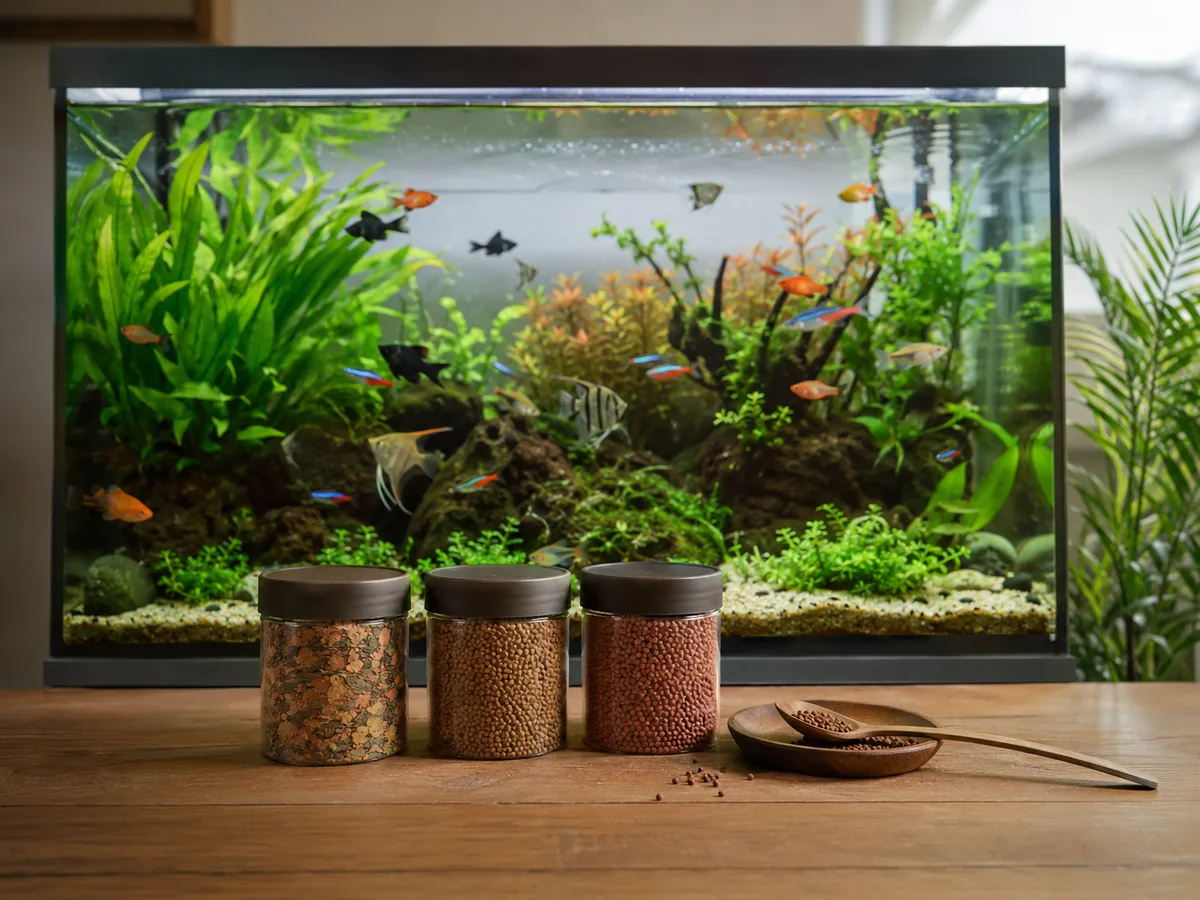
Fish food affects more than growth and color. Every pellet, flake, wafer, or frozen cube also becomes part of the tank’s nutrient load. Uneaten food decays into ammonia, phosphate, dissolved organics, and bacterial growth pressure.
The best fish food is the one your fish can actually eat, digest, and finish quickly. A premium formula still becomes pollution if the portion is too large or the pellet size is wrong.
Match Food to the Fish
Small community fish need small bites. Bettas need appropriately sized floating or slow-sinking foods that do not encourage overfeeding. Bottom feeders need sinking foods, but wafers should not be left in the tank for hours as if they are harmless.
Look at mouth size, feeding level, and behavior. A food that works for adult livebearers may be too large for small tetras. A wafer that suits a group of corydoras may be too much for one small bottom feeder.
Portion Control Is Water Care
Feed what fish can finish within a few minutes, and remove leftovers after about 5 minutes. This is especially important in small tanks where a few extra pellets can noticeably increase ammonia risk.
If fish spit food out, do not immediately try a richer food. Check pellet size, freshness, temperature, stress, and water quality. Fish that refuse food can be reacting to ammonia, nitrite, low oxygen, or social stress.
Storage and Freshness
Fish food loses quality when exposed to heat, moisture, and air. Buy smaller containers unless you keep many tanks. Keep food sealed, dry, and away from aquarium humidity.
Frozen foods can be useful variety, but they should be portioned carefully. Thaw small portions and avoid dumping thaw water into the tank when it carries excess dissolved waste.
Cleaner Feeding Kit: Keep a small feeding spoon, pipette or turkey baster, airtight food container, and water test kit near the tank. These tools make portion control and leftover removal easier.
Practical Upgrade Scenarios
If fish look thin even though food is offered daily, observe whether dominant fish are taking most of the portion. The answer may be feeding method rather than food quality. Spread tiny portions across more than one area or use sinking food for bottom feeders after active surface fish are occupied.
If the tank becomes cloudy after feeding, reduce the portion before changing brands. Cloudiness after feeding often means dissolved organics and heterotrophic bacteria are rising faster than the filter and routine maintenance can process.
If a food container has been open for months in a humid fish room, freshness may be the hidden problem. Stale food can lose appeal and nutritional value. Smaller containers are often better for one or two home aquariums.
How to Judge a Food After Buying It
The first test is not the ingredient panel; it is the tank response. Fish should notice the food, eat it cleanly, and return to normal behavior without long trails of waste or leftovers on the substrate. Water should not cloud shortly after feeding.
Keep a simple feeding note for new foods. Record portion size, how quickly fish finish it, and whether any fish are excluded. This prevents overcorrecting when the real issue is social competition or pellet size.
Related Guides
- Best Betta Fish Food
- Ammonia, Nitrite, and Nitrate
- Aquarium Maintenance Schedule
- Cloudy Aquarium Water
- Betta Swim Bladder Disease
- How Often Water Change
FAQ
What is the best fish food for beginners?
A high-quality staple pellet or flake matched to the fish’s mouth size and feeding level is the best starting point.
Are pellets better than flakes?
Pellets are easier to portion, but flakes can work well for small surface-feeding community fish.
How much should I feed?
Feed a small amount that fish finish quickly. Remove leftovers after about 5 minutes.
Can overfeeding cause ammonia?
Yes. Uneaten food and extra waste can raise ammonia and fuel bacterial blooms.
Should I feed frozen food daily?
Usually no. Use frozen food as variety unless the species has a specific need.
Why are my fish spitting food out?
The food may be too large, stale, too hard, or the fish may be stressed by water quality or temperature.
How should fish food be stored?
Keep it sealed, dry, cool, and away from aquarium splash and humidity.
Is high protein always better?
No. Protein needs vary by species, and excess food still becomes waste.
Should bottom feeder wafers stay overnight?
No. Remove uneaten food. Long soak times can pollute the tank.
Can food affect algae?
Yes. Overfeeding increases nutrients and organics that can support algae growth.
References
- Merck Veterinary Manual. Aquarium fish health and environmental disease guidance. https://www.merckvetmanual.com/exotic-and-laboratory-animals/aquarium-fish
- University of Florida IFAS Extension. Aquarium fish management and water quality resources. https://edis.ifas.ufl.edu/
- API Fishcare. Freshwater aquarium testing and water-care education. https://www.apifishcare.com/