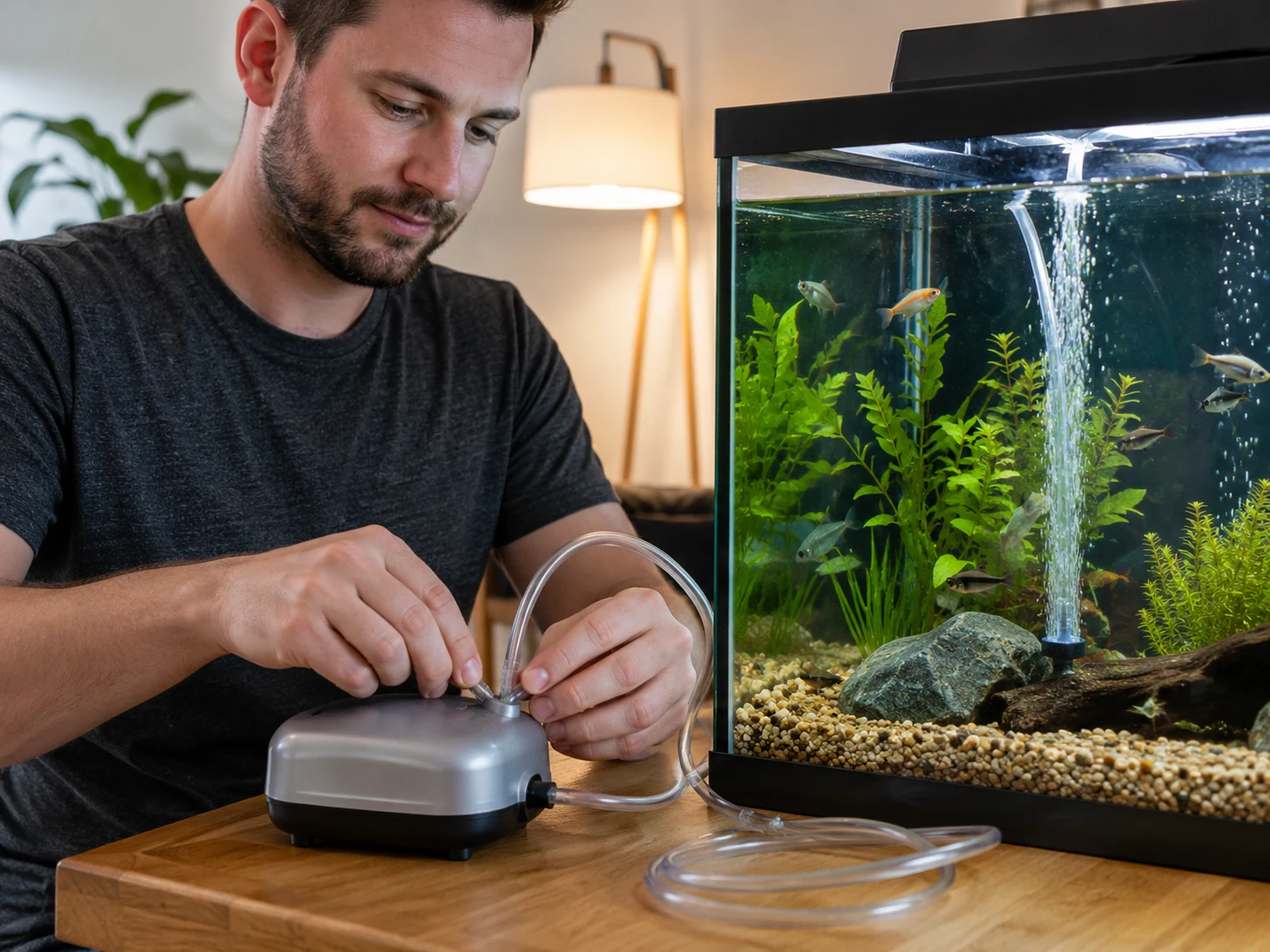
You need an aquarium air pump if you run a sponge filter, need extra surface agitation, treat sick fish in a hospital tank, use medication that lowers oxygen, keep fish in warm water, or want backup aeration during emergencies. You may not need one if your filter already creates strong surface movement and fish show no oxygen stress.
| Situation | Air pump useful? | Why |
|---|---|---|
| Sponge filter | Yes | Powers filtration |
| Hospital tank | Yes | Gentle oxygen and filtration |
| Fish gasping | Often urgent | Adds oxygen support while testing |
| Warm aquarium | Often useful | Warm water holds less dissolved oxygen |
| Medication | Often useful | Some treatments reduce oxygen |
| Power outage | Yes, with battery pump | Keeps surface movement going |
| Betta tank | Sometimes | Use gentle flow only |
| CO2 planted tank | Sometimes | Timing matters |
| Strong HOB/canister flow | Maybe not | Surface exchange may already be enough |
An aquarium air pump is simple equipment, but beginners often misunderstand what it does.
The bubbles are not the main source of oxygen. The real value is movement. Air bubbles rise, pull water upward, break surface film, and improve gas exchange at the surface where oxygen enters and carbon dioxide leaves.
That makes an air pump useful in several situations: a sponge filter, a hospital tank, warm water, medication treatment, fish gasping at the surface, a filter failure, or a power-outage backup plan.
It is not a cure for ammonia, nitrite, dirty substrate, overstocking, chlorine exposure, or a crashed filter.
Use it as oxygen support while you diagnose the real cause.
How Air Pumps Help Oxygen
Air pumps improve oxygen mostly by moving water and disturbing the surface.
| Air pump effect | Why it matters |
|---|---|
| Surface agitation | Improves oxygen exchange |
| Breaks surface film | Restores air-water contact |
| Moves stagnant water | Reduces low-oxygen pockets |
| Powers sponge filters | Adds filtration and aeration |
| Supports warm tanks | Helps when oxygen capacity is lower |
| Supports medication | Helps fish under treatment stress |
If fish are gasping, add aeration first, then test ammonia, nitrite, and temperature. Do not assume bubbles fixed the cause.
Air Pump vs Filter Flow
A filter and an air pump are not the same tool.
| Equipment | Main job |
|---|---|
| Filter | Traps waste and supports beneficial bacteria |
| Air pump | Moves air to air stones or air-driven filters |
| Sponge filter | Air-powered mechanical and biological filtration |
| Powerhead | Water circulation |
| Surface skimmer | Removes surface film |
| Air stone | Aeration and surface movement |
Many aquariums with good filter return flow do not need a separate air pump every day. But an air pump is still a strong backup tool.
Air Stones: Useful, But Not Magic
Air stones create smaller bubbles and smoother movement than an open airline.
| Benefit | Limit |
|---|---|
| Finer bubbles | Pump can still be noisy |
| Better surface movement | Does not remove ammonia |
| Breaks surface film | Does not replace filter maintenance |
| Looks clean | Not a diagnosis tool |
| Hospital support | Still needs water changes |
| Emergency oxygen | Still test water |
If an air stone clogs, the pump may get louder because back pressure increases. Replace or clean clogged air stones instead of forcing the pump to work harder.
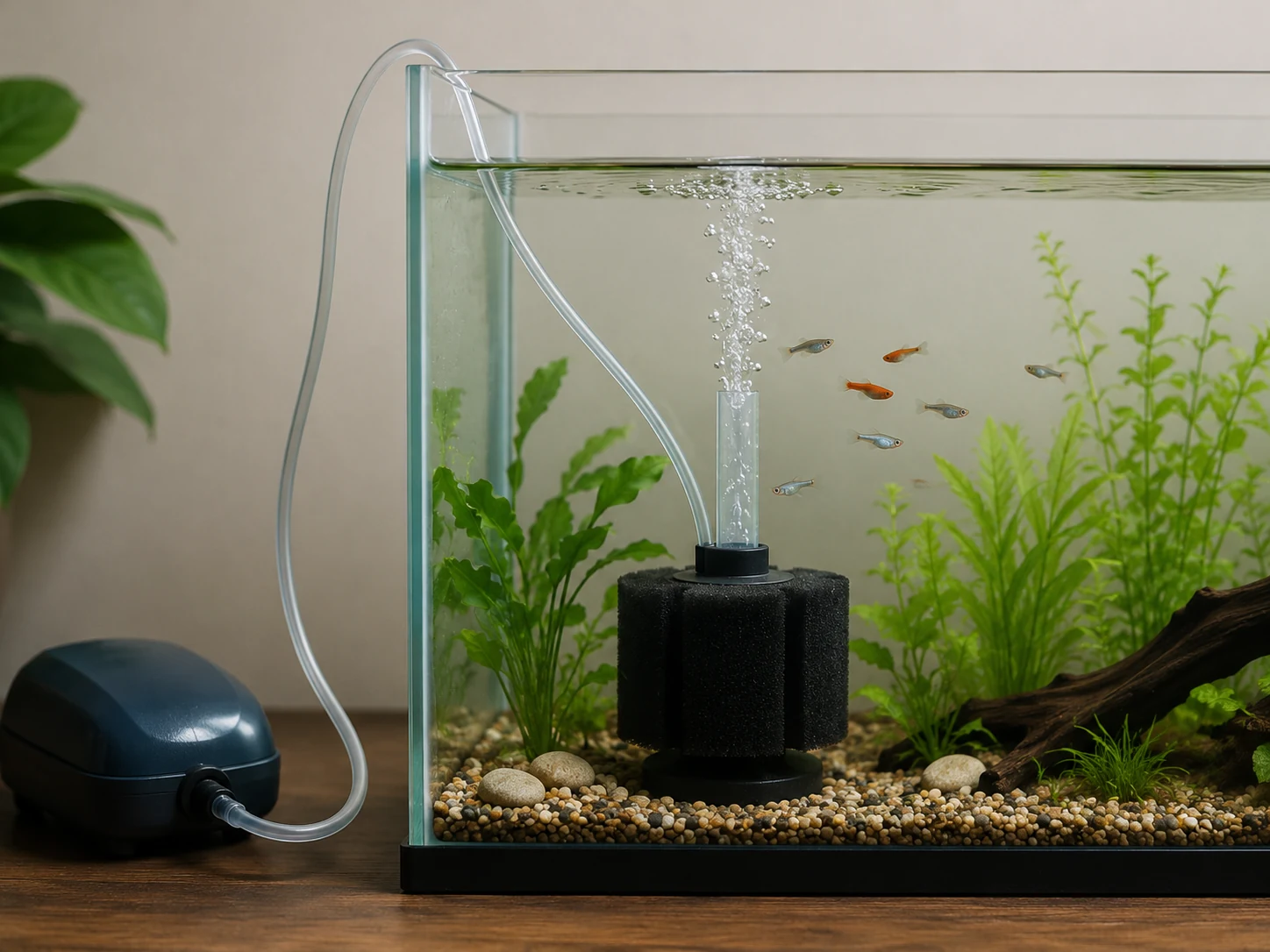
Sponge Filters and Air Pumps
Sponge filters are one of the best uses for an aquarium air pump.
They are gentle, safe for fry and shrimp, useful for bettas, and easy to clean. They also give beneficial bacteria a place to live.
| Sponge filter advantage | Why it helps |
|---|---|
| Gentle flow | Good for bettas, fry, shrimp |
| Biological surface area | Supports the cycle |
| Mechanical capture | Traps fine debris |
| Easy cleaning | Squeeze in old tank water |
| Emergency use | Can run from battery air pump |
| Hospital tank use | Simple, gentle filtration |
Do not blast a tiny tank with an oversized pump. Use a control valve to reduce flow if needed.
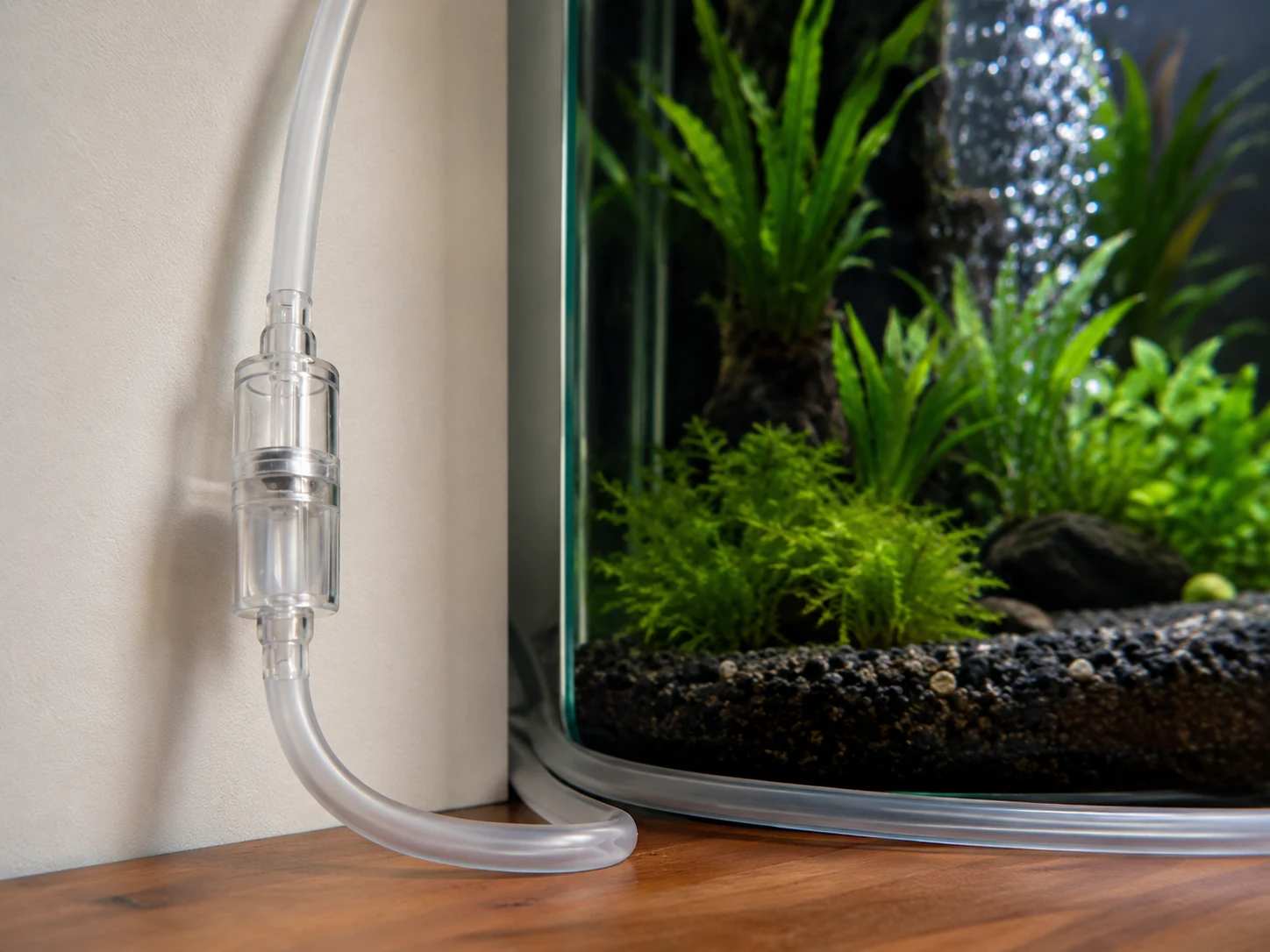
Check Valves: Small Part, Big Safety Role
A check valve prevents aquarium water from siphoning backward into the air pump if power stops.
| Setup | Check valve needed? |
|---|---|
| Pump below waterline | Yes |
| Pump beside tank but lower than rim | Yes |
| Pump above aquarium | Still recommended |
| Battery backup pump | Recommended |
| Multiple airlines | Use check valves or proper manifold |
Install it in the correct direction. Most check valves have an airflow arrow. If installed backward, air will not pass.
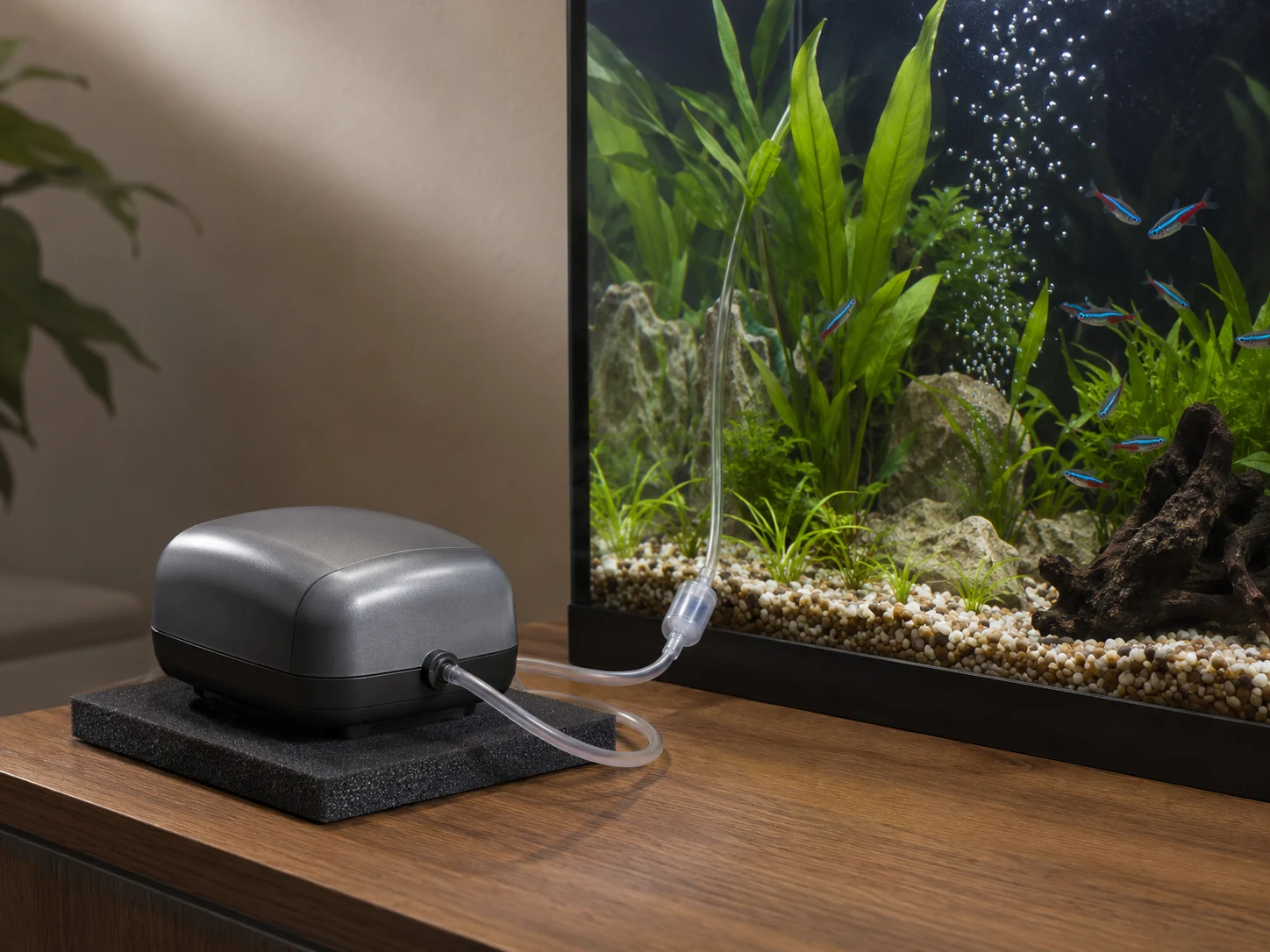
How to Make an Aquarium Air Pump Quieter
Air pump noise usually comes from pump vibration, bubble noise, tubing rattle, or back pressure.
| Noise source | Fix |
|---|---|
| Pump vibration | Place on soft foam pad |
| Hollow cabinet resonance | Move pump to a solid surface |
| Loud bubbles | Use better air stone or reduce flow |
| Airline rattle | Secure tubing |
| Clogged air stone | Replace or clean air stone |
| Oversized pump | Use valve or smaller pump |
| Worn diaphragm | Replace diaphragm or pump |
Do not seal an air pump inside a closed box. It needs ventilation. Heat shortens pump life.
Choosing the Right Air Pump Size
Choose based on what the pump must power, not just tank volume.
| Use case | Pump need |
|---|---|
| One small air stone | Small pump |
| One sponge filter | Small or medium pump |
| Deep tank | More pressure |
| Multiple sponge filters | Larger pump or manifold |
| Air curtain | More output |
| Battery backup | Enough emergency airflow |
| Fish room rack | Strong pump with manifold |
Depth matters. A deep tank needs more pressure than a shallow tank because the pump must push air against more water pressure.
Control Valves, Gang Valves, and Manifolds
Air-control parts make air pumps safer and more flexible.
| Part | Use |
|---|---|
| Control valve | Reduce air flow |
| Gang valve | Split air to multiple lines |
| Manifold | Larger multi-tank setup |
| Check valve | Prevent back-siphon |
| Airline suction cups | Keep tubing stable |
| Bleed valve | Safely release excess air |
Do not block a strong pump completely. Too much back pressure can damage the pump.
Air Pumps During Medication
Sick fish often need more oxygen, not less.
Some medications reduce oxygen. Heat-based treatments also reduce oxygen because warm water holds less dissolved oxygen.
| Treatment situation | Air pump role |
|---|---|
| Ich treatment with warmer water | Extra aeration |
| Antibiotics in hospital tank | Oxygen support |
| Fish gasping during medication | Urgent aeration |
| Sponge filter hospital setup | Gentle filtration |
| Biofilter stress | Test ammonia/nitrite |
Always read medication labels. Some treatments require removing carbon, but that does not mean removing oxygen support.
Air Pumps During Power Outages
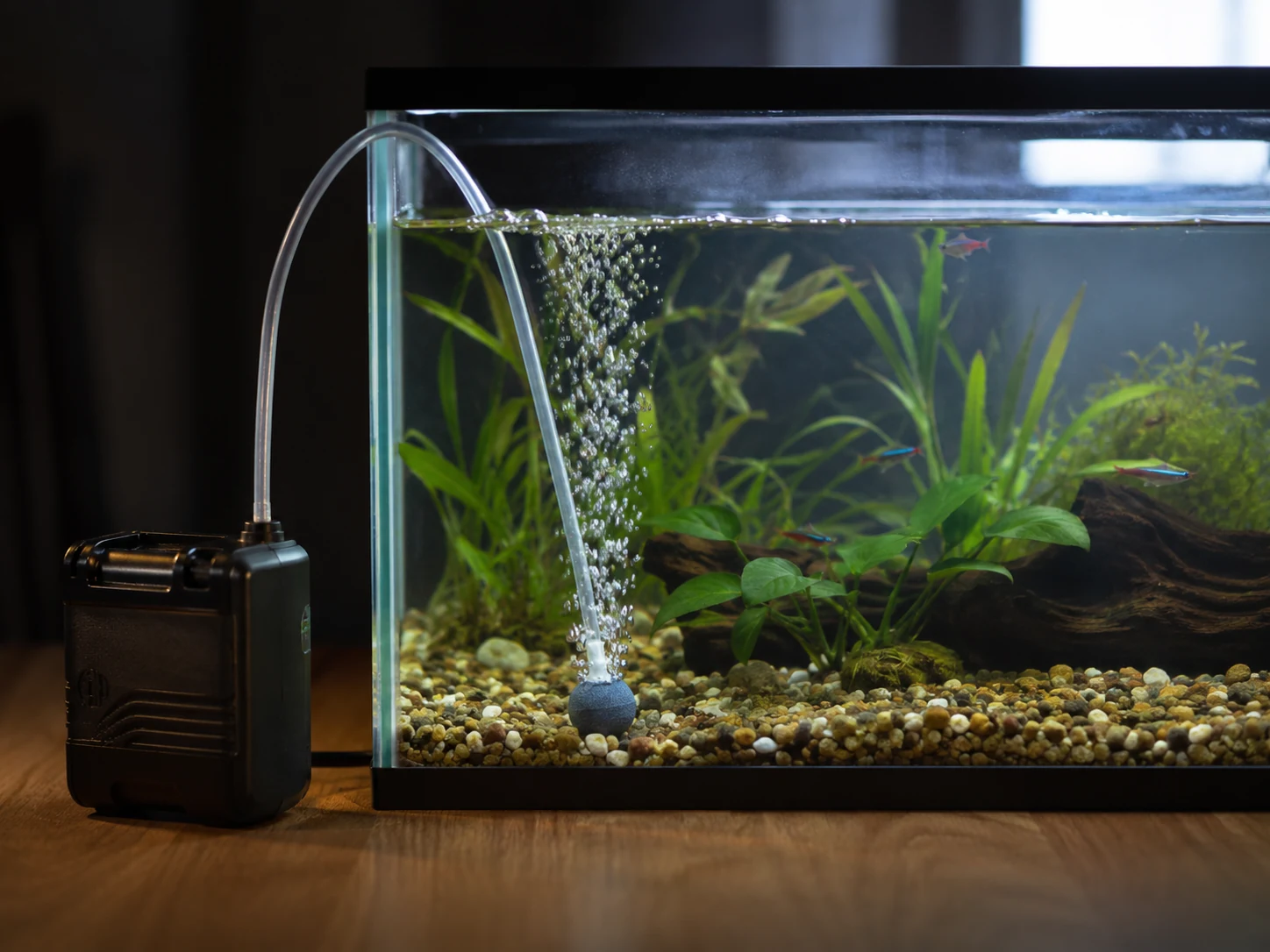
A plug-in air pump does nothing when power fails.
A battery air pump or USB air pump with a power bank can save fish in a long outage.
| Backup option | Use |
|---|---|
| Battery air pump | Emergency aeration |
| USB air pump | Works with power bank |
| Sponge filter + battery pump | Backup filtration and aeration |
| Generator | Larger system backup |
| Manual water movement | Temporary only |
Warm, heavily stocked, or high-value tanks should have backup aeration ready before the emergency happens.
Betta Tanks and Air Pumps
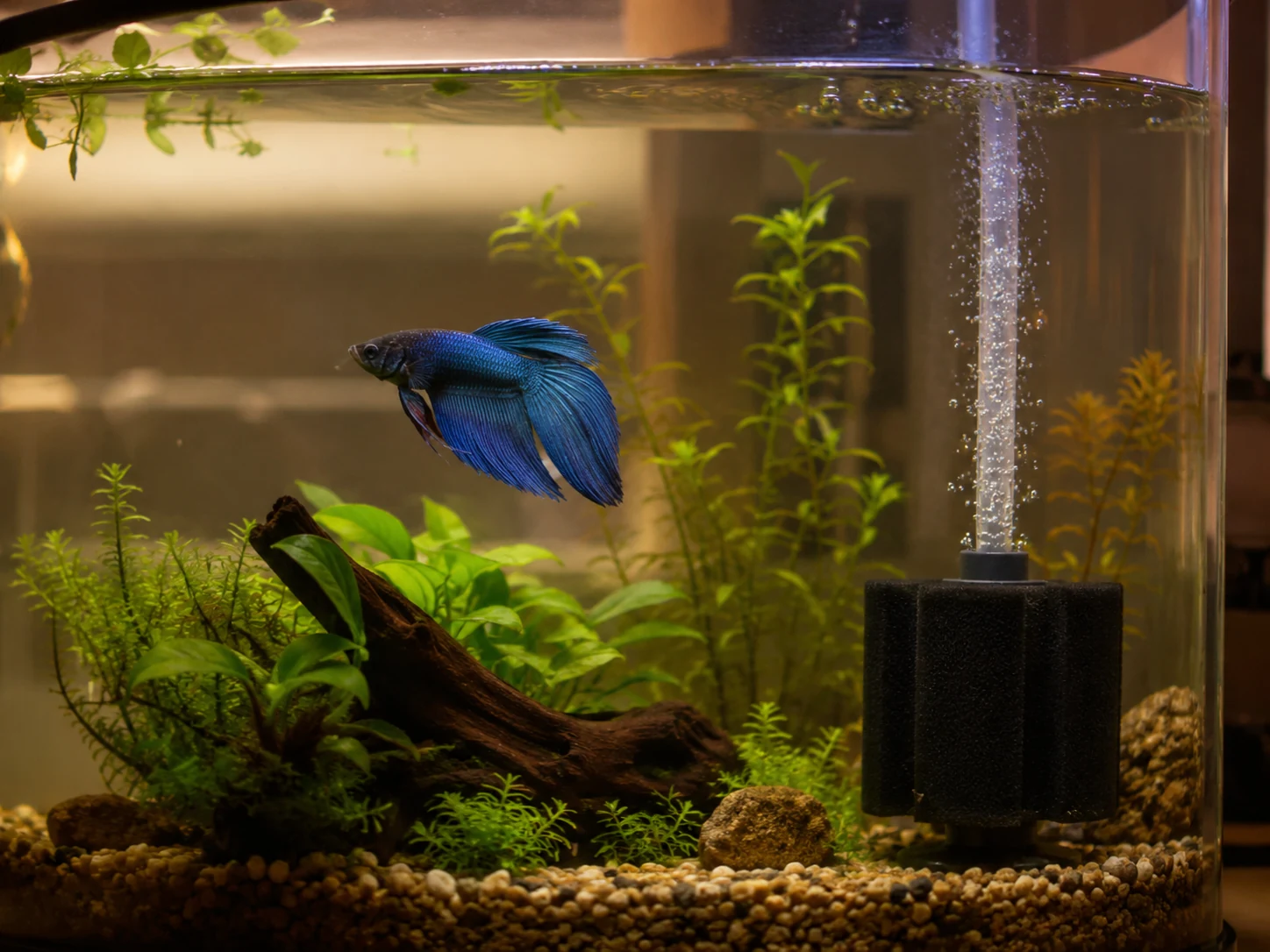
Bettas can breathe surface air, but they still need clean oxygenated water.
The problem is too much turbulence.
| Betta setup | Guidance |
|---|---|
| Sponge filter | Good if gentle |
| Strong air stone | Can stress long fins |
| Control valve | Very useful |
| Hospital tank | Sponge filter is helpful |
| Small tank | Avoid oversized pump |
A betta should not be pushed around by bubbles. Gentle surface movement is enough.
Planted Tanks and Air Pumps
Planted tanks need nuance.
Plants produce oxygen during photosynthesis, but they also use oxygen at night. In CO2-injected tanks, heavy aeration during the light period can drive off CO2.
| Planted tank situation | Air pump guidance |
|---|---|
| Low-tech tank | Gentle aeration is usually fine |
| CO2-injected tank | Avoid wasting CO2 during photoperiod |
| Night oxygen concern | Timer-based aeration may help |
| Surface film | Air or skimmer can help |
| Fish gasping before lights on | Treat as urgent |
| Melting plants | Remove rot and test water |
Do not assume plants guarantee oxygen all night.
When Air Pumps Are Not Enough
An air pump supports oxygen. It does not fix the source of many problems.
| Problem | Air pump helps? | Still needed |
|---|---|---|
| Ammonia | Supports fish | Water change/detoxifier/cycle fix |
| Nitrite | Supports fish | Water changes and biofilter protection |
| High temperature | Helps oxygen | Gradual cooling |
| Overstocking | Only partially | Reduce load or upgrade system |
| Clogged filter | Only partially | Clean filter safely |
| Chlorine/chloramine | No | Conditioner and water change |
| Dirty substrate | No | Siphon maintenance |
If fish are gasping, add air immediately. Then test.
Air Pump Buying Checklist
| Feature | Why it matters |
|---|---|
| Correct output | Enough air without excess noise |
| Quiet design | Better for living spaces |
| Replaceable diaphragm | Longer useful life |
| Tank-depth pressure | Important for deep tanks |
| Control valve compatibility | Flow adjustment |
| Battery option | Emergency backup |
| Check valve included | Safety |
| Air stone quality | Smoother bubbles |
| Sponge filter compatibility | Useful for hospital/nano tanks |
If you need a hospital or emergency setup, keep it simple: a small clean container or tank, dechlorinated water, stable heat when needed, gentle aeration, and basic test supplies. The goal is controlled observation and safe water, not a complicated second display tank.
Emergency Aeration Toolkit
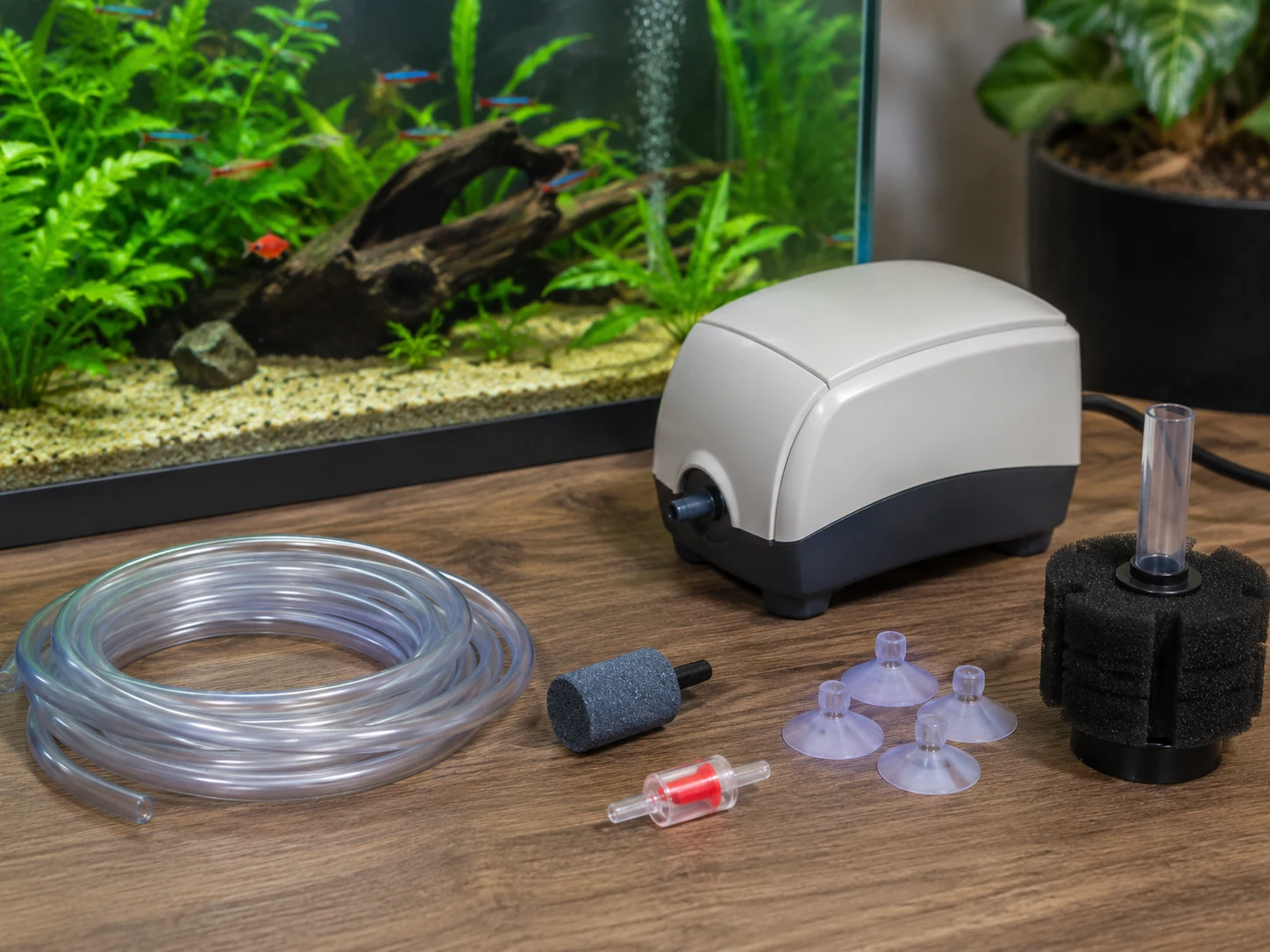
| Tool | Why it helps |
|---|---|
| Battery air pump | Works during outage |
| Air stone | Adds surface movement |
| Airline tubing | Connects the system |
| Check valve | Prevents back-siphon |
| Control valve | Reduces excessive air |
| Sponge filter | Emergency filtration |
| Thermometer | Checks heat/oxygen risk |
| Ammonia/nitrite test | Finds toxin stress |
| Water conditioner | Safer water changes |
Keep the kit accessible.
Not buried in storage.
What Not to Do
| Mistake | Why it is risky |
|---|---|
| Assume bubbles fix ammonia | Toxins remain |
| Skip check valve below tank | Back-siphon risk |
| Oversize pump for tiny tank | Stress, noise, and excess back-pressure if choked |
| Seal pump in closed box | Heat and failure risk |
| Ignore clogged air stone | Back pressure |
| Blast bettas with bubbles | Stress |
| Run strong air stone with daytime CO2 injection | Drives off CO2 and destabilizes planted tanks |
| Use air pump instead of filtration | Incomplete setup |
| Skip testing when fish gasp | Misses the real cause |
| Rely on plug-in pump during outage | No power, no air |
FAQ
What does an aquarium air pump do?
An air pump pushes air through tubing to an air stone, sponge filter, or air-driven device. It improves gas exchange mainly by moving water and disturbing the surface.
Do fish need an air pump?
Not always. Many tanks have enough surface movement from the filter. Air pumps are useful for sponge filters, hospital tanks, warm water, medication, emergencies, and tanks with poor oxygen exchange.
Do air stones add oxygen directly?
Mostly they help by moving water and improving gas exchange at the surface. The bubbles themselves are not the main oxygen source.
Why are my fish gasping if I have an air stone?
The cause may be ammonia, nitrite, chlorine, high temperature, disease, or poor water quality. Add aeration, then test the water immediately.
Do bettas need air pumps?
Bettas do not always need a separate air pump, but a gentle sponge filter powered by an air pump can be excellent. Avoid strong bubbles that push the betta around.
Can an air pump be too strong?
Yes. Too much air can create stress, noise, and excessive turbulence. Use a control valve or smaller pump.
Do I need a check valve?
Yes if the air pump is below the aquarium waterline. It is also a good safety habit even when the pump is above the tank.
Why is my air pump so loud?
The pump may be vibrating on a hard surface, oversized, worn, or pushing against a clogged air stone. A foam pad, better placement, and clean air stone can help.
Can an air pump run a filter?
Yes, if the filter is air-driven, such as a sponge filter or box filter. An air pump does not run standard HOB or canister filters.
Should I run an air pump at night in a planted tank?
It can help if fish show low-oxygen signs before lights come on. In CO2-injected tanks, timing matters because heavy aeration can drive off CO2.
What air pump should I keep for emergencies?
A battery air pump or USB air pump with power bank is useful. Pair it with airline tubing, air stone, check valve, and ideally a sponge filter.
Can air pumps replace water changes?
No. Air pumps support oxygen exchange. They do not remove nitrate, ammonia, nitrite, dissolved organics, or waste.
Which direction should a check valve face?
The arrow on the check valve should point toward the aquarium, following the direction of airflow from the air pump to the tank. If the arrow points toward the pump, the valve is backwards and may block air.
Can an air pump damage itself if I close the control valve too much?
Yes. If you choke the airline almost shut, back-pressure can make the pump run louder, hotter, and harder. Over time this can damage the diaphragm. Use a T-valve or gang valve to bleed extra air safely, or use a smaller pump.
Should I run an air stone during the day in a CO2 planted tank?
Usually no, not during the same period as pressurized CO2 injection, unless fish are in distress. Strong daytime aeration can drive off CO2 and destabilize plant growth. If needed, run aeration at night, opposite the lights and CO2 system.
Related Guides
- Fish Gasping at the Surface
- Aquarium Filter Maintenance
- Noisy Aquarium Filter
- Aquarium Heater Guide
- How Often Should You Change Aquarium Water?
- Best Aquarium Filters
- Best Aquarium Test Kits
- Freshwater Aquarium Checklist
Written by Healthy Aquariums Editorial Team.
Healthy Aquariums creates practical freshwater fishkeeping guides for everyday aquarists who want healthier fish, clearer water, and fewer avoidable mistakes.
This guide is educational and intended for home freshwater aquariums. Air pumps can improve oxygen support and run sponge filters, but they do not replace testing, filtration, water changes, or proper stocking. If fish are gasping, treat the situation as urgent and test ammonia, nitrite, temperature, and oxygen-related conditions.
Healthy Aquariums does not recommend using air bubbles as a substitute for diagnosing water-quality problems.
References
- University of Florida IFAS Extension. “Dissolved Oxygen for Fish Production.” https://edis.ifas.ufl.edu/publication/FA002
- University of Florida IFAS Extension. “Ammonia in Aquatic Systems.” https://edis.ifas.ufl.edu/publication/FA031
- Aqueon. “Aquarium Filtration.” https://www.aqueon.com/articles/aquarium-filtration
- Aqueon. “Freshwater Aquarium Water Quality: The Nitrogen Cycle & More.” https://www.aqueon.com/articles/freshwater-aquarium-water-quality
- Manufacturer instructions for aquarium air pumps, check valves, sponge filters, air stones, and battery backup pumps used by the reader.