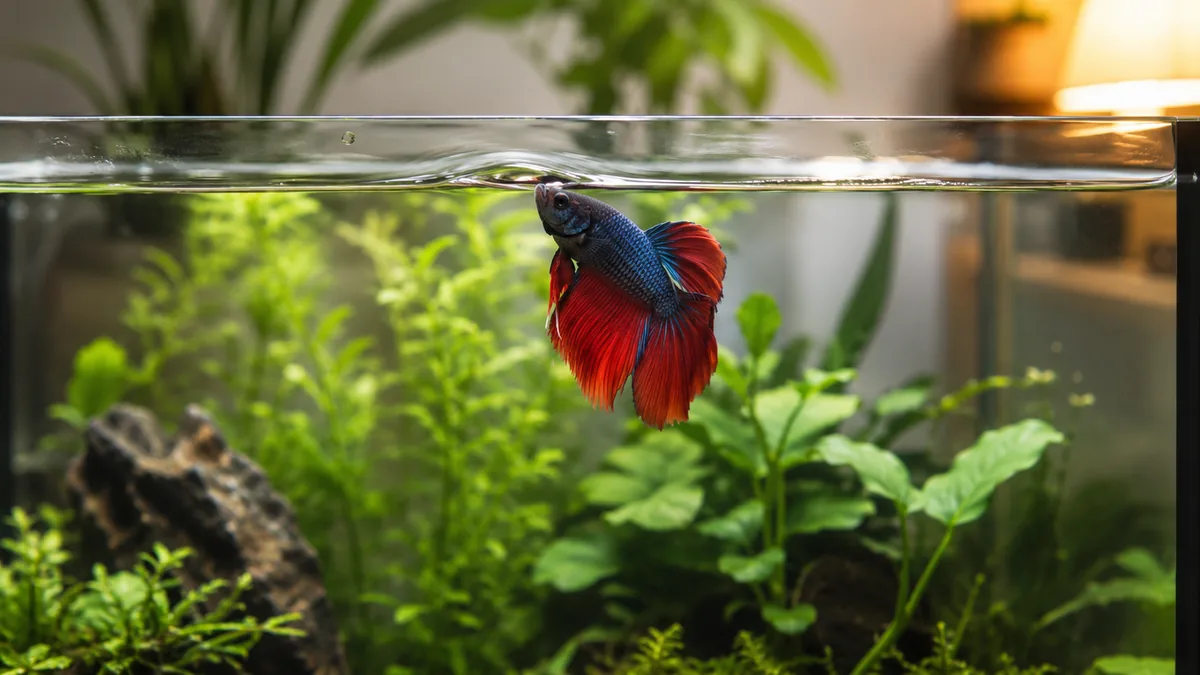
Start Here: Bettas Breathe Air, but Gasping Is Still a Warning Sign
The mistake many beginners make is thinking bettas are immune to oxygen and water-quality problems because they can breathe air.
They are not.
A betta still uses its gills. It still lives in water. Its body is still exposed to ammonia/ammonium (NH3/NH4+), nitrite (NO2-), temperature swings, dissolved oxygen changes, and surface conditions.
A quick surface breath can be normal.
A fish staying at the surface because it seems unable to breathe comfortably is not the same thing.
Use this first distinction:
| Behavior | More normal | More concerning |
|---|---|---|
| Surface visit | Quick air sip, then swims normally | Stays at surface for long periods |
| Breathing | Calm, regular | Rapid gill movement or frantic gasping |
| Body position | Controlled | Hanging, tilted, weak, or pinned at top |
| Appetite | Normal | Refusing food |
| Tank behavior | Explores the tank | Only stays at surface |
| Water tests | Safe | Ammonia or nitrite above zero |
A betta that surfaces occasionally is using normal biology.
A betta that cannot leave the surface may be telling you the tank is unsafe.
Do not wave this away because “bettas breathe air.”
That ability is not a free pass.
The First Five Checks to Do Immediately
When a betta is gasping, do not start by changing food or buying medication.
Start with the environment.
| First check | Why it matters |
|---|---|
| Ammonia/ammonium (NH3/NH4+) | Can irritate gills and cause severe stress |
| Nitrite (NO2-) | Can interfere with oxygen transport and stress fish |
| Temperature | Warm water holds less dissolved oxygen; cold stress also matters |
| Surface movement | Gas exchange happens at the surface |
| Surface film or tight cover | Can reduce air/water exchange or surface access |
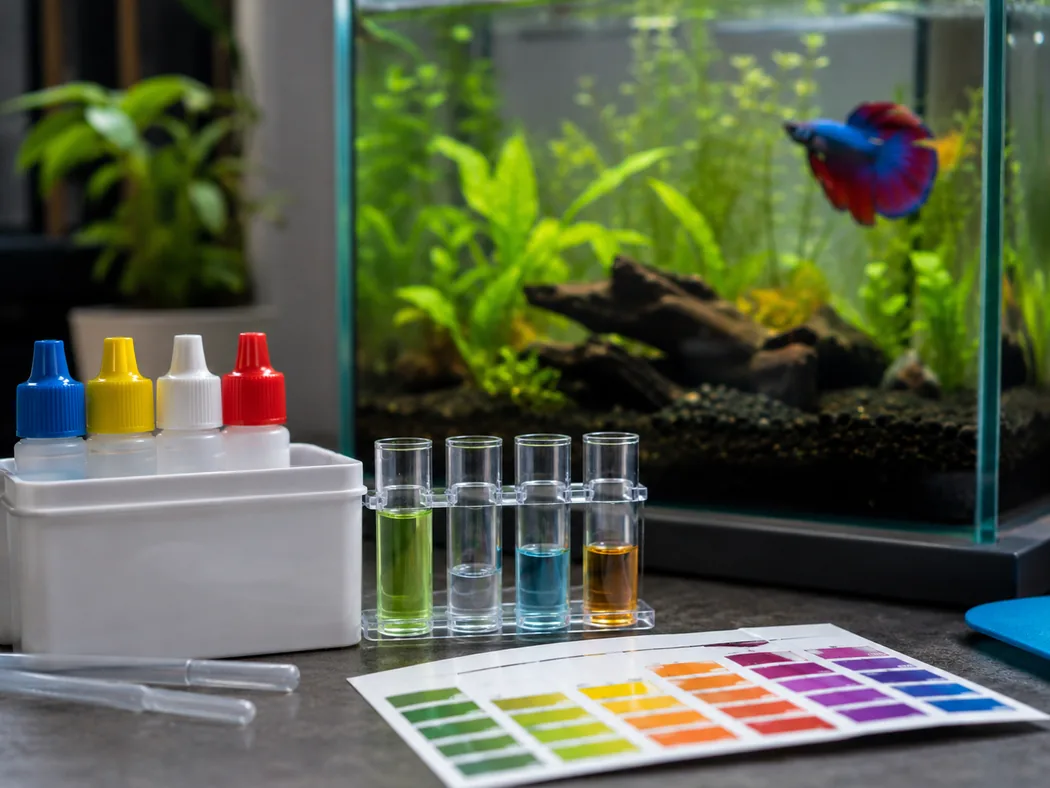
If you have a liquid test kit, use it now.
If you do not have one, treat the situation as potentially serious and prepare a partial water change with conditioned, temperature-matched water.
The safest quick response is usually:
- Stop feeding.
- Remove uneaten food.
- Check temperature.
- Increase gentle surface movement.
- Test ammonia and nitrite.
- Do a partial water change if tests are unsafe or unknown.
- Keep the filter running.
- Watch breathing.
Do not do a full tank reset in panic.
Do not replace all filter media.
Do not add random medication before checking water.
The first goal is to make the water safer and oxygen exchange better without shocking the fish.
Normal Surface Breathing vs Emergency Gasping
A betta’s labyrinth organ allows it to take air from the surface. That is why occasional surface breathing is expected.
The question is whether the fish is choosing the surface or trapped there by stress.
| Observation | Likely normal | More urgent |
|---|---|---|
| Frequency | Occasional quick breaths | Repeated or constant gasping |
| Movement after breath | Swims away normally | Stays at top |
| Gill movement | Calm | Rapid or heavy |
| Fins | Relaxed | Clamped |
| Body | Balanced | Tilted, weak, or floating oddly |
| Color | Normal | Darkened, pale, or stressed |
| Appetite | Normal | Refuses food |
| Other fish, if present | Normal | Also gasping or acting stressed |
If every fish in the tank is at the surface, think oxygen or water quality immediately.
If only the betta is gasping, still check water first. Bettas may show stress differently from other fish, and long-finned bettas can also be affected by flow, surface access, or exhaustion.
One surface breath is not the problem.
A pattern is the problem.
Reason 1: Ammonia or Nitrite Is Burning the Gills
If your betta is gasping at the surface, ammonia and nitrite should be among the first things you test.
Fish waste, uneaten food, and decaying plant material can produce ammonia/ammonium (NH3/NH4+). In a cycled aquarium, beneficial bacteria convert that into nitrite (NO2-) and then nitrate (NO3-). In a new, overfed, under-filtered, or disrupted tank, ammonia and nitrite can appear.
Both can stress fish badly.
Clear water does not protect you here.
Merck Veterinary Manual notes that low dissolved oxygen and high ammonia are among the water-quality parameters most likely to directly kill fish. MSD’s common environmental hazards table lists low dissolved oxygen as hypoxia with surface piping behavior and also identifies high total ammonia nitrogen as a serious hazard.
For a gasping betta, check:
| Parameter | Safer target |
|---|---|
| Ammonia/Ammonium (NH3/NH4+) | 0 ppm |
| Nitrite (NO2-) | 0 ppm |
| Nitrate (NO3-) | Controlled with water changes |
| pH | Stable; many beginner betta tanks do well around 6.5–7.5 |
| Temperature | Stable around 76–80°F or 24–27°C |
If ammonia or nitrite is above zero, this is not a simple surface-breathing issue.
It is a water-quality problem.
A partial water change with conditioned, temperature-matched water is usually the most reliable first response. Keep the filter running. Do not replace all filter media. Feed lightly or pause feeding while the tank stabilizes.
If the tank is new, you may be in fish-in cycling.
Related guide: How to Cycle a Fish Tank
Reason 2: Low Dissolved Oxygen or Poor Surface Exchange
Fish do not get oxygen because the water looks clean.
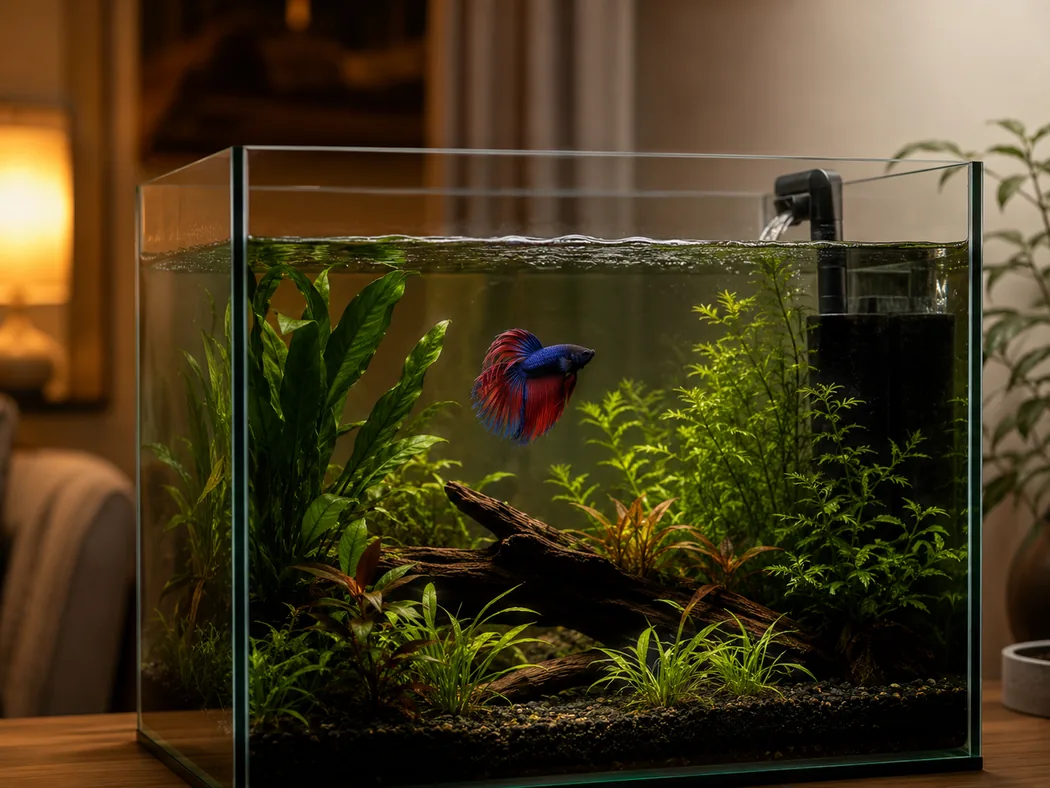
Oxygen enters the aquarium mainly through gas exchange at the surface. Surface movement matters because it refreshes the boundary between air and water.
A still surface can become a problem, especially when combined with high temperature, overfeeding, heavy organic waste, bacterial bloom, surface film, or an overcrowded tank.
Signs of oxygen stress can include:
- Gasping at the surface
- Hanging near the filter output
- Rapid gill movement
- Fish clustering at the top
- Sudden stress after a power outage
- Worse symptoms early morning
- Sluggish behavior after overfeeding or cloudy water
Bettas can breathe surface air, but that does not mean oxygen problems are irrelevant. If the water quality is poor or the fish is weak, gasping can still become dangerous.
Good oxygen support for bettas is gentle, not violent.
You do not need to turn a betta tank into a washing machine.
Better options include:
| Oxygen support | Betta-safe approach |
|---|---|
| Sponge filter | Gentle bubbles and biological filtration |
| Baffled filter output | Surface movement without blasting the fish |
| Air stone | Use gently; reduce flow if fish is stressed |
| Surface cleanup | Remove film and debris |
| Water change | Reduces waste and refreshes water |
| Avoid overfeeding | Less decay and bacterial oxygen demand |
The goal is surface exchange, not chaos.
A betta should be able to breathe at the surface without fighting current.
Reason 3: Surface Film Is Blocking Gas Exchange
Surface film is easy to miss.
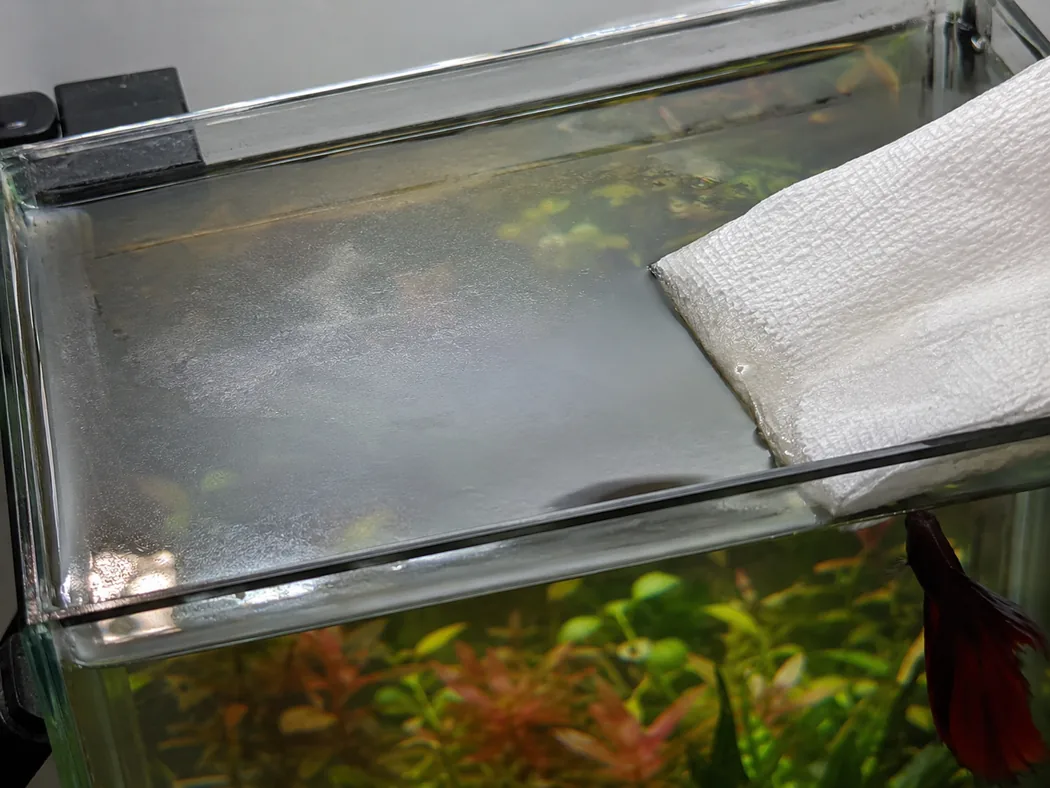
It can look like an oily sheen, dust, biofilm, or a thin layer sitting on top of the water. It may come from protein buildup, oils from hands, food, decaying organics, poor surface movement, or a tank that is too still.
A little film may not immediately harm a stable tank, but in a small betta aquarium it can contribute to poor gas exchange and make surface access less clean.
For a betta, surface quality matters.
The fish uses the surface to breathe atmospheric air. If the surface is coated, stagnant, or poorly exchanged, surface behavior can change.
How to check for film:
| Check | What you may see |
|---|---|
| Look across the waterline | Rainbow sheen or dull skin-like layer |
| Touch with clean paper towel | Film lifts onto towel |
| Watch floating food | Food sits in a greasy patch |
| Observe bubbles | Bubbles linger oddly or collect at film |
| Check flow | No movement across surface |
Safe fixes:
- Remove film gently with a clean paper towel laid briefly on the surface.
- Increase gentle surface movement.
- Reduce overfeeding.
- Remove decaying leaves and debris.
- Avoid putting hands or oily tools into the tank.
- Clean filter intake/outflow if flow is weak.
Do not add random chemical clarifiers to fix surface film.
Fix the cause.
Reason 4: The Water Is Too Warm or Temperature Is Swinging
Temperature affects oxygen.
Warmer water holds less dissolved oxygen than cooler water. That does not mean bettas should be kept cold. They are tropical fish. But it does mean an overheated or unstable tank can make breathing stress worse.
For most beginner betta setups, a practical range is around 76–80°F or 24–27°C. RSPCA guidance recommends heated water for Siamese fighting fish around 24–26°C, while FishBase lists Betta splendens as tropical with a broader 24–30°C range.
Problems can happen when:
| Temperature issue | Why it matters |
|---|---|
| Tank overheats above normal care range | Less dissolved oxygen, more stress |
| Temperature swings day to night | Stress and unstable metabolism |
| Heater sticks on | Can become dangerous quickly |
| Tank sits in direct sun | Heat spikes and algae issues |
| Room gets very hot | Small tanks warm rapidly |
| No thermometer | You are guessing |
A gasping betta in warm water needs careful handling.
Do not throw ice into the tank.
Do not create a sudden temperature crash.
Turn off extra heat sources, move the tank away from direct sun if safe, improve room conditions, and use gradual correction. If the water is dangerously warm and the fish is distressed, a partial water change with conditioned water close to the target range may help, but avoid abrupt shock.
A thermometer is not optional here.

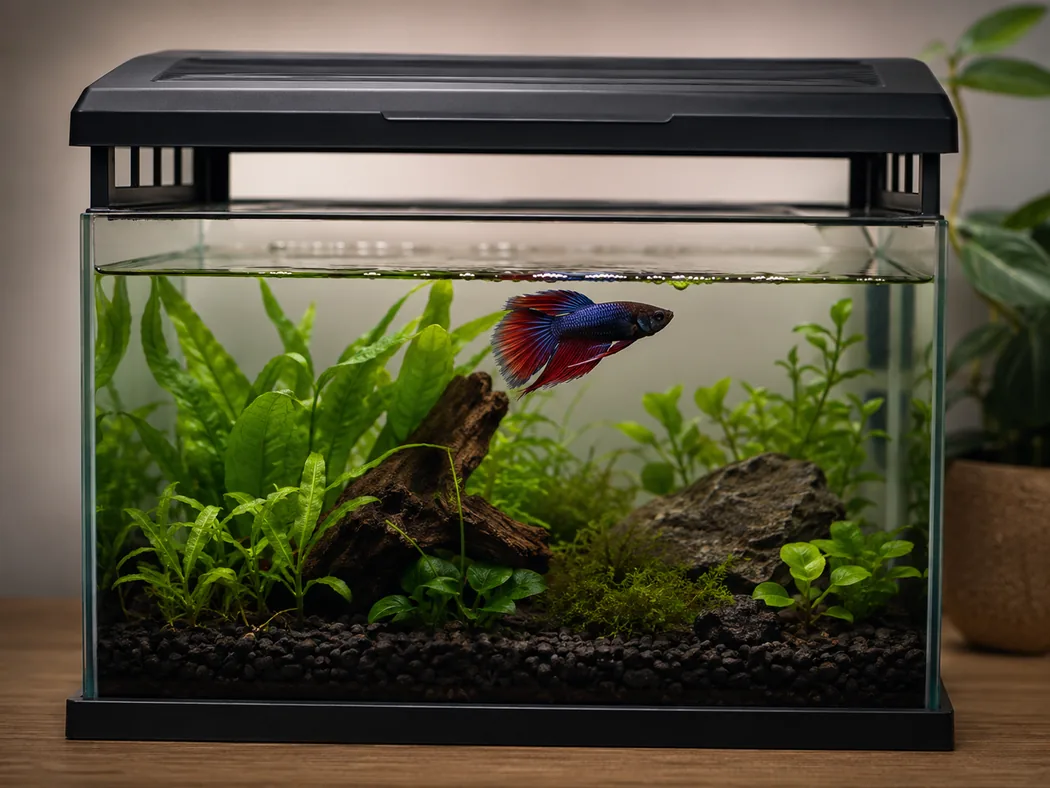
Reason 5: A Tight Lid or Poor Air Gap Is Making Surface Breathing Harder
Bettas jump, so lids are important.
But an airtight or poorly ventilated cover can create problems, especially if the surface space is cramped, humid, stagnant, or colder than the water.
Bettas breathe atmospheric air with their labyrinth organ. They need access to the surface and a reasonable air space above it. A lid should prevent jumping without sealing the tank like a jar.
A practical beginner setup should have:
| Lid/surface feature | Why it matters |
|---|---|
| Secure cover | Prevents jumping |
| Ventilation or small openings | Allows air exchange |
| 2–3 cm air gap | Gives surface breathing room |
| Warm room air | Reduces cold-air shock risk |
| Clear surface access | Lets fish reach air easily |
| Not filled to the absolute rim | Prevents cramped surface breathing |
This does not mean you should remove the lid and risk a jumper.
It means the lid should be safe, ventilated, and practical.
If your betta is gasping and the tank is tightly sealed, check the air gap, waterline, surface film, and ventilation.
The fish needs a covered tank.
Not a sealed container.
Reason 6: The Tank Is New, Overfed, or Biologically Unstable
Many gasping problems happen in new tanks.
A tank can look finished before it is biologically ready. The water is clear. The plants are arranged. The fish is in. The filter is running.
Then ammonia rises.
Or nitrite appears.
Or bacterial bloom consumes oxygen.
Or uneaten food decays.
The betta starts gasping, and the owner wonders why it happened so suddenly.
New tanks are unstable because the beneficial bacteria colony is not mature yet. Overfeeding makes this worse. Replacing filter media can also restart the problem.
Common triggers:
| Trigger | What can happen |
|---|---|
| Fish added before cycling | Ammonia/nitrite exposure |
| Heavy feeding | Waste spike |
| Uneaten food | Decay and oxygen demand |
| Replaced filter cartridge | Loss of bacteria |
| Washed filter media under untreated tap water | Bacteria damage |
| Added too many animals | Overload |
| Power outage | Filter bacteria and oxygen stress |
If your betta is gasping in a tank under 6–8 weeks old, treat water quality as the main suspect until tests prove otherwise.
Do not rely on the water looking clear.
Test.
Reason 7: Medication, Chemicals, or Conditioner Mistakes
Sometimes gasping starts after the owner adds something.
That “something” may be medicine, algaecide, clarifier, pH adjuster, plant chemical, cleaning residue, fragrance, aerosol, or even too much of a product used incorrectly.
A betta gasping after a chemical addition should be taken seriously.
Ask:
- Did you add medication?
- Did you dose conditioner correctly?
- Did you use a bucket that touched soap?
- Did anyone spray cleaner, perfume, insecticide, or air freshener near the tank?
- Did you use pH up/down products?
- Did you add algae remover?
- Did you rinse décor with anything besides safe water?
- Did you overdose a product?
A water conditioner is essential for tap water, but products should still be used according to directions. More is not always better. Mixing treatments without knowing interactions can also stress fish.
If you suspect contamination or a bad chemical reaction:
- Increase gentle aeration/surface movement.
- Do a partial water change with conditioned, temperature-matched water.
- Remove chemical media only if it is part of the suspected problem.
- Add fresh activated carbon only if your filter can hold it properly.
- Avoid adding more products blindly.
- Watch breathing closely.
If the fish is rapidly declining, this is urgent.
Chemical problems can move quickly.
Reason 8: Gill Disease, Injury, or Severe Stress
If water, oxygen, temperature, and surface access all check out, look more closely at the fish.
Gasping can be connected to gill irritation, parasites, infection, injury, severe stress, or advanced weakness.
Look for:
| Sign | Direction to investigate |
|---|---|
| One gill stuck open | Gill injury or disease |
| Excess mucus | Irritation or parasite possibility |
| Scratching/flashing | External irritation or parasites |
| Clamped fins | Stress or illness |
| White spots | Possible ich |
| Fuzzy patches | Possible fungal/bacterial issue |
| Red gills or sores | Irritation, injury, or infection |
| Extreme lethargy | Advanced stress or illness |
| Loss of balance | Serious weakness or internal issue |
Do not choose medication based on gasping alone.
Gasping plus white spots is different from gasping plus ammonia. Gasping plus cold water is different from gasping after an aerosol spray near the tank.
The wrong treatment can waste time or make conditions worse.
Stabilize the environment first.
Then evaluate disease signs.
What to Do Right Now If Your Betta Is Gasping
Here is the immediate plan.
1. Stop Feeding
Do not add more waste.
If food is in the tank, remove it.
2. Check Temperature
Use a thermometer.
Too warm, too cold, or swinging temperature can all contribute to stress.
3. Test Ammonia and Nitrite
Test ammonia/ammonium (NH3/NH4+) and nitrite (NO2-) immediately if possible.
If either is above zero, do a partial water change with conditioned, temperature-matched water.
4. Improve Gentle Surface Movement
Point filter output so the surface ripples slightly, add a gentle air stone, or use a sponge filter. The surface should move, but the betta should not be blasted around.
5. Remove Surface Film
Use a clean paper towel to lift film from the surface if present. Improve surface movement afterward.
6. Check the Lid and Waterline
Make sure the betta has access to surface air, ventilation, and a small air gap.
7. Do a Partial Water Change if Tests Are Bad or Unknown
If you cannot test and the fish is actively gasping, a cautious partial water change with conditioned, temperature-matched water is often safer than waiting.
8. Watch for Red Flags
If the fish cannot swim, is tilting, clamped, swollen, pale, or gasping heavily after water support, treat it as urgent.
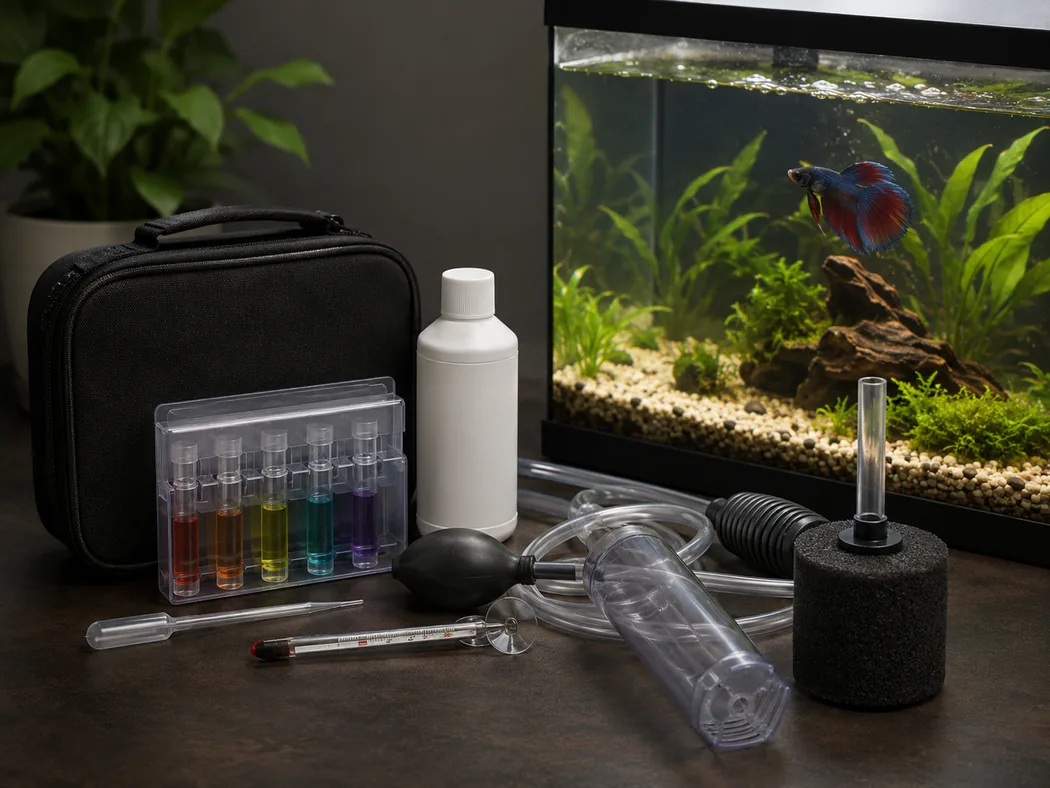
How to Increase Oxygen Without Stressing Your Betta
The key word is gentle.
A betta does not want a torrent. Strong flow can exhaust it, especially if it has long fins. But completely still water can also create surface exchange problems.
Good approaches:
| Method | Betta-safe note |
|---|---|
| Sponge filter | Excellent gentle aeration and biological filtration |
| Air stone | Use low flow if possible |
| Baffled HOB output | Ripple the surface without blasting the fish |
| Filter maintenance | Restore weak flow without replacing all media |
| Remove surface film | Improves air/water exchange |
| Lower stocking/waste | Less oxygen demand |
| Partial water change | Refreshes water and reduces waste |
If you add an air stone, watch the fish.
If it hides, gets pushed around, or cannot rest, reduce the air flow. A simple air control valve can help.
Aim for visible surface ripple, not violent bubbles.
A calm betta tank can still be oxygenated.
When Gasping Becomes an Emergency
Treat gasping as urgent if any of these are true:
- Ammonia/ammonium (NH3/NH4+) is above 0 ppm
- Nitrite (NO2-) is above 0 ppm
- The fish is gasping constantly
- The fish cannot leave the surface
- The fish is tilting, rolling, or losing balance
- The fish is clamped and lethargic
- Other fish are also at the surface
- The water is very warm
- There was a power outage
- Chemicals, cleaners, or medication were recently added
- The tank is new or uncycled
- The fish is pale, darkened, swollen, or covered in visible spots/fuzz
The worst response is to wait several days while continuing to feed.
A gasping fish is telling you breathing is not comfortable.
Act on water and oxygen first.
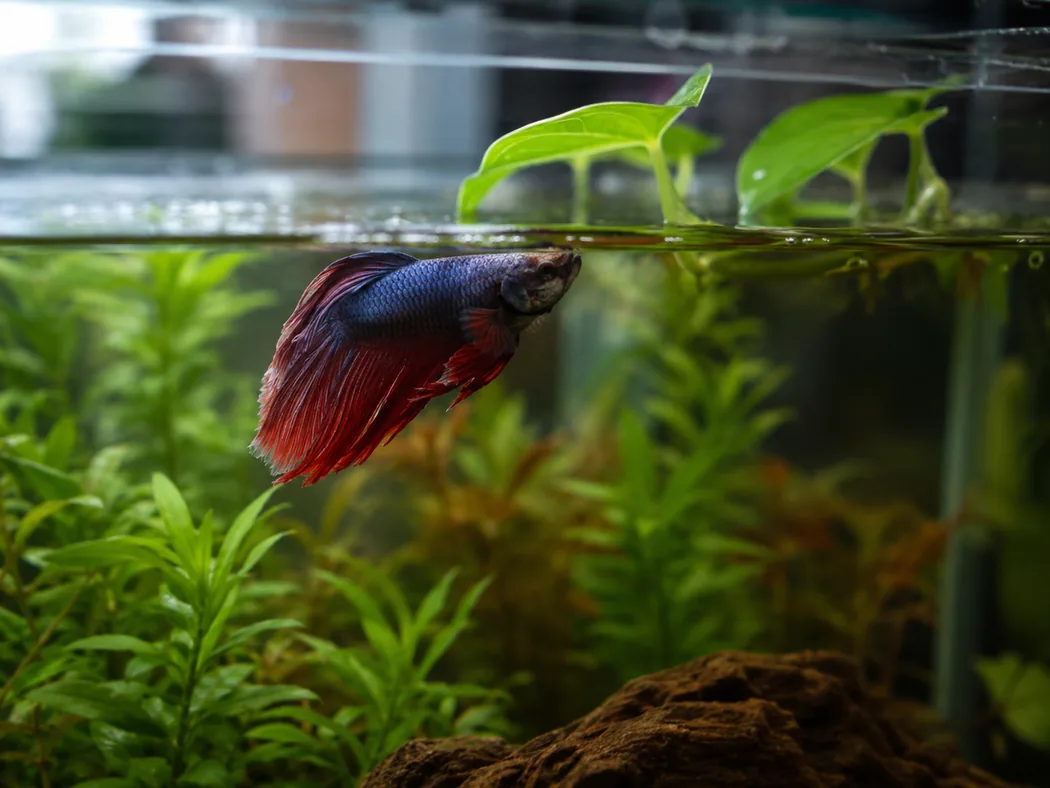
What Not to Do When a Betta Is Gasping
Do Not Assume It Is Normal Because Bettas Breathe Air
They do breathe air.
That does not make constant gasping safe.
Do Not Add More Food
Food creates waste and can worsen ammonia or oxygen demand.
Do Not Replace All Filter Media
That can remove beneficial bacteria and make ammonia/nitrite worse.
Do Not Do a Full Tank Scrub
A total reset can crash biological stability.
Do Not Add Random Medication First
Medicine does not fix ammonia, nitrite, overheating, low oxygen, surface film, or chemical contamination.
Do Not Create Violent Flow
More bubbles are not always better if the fish is exhausted by current.
Do Not Remove the Lid Permanently
Bettas jump. Improve ventilation and air gap, but do not create an escape risk.
Do Not Ignore Surface Film
A still, oily surface is not just ugly. It can affect gas exchange and surface breathing.
Betta Gasping at Surface Checklist
Use this before deciding the behavior is “just normal betta breathing.”
| Question | Checked? |
|---|---|
| Is the betta gasping repeatedly or only taking occasional air breaths? | |
| Is ammonia/ammonium (NH3/NH4+) at 0 ppm? | |
| Is nitrite (NO2-) at 0 ppm? | |
| Is nitrate (NO3-) controlled? | |
| Is temperature stable around 76–80°F or 24–27°C? | |
| Is the water too warm or temperature swinging? | |
| Is there gentle surface movement? | |
| Is there surface film? | |
| Is the lid ventilated with a small air gap? | |
| Has there been a power outage? | |
| Is the tank new, overfed, or uncycled? | |
| Was medication or any chemical recently added? | |
| Are other fish also gasping? | |
| Is the betta clamped, tilted, swollen, pale, or losing balance? | |
| Has uneaten food been removed? | |
| Did you avoid replacing all filter media? |
If you can work through this list, you are no longer guessing.
You are troubleshooting.
Related Guides
Continue with these guides:
- Why Is My Betta Not Eating?
- Why Is My Betta Laying at the Bottom?
- Betta Fish Care Guide
- Betta Tank Setup
- How to Cycle a Fish Tank
- Freshwater Aquarium Checklist
- Best Aquarium Test Kits
- Why Is My Fish Gasping at the Surface?
- Why Is My Betta Fish Bloated?
- Betta Fin Rot
- Betta Fish Popeye
- Betta Dropsy
- Cloudy Fish Tank Water
Final Advice
A betta at the surface is not automatically in danger.
A betta gasping at the surface is different.
Do not dismiss repeated gasping because bettas can breathe air. Their labyrinth organ helps them survive certain conditions, but it does not make ammonia, nitrite, low oxygen, overheating, surface film, or chemical stress harmless.
Start with the tank.
Test the water.
Check the temperature.
Improve gentle surface movement.
Remove uneaten food.
Make sure the fish can reach clean surface air.
Then watch the fish.
The faster you check the basics, the less likely you are to lose time on the wrong solution.
FAQ
Is it normal for a betta to breathe at the surface?
Yes. Bettas have a labyrinth organ and can take atmospheric air from the surface. Occasional surface breaths are normal. Repeated gasping, hanging at the top, rapid breathing, or weakness is not something to ignore.
Why is my betta gasping at the surface?
Common causes include ammonia/ammonium (NH3/NH4+), nitrite (NO2-), low dissolved oxygen, surface film, high temperature, poor surface movement, chemical irritation, stress, or gill disease.
Can ammonia make a betta gasp?
Yes. Ammonia/ammonium (NH3/NH4+) can irritate fish and damage breathing comfort. It should be 0 ppm in a stable aquarium.
Can nitrite make a betta gasp?
Yes. Nitrite (NO2-) is dangerous and should be 0 ppm. A fish exposed to nitrite may show breathing stress and abnormal behavior.
Should I do a water change if my betta is gasping?
If ammonia or nitrite is above zero, or if you cannot test and the fish is actively gasping, a partial water change with conditioned, temperature-matched water is often a good first response.
Does a betta need an air stone?
Not always. Many betta tanks do fine with gentle filter surface movement. An air stone can help in low-oxygen situations, but use gentle flow so the fish is not stressed.
Can a lid make a betta gasp?
A lid is important because bettas jump, but a lid should not seal the tank completely. Leave ventilation and a small air gap so the betta can access surface air.
Why is my betta gasping after a water change?
Possible causes include temperature shock, untreated chlorine/chloramine, pH swing, disturbed debris, filter disruption, or stress. Check temperature, conditioner use, ammonia, nitrite, and breathing pattern.
Why are all my fish gasping at the surface?
If multiple fish are at the surface, think oxygen, ammonia, nitrite, temperature, chemical contamination, or power outage immediately. Increase gentle aeration and test water.
Can warm water make a betta gasp?
Yes. Warmer water holds less dissolved oxygen, and overheating can stress fish. Keep temperature stable and appropriate for bettas.
Should I medicate a gasping betta?
Not automatically. Test water and check oxygen/surface conditions first. Medication may be needed if there are clear disease signs, but gasping alone is not enough to choose treatment blindly.
When is gasping an emergency?
Treat it as urgent if the betta is gasping constantly, cannot leave the surface, is tilted or losing balance, has clamped fins, is swollen, other fish are gasping, or ammonia/nitrite is above zero.
This article is written for beginner Betta splendens keepers troubleshooting surface gasping in home freshwater aquariums. Gasping can come from water quality, oxygen exchange, temperature, surface film, stress, chemical exposure, or illness. Use your own water test results and fish behavior when making care decisions. Severe symptoms may require help from an aquatic veterinarian or experienced local fish professional.
References
This guide was written for beginner betta keepers and should be cross-checked against fish welfare, aquarium husbandry, and species-reference sources when publishing.
- RSPCA Knowledgebase — Siamese fighting fish care
- FishBase — Betta splendens species data
- Merck Veterinary Manual — Environmental Diseases of Aquatic Animals in Aquatic Systems
- MSD Veterinary Manual — Common Environmental Hazards for Fish
- RSPCA Knowledgebase — Aquarium water quality and biological filtration basics
- Manufacturer instructions for any specific heater, filter, conditioner, test kit, air stone, medication, or aquarium equipment mentioned in future buying guides.