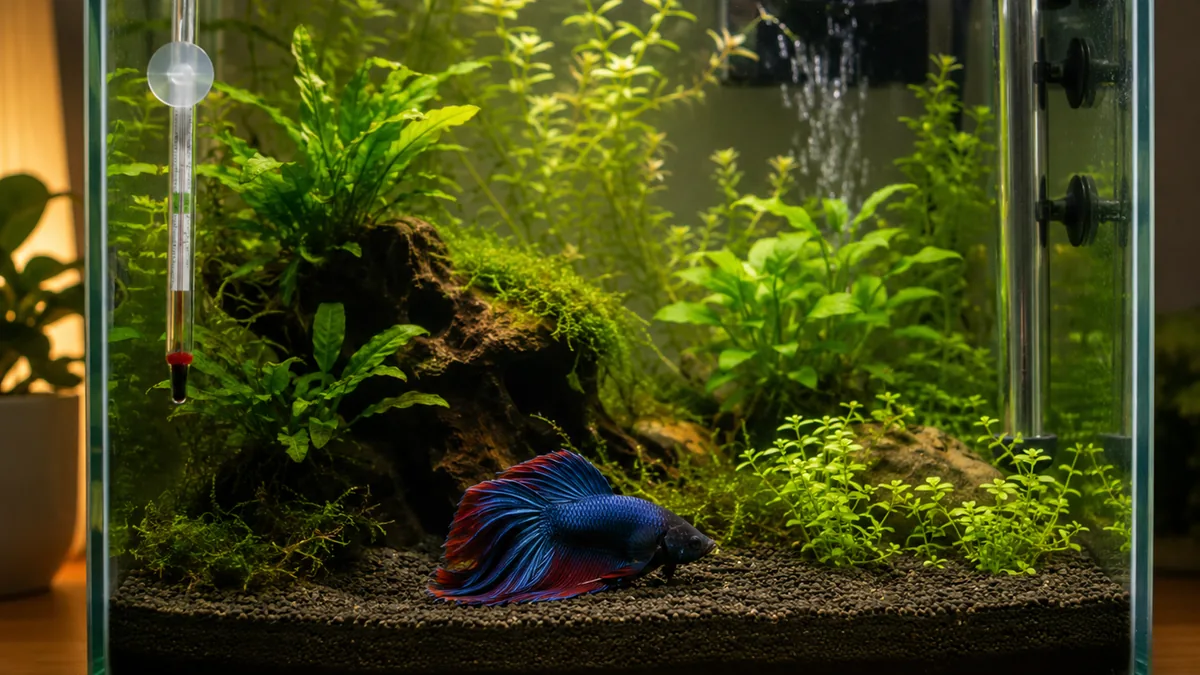
Start Here: Resting Is Normal, Collapsing Is Not
A healthy betta does not need to swim constantly.
This matters because many beginners compare bettas with faster schooling fish. Bettas are different. They often pause, perch, hover, and rest. Some love broad leaves. Some rest on a betta hammock. Some tuck near plants. Some sleep near the bottom at night.
That can be normal.
The warning sign is not simply “the fish is low.”
The warning sign is that the fish cannot or will not behave normally when it needs to.
Ask these questions:
| Question | More normal | More concerning |
|---|---|---|
| Does the betta respond when you approach? | Looks up, moves, or comes forward | No response, dull posture |
| Can it swim to the surface easily? | Yes | Struggles, sinks, tilts, or gives up |
| Are fins open or clamped? | Relaxed/open | Clamped tight |
| Is breathing normal? | Calm gill movement | Rapid breathing or gasping |
| Is appetite normal? | Eats or shows interest | Refuses food repeatedly |
| Are water tests safe? | 0 ppm ammonia/nitrite | Ammonia or nitrite present |
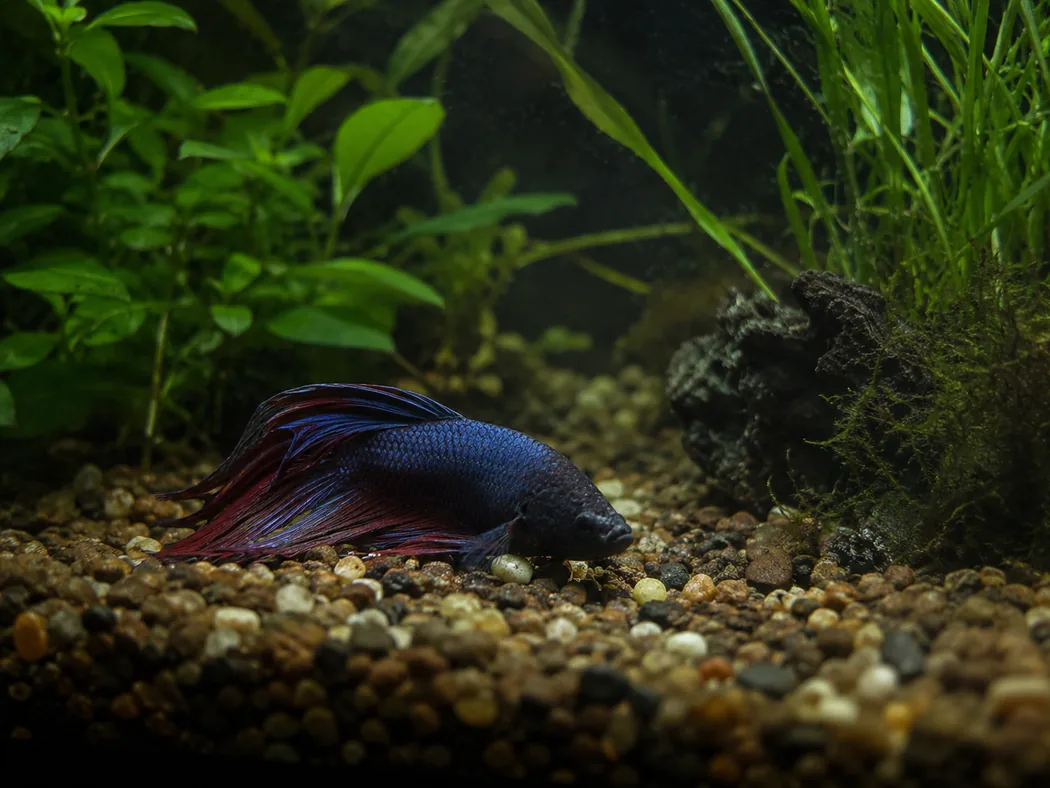
A betta can rest at the bottom and still be okay.
A betta lying at the bottom while the tank is cold, uncycled, overfed, or full of strong current is telling you something.
Do not diagnose from one posture.
Read the whole tank.
The First Five Checks Before You Assume Disease
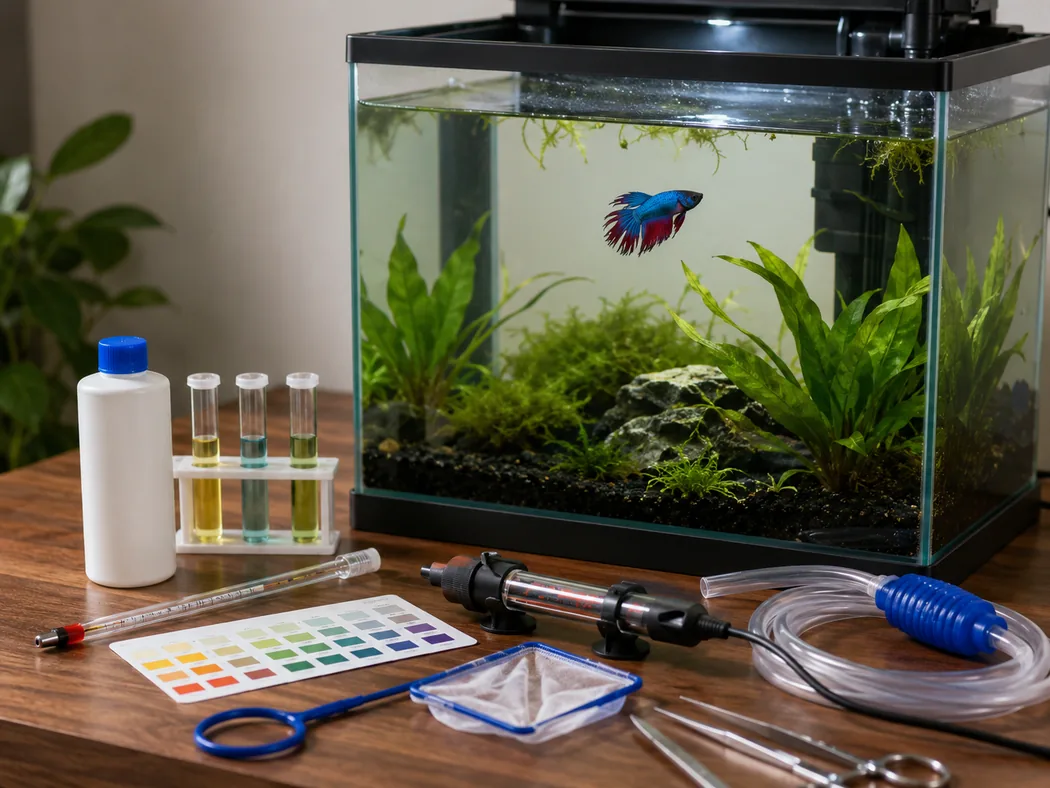
Before buying medication, changing food, or tearing the tank apart, check the five basics.
| First check | Why it matters |
|---|---|
| Temperature | Cold water commonly makes bettas sluggish |
| Ammonia/ammonium (NH3/NH4+) | Irritates fish and can cause lethargy |
| Nitrite (NO2-) | Toxic stress even when water looks clear |
| Filter flow | Strong current can exhaust long-finned bettas |
| Recent changes | New tank, big water change, new décor, new filter, move, or lighting shift |
This is the same logic as troubleshooting appetite loss.
A betta lying at the bottom is a symptom, not a diagnosis.
Clear water does not prove the tank is safe.
A bright-colored fish can still be stressed.
A fish that ate yesterday can still be in trouble today.
The first response should be calm and practical:
- Look at the fish.
- Check the thermometer.
- Test the water.
- Look at the filter flow.
- Think about recent changes.
That is how you avoid treating the wrong problem.
When Bottom Resting Can Be Normal
There are normal versions of bottom resting.
A betta may rest low in the tank:
- At night
- After a meal
- In a calm shaded area
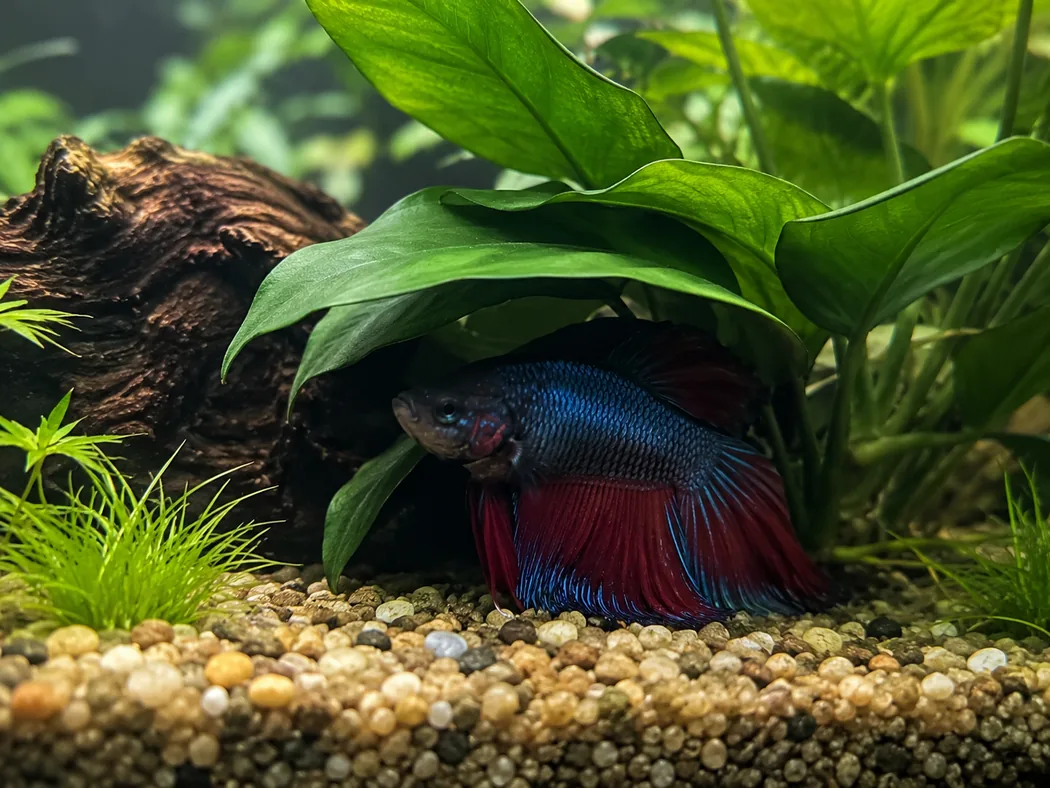
- Under broad leaves
- On smooth substrate
- During short naps
- In older age
- After exploring the tank
Normal resting usually has one thing in common: the fish still seems in control.
It can swim up.
It reacts.
It breathes normally.
It does not look pinned, tilted, trapped, or panicked.
Some bettas also choose odd sleeping places. One fish may sleep on an Anubias leaf. Another may sleep wedged behind a plant. Another may rest on the gravel under shade.
If water parameters are good, temperature is stable, and the fish eats normally, occasional bottom resting is not automatically bad.
But there is a problem when bottom resting becomes the whole day.
A betta that only moves when startled, refuses food, clamps fins, breathes rapidly, or lies flat in a corner deserves immediate checking.
Normal rest has recovery.
A problem has a pattern.
Reason 1: The Water Is Too Cold
Cold water is one of the most common reasons a betta becomes inactive and stays near the bottom.
Bettas are tropical fish. For beginner home aquariums, a practical care range is around 76–80°F or 24–27°C. RSPCA guidance for Siamese fighting fish recommends a heated tank maintained around 24–26°C, while FishBase lists Betta splendens as a tropical species with a broader 24–30°C range.
Cold water slows the fish down. It can reduce appetite, digestion, immune function, and normal activity. A betta in cold water may look “lazy,” but the fish may simply be physiologically slowed.
Check this before anything else:
| Temperature issue | What it can cause |
|---|---|
| No heater | Room temperature may be too cold or unstable |
| Preset heater inaccurate | Water may not be as warm as expected |
| Temperature drops overnight | Betta becomes sluggish by morning |
| Heater too small | Tank never reaches stable tropical range |
| No thermometer | You are guessing |
Do not use your hand to judge temperature.
Use a thermometer.
If the water is cold, correct it gradually with a proper aquarium heater. Do not pour hot water into the tank. Do not chase temperature aggressively. Sudden changes can stress fish too.
A betta that perks up after temperature becomes stable was not being stubborn.
It was cold.

Reason 2: Ammonia or Nitrite Is Stressing the Fish
If a betta is lying at the bottom, test water.
Do not skip this step because the water looks clear.
Fish waste, uneaten food, and decaying plant matter can produce ammonia/ammonium (NH3/NH4+). In a cycled tank, beneficial bacteria process it into nitrite (NO2-) and then nitrate (NO3-). If the tank is new, overfed, under-filtered, or recently disrupted, ammonia or nitrite can appear.
Both can stress fish.
Merck Veterinary Manual notes that low dissolved oxygen and high ammonia are among the water-quality parameters most likely to directly kill fish. MSD’s environmental hazard table also connects old tank syndrome and high total ammonia nitrogen with lethargy and poor appetite.
For a bottom-sitting betta, test:
| Parameter | Practical target |
|---|---|
| Ammonia/Ammonium (NH3/NH4+) | 0 ppm |
| Nitrite (NO2-) | 0 ppm |
| Nitrate (NO3-) | Controlled with water changes |
| pH | Stable; many beginner betta tanks do well around 6.5–7.5 |
| Temperature | Stable around 76–80°F or 24–27°C |
If ammonia or nitrite is above zero, the bottom sitting may be a water-quality warning.
The first response is not medicine.
It is water support:
- Remove uneaten food.
- Do a partial water change with conditioned, temperature-matched water.
- Keep the filter running.
- Do not replace all filter media.
- Feed lightly.
- Retest.
A betta lying low in bad water is not resting comfortably.
It is enduring the tank.

Reason 3: Filter Flow Is Exhausting the Betta
A betta can lie at the bottom because the rest of the tank is too difficult to swim in.
This is especially common with long-finned bettas in small tanks using filters with strong output. The fish may look inactive, but the real problem is that open water has become work.
Signs the filter flow may be too strong:
- The betta avoids the center of the tank.
- Fins are pushed backward when it swims.
- The fish hides behind the filter, heater, or plants.
- Food moves too fast at feeding time.
- The betta rests at the bottom away from the current.
- Bubble nests break apart immediately.
- The fish can swim up but returns to the bottom quickly.
The solution is not usually to remove the filter.
Bettas still need biological filtration.
The solution is to soften the flow.
Good options include:
| Flow fix | How it helps |
|---|---|
| Use a sponge filter | Gentle biological filtration |
| Add a pre-filter sponge | Softens intake and protects fins |
| Baffle the filter output | Reduces direct current |
| Turn down adjustable flow | Makes open water easier to use |
| Add plants and hardscape | Creates calm resting zones |
| Reposition the filter | Stops the current from blasting the whole tank |
The test is simple:
Your betta should be able to hover, turn, rise to the surface, and rest without being pushed around.
If it cannot, the tank may be clean but not comfortable.
Reason 4: The Betta Has No Safe Resting Places Near the Surface
Bettas breathe atmospheric air at the surface.
They can also get tired, especially long-finned varieties. If the only resting place is the bottom, the betta may spend too much time low because the tank gives it no easier option.
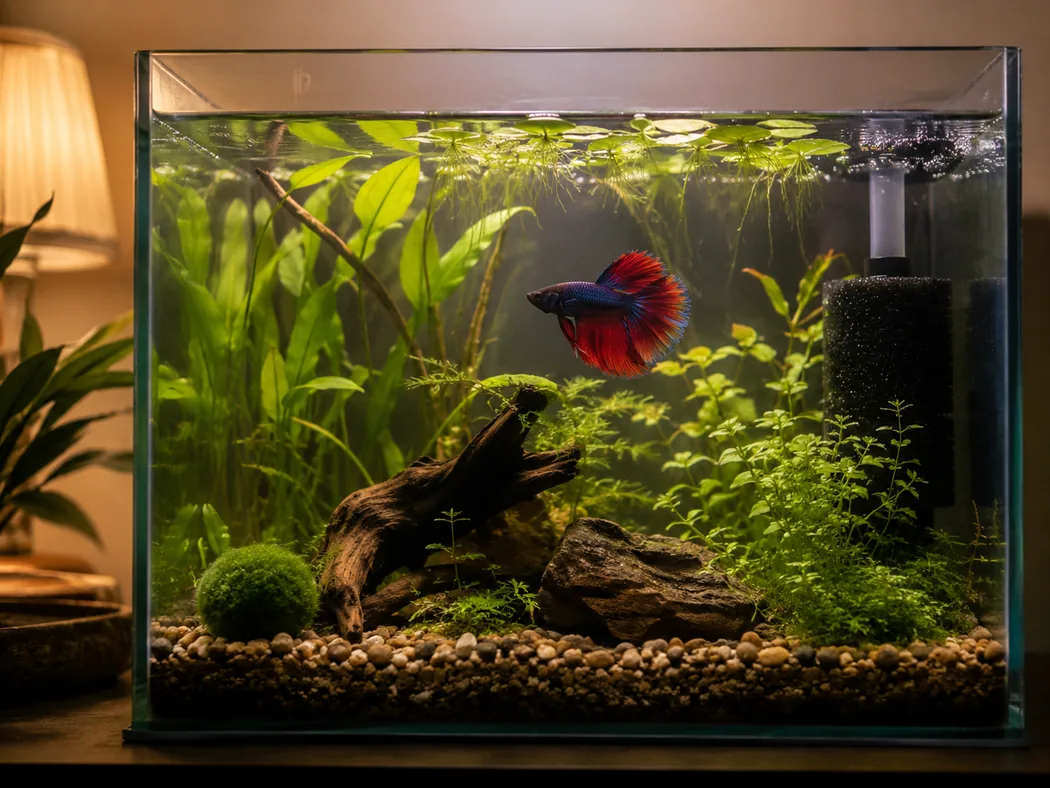
A good betta tank should include resting places at different heights.
Especially near the surface.
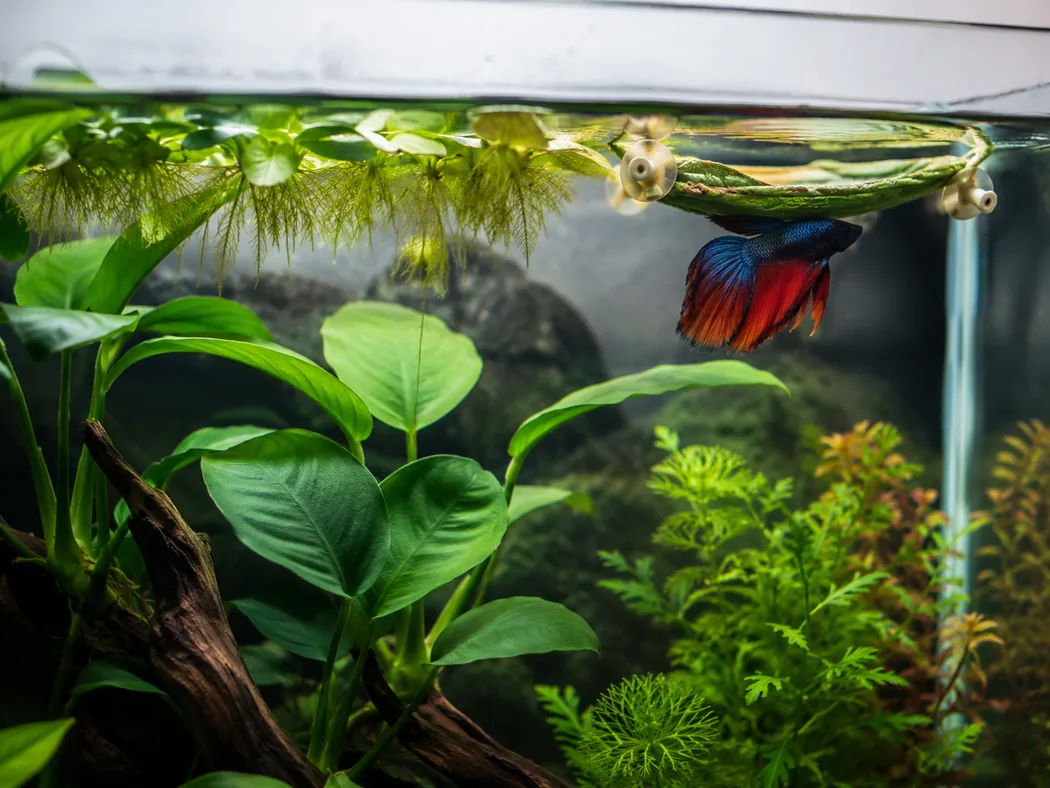
Useful resting areas include:
| Resting place | Why it helps |
|---|---|
| Anubias leaves | Broad, sturdy, natural perch |
| Java fern leaves | Soft cover and resting surface |
| Betta hammock | Simple surface-level rest |
| Floating betta log | Shaded surface access |
| Floating plants | Cover and security |
| Smooth cave/hide | Safe retreat |
| Tall plants | Mid-level resting zones |
A bare tank forces the fish to choose between swimming all the time or lying on the bottom.
That is not enrichment.
That is poor layout.
A betta lying at the bottom may be telling you it needs easier places to rest.
The fix does not need to be fancy. Add broad-leaf plants, a safe leaf hammock, floating cover, and calm zones away from filter flow.
The tank should let the fish rest without making it work to breathe.
Reason 5: Recent Stress, Transport, or Tank Changes
A betta may lie low after a stressful change.
This can happen after:
- Bringing the fish home
- Moving the tank
- A large water change
- Replacing filter media
- Adding new décor
- Changing the light
- Adding tank mates
- Changing food
- Sudden room temperature change
- A loud or high-traffic room
A new betta may hide or rest near the bottom for a day or two while adjusting. That can be normal if the water is warm, cycled, and safe.
But stress becomes more concerning when it is paired with bad water, rapid breathing, no appetite, or loss of balance.
For a recently moved or newly purchased betta:
| Better response | Why |
|---|---|
| Keep lights gentle | Reduces stress |
| Avoid tapping glass | Prevents startle response |
| Offer tiny meals only | Prevents excess waste |
| Remove uneaten food | Protects water quality |
| Do not rearrange repeatedly | Lets the fish map the tank |
| Test water | Confirms the tank is actually safe |
Do not keep “fixing” the tank every hour.
A stressed fish needs stability, not constant intervention.
Give the betta calm conditions, then watch the trend.
Reason 6: Overfeeding, Bloating, or Digestive Stress
A betta lying at the bottom after eating may be dealing with digestive stress.
This is common because bettas are easy to overfeed. They beg. They flare. They rush to the front. People mistake that enthusiasm for need.
A bloated betta may become sluggish, hover awkwardly, rest low, or refuse the next meal.
Overfeeding also creates water-quality problems, so digestion and ammonia can become connected.
Check for:
| Sign | Possible issue |
|---|---|
| Rounded swollen belly after meals | Too much food |
| Long waste | Diet or digestion issue |
| Floating oddly | Bloating or buoyancy stress |
| Sinking and resting low | Weakness, bloating, or illness |
| Uneaten food in tank | Overfeeding and waste buildup |
| Cloudier water after feeding | Food breaking down |
For most adult bettas, 1–2 small meals per day is enough. Many do well with a few small pellets per meal, depending on pellet size.
Pellet size matters.
A “few pellets” can be too much if the pellets are large.
If bloating is mild and the fish is otherwise stable, feed lighter, keep the water warm and clean, and avoid rich treats for the moment. Do not dump more food in to “test appetite.”
If the belly is severely swollen, scales are pineconing, the fish loses balance, or the condition worsens, treat it as more serious than simple overfeeding.
Reason 7: Low Oxygen, Poor Surface Access, or Labyrinth Stress
Bettas can breathe atmospheric air with their labyrinth organ.
That does not mean oxygen and surface access do not matter.
A betta still uses gills. It still needs reasonable water quality. It still needs easy access to the surface. A betta that is weak, stressed, or fighting current may struggle if it has to work too hard to reach air.
Watch for:
- Gasping at the surface
- Rapid gill movement
- Staying near the surface constantly
- Trying to surface but sinking
- Lying at the bottom and breathing hard
- Film on the water surface
- No surface movement at all
- Tank covered too tightly with poor ventilation
A lid is important because bettas jump, but a lid should not create a sealed, stagnant air pocket. Leave a small air gap and some ventilation.
Also avoid filling the tank so high that there is no practical surface gap. In many setups, leaving about 2–3 cm between the waterline and lid is useful.
If the betta is lying at the bottom and breathing hard, check water quality first. Ammonia, nitrite, high heat, low oxygen, and gill irritation can overlap.
The solution depends on the cause, but the first checks are always the same:
temperature, ammonia, nitrite, surface condition, and filter flow.
Reason 8: Illness, Injury, or Old Age
Sometimes bottom sitting is not the tank.
Sometimes the fish is sick, injured, or old.
Aging bettas may rest more than young bettas. Their fins may be heavier relative to their strength, their activity may decline, and they may prefer easy resting places. Older fish often benefit from lower flow, shallow resting zones, and stable routines.
Illness or injury is more concerning.
Look for:
| Sign | Why it matters |
|---|---|
| Clamped fins | Stress or illness |
| Rapid breathing | Water quality, oxygen, gill irritation, disease |
| White spots | Possible parasites |
| Fuzzy patches | Possible fungal or bacterial issue |
| Swelling or pineconing | Serious internal issue |
| Loss of balance | Buoyancy, weakness, or neurological issue |
| Red sores or streaks | Injury or infection |
| Fin edges receding | Fin rot or poor healing conditions |
| Lying on side | More urgent than upright resting |
Do not medicate based on bottom sitting alone.
Bottom sitting plus visible disease signs is different.
If water and temperature are safe but the fish continues to decline, investigate illness more carefully and consider experienced local fish help or an aquatic veterinarian if available.
The first job is to separate environmental problems from disease.
Medication cannot fix cold water, ammonia, nitrite, or exhausting current.
What to Do Today If Your Betta Is Laying at the Bottom
Here is a practical same-day plan.
Do not do everything dramatically at once.
1. Observe Before Touching the Tank
Watch for breathing, posture, reaction, balance, and whether the fish can swim up.
Do not immediately net the fish.
2. Check Temperature
Use a thermometer.
If the tank is cold or swinging, correct temperature gradually.
3. Test Water
Test ammonia/ammonium (NH3/NH4+) and nitrite (NO2-) at minimum. If possible, also test nitrate (NO3-) and pH.
4. Remove Uneaten Food
If there is food in the tank, remove it.
Do not add more food while troubleshooting.
5. Look at Filter Flow
Is the fish avoiding current? Is food being blown around? Is the fish staying in the only calm corner?
Reduce or baffle flow if needed.
6. Do a Partial Water Change If Tests Show a Problem
Use conditioned, temperature-matched water.
Do not do a huge random clean-out unless there is a clear reason.
7. Add Resting Options If the Tank Is Bare
Broad leaves, floating plants, safe hides, and calm zones help the fish rest without collapsing on the substrate all day.
8. Recheck Behavior Later
A betta may not instantly recover after one fix. Watch trend: breathing, posture, appetite, and surface access.
How to Tell Bottom Resting From an Emergency
Use this table when you are unsure.
| Sign | Likely normal resting | More urgent |
|---|---|---|
| Position | Upright, controlled | On side, tilted, trapped, or unable to rise |
| Breathing | Calm | Rapid, heavy, or gasping |
| Response | Reacts to movement | No response or very weak response |
| Appetite | Eats normally | Refuses repeatedly |
| Fins | Relaxed | Clamped tight or deteriorating |
| Water | Ammonia/nitrite 0 ppm | Ammonia or nitrite present |
| Temperature | Stable warm range | Cold or swinging |
| Duration | Short rest periods | Most of the day, worsening |
The most important detail is control.
A fish resting by choice can move when it wants to.
A fish in trouble often cannot.
What Not to Do When a Betta Lies at the Bottom
Do Not Assume It Is Sleeping Without Checking Water
Sometimes it is sleeping.
Sometimes it is ammonia.
Test before reassuring yourself.
Do Not Dump in More Food
A bottom-sitting fish may not eat, and uneaten food worsens water quality.
Do Not Replace All Filter Media
That can remove beneficial bacteria and create a water-quality spike.
Do Not Do a Full Tank Scrub
Unless there is a specific reason, full clean-outs often destabilize tanks.
Do Not Add Medicine Blindly
Medicine does not fix cold water, strong current, ammonia, nitrite, or stress.
Do Not Keep Changing the Tank Layout
A stressed betta needs calm and predictable surroundings.
Do Not Add Tank Mates
A struggling betta does not need more competition, stress, or waste.
Do Not Ignore a Cold Tank
Temperature is easy to check and often overlooked.
A thermometer is not optional in betta care.
Betta Laying at Bottom Checklist
Use this checklist before deciding your betta is “just resting.”
| Question | Checked? |
|---|---|
| Is the betta upright and able to swim up? | |
| Is breathing calm, not rapid or gasping? | |
| Is temperature stable around 76–80°F or 24–27°C? | |
| Is ammonia/ammonium (NH3/NH4+) at 0 ppm? | |
| Is nitrite (NO2-) at 0 ppm? | |
| Is nitrate (NO3-) controlled? | |
| Is filter flow gentle enough? | |
| Does the tank have resting places near the surface? | |
| Was there a recent move, large water change, or tank change? | |
| Has uneaten food been removed? | |
| Is the betta bloated or overfed? | |
| Are fins clamped, torn, or worsening? | |
| Are there visible spots, fuzz, sores, swelling, or pineconing? | |
| Is the lid ventilated with surface air access? | |
| Did you avoid random medication before checking water? |
If you can answer these honestly, you are already troubleshooting better than most beginners.
Related Guides
Continue with these guides:
- Why Is My Betta Not Eating?
- Betta Fish Care Guide
- Betta Tank Setup
- How to Cycle a Fish Tank
- Freshwater Aquarium Checklist
- Best Aquarium Test Kits
- Best Aquarium Heaters
- Why Is My Fish Gasping at the Surface?
- Why Is My Betta Fish Bloated?
- Betta Fin Rot
- Betta Fish Popeye
- Betta Dropsy
Final Advice
A betta laying at the bottom is not automatically dying.
But it is not something to ignore either.
The difference comes from context.
Is the fish resting normally, breathing calmly, eating, responding, and living in warm, clean, stable water?
Or is it lying low because the water is cold, the tank has ammonia, the filter flow is exhausting, the fish is bloated, or something is medically wrong?
Do not guess from posture alone.
Check the tank.
Then check the fish.
Most good troubleshooting starts there.
FAQ
Is it normal for a betta to lay at the bottom?
Sometimes. Bettas rest, and some sleep near the bottom. It is more likely normal if the fish is upright, breathing calmly, eating normally, and can swim to the surface easily.
Why is my betta laying at the bottom and not eating?
Check temperature and water quality first. Cold water, ammonia/ammonium (NH3/NH4+), nitrite (NO2-), stress, bloating, illness, or strong current can all cause bottom sitting and appetite loss.
Can cold water make a betta stay at the bottom?
Yes. Cold water can slow metabolism, reduce appetite, and make a betta sluggish. Use a thermometer and keep the tank in a stable warm range around 76–80°F or 24–27°C for most beginner setups.
Can ammonia make a betta lay at the bottom?
Yes. Ammonia/ammonium (NH3/NH4+) and nitrite (NO2-) can stress fish and cause abnormal behavior. Both should be 0 ppm in a stable aquarium.
Why is my betta laying on its side?
Lying on the side is more concerning than upright resting. Check water, temperature, breathing, bloating, balance, and visible disease signs immediately.
Why does my betta stay at the bottom after a water change?
The water change may have caused temperature, pH, or stress changes. Check the new water temperature, conditioner use, ammonia, nitrite, and whether the filter or décor was disturbed.
Should I feed a betta that is laying at the bottom?
Do not keep adding food if the fish refuses it. Offer a tiny amount only after checking temperature and water quality, then remove uneaten food.
Does my betta need a resting leaf?
A resting leaf or broad-leaf plant can help, especially for long-finned bettas. It should not replace proper water quality, temperature, and gentle flow.
Can strong filter flow make a betta lay at the bottom?
Yes. If the current is too strong, the betta may hide or rest low to avoid it. Reduce flow, add a baffle, or use a gentle sponge filter.
Is my betta old or sick?
Older bettas often rest more, but age should not be used to ignore water or illness signs. Check temperature, water quality, appetite, breathing, fins, swelling, and balance.
Should I medicate a betta lying at the bottom?
Not automatically. Test water and check temperature first. Medication may be appropriate when there are clear disease signs, but bottom sitting alone is not enough to choose a treatment.
When is bottom sitting an emergency?
Treat it as urgent if the fish is gasping, tilted, unable to swim up, lying on its side, pineconing, swollen, clamped, not responding, or if ammonia or nitrite is above zero.
This article is written for beginner Betta splendens keepers troubleshooting bottom-sitting behavior in home freshwater aquariums. Bottom resting may be normal, but it can also signal cold water, poor water quality, stress, flow issues, digestive problems, illness, or injury. Use your own water test results and fish behavior when making care decisions. Severe symptoms may require help from an aquatic veterinarian or experienced local fish professional.
References
This guide was written for beginner betta keepers and should be cross-checked against fish welfare, aquarium husbandry, and species-reference sources when publishing.
- RSPCA Knowledgebase — Siamese fighting fish care
- FishBase — Betta splendens species data
- Merck Veterinary Manual — Environmental Diseases of Aquatic Animals in Aquatic Systems
- MSD Veterinary Manual — Common Environmental Hazards for Fish
- RSPCA Knowledgebase — Aquarium water quality and biological filtration basics
- Manufacturer instructions for any specific heater, filter, conditioner, test kit, food, medication, or aquarium equipment mentioned in future buying guides.